AI traffic: answers, visits and crawlers
On this page
- Three kinds of AI traffic
- AI answers: assistants reading your pages
- Visits from AI answers: the AI channel
- The AI & crawlers card
- What Quillly can't see
- Common questions
- Why do the tile and the crawler card show different AI answer numbers?
- Do AI crawls count toward my event allowance?
- Can my AI assistant read these numbers?
- Related
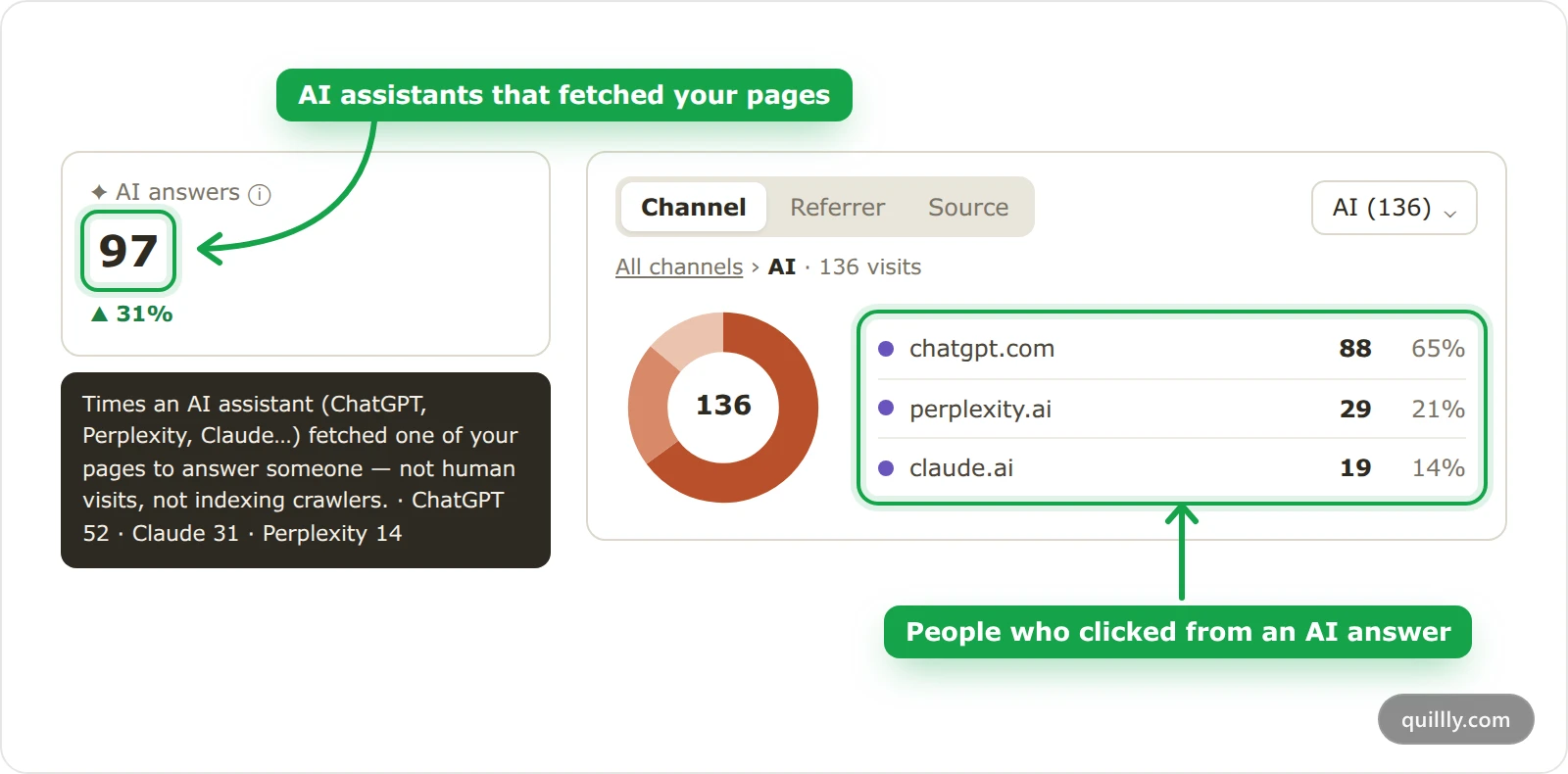
Quillly shows AI traffic in three places: assistants that fetch your pages to answer someone, people who click through from an AI answer, and crawlers that index or train on your pages. This page explains each one, and what Quillly can and can't see.
Three kinds of AI traffic#
What | Where it shows | What it counts |
|---|---|---|
AI answers | A tile at the top of Analytics | Times an AI assistant fetched one of the pages Quillly serves to answer someone |
AI channel | The Traffic Sources card | People who clicked through to your site from an AI assistant |
Crawlers | The AI & crawlers card at the bottom of Analytics | Every crawler visit to the pages Quillly serves, grouped by purpose |
The first and the last come from Quillly's servers, so they cover only the pages Quillly serves: your blog, docs, changelog and news, including their .md pages and llms.txt. The AI channel comes from real visits, so the tag on your own pages counts it too.
AI answers: assistants reading your pages#
When someone asks an assistant a question, it may fetch your page to write the answer. Quillly spots these fetches by the assistant's user agent and counts them in the AI answers tile. Hover the tile to see the top three assistants, such as ChatGPT, Claude and Perplexity.
The tile counts the assistants whose makers document a fetcher that runs when a person asks: ChatGPT, Claude, Perplexity, Meta AI, DuckAssist, Alexa and Le Chat. OpenAI's list of its crawlers and Perplexity's guide to its bots describe the difference between these fetchers and their crawlers.
They aren't visits. Fetches never count as visitors or sessions, and they don't count toward your event allowance.
The tile hides at zero. It appears only when an assistant fetched one of your pages in the range, so a site measured only by the tag never shows it.
Visits from AI answers: the AI channel#
A person who clicks a link inside an AI answer is a normal visitor, and Quillly files the visit under the AI channel. It does this when the referring site is an assistant, such as chatgpt.com, claude.ai, perplexity.ai, gemini.google.com or copilot.microsoft.com.
It's the one kind of AI traffic that the tag on your own pages counts too. In the Traffic Sources card, pick AI from the menu above the donut to see which assistants sent the visits. Read the Analytics dashboard explains the other channels.
Note
Quillly recognises the AI channel by the referring site. A visit that arrives without a referrer, as some apps send them, lands in Direct, even when its utm_source names the assistant.
That's why ChatGPT traffic can show up twice: as fetches in the AI answers tile, and as people in the AI channel. The first measures how often ChatGPT read your pages, and the second how many of its users came to see for themselves.
The AI & crawlers card#
The AI & crawlers card lists every crawler visit to the pages Quillly serves, kept apart from your human visitors. Its tabs split the crawls by purpose, and they add up to the total.
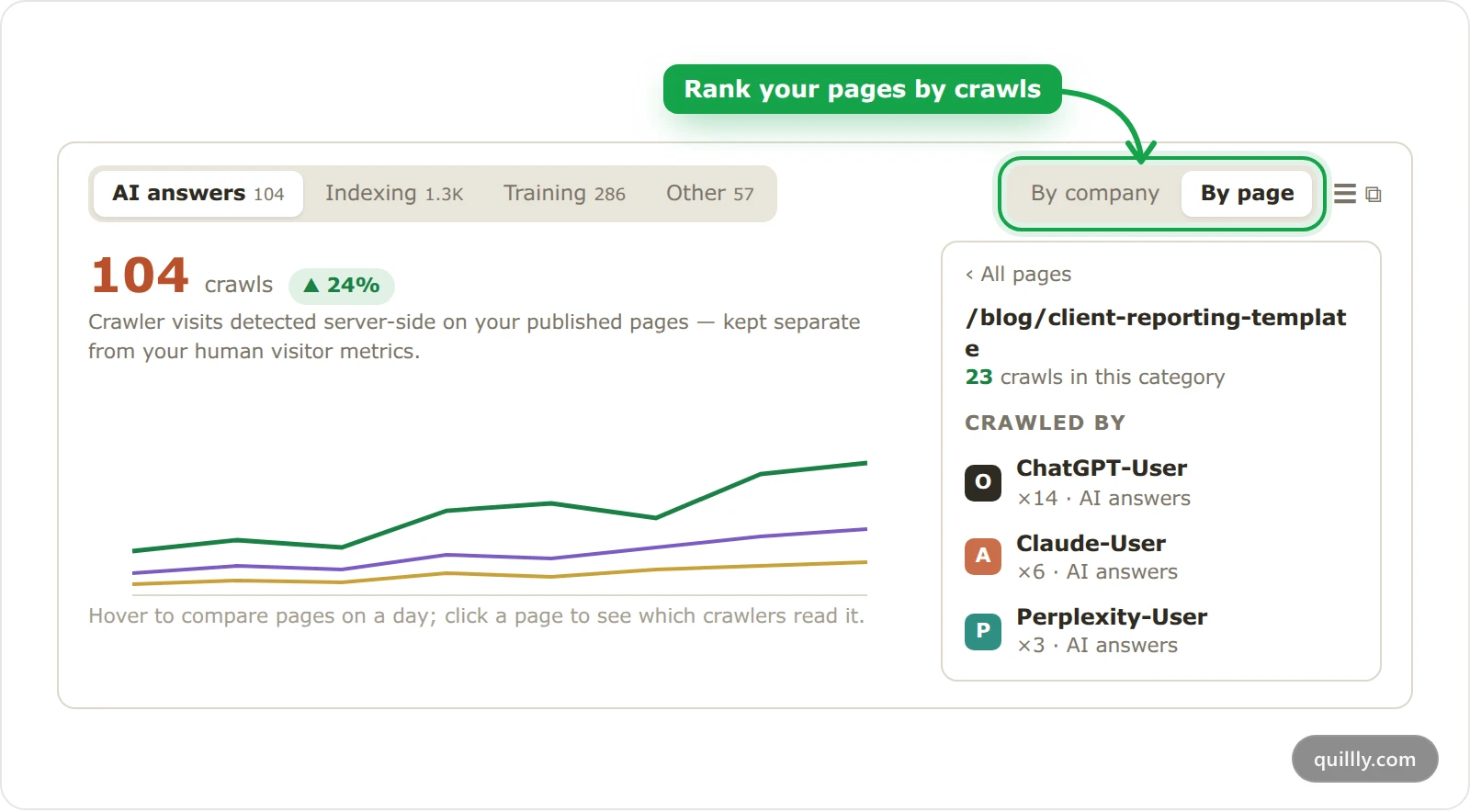
AI answers: fetches made to answer a person's question. This tab also counts Copilot, Grok, Kimi, Qwen, NotebookLM and Google Read Aloud, so it can show more than the tile.
Indexing: search engine crawlers, including the indexes behind AI search, such as Googlebot, Bingbot, OAI-SearchBot, Claude-SearchBot and PerplexityBot.
Training: crawlers that collect training data, such as GPTBot, ClaudeBot, CCBot, Bytespider and Applebot.
Other: SEO tools such as AhrefsBot and SemrushBot, AI bots with no stated purpose, unknown bots, and people or scripts that opened a
.mdpage orllms.txtdirectly.
Switch between By company and By page. By company groups each company's crawlers into one line, such as OpenAI. By page ranks your pages, and clicking a page shows which crawlers read it under Crawled by.
Quillly records one crawl per crawler, per page, per hour, so an eager crawler can't flood the numbers. Crawls never count toward your event allowance.
What Quillly can't see#
Some AI traffic stays out of view:
Crawls of your own pages. Crawlers don't run the tag, so the pages you host yourself show AI visits in the channel, but no fetches or crawls.
Answers from a copy. An assistant that answers from its index, or from a page it read earlier, sends no fetch to count.
Anything while your plan is inactive. Crawls aren't recorded when your trial or plan has ended.
To help assistants read your pages, Quillly serves a Markdown version of each one and an llms.txt. AI crawlers, llms.txt and Markdown pages covers both.
Common questions#
Why do the tile and the crawler card show different AI answer numbers?#
The tile counts only assistants whose makers document their question-time fetcher. The card's AI answers tab also counts Copilot, Grok, Kimi, Qwen, NotebookLM and Google Read Aloud, so its number can be higher.
Do AI crawls count toward my event allowance?#
No. Crawls and assistant fetches are stored apart from your visitors' events, and they never count toward your plan's allowance, whatever the volume.
Can my AI assistant read these numbers?#
Yes. The get_website_analytics tool returns AI answer reads along with visitors and sources, as the MCP tool reference shows. Ask your assistant about your AI traffic, such as which pages assistants read most this month.
Related#
AI crawlers, llms.txt and Markdown pages: how assistants read the pages Quillly serves.
Read the Analytics dashboard: channels, sources and the rest of the page.
Install analytics on your website: count AI visits on your own pages too.