
AI can write a solid blog draft in seconds. But a draft is not traffic, and AI-powered blog SEO is what turns one into the other. Ranking on Google takes a title that earns the click, the right keyword behind the topic, clean on-page structure, internal links, and a way to actually get the page indexed and tracked. This guide walks the whole path — from a one-sentence prompt to a published, ranking page on your own domain — and shows where an AI-native workflow removes the busywork at each step. Treat it as a working blog SEO guide rather than a theory piece: every step below is one we run on this site, and the AI content SEO numbers quoted later are our own, measured in August 2026.
From idea to indexed: the whole workflow#
Before the details, here's the loop every post runs through. The writing is one small box; everything after it is where posts usually stall.
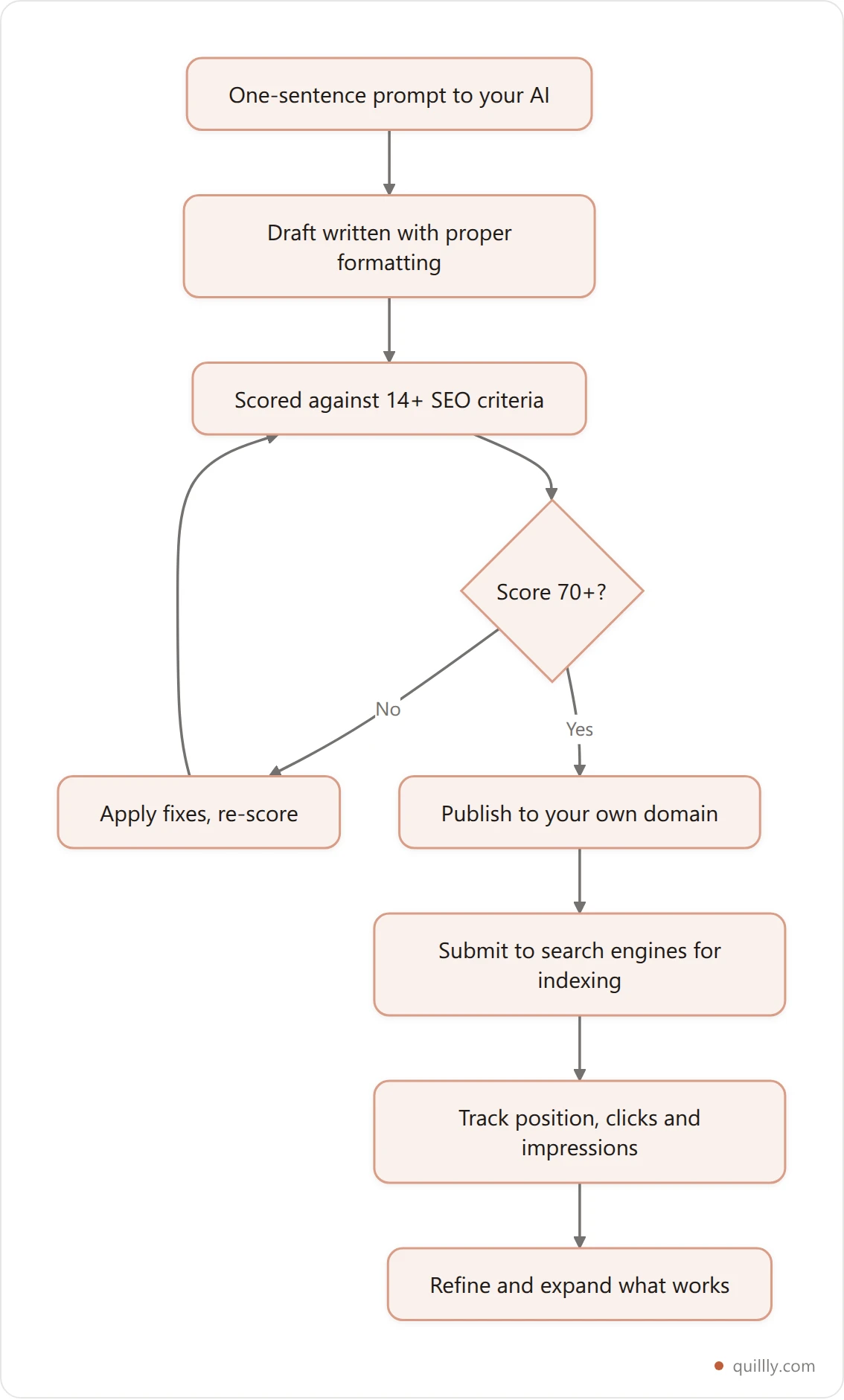
The rest of this guide to AI-powered blog SEO is those boxes, one at a time. If you'd rather see it in action than read about it, you can start a free trial and publish your first post today — no card required.
Haven't picked a platform yet? Our Wix vs WordPress breakdown covers which one a content-led blog outgrows first.
Getting started in under 10 minutes#
You can go from zero to a published, SEO-scored post on your domain in about ten minutes. Here's what you need and the four steps to get there.
What you need: a domain where the blog should live (e.g. yourdomain.com/blog), an AI tool that supports MCP (Claude, ChatGPT, Cursor, Windsurf, or any MCP-compatible client), and a Quillly account — the 14-day trial needs no card.
Create your account. Every account starts with a 14-day free trial, no card required, then $19/month on Pro for up to 5 websites and unlimited content you write.
Add your website. Enter your domain and you'll get a setup guide for your host (Vercel, Cloudflare, Nginx, and more) for the one routing rule that makes the blog appear on your own domain. Not technical? A Quillly-hosted subdomain skips this entirely. Still weighing platforms at this stage? CMS SEO: which platform actually ranks compares eight of them on the seven technical levers a CMS actually controls — and shows, with our own indexing data, how little the choice decides.
Connect your AI. Grab your MCP server URL and key from the dashboard and add it to your AI tool — a single config line. There are one-click guides for the major clients.
Publish your first post. Tell your AI: "Write a blog about [your topic] and publish it to my website." It drafts with proper formatting, scores the SEO, fixes issues, and publishes — live on your domain.
That's the setup. Those four steps are the whole of what people mean by "publish blog with AI" — prompt, score, fix, ship. Everything below is how to make each of those posts actually rank.
SEO fundamentals: the core of AI-powered blog SEO#
AI writes fluent prose, but ranking needs more than good writing. These are the non-negotiables — and the exact things a good SEO score checks before you publish.
Title tag: the single most important on-page element. Under 60 characters, primary keyword near the front, compelling enough to click.
Meta description: under 160 characters. It doesn't rank you directly, but it drives click-through from the results page.
Heading structure: one H1, then H2s for sections and H3s for sub-sections, with your keyword in at least one H2 so readers and crawlers both follow the shape.
Keyword placement: title, first paragraph, one H2, and naturally through the body — a 0.5–3% density that signals relevance without reading as spam.
Depth over length: there's no magic word count, but aim for 800+ words for standard posts and 1,500+ for pillar pieces. Cover the topic thoroughly — we checked how long a blog post should be against our own indexing data, and length barely separated the pages Google indexed from the ones it skipped.
E-E-A-T: Experience, Expertise, Authoritativeness, Trust. Real author info, credible citations, and original insight — not generic filler.
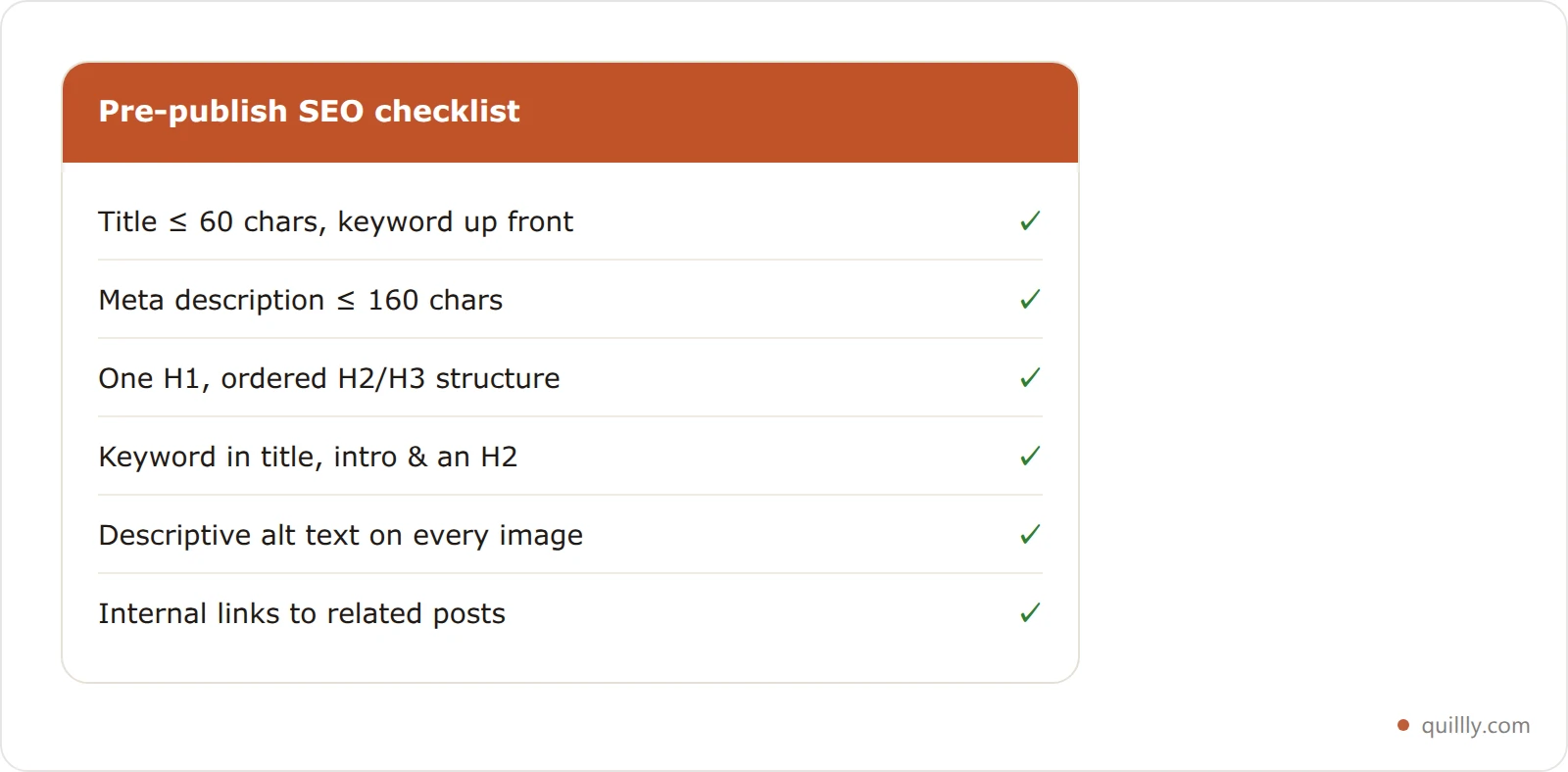
Instead of auditing this by hand, a live score against 14+ criteria tells you what a draft still fails and by how much — the same idea as a standalone on-page SEO audit, run automatically before every publish.
Keyword research: write what people actually search#
Great content on a topic no one searches for is invisible. Keyword research is how you point your writing at real demand.
Start with intent. Every query is informational, navigational, commercial, or transactional. Most blog content serves informational and commercial intent — match the format to it.
Go long-tail. "How to reduce SaaS churn with onboarding" beats "SaaS onboarding": lower competition, higher conversion, and far easier to rank for a newer site.
Respect difficulty. High-difficulty terms are owned by established sites. Target keywords you can realistically compete for today, and grow into the harder ones. On a young domain this is the whole game — see SEO for startups for how to verify a query before you write it.
Mine "People Also Ask." Those boxes are real questions from real searchers — each one is an H2 or a whole post.
Map one primary keyword per post plus two or three secondary terms, so posts don't cannibalize each other.
Modern AI keyword research speeds the discovery step, and connecting Google Search Console closes the loop by showing which terms your posts actually rank for over time.
Optimize the draft into content that ranks#
AI gives you a strong first draft. Optimization turns it into something that ranks and holds a reader — and most of that work is far cheaper before the draft exists, which is exactly what a blog outline template is for: it sizes headings, visuals and CTAs from your target word count so the draft has nothing structural left to fix.
Readability: short sentences (under ~20 words), plain language, 2–3 sentence paragraphs, and lists to keep it scannable.
A hook of an intro: open with the reader's problem, promise the payoff, and get the primary keyword into the first paragraph.
Visuals that explain: a featured image plus a diagram or chart every few hundred words — each with descriptive alt text. Explanatory visuals like diagrams and charts earn more than decorative stock photos.
Write for snippets: pose an H2 as a question and answer it directly underneath — that's what Google lifts into position zero.
Close with a next step: summarize the takeaways and give one clear call to action, which also signals a complete, thorough page.
Internal linking: turn posts into topic authority#
A single post is a leaf. Internal links turn a pile of leaves into a tree — a topic cluster that tells Google you have real depth on a subject.
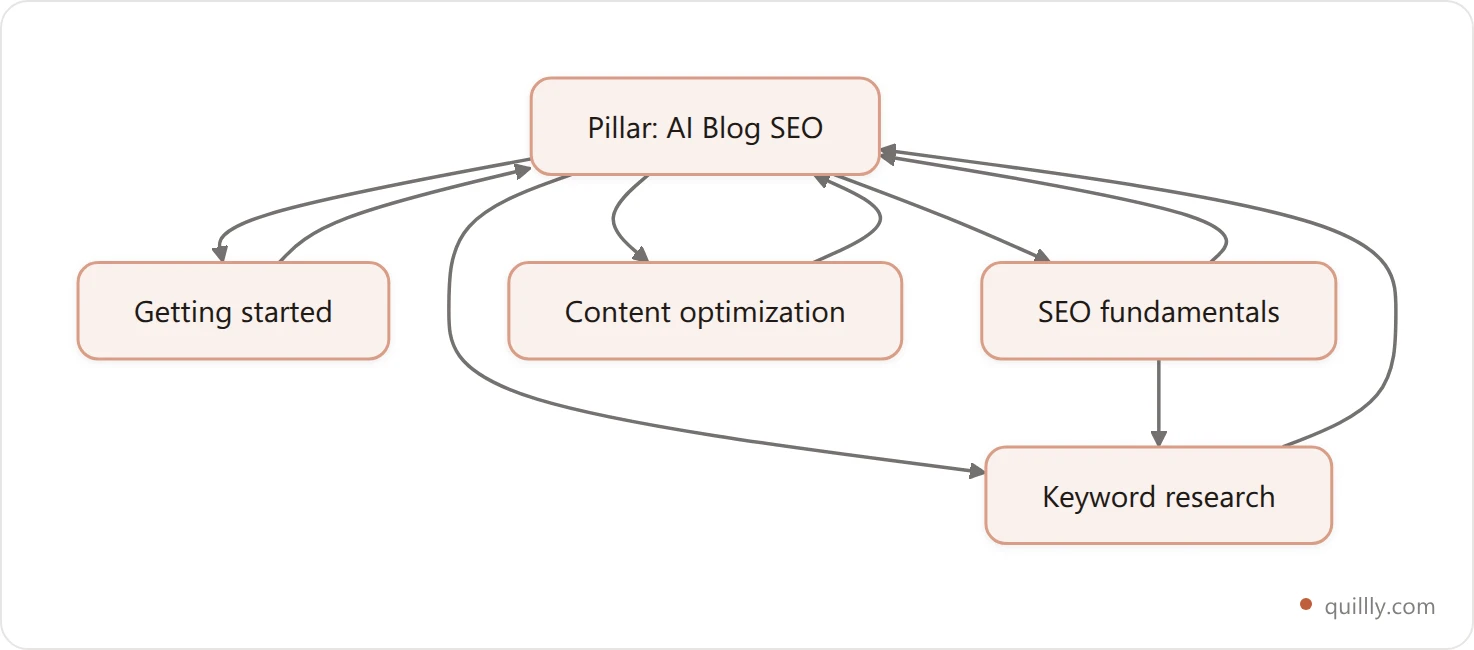
Point each supporting post back at the pillar and across to its siblings, using descriptive anchor text (not "click here"). Keep the anchors natural and relevant — the link should help a reader as much as a crawler. When you rename a post later, a good platform keeps the internal links pointing at the right place instead of silently 404-ing.
Two adjacent pieces worth reading alongside this one: what a FAQPage schema example looks like in practice, and which hosting decisions actually move rankings.
Measure, then improve#
Publishing isn't the finish line — it's the start of the feedback loop. The pages that compound are the ones you watch and refine.

Connect Google Search Console and watch three things per page: position (are you climbing?), clicks (is the title earning them?), and impressions (is the page even surfacing?). A page stuck on page two with high impressions usually needs a stronger title or a depth pass, not a brand-new post. Track indexing status too — a page that never gets indexed can't rank at all, which is why your indexing rate should set how often you publish. It can't be cited by an AI assistant either: Gemini grounds only in pages Google has already indexed, so an unindexed URL is invisible on both surfaces at once. Then do more of what works: expand the winners, refresh the fading ones, and retire the dead weight.
What this loop looks like on a real site#
Here are our own numbers, measured on quillly.com in August 2026, because a guide that only shows wins isn't much of a guide.
We have 132 published pages. Google has indexed 76 of them, Bing 27 and Yandex 105. Median time from publish to indexed runs about 11 days. That means roughly two in five pages we wrote are earning nothing on Google right now, and four in five are earning nothing on Bing.
Two lessons came out of that. First, the bottleneck on a young domain is almost never draft quality — every one of those pages cleared a score of 85 before it shipped. It's discovery. Second, the thing that actually moved pages into the index was internal links from already-indexed pages, not publishing more posts. We now give every new post three inbound links from pages Google has confirmed it holds before we move on to the next one.
If you want the same per-engine view of your own library, start with your first post.
Frequently Asked Questions#
Do I need to be technical to publish an AI blog?#
No. If you use a Quillly-hosted subdomain, there's zero setup — no DNS, no code. To serve the blog on your own domain you add one routing rule, and there are copy-paste guides for every major host with a one-click verify step.
Does AI-generated content actually rank on Google?#
Yes, when it's genuinely useful. Google judges helpfulness and E-E-A-T, not whether a human or AI typed it. Score each post against on-page criteria, add real insight and citations, and publish content that answers the query thoroughly.
How long should an AI blog post be?#
There's no fixed number. Aim for 800+ words for standard posts and 1,500+ for pillar guides, but depth beats length — cover the topic completely rather than padding to a word count. We measured this across 66 of our own posts in how long should a blog post be.
How do I get my blog posts indexed faster?#
Publish to a crawlable page on your own domain, keep an up-to-date sitemap, and submit new URLs to search engines on publish. On WordPress, check what robots txt WP actually serves before anything else — the file is generated rather than stored, so a stray one at your web root can be blocking the crawl you're waiting on. If pages are still stuck, work through the fix stack for Google not indexing your blog. Indexing is always at Google's discretion, but a clean sitemap plus instant submission is the fastest sanctioned path.
Can I use my own drafts instead of fully AI-written content?#
Absolutely. Paste your own draft and use the workflow just for scoring, internal linking, images, meta, and publishing. The AI is there to remove busywork, not to replace your voice.
Key takeaways#
AI-powered blog SEO is a loop, not a draft: research, write, score, publish, submit, measure, refresh.
Score every post before it ships — title under 60 characters, meta under 160, one H1, and the keyword in the first paragraph and at least one H2. That title check matters most on WordPress, where a plugin owns the field — see what the Yoast SEO title actually controls.
Depth beats length: 800+ words for a standard post, 1,500+ for a pillar guide.
Internal links turn separate posts into a cluster, and on a young domain they are what gets new pages discovered at all.
Indexing is the real bottleneck. Track it per engine, because a page Google hasn't indexed can neither rank nor be cited.
Start publishing content that ranks#
You now have the whole AI-powered blog SEO loop: set up in minutes, nail the fundamentals, research the keyword, optimize the draft, link it into a cluster, and measure what happens. The only thing left is to ship the first post.
Related Reading#
Running a local or service business instead of a content site? The small business SEO checklist orders the same fundamentals by payback — what to do on day one, what to skip in year one, and why your indexed share matters more than your average position.
Shopping for tooling rather than tactics? The MarketMuse alternatives comparison prices seven content tools against the four jobs they each replace — inventory, briefs, optimization and publishing — so you only pay for the step your workflow actually stalls on.
Shopping at the cheap end of that market? Rytr alternatives maps the price cliff between a $7.50 writing tool and the $39–$79 tools every roundup names to replace it — sorted by which part of the workflow you actually outgrew, including the case for not switching at all.
Still deciding what shape your next post should take? Seven examples of a blog post puts the comparison post, data study, checklist, tool page, review, playbook and decision guide side by side — each with the real impressions and search position it earned on this site.
And for the pre-publish pass itself, the blog SEO checklist ranks 14 items by measured effect rather than convention — which four actually moved impressions on this domain, which nine are table stakes, and the two that did nothing at all.
Related reading#
Publishing well is only half the job — the page still has to earn a slot in the index. For what happens when Google crawls a post and declines it anyway, read crawled currently not indexed, which follows 284 tracked URLs and two 14-day recovery campaigns to show why re-submitting an unchanged page almost never works.
Still deciding which tool should run this loop for you? AI based SEO tools: who does the work sorts the category into three layers — advice, draft and execution — by how much of the pipeline above actually leaves your desk, and explains why most roundups read the same. And if you're weighing paying someone else to run the whole loop, AI SEO services: what you're actually paying for separates the agency, the software and the agent — with the six questions that tell a real service from a repackaged retainer.
Related: Everything above assumes your posts build up your own domain. If you're still choosing where to publish, the best blogging platform guide sorts 10 platforms by who keeps the search traffic.