

We published 16 posts in 30 days on this site. Search impressions went down — from 4,732 in June to 1,902 across the first three weeks of August.
So when people ask how often should you blog, a number off a calendar isn't the answer. Most blogging frequency advice assumes every post you publish becomes a page in the index. Ours didn't.
How often should you blog? As often as search engines can actually index what you publish. For most sites that means one to three posts a week. If under 70% of your published pages are indexed, your number is closer to one — and the hours you free up belong to the pages already stuck in the queue, not to a seventeenth new post.
On this page
The advice you've already read, and what it assumes#
Search this question and you get a number. Two to four posts a week. One a week if you're small. Daily if you're serious. The Reddit threads split between "quality over quantity" and "just ship more," and neither side is exactly wrong.
But nearly every answer rests on one unstated step: publish → indexed → ranked. That middle arrow is not free and not guaranteed.
Google crawls on a budget it sets, not one you set. Its own large-site crawl budget guidance is blunt that crawl rate follows your site's capacity and Google's demand for your content — publishing more URLs doesn't raise it. And the Page Indexing report has an entire bucket called Discovered — currently not indexed, which translates to: we know the URL exists, and we haven't gotten to it.
So the real question isn't how many posts you can write. It's how many pages a week your site can get indexed. Publish faster than that rate and the extra posts don't underperform — they queue.
What happened when we published 16 posts in 30 days#
Impressions rose 11x over 90 days while clicks went from 9 to 16 — and inside that window, the month we published most delivered 60% fewer impressions than the month we published least. Volume moved rankings for a handful of pages and did nothing at all for the rest.
Here are our own numbers, pulled live on 24 August 2026, across Google, Bing and Yandex.
Window | Impressions | Clicks | CTR | Avg position |
|---|---|---|---|---|
Previous 90 days | 914 | 9 | 0.98% | 36.5 |
Last 90 days | 10,256 | 16 | 0.16% | 41.8 |
Impressions grew 11x. Clicks grew by seven. That alone is a familiar story for a young site: you become visible before you become clickable.
The more interesting part is the shape inside that window.

June was our best month for impressions — and June is when the library was smaller. August, the month we published most aggressively, delivered 60% fewer impressions than June. (August is a partial month here, and search data lags about two days, but the slope is unmistakable.)
Publishing more did do something. Our keyword position distribution moved from 1 keyword in the top three and none in the top ten, to 33 in the top three and 31 in the top ten. The wins are real. They're just concentrated in a handful of pages, and the marginal post stopped adding visibility somewhere in July.
Half of what we published isn't in the index#
This is the constraint that sets our pace. Of 269 URLs Google has inspected on this domain, 139 are indexed — 52%. The rest sit in buckets:
80 — Discovered, currently not indexed (Google knows the URL, hasn't crawled it)
21 — URL is unknown to Google
19 — Crawled, currently not indexed (Google looked and passed — a quality verdict)
4 — previously indexed, then dropped
Median time from publish to indexed: 11.3 days. Which means that when you publish daily, you're adding roughly eleven days of unindexed inventory before the first one lands.
It gets sharper per engine. Of 128 published items:

Bing has 20% of our pages. That's the number that should govern our calendar, not Google's 59% and definitely not Yandex's 77% — because the weakest engine is the one telling you your content isn't being absorbed. If you've never looked at anything but Google, multi-engine coverage is usually where the ugliest number hides. You can check your own indexed share free before you commit to any cadence.
The formula: your frequency is your indexing rate#
Here's the rule that replaces "two to four posts a week":
Sustainable frequency = pages indexed per week — not posts written per week.
So "how many blog posts per week" is the wrong first question. The right one is how many pages a week your site actually gets into an index. That number sets your publishing cadence, and it belongs to your domain, not to a benchmark.
This is the constraint that sits underneath the stage-based advice. Our 3-gear cadence model says a new blog should run 3-5 posts a week, and that's right — as long as those posts get indexed. The moment they don't, the gear you're in stops mattering and coverage takes over.
Work it out on your own data. Take the pages you published in the last 60 days, count how many are now indexed on your worst connected engine, and divide by the weeks elapsed. That's your ceiling. Publishing above it doesn't buy visibility; it buys backlog.
We built this rule into Quillly's own strategy engine, so it's worth showing the exact bands it uses:
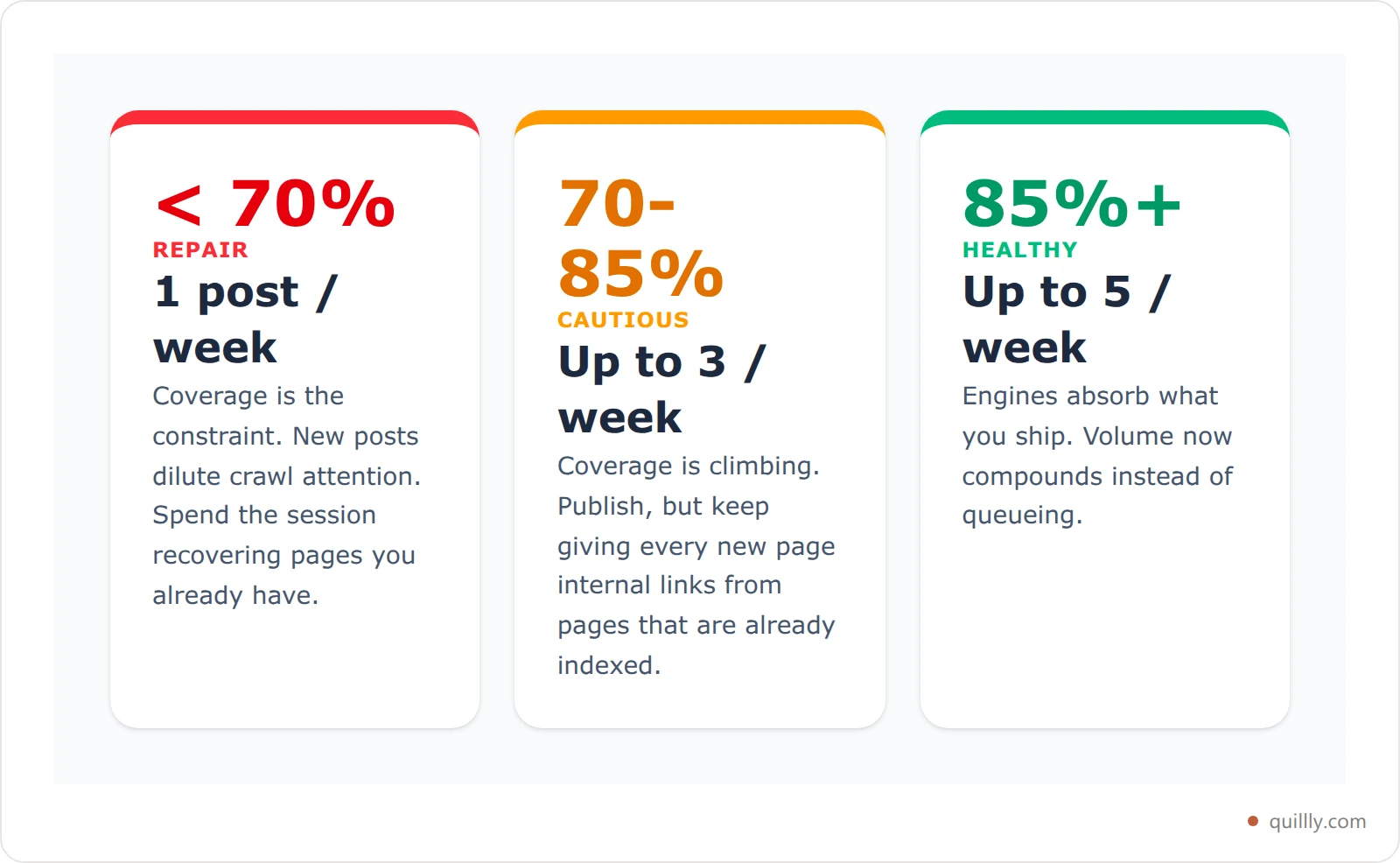
Quillly computes that band from your worst sufficiently-covered engine every time a writing session starts, and hands the number to whichever AI assistant is doing the writing. Ours currently reads repair, one post per week — which is exactly why this post exists and a batch of five doesn't.
Find your own number in about 20 minutes#
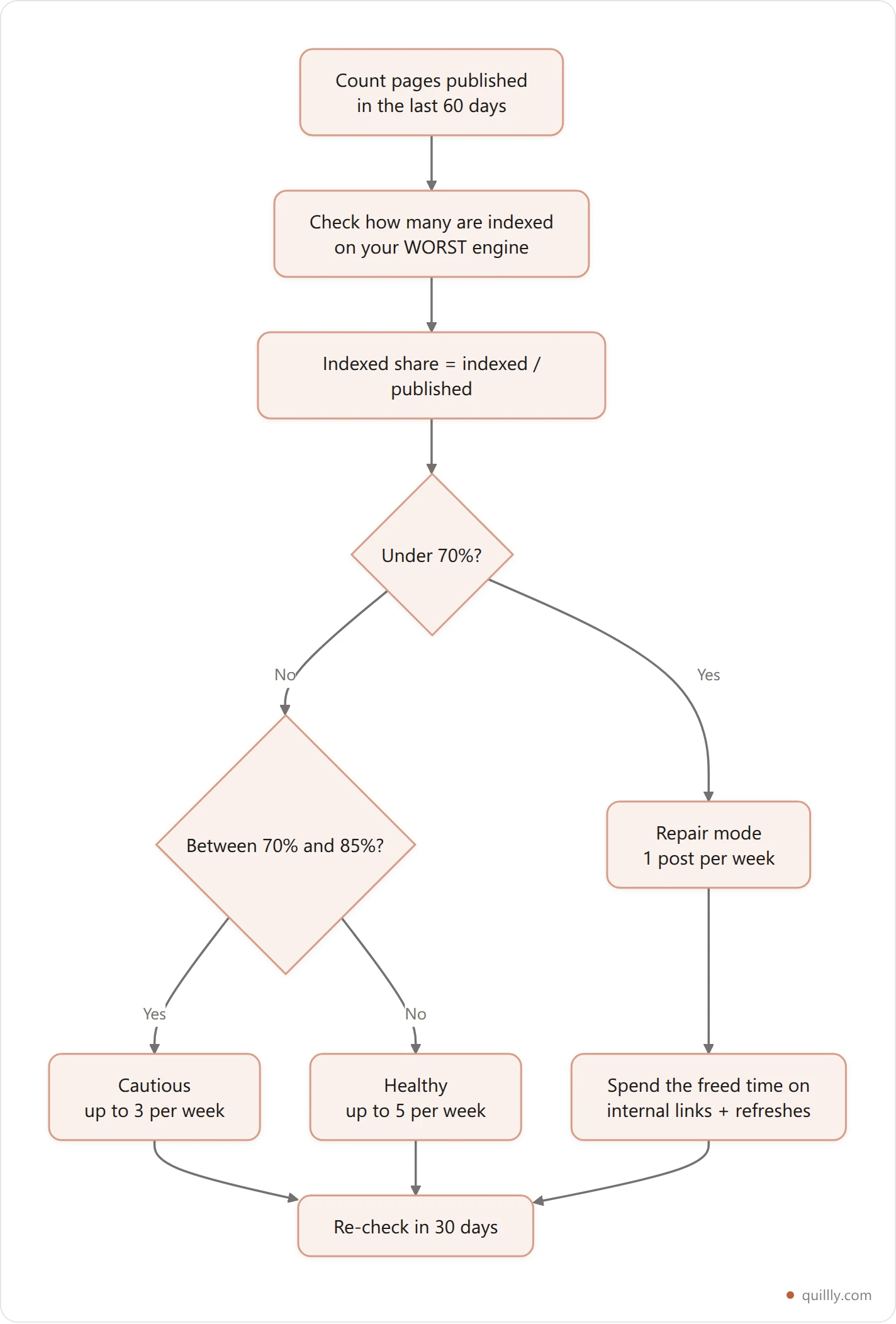
The steps behind that flow:
Open your indexing report on every engine you've connected, not just Google. Bing and Yandex both publish per-URL status, and IndexNow covers the rest.
Count published vs. indexed for the last 60 days of posts. Ignore your all-time library — old pages flatter the ratio.
Divide. That percentage picks your band from the cards above.
Set the cap and hold it for 30 days. One month is the minimum honest test, given an 11-day median lag.
Re-measure. If indexed share climbed, move up a band. If it fell, you were publishing above your rate.
If you'd rather not redo that arithmetic every month, Quillly runs it at the start of every writing session — see the cadence your coverage supports.
If step one is where you stall, our guide to getting indexed on Google fast covers the submission and sitemap mechanics, and IndexNow is the free way to push new URLs to Bing, Yandex and the rest the moment they go live.
When publishing more actually is the right call#
Raise your blogging frequency when the ceiling isn't binding: a brand-new site with nothing to dilute, an indexed share above 85%, a genuinely time-sensitive topic, or posts substantively different from one another. In those four cases, more really is better.
The detail behind each:
Your site is brand new — under five posts, there's no coverage ratio to dilute and no history for an engine to judge. Build the initial cluster.
Indexed share is above 85% — engines are absorbing what you ship, so volume compounds. This is when a five-a-week cadence earns its keep.
The topic is genuinely time-sensitive — a product launch or a news cycle has a value curve that doesn't wait for your crawl budget.
Each post is genuinely different — not the ninth near-identical roundup. We learned that one the hard way, and Google's spam policies name scaled content abuse explicitly. We wrote up what that policy actually targets after nine similar comparison posts mostly failed to index.
What to do with the hours you stop spending on new posts#
Spend them raising the ceiling: add internal links from indexed pages to recent ones, refresh posts already ranking on page two, rewrite titles for pages with near-zero CTR, consolidate near-duplicates, and fix the basics on your weakest engine. That work compounds. A seventeenth post doesn't.
In practice, that means:
Give every recent post 3+ internal links from pages that are already indexed. Links from unindexed pages pass nothing. This is the single highest-yield fix for the Discovered — currently not indexed bucket.
Refresh the pages that already rank on page two. A keyword at position 15 with impressions is worth more than a new page at position 60. Our blog traffic reality check walks through picking those targets.
Rewrite titles and meta descriptions for anything ranking with near-zero CTR. At an average position of 41.8, we have plenty of these; so will you.
Consolidate near-duplicates into one stronger page and redirect the rest.
Verify the basics on the weakest engine. Bing's webmaster guidelines differ from Google's, and 20% coverage usually means something structural, not something editorial.
If you're in your first quarter and want the fuller sequence, SEO for startups: the first 90 days lays out the same data from the beginning of this site's life.
Let your indexing rate set your calendar
Quillly checks your indexed share across Google, Bing and Yandex every session, computes the publishing cap your coverage can actually support, and hands it to Claude, ChatGPT or Cursor before a word gets written. 14-day free trial, no card.
Start free trialKey takeaways#
Frequency is a function of indexing, not ambition. Count how many of your last 60 days of posts are indexed on your weakest engine, divide by the weeks elapsed, and publish at that rate.
Under 70% indexed, publish once a week. Anything above that rate queues instead of ranking.
Watch the worst engine, not the best. Ours is Bing at 20%; Google's 59% would have flattered us into publishing more.
Impressions can climb while clicks don't. Being seen at position 41 is not the same as being read.
The freed hours are the point. Internal links from indexed pages and refreshes of page-two posts beat net-new volume while coverage is the constraint.
Frequently Asked Questions#
How often should you blog for SEO in 2026?#
As often as your pages get indexed — typically one to three posts a week. Measure the share of your last 60 days of posts that are indexed on your weakest engine. Under 70%, publish once a week and fix coverage. Above 85%, you can sustain four or five.
Is it better to post one great article or three average ones?#
One great article, in almost every case where coverage is the constraint. Google's Crawled — currently not indexed bucket is a quality verdict: the page was seen and declined. Three average posts add three chances to be declined; one strong post adds one chance to be kept.
Does publishing daily hurt your SEO?#
Not directly — frequency isn't a ranking factor. It hurts indirectly when output outruns your crawl budget, leaving a growing share of pages unindexed, and when volume pressure produces near-duplicate pages that trip Google's scaled content abuse policy.
How long before a new blog post gets indexed?#
On this site the median is 11.3 days from publish to indexed on Google, and Bing is slower still. Days to weeks is normal for a low-authority domain. Submitting via sitemap plus IndexNow shortens discovery, but it can't force a quality decision.
How many blog posts do I need before I see traffic?#
Volume isn't the trigger — indexed, ranking pages are. We reached 128 published items with 10,256 impressions and 16 clicks in 90 days, because average position sat near 41. Pages that reach the top ten produce clicks; pages that never index produce nothing, however many you write.
Should I keep a fixed schedule at all?#
Yes, but set the cap from your data and re-check it monthly. A fixed cadence keeps the habit; the indexing check keeps the cadence honest. The two together beat either alone.


