Most builders pour every ounce of effort into one search engine, Google, and then wonder why ChatGPT, Copilot, and Perplexity never quote them. Here's the uncomfortable math: Google sends most of your clicks today, but it is not the only index that decides whether an AI answer cites you. Multi-engine SEO is the practice of earning visibility across Bing, Yandex, and the AI answer engines that quietly borrow those indexes, and in 2026 it has turned from a nice-to-have into the line between being cited and being invisible.
The numbers make the case. SparkToro found that 54% of AI answer blocks cite at least one Bing-discoverable URL. AI referrals from Bing-powered experiences jumped 357% year over year by mid-2025. Yet almost nobody checks their Bing or Yandex rankings. They watch Google Search Console, see one number, and call it a day.
This guide fixes that blind spot. You'll get a named framework for spreading coverage across engines, a side-by-side of how Google, Bing, and Yandex actually rank pages, and a repeatable way to track your position on all of them at once.
Multi-engine SEO means optimizing and tracking content across every index that matters, Google plus Bing plus Yandex, instead of Google alone. It matters now because AI answer engines like ChatGPT and Copilot ground their citations in the Bing index, so your non-Google visibility directly shapes whether AI tools quote you.
What multi-engine SEO actually means#
Multi-engine SEO is a coverage strategy: you make sure every search index that can send you traffic or a citation has crawled, indexed, and ranked your best pages. It is broader than answer engine optimization, which targets the AI answer layer. Multi-engine work targets the indexes underneath that layer, because an AI engine can only cite what its source index already holds.
Three indexes carry almost all the weight for English-language content:
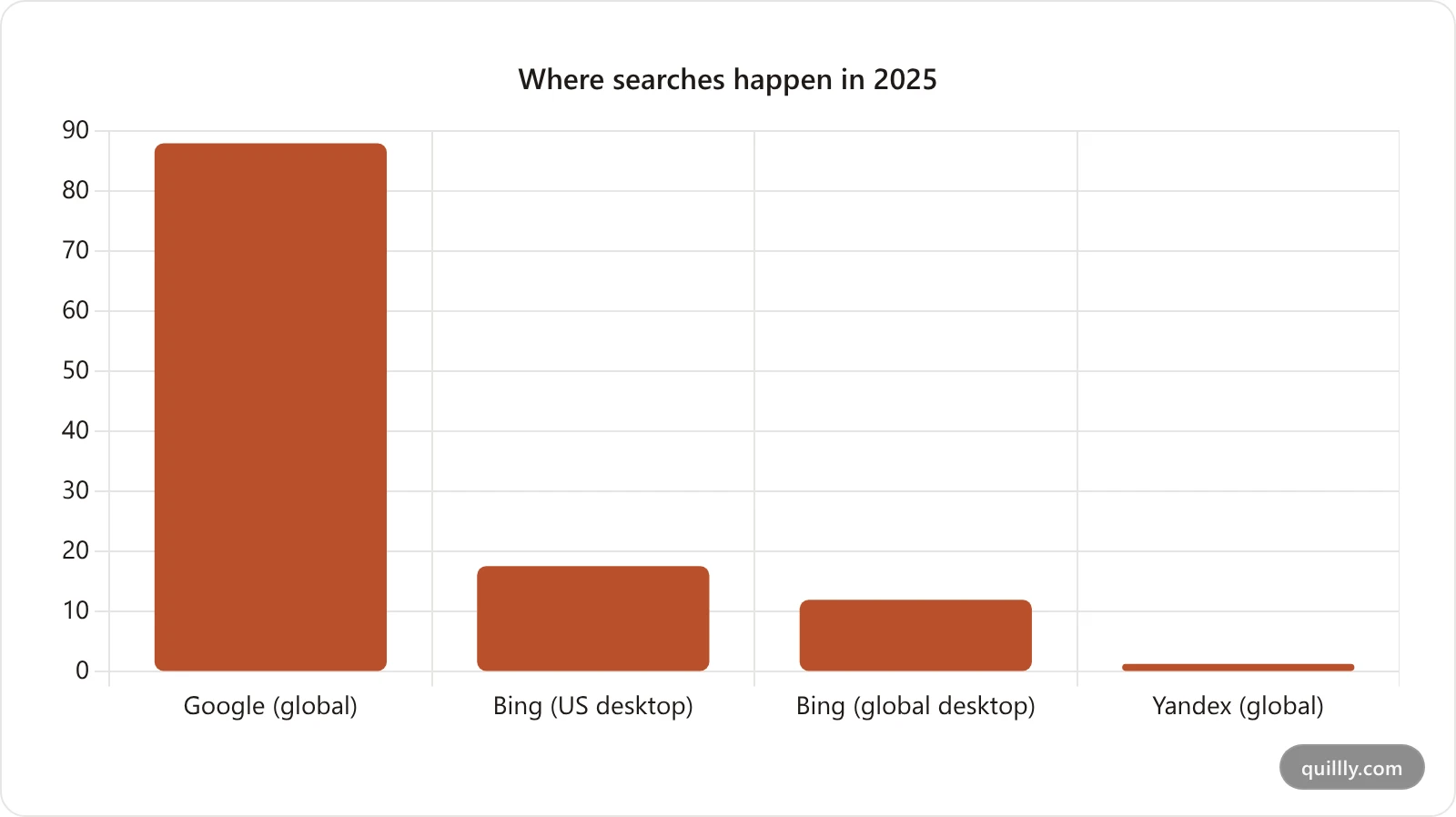
Google is the giant, still around 90% of global search, and the source behind AI Overviews and Gemini.
Bing is the quiet powerhouse: it feeds Yahoo, Ecosia, DuckDuckGo, and, critically, Microsoft Copilot and ChatGPT Search.
Yandex owns roughly 73% of Russian search and runs its own Neuro AI answers.
Optimize once with clarity and structure, then make sure all three have your content. That is the whole game.
Why non-Google indexes suddenly matter in 2026#
The reason is ownership and plumbing. Microsoft owns a large stake in OpenAI, and its Prometheus system grounds AI answers with the Bing index and Bing ranking before a model ever writes a word. So when ChatGPT Search or Copilot answers a question, it is running internal queries against Bing, not Google. If Bing hasn't indexed you, you are not in the running for that citation, no matter how well you rank on Google.
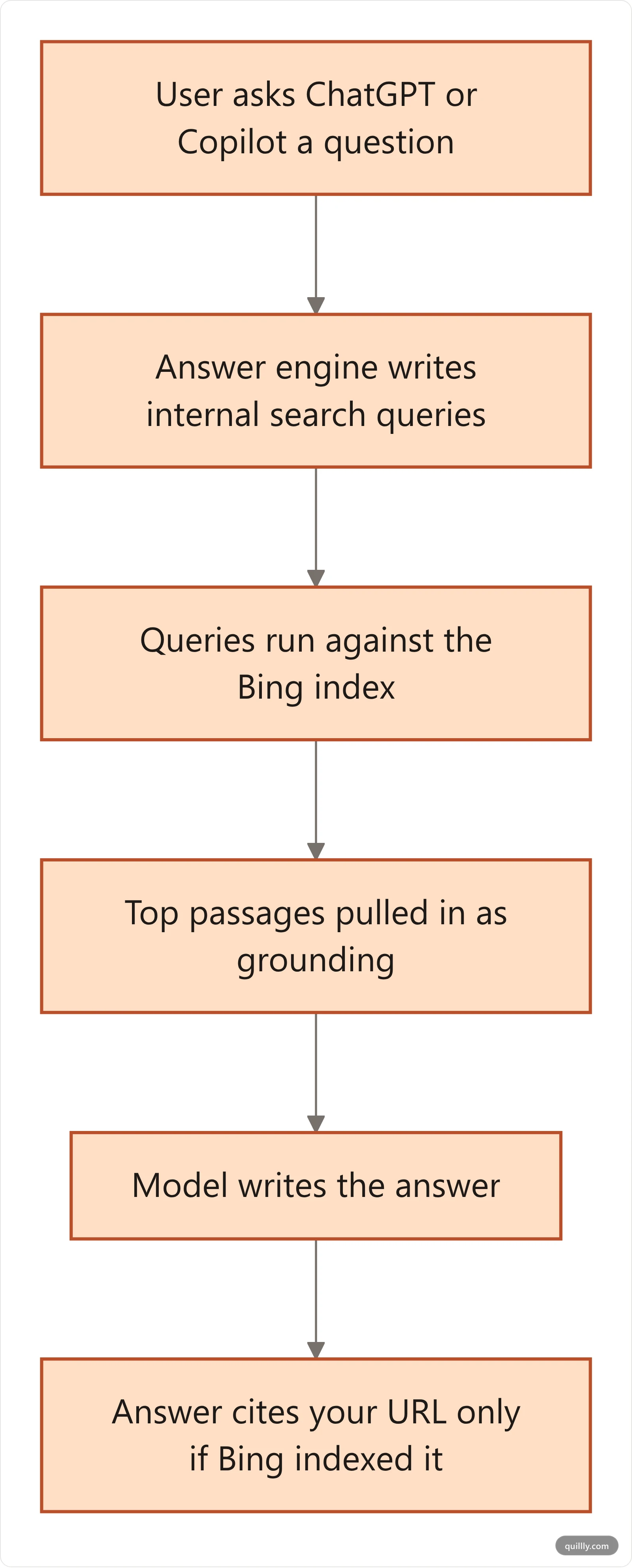
Different assistants lean on different indexes, which is why multi-engine SEO is really AI-answer SEO in disguise. Here's the mapping worth memorizing.
AI answer engine | Primary index it grounds on | What that means for you |
|---|---|---|
ChatGPT Search | Bing | Bing indexing is required to be cited; see OAI-SearchBot |
Microsoft Copilot | Bing | Same Bing-first grounding via Prometheus (Bingbot) |
Perplexity | Own crawler + Bing signals | Allow PerplexityBot; Bing coverage helps |
Google AI Overviews / AI Mode | Standard Google indexing applies | |
Gemini | Google index and Search grounding | |
Yandex Neuro | Yandex | Yandex Webmaster indexing required |
If your entire strategy assumes Google is the only door, you have locked yourself out of every room powered by Bing, and that is now most of the AI-answer surface. For a deeper look at the selection logic, see how AI search chooses citations.
The opportunity: less competition, different winners#
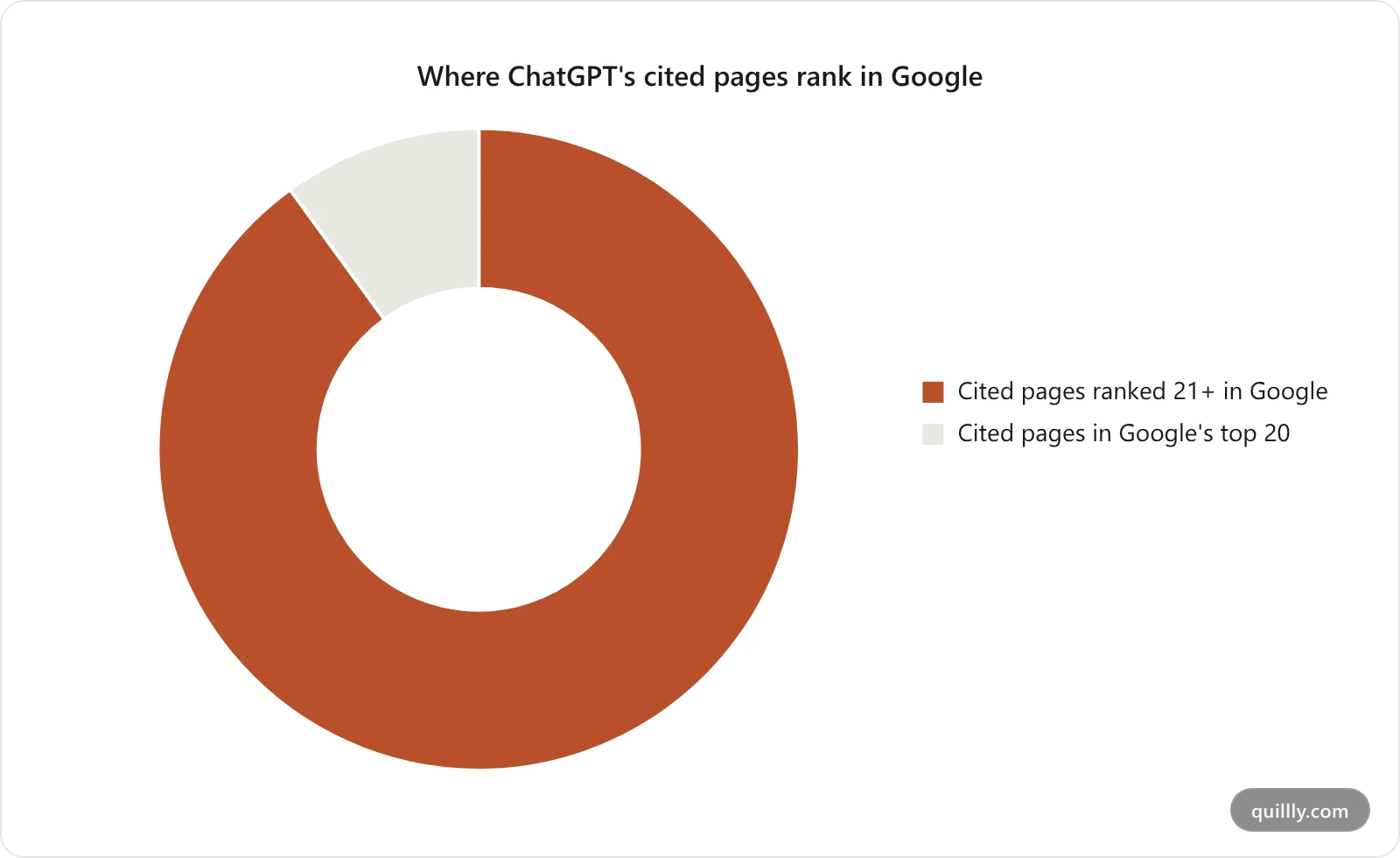
Here's the contrarian part. A page that limps along on Google page two can be a top result on Bing, and Bing is what gets it into AI answers. Research on ChatGPT Search found that roughly 90% of its cited pages rank 21 or lower in Google's results. The AI citation economy does not reward the same winners as the blue links, which means your "underperforming" content may already be winning somewhere you're not looking.
The competition on non-Google engines is also thinner. Bing holds roughly 12% of global desktop search and about 17.6% of US desktop, and far fewer teams optimize for it, so the same effort travels further. According to Search Engine Journal, the alternative-engine slice is fragmenting across more surfaces than ever, and each of those surfaces is a place your rivals have ignored.
Bing: the highest-leverage second engine#
If you do one thing beyond Google, do Bing. It is the second index for a huge share of AI answers, and getting in is mostly mechanical. Verify your site in Bing Webmaster Tools, submit your sitemap, and import your Google Search Console data in two clicks so you start with your existing property. Bing then crawls and ranks on its own logic.
That logic differs from Google in ways worth knowing. Bing leans more on exact-match keywords in titles and headers, weighs on-page signals and clean technical structure heavily, and reads social signals more openly than Google admits to. It is less forgiving of thin JavaScript rendering, so server-rendered HTML and a clean markdown twin for crawlers both help. Microsoft Advertising's own guidance on AI answers says inclusion starts with content that is "fresh, authoritative, structured, and semantically clear," which is exactly what earns Bing rankings too. Optimize for one, benefit on both. Let your AI handle Bing setup and publishing for you.
Yandex: when the fourth engine is worth it#
Takeaway: chase Yandex only when your audience is in its territory. Yandex holds about 73% of Russian search and meaningful shares in Belarus and Kazakhstan, but roughly 1.3% globally and shrinking outside those regions. If you sell to Russian-speaking markets, it is non-negotiable. If you don't, it is a low priority you can still capture almost for free through IndexNow.
Yandex ranks differently again. It weighs geolocation more than Google, rewards genuine native-language content over translated pages, and runs Yandex Neuro, its own AI answer product grounded in the Yandex index. Register in Yandex Webmaster, submit your sitemap, and let its crawler in. One striking-distance query in Quillly's own data, "yandex neuro vs google ai overviews," already sits at position 4, proof that the multi-engine long tail is real and reachable.
IndexNow: tell every engine at once#
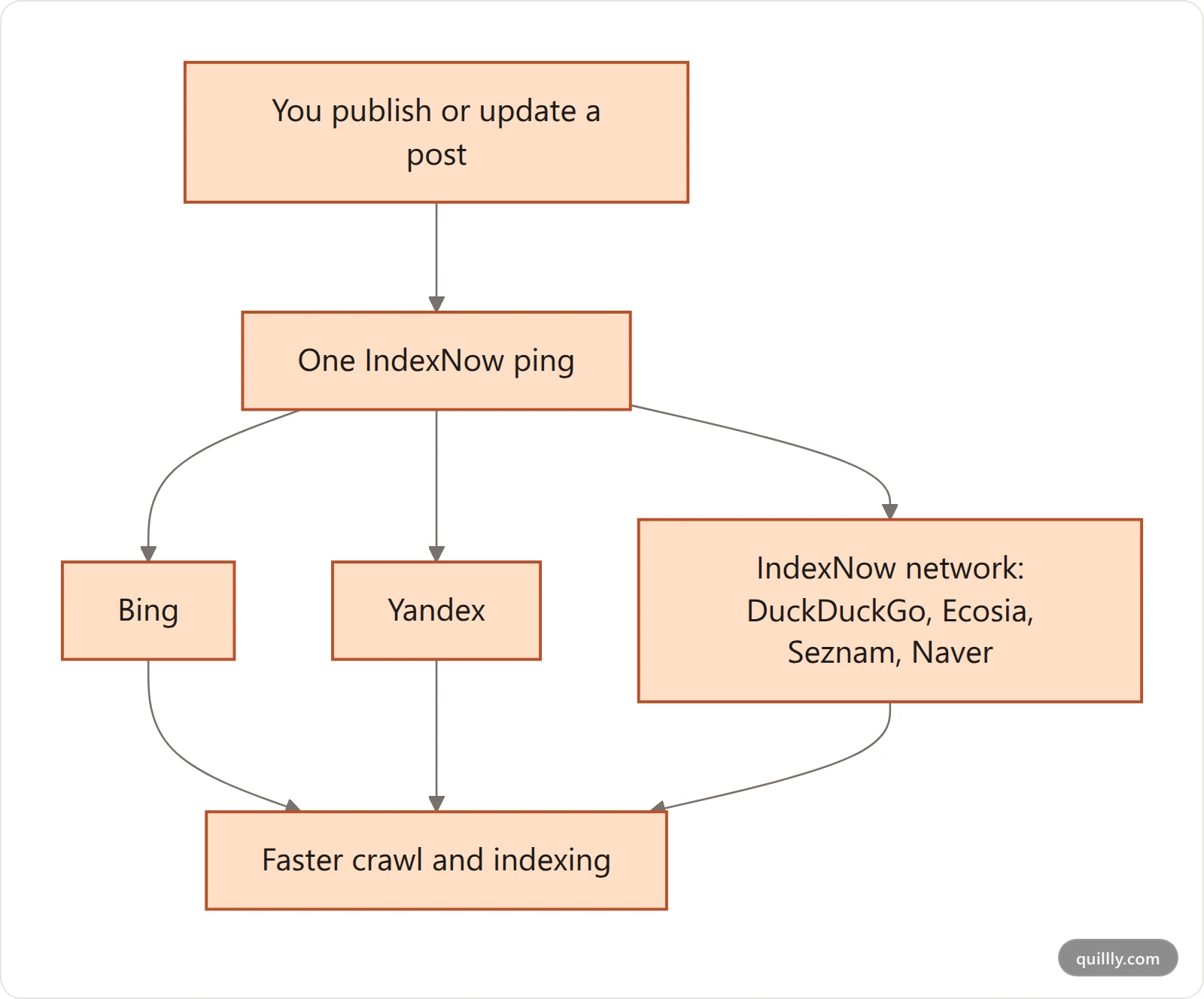
IndexNow is the cheat code for multi-engine coverage. Instead of waiting days for each crawler to rediscover your sitemap, you send one ping and Bing, Yandex, and the wider network get notified the moment a URL changes. It is the difference between "indexed next week" and "indexed today," and it costs you nothing but the setup. Pair it with clean sitemaps and the fast-indexing basics and your worst-case discovery time collapses.
This is where doing it by hand falls apart. Verifying three engines, keeping three sitemaps fresh, and firing IndexNow pings on every edit is real overhead. Quillly automates the whole chain: publish once and it submits your sitemap, pings IndexNow across eight search engines, and tracks what each one does next. Your AI writes the post; the plumbing to every index runs itself.
The Index Parity Framework: multi-engine SEO in five steps#
Most teams optimize one engine and hope the rest follow. Index parity flips that: you treat every target index as a channel that must reach the same coverage. Here is the five-step method, named so you can reuse it on every post.
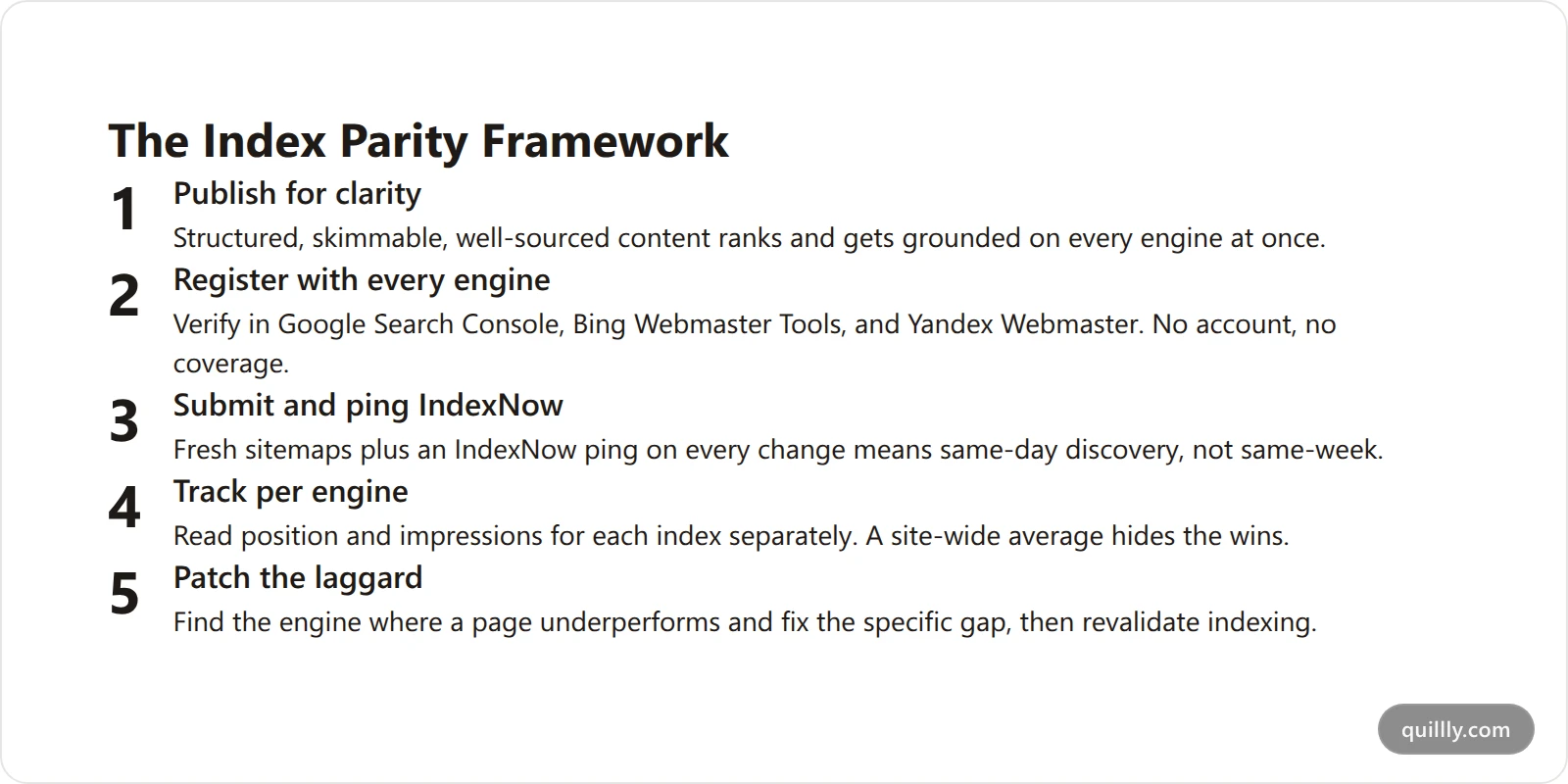
Run this loop on each new post and your coverage compounds. The engines that competitors ignore become your quietest, least-contested source of citations. Effort-wise, here's how the channels stack up.
Channel | Effort to set up | Payoff | Priority |
|---|---|---|---|
Google Search Console | Low | High (still most clicks) | Do first |
Bing Webmaster Tools | Low (import from GSC) | High (feeds ChatGPT + Copilot) | Do first |
IndexNow | Low (one-time) | High (all engines, faster) | Do first |
Yandex Webmaster | Medium | High regionally, low elsewhere | Regional or free-via-IndexNow |
Multi-engine SEO tracking: the Google Search Console blind spot#
Here's the mistake that keeps this whole opportunity hidden: teams track only Google, so a page that ranks 4th on Bing and 40th on Google shows up as a failure. The average lies. Real multi-engine SEO means reading each index on its own axis, because the same URL lives in three very different competitions.
The gap is stark in practice. In one real property, the site-wide average position was about 41 on Google but 4.3 on Bing over the same 90 days — the same split that reshapes the whole small business SEO checklist when your domain is new. If you only watched the Google number, you'd conclude the content wasn't working, while it was quietly dominating the index that feeds ChatGPT and Copilot. That is exactly the citation channel you most want to win.
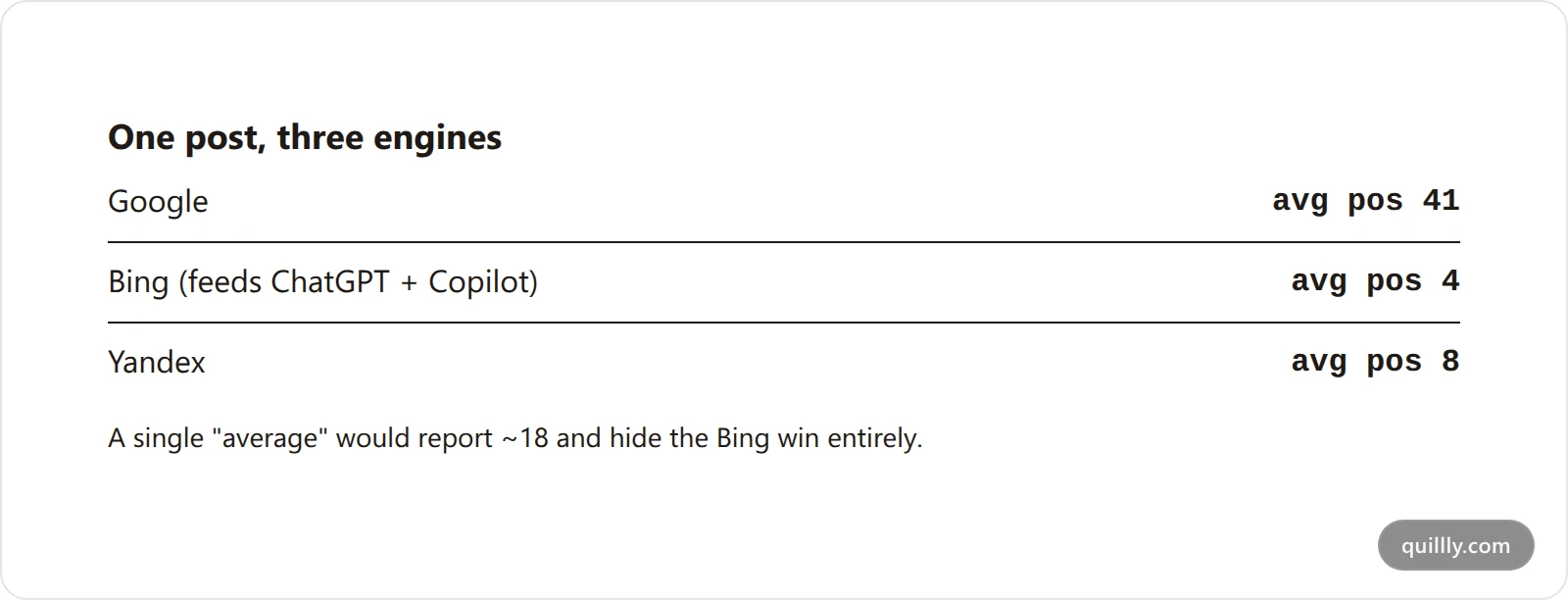
This is the reporting most tools skip. Quillly's get_search_performance reads clicks, impressions, and position for Google, Bing, and Yandex separately, then rolls them up with a per-engine breakdown so you can see the Bing win instead of averaging it away. When you spot a laggard, check_blog_seo scores the page and hands you the specific patches, so fixing the weak engine is a targeted edit, not a guess. Track the full sitemap you own this way and no win stays hidden. Connect your AI to Quillly and read every engine in one view.
Google vs Bing vs Yandex: how each ranks pages#
The engines share fundamentals, quality content, crawlability, structured data, but they diverge enough that a page can win one and lag another. Knowing where they split tells you what to patch when parity breaks.
Ranking factor | Bing | Yandex | |
|---|---|---|---|
Content quality signals | E-E-A-T, helpfulness | On-page relevance, freshness | Native-language depth |
Exact-match keywords | Downweighted | Weighted more | Weighted |
Backlinks | Very important | Important | Important |
Social signals | Officially discounted | Read more openly | Considered |
Geolocation | Moderate | Moderate | Very heavy |
JavaScript rendering | Handled well | Prefers server HTML | Prefers server HTML |
AI answer product | AI Overviews / AI Mode | Copilot / ChatGPT grounding | Yandex Neuro |
In her AI Search Optimization Roadmap, SEO consultant Aleyda Solis recommends whitelisting AI and search crawlers together, "GPTBot, Googlebot..., bingbot, Claude, CCBot, PerplexityBot," a reminder that visibility now depends on letting every engine's bot in, not just Googlebot. On WordPress that allowlist lives in a file you never created — what robots txt WP actually serves is generated on every request, and rules inherited from an old template are the usual reason a bot is locked out without anyone noticing.
Once you look past the big three, the second tier of indexes runs its own bots, and blocking them by accident is how a page quietly disappears from an entire market:
Engine | Its crawler | Where it matters |
|---|---|---|
Bing | Feeds Copilot and ChatGPT grounding | |
Baidu | Mainland China's dominant index | |
Qwen | Alibaba's assistant, live fetches | |
You.com | Small index, heavy AI-answer usage | |
xAI | Grok's search layer | |
Voice and accessibility surfaces |
The second-tier search and AI crawlers behind multi-engine SEO visibility The single best hedge is content built for clarity: structured, well-sourced, and server-rendered pages tend to win everywhere at once, which is the entire premise of publishing with AI the right way.
Frequently Asked Questions#
Is multi-engine SEO worth it if Google sends most of my traffic?#
Yes, because clicks and citations are now separate games. Google may drive most of your direct clicks, but Bing feeds ChatGPT Search and Copilot, so your Bing coverage decides whether AI tools quote you. Since setup is cheap, mostly importing your existing data, the payoff-to-effort ratio is high even when Google still dominates raw traffic.
Does ranking on Bing really affect AI answers?#
Directly. Microsoft's Prometheus system grounds Copilot and ChatGPT answers using the Bing index and Bing ranking. SparkToro found 54% of AI answer blocks cite at least one Bing-discoverable URL. If Bing hasn't indexed a page, that page cannot be pulled in as grounding, so Bing visibility is a prerequisite for a large share of AI citations.
How is multi-engine SEO different from AEO or GEO?#
Answer engine optimization (AEO) and generative engine optimization (GEO) target the AI answer layer, how you get cited in a generated response. Multi-engine SEO targets the indexes underneath that layer. They stack: an AI engine can only cite content its source index already crawled, so multi-engine coverage is the foundation AEO is built on.
Do I need to optimize for Yandex?#
Only if your audience is in Russian-speaking markets, where Yandex holds around 73% of search. Elsewhere its global share is roughly 1.3% and falling, so it is a low priority. That said, IndexNow notifies Yandex for free alongside Bing, so you can capture its long tail without dedicated effort.
What is IndexNow and why does it help multi-engine SEO?#
IndexNow is a protocol that lets you instantly notify participating search engines whenever a URL is added or changed. One ping reaches Bing, Yandex, and the wider network, so new content is discovered in hours instead of days. It is the fastest, cheapest way to keep multiple indexes in sync with your site.
How do I track my rankings on Bing and Yandex, not just Google?#
Connect Bing Webmaster Tools and Yandex Webmaster, then read each engine's position and impressions separately rather than as one blended number. Tools like Quillly's get_search_performance pull all three into a single per-engine view, so you can spot a page that wins on Bing while lagging on Google.
Can a page rank well on Bing but poorly on Google?#
Absolutely, and it's common. Research shows roughly 90% of ChatGPT's cited pages rank 21 or lower in Google. Bing weighs exact-match keywords and on-page signals differently, so a page buried on Google page two can sit near the top of Bing, which is exactly what puts it into AI answers.
The takeaway: build for every index, track each one#
Google is still the biggest door, but it is no longer the only one that matters. Three facts should reset your strategy: 54% of AI answer blocks cite a Bing-discoverable URL, roughly 90% of ChatGPT's citations come from pages ranked 21+ on Google, and AI referrals from Bing-powered surfaces grew 357% year over year. The teams winning AI citations are the ones covering the indexes their competitors ignore.
Do three things this week. Verify in Bing Webmaster Tools and Yandex Webmaster, turn on IndexNow so every publish reaches all of them at once, and start reading your rank per engine instead of as one misleading average. Run the Index Parity Framework on every new post and the compounding coverage becomes a moat.
Want your AI to actually publish the post it just wrote, then ping every index and track each engine for you? Connect Quillly to Claude or ChatGPT in 30 seconds.
Related Reading#
If you're setting this up before a site has even launched, start with our SEO checklist for new websites — it covers the sitemap, IndexNow, and submission steps this multi-engine strategy builds on.
Running a local or service business rather than a software product? The small business SEO checklist orders the same work by payback and shows why Bing is usually your first source of real search traffic.
Shopping for a content tool to run this loop? Our MarketMuse alternatives comparison prices seven options against the four jobs they replace — and flags the one job almost none of them cover, which is getting a finished page submitted to every index in the first place.
Want the per-post version of this? The blog SEO checklist ranks 14 pre-publish items by measured effect on a DR 12 site — and the Google-versus-Bing split above is exactly why multi-engine submission lands at number one rather than buried under the on-page items.
For the hard numbers behind the per-engine gap described here, see crawled currently not indexed — a 284-URL test where Google indexed none of the pages it had already crawled and declined, while Yandex accepted 101 of the same URLs over the same period.
A reasonable next question is whether domain authority explains the gap. It doesn't — what DR in SEO actually predicts walks through the same per-engine split against a single Domain Rating, which is how you can tell indexing is not an authority problem.
And if a gap that wide makes you question how much you should be publishing at all, our SEO content strategy field report turns the same coverage numbers into a publishing rule — 53% indexed on Google, 20% on Bing, 91% on Yandex across 143 pages, and the cadence cap that follows from it.