

Our best average search position last quarter wasn't on Google. It was 4.2 — on Bing, where only 20% of our library is indexed. Google, where 55% is indexed, averaged position 38.6. Same posts, same on-page work, same authors. The gap wasn't the writing.
The short answer: a blog SEO checklist should be ordered by measured effect, not by convention. On a DR 12 site, the items that moved real impressions were indexing submission, title-to-query match, internal links from already-indexed pages, and multi-engine distribution. The on-page basics are table stakes — necessary to pass, but they don't move rankings on their own.
Most checklists you'll find are 40-plus undifferentiated items, written by sites with domain ratings in the 400s, where almost anything works. This one is ranked by what we measured across 137 published posts on a domain rating of 12 — including the three items that did nothing at all.
Why Most Blog SEO Checklists Fail at Low Authority#
A checklist is a priority order in disguise. When every item looks equally weighted, you spend your first hour on alt text and your last five minutes on whether the page can be found — which is exactly backwards at low authority.
Here's the position we're writing from, pulled from our own dashboard today rather than from a case study:
Domain rating 12 (Ahrefs, checked 10 August 2026)
137 published items tracked for indexing; 130 indexed on at least one engine
8,730 impressions and 17 clicks over the last 90 days, average position 39
The prior 90-day window: 2,556 impressions and 9 clicks, average position 51.2
That's a 3.4x impression gain and a 12-place average improvement in one quarter. It's also 17 clicks. Both facts are true, and a checklist that only tells you the first half isn't worth following.
The reason the split matters: at DR 12, you don't lose because your H2s are wrong. You lose because pages never get indexed, or get indexed on an engine nobody in your market uses. Google's own SEO starter guide makes the same point in a gentler way — it opens with whether Google can find your pages, not with keyword density.
The Data Behind the Ranking#
Two numbers reframed the whole checklist for us.

The first is above: the same 137 posts average position 38.6 on Google, 4.2 on Bing and 7.6 on Yandex. The second explains why that isn't a victory — coverage.

Bing ranks our posts at position 4.2 and has only indexed 28 of 137. That's the single largest gap between what a checklist item costs and what it returns on this site — and no on-page item comes close to it. It's also the item almost every blog SEO checklist leaves out entirely.
Before you touch a single on-page item, it's worth seeing your own split: check your indexing coverage per engine. It's rarely the shape people expect.
Tier 1: The Four Items That Moved Our Numbers#
These are ordered by measured effect. Do them in this order.
1. Submit the URL to every engine, not just Google#
Google discovers pages through your sitemap and RSS. The rest of the network — Bing, Yahoo, Yandex, Naver, Seznam, Yep and Amazon — runs on IndexNow, a push protocol where you notify engines the moment a URL changes instead of waiting to be crawled. Google doesn't participate in IndexNow, so this is genuinely two jobs, not one.
Our Bing numbers are the argument. Four of our 17 clicks last quarter came from Bing, off 629 impressions — a 0.64% click rate against Google's 0.16%. Bing sends less traffic in absolute terms and converts it far better, because we're on page one there and page four on Google.
2. Match the title to the query, not to the topic#
We track 100 queries. Thirty-three of them sit in the top 3, and 29 more in the top 10 — yet the blended average position is 39. That distribution is barbelled, not middling: a set of queries we own outright, and a long tail we don't rank for at all.
Almost every top-3 query is one where the title states the query in the searcher's words. The tail is full of posts titled around a theme. If you want the full treatment, we wrote up what makes a title rank and get cited separately.
3. Link to the new post from pages that are already indexed#
A new post on a low-authority domain is invisible until something already in the index points to it. Two or three links from indexed posts is the cheapest discovery mechanism you have.
The important qualifier is already indexed. A link from a page that Google itself hasn't indexed passes nothing, and on a fast-publishing site a surprising share of your library falls into that bucket. Check before you link.
4. Give it a real internal-link destination, not an orphan#
Every new post should link out to two or three existing posts as well. This is the part people skip because it feels like housekeeping — but broken and missing internal links are the most common structural defect we find in our own audits, which is why we built a broken internal link audit process around it.
Tier 2: The On-Page Items That Are Table Stakes#
This is the part most blog post SEO advice spends all its time on, and it doesn't move rankings by itself. Skipping them will hurt you; perfecting them won't save you. Treat them as a gate you pass, not a lever you pull.
5. One H1, carrying the primary keyword early. Our library averages an SEO score of 84 across 156 items, and the most common single deduction is a duplicate H1 — usually a title repeated inside the body when the template already renders it.
6. A meta description between 140 and 155 characters. Google rewrites descriptions often, but a missing one guarantees it.
7. Descriptive alt text on every image. Not decoration — it's the only text layer a crawler gets from a diagram.
8. Headings that answer real questions. Seven to nine H2s, each a question a searcher would actually type.
9. A visual every 300–500 words. Diagrams and charts explain; stock photos decorate. A long stretch of unbroken prose reads as thin to both people and scoring systems.
10. An FAQ section with real questions. Four to seven, each answered in 40–60 words, marked up as structured data where it fits.
11. Three to five authoritative outbound links. And check them — dead outbound links are the most common defect in our own older posts.
12. A sitemap entry. Google's sitemap documentation is the reference; the failure mode is a sitemap that exists but isn't submitted.
If you want these checked mechanically rather than by eye, our blog SEO checker walks through the 14-point audit we run against every draft.
Tier 3: The Three Items That Did Nothing#
This is the part other checklists don't include, because negative results are unflattering. All three of these are standard advice. All three failed to move anything measurable on our site.
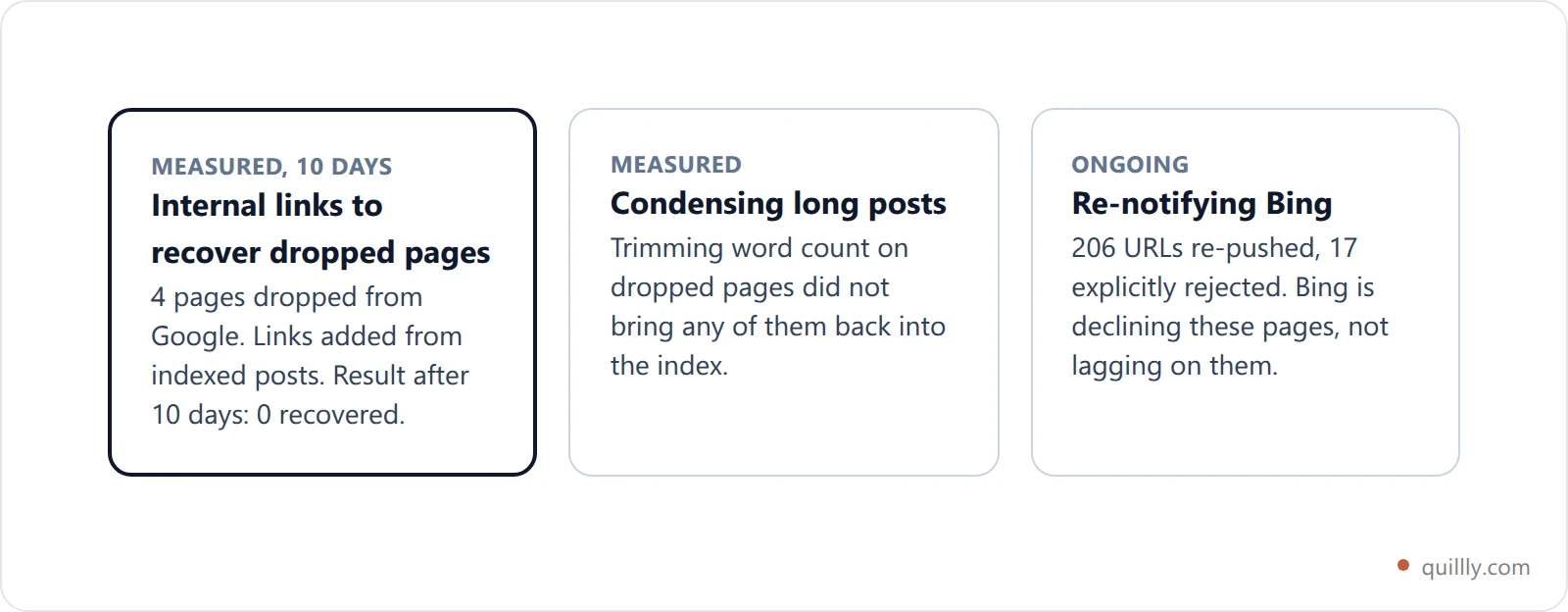
13. Internal links do not recover a dropped page. This is the one that surprised us. Adding links from indexed pages is Tier 1 for discovering a new post — and it did nothing for pages Google had already indexed and then dropped. We ran it as a controlled change across four dropped pages for ten days in August: zero recovered. Discovery and recovery are different problems, and the same lever only solves one of them.
14. Republishing without changing anything. Bumping a date doesn't re-earn a position. Our own indexing timestamps get rewritten by routine sync jobs, which makes "last updated" a genuinely unreliable signal — for you and for the engine.
The honest conclusion from Tier 3 is that once a page is dropped, on-page work isn't the lever. At DR 12, off-site authority is the remaining variable, and no checklist item substitutes for it.
Want the multi-engine half of this handled automatically? Start a 14-day free trial — every post you publish is pushed to Google via sitemap and RSS, and to the IndexNow network in the same step.
The Full 14-Point Blog SEO Checklist#
# | Item | Tier | Why it's ranked there |
|---|---|---|---|
1 | Submit to every engine, not just Google | Moves numbers | Bing averages position 4.2 for us; only 20% indexed |
2 | Title matches the query wording | Moves numbers | 33 of 100 tracked queries in the top 3 |
3 | Inbound links from indexed posts | Moves numbers | The discovery mechanism at low DR |
4 | Outbound internal links, no orphans | Moves numbers | Structural, and the most common defect we find |
5 | One H1, keyword in the first five words | Table stakes | Most common scoring deduction |
6 | Meta description 140–155 characters | Table stakes | Missing guarantees a rewrite |
7 | Alt text on every image | Table stakes | The only text layer on a diagram |
8 | 7–9 question-shaped H2s | Table stakes | Matches how queries are typed |
9 | A visual every 300–500 words | Table stakes | Density and distribution both count |
10 | FAQ with 4–7 real questions | Table stakes | Structured-data eligibility |
11 | 3–5 live outbound sources | Table stakes | Dead links are our top legacy defect |
12 | Sitemap entry, actually submitted | Table stakes | Existing isn't the same as submitted |
13 | Internal links to recover dropped pages | Did nothing | 0 of 4 recovered over 10 days |
14 | Republishing with no real change | Did nothing | Date bumps aren't a ranking signal |
Run the whole checklist on autopilot
Quillly scores every draft against 14+ SEO criteria before it ships, publishes to your own domain, and pushes each URL to Google plus the IndexNow network — then tracks indexing and position per engine.
Start a 14-day free trialHow to Run This Before You Hit Publish#
The sequence matters more than the items. Run it in this order and each step makes the next one cheaper:
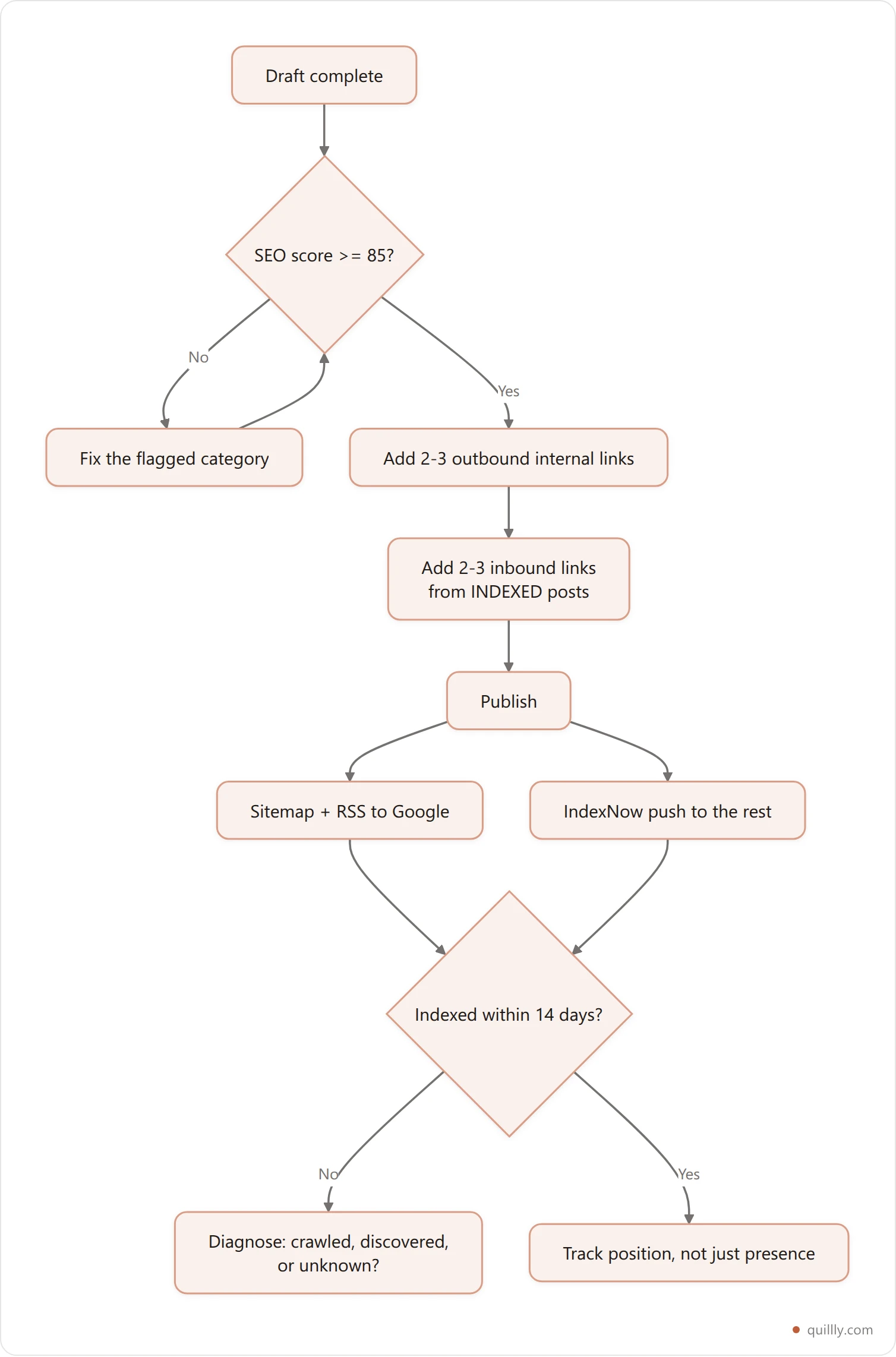
Score the draft first. Fix whatever the score flags while the text is still soft. We gate at 85 and won't publish below it.
Add outbound internal links to two or three existing posts, chosen for topical adjacency rather than convenience.
Pick your inbound sources — two or three posts that are confirmed indexed on Google, not merely published — and add the link from each.
Publish, then submit twice: sitemap and RSS for Google, IndexNow for the other seven engines.
Set a 14-day reminder to check indexing. Our median time to index currently runs about 9.5 days, so a two-week check catches real failures without panicking over normal lag.
Step 3 is where most of the value hides, and it's the step that needs live data. "I linked to it from a post I wrote last month" isn't the same claim as "I linked to it from a page Google has indexed."
What to Measure After You Publish#
Blog indexing is necessary but nowhere near sufficient. Presence isn't performance, and a page can be indexed and still invisible — we have posts that have been indexed for over a month with zero impressions, which is an entirely different diagnosis from a page that was never indexed at all.
Track these three, in order:
Indexed or not, per engine. Cross-engine "indexed" hides the case that matters: a page live on Yandex alone is not findable by your actual readers.
Impressions before clicks. Zero impressions is a targeting or indexing problem. Impressions without clicks is a title problem — a much easier fix.
Position distribution, not average position. Our average of 39 describes none of our queries. Thirty-three are in the top 3; the rest are nowhere. The average is the least useful number on the page.
That last point is why striking-distance keywords are worth more attention than headline averages — the queries sitting at positions 8 to 20 are the ones a single revision can move.
For the wider strategy this checklist sits inside, our complete guide to AI-powered blog SEO covers the parts that happen before a draft exists, and multi-engine SEO covers the distribution half in depth.
Frequently Asked Questions#
How many items should a blog SEO checklist have?#
Fewer than you think, ranked rather than listed. Ours is 14 items in three tiers, and only four of them measurably moved our numbers. A 40-item list with no priority order costs you the first hour of every post on work that doesn't change the outcome.
Does on-page SEO still matter in 2026?#
Yes, as a gate rather than a lever. Every item in Tier 2 will hurt you if you skip it and won't lift you if you perfect it. At low domain authority, indexing and distribution decide whether your on-page work is ever seen at all.
Why check Bing separately from Google?#
Because they disagree, sometimes dramatically. Our library averages position 4.2 on Bing and 38.6 on Google, off the same posts. Bing also feeds ChatGPT's search results, so its index reaches further than its market share suggests.
How long should you wait before deciding a post failed?#
About two weeks. Our median time to index currently runs about 9.5 days, so a check at 14 days separates a genuine failure from normal crawl lag. Judge impressions at 28 days, not clicks.
What do you do when a page gets dropped from the index?#
Not what most guides suggest. We tested internal links and content condensation across four dropped pages for ten days and recovered none of them. Once a page is dropped, off-site authority is the remaining variable — on-page edits didn't move it.
Should you republish old posts to refresh them?#
Only with substantive changes. A date bump isn't a signal, and automated sync jobs rewrite "last modified" timestamps anyway, which makes the field unreliable as evidence that anything actually changed.
The Short Version#
Rank your checklist before you run it. On a domain rating of 12, four items did the work — multi-engine submission, query-shaped titles, inbound links from confirmed-indexed pages, and no orphans — while twelve on-page conventions kept us eligible without lifting anything, and two pieces of standard advice measurably did nothing.
The uncomfortable finding is the one worth keeping: our best-ranking engine is the one where four-fifths of our library isn't indexed. That's not a writing problem, and no amount of on-page polish would have found it. It took looking at the data per engine instead of in aggregate.
If you'd rather not run the distribution half by hand, Quillly scores every draft against 14+ SEO criteria before it ships and pushes each published URL to Google plus the IndexNow network — then tracks indexing and position per engine so a gap like ours shows up in week one instead of quarter two.


