

On the site you're reading right now, 267 pages have been inspected by Google — and only 139 are actually indexed. Every one of them shipped with a sitemap, clean HTML, and no noindex tag. A checklist gets you crawlable. It doesn't guarantee you get indexed, and conflating the two is the most common mistake new-website owners make.
This SEO checklist for new websites covers what actually moves a site from "technically fine" to "indexed and ranking": the pre-launch technical setup, the on-page basics search engines expect, enough content depth to survive a quality check, and the submission and monitoring steps most launch guides skip entirely.
Before You Publish: The Technical Foundation#
Do these before your first page goes live — fixing them after launch means waiting for a re-crawl.
HTTPS is on and forced. Every URL should redirect to the HTTPS version, with no mixed-content warnings.
robots.txt allows crawling. Check it isn't blocking
/by accident — this happens constantly on staging-to-production migrations.No accidental
**noindex**. Staging environments often have a blanket noindex meta tag that quietly ships to production.One canonical URL per page. Decide on
wwwvs non-wwwand trailing slash vs none, then make it consistent everywhere.An XML sitemap exists and validates. List only canonical, indexable URLs — not redirects or 404s.
Core Web Vitals pass on mobile. Google's own guidance treats page experience as a ranking input, and mobile is the default index.
Structured data validates. Organization, breadcrumb, and article schema where relevant — errors here can block rich results even when the page indexes fine.
Submit to Search Engines the Right Way#
A sitemap sitting on your server doesn't announce itself. You still have to tell engines it exists.
Verify the domain in Google Search Console and submit the sitemap under Indexing → Sitemaps.
Verify in Bing Webmaster Tools too. Bing's webmaster guidelines cover crawl requirements that differ slightly from Google's, and Bing typically indexes new sites slower than Google does.
Use IndexNow for instant notification across Bing, Yandex, Naver, Seznam, and Yep in one call instead of waiting on each engine's own crawl schedule — the IndexNow protocol exists specifically so you don't have to.
Set expectations with real numbers, not launch-day hope. On this site, the median time from submission to indexing is 9.5 days, measured across 267 inspected URLs. Some pages clear in under a week; others sit in a "discovered, not yet crawled" queue for weeks because of crawl budget, not because anything is broken.
Requesting indexing once in Search Console for a page that never gets revisited is not a strategy — it's a single data point. Google's own documentation on crawling and indexing is worth reading end to end before you assume a slow index is a bug.
On-Page SEO Basics for Every New Page#
This is the part of any technical SEO checklist that's easy to skip because nothing "breaks" if you get it wrong — pages just underperform quietly for months.
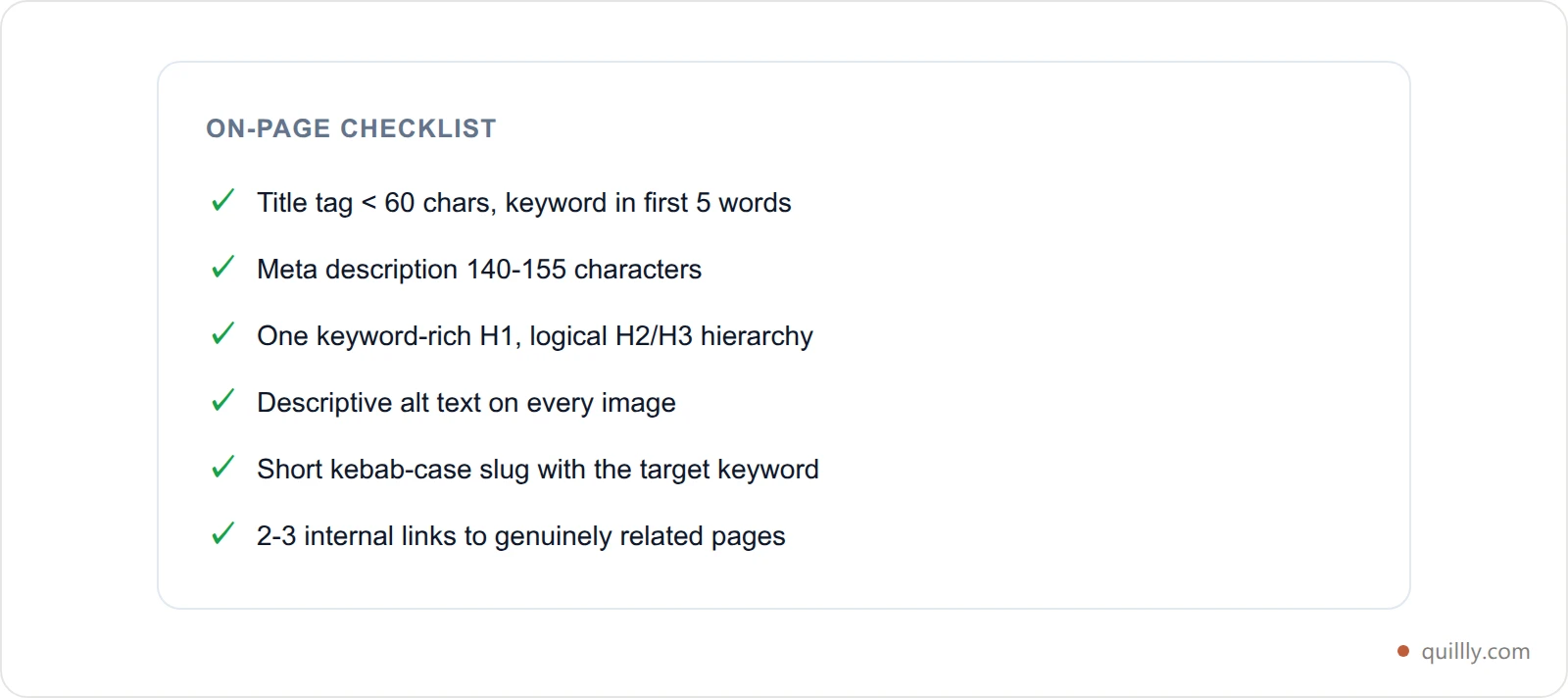
Title tags under 60 characters, primary keyword in the first five words.
Meta descriptions between 140-155 characters. Anything past 160 gets truncated in the search snippet, and on Quillly specifically, over-length descriptions are rejected outright before a post can publish.
One H1 per page, and it should contain the target keyword — not a generic tagline.
A logical H2/H3 hierarchy that mirrors the questions a reader actually has, not a list of features you want to mention.
Descriptive alt text on every image — not "image1.jpg," a sentence describing what's actually in the frame.
Short, readable URL slugs — 3-5 words, kebab-case, keyword included, no dates or IDs baked in that you'll regret later.
2-3 internal links minimum per page, pointing to genuinely related content, not just your homepage.
Run new pages through a structured on-page audit before launch rather than after — it's much cheaper to fix a missing H1 pre-publish than to notice it three months into flat rankings.
Give Search Engines Something Worth Indexing#
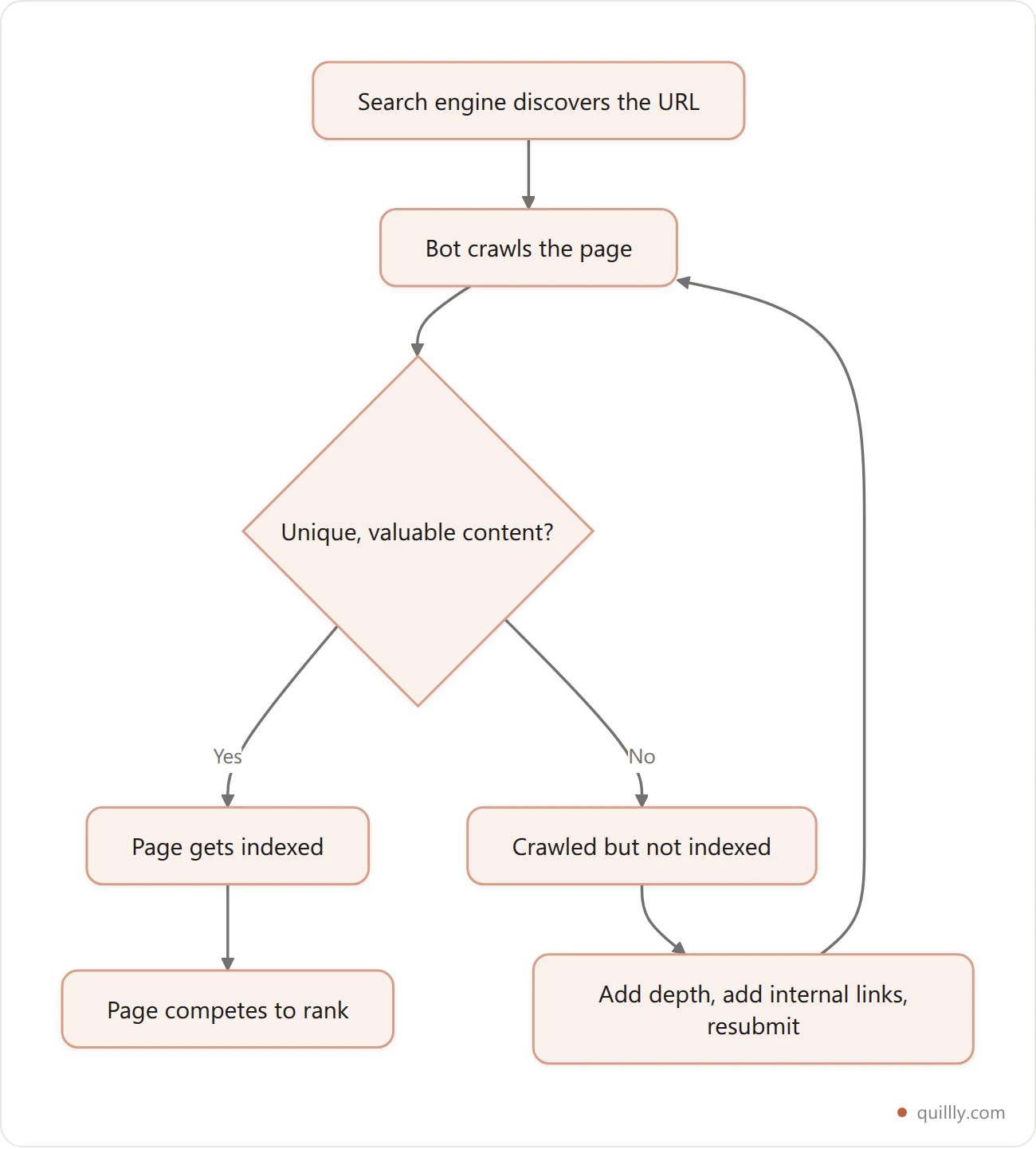
Here's the part most new-website SEO checklists leave out entirely: passing every technical and on-page item does not guarantee indexing. Google still has to decide your content is worth keeping. On this site, "Crawled – currently not indexed" is the single most common reason pages don't make it in — worse than any technical error.

The fix for "crawled but not indexed" is never a resubmission — it's depth. A new website's first pages should each:
Fully answer one search intent, not skim five topics at 300 words apiece.
Include something original — your own data, a worked example, a screenshot, a specific number — not a rewrite of what's already ranking.
Avoid boilerplate across pages. Template-generated pages that differ only in a city name or product SKU are exactly what "crawled, not indexed" was built to catch.
Match search intent for format, not just keyword.** If the top results for your target keyword are all comparison tables, a single-product landing page won't out-rank them regardless of on-page polish — check the live SERP before you commit to a format.
A tight SEO content brief before writing does more for indexing odds than any technical fix applied after the fact.
Score your launch pages before they ship, not after
Site Structure and Internal Linking#
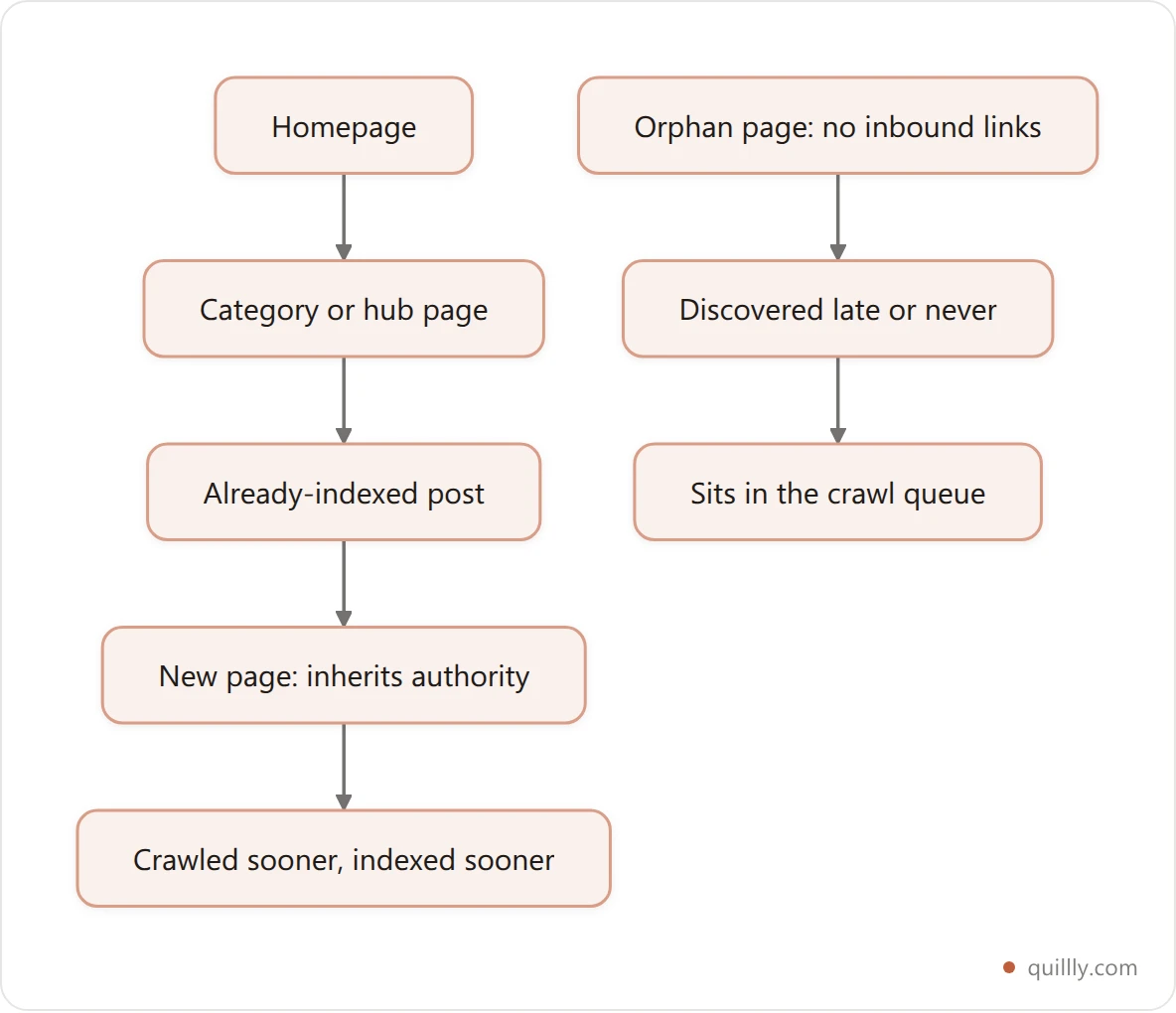
A brand-new page has zero authority of its own. It borrows authority from what already links to it — which means orphan pages (no internal links pointing in) are one of the quietest ways new content stalls.
Link every new page from at least one already-indexed page, not just a category archive that may itself be thin.
Keep your folder/category structure shallow. Three clicks from the homepage to any page is a reasonable ceiling for a new site.
Use descriptive anchor text, not "click here" — anchor text is a relevance signal, not just a hyperlink.
Audit for broken internal links regularly. A link pointing at a page you deleted or unpublished doesn't just look bad, it wastes the crawl budget spent finding it.
If you're choosing between building this by hand and using software, an internal linking tool that flags orphan pages automatically will catch what manual audits miss once a site passes 50-100 pages.
Website Launch Checklist: Analytics and Monitoring Setup#
Launch day isn't the finish line — it's when monitoring starts.
Google Search Console, verified and connected before launch, not after you notice a problem.
Google Analytics 4 (or a privacy-respecting equivalent), with goals mapped to real conversion actions.
A weekly coverage check. Search Console's Page Indexing report should be part of a recurring routine, not a one-time glance.
Rank tracking on your target keywords, even a handful, so you notice movement before it shows up in traffic.
A keyword research process that keeps feeding new pages. AI-assisted keyword research works well here specifically because a new site needs a steady stream of winnable, low-competition targets rather than head terms it has no authority to rank for yet.
Skipping monitoring is how sites end up publishing for six months before anyone notices half their pages never got indexed in the first place.
Common Mistakes on a New Website SEO Checklist#
Publishing before the technical foundation is verified. Fixing a robots.txt block after 50 pages are live costs you weeks of wasted crawl budget.
Requesting indexing once and walking away. One request in Search Console is a data point, not a fix — if a page is still "crawled, not indexed" two weeks later, the content needs work, not another click.
Ignoring every engine except Google. Bing and Yandex combined can be a meaningful share of impressions, and IndexNow notifies both for the cost of one API call.
Treating the checklist as a one-time event. New pages need the same rigor six months in as they did on launch day — the checklist doesn't expire.
Meta descriptions over 160 characters. They get truncated in the snippet and, on platforms that enforce the limit at publish time, get rejected outright.
Frequently Asked Questions#
How long does it take for a new website to get indexed by Google?#
It varies widely — days for a strong, well-linked page, weeks or months for a thin one. On this site the median is 9.5 days across 267 inspected URLs, but that's a median, not a guarantee: some pages sit in "discovered, not crawled" for a month while crawl budget catches up.
Is SEO for new websites different from optimizing an established site?#
Yes — a new site has no authority to borrow from internal links yet, and every early page is judged partly on how the whole domain looks so far. The checklist items are the same; the margin for error is smaller because there's no existing trust to fall back on.
Do I need an XML sitemap for a small website?#
Yes, even for five pages. A sitemap doesn't just list URLs — it's the clearest signal to a search engine about which pages you consider canonical and worth crawling, and it's referenced automatically every time you submit changes through Search Console.
Should I submit my site to Bing and Yandex, not just Google?#
If your audience is global or Google isn't your only traffic source worth capturing, yes. IndexNow submits to Bing, Yandex, Naver, Seznam, and Yep in a single call, so there's little reason not to.
What's the difference between "crawled" and "indexed"?#
Crawled means a bot visited the page. Indexed means Google decided it was worth adding to the index it actually serves results from. A page can be crawled repeatedly and never indexed if Google judges the content thin, duplicate, or not clearly better than what already ranks.
How many pages should a new website launch with?#
Fewer, deeper pages beat many thin ones. Ten pages that each fully answer a real search intent will out-index and out-rank fifty pages built to hit a launch-day page count.
Skip the manual checklist audit
Quillly scores every page against 14+ SEO criteria before it can publish — including keyword coverage, internal linking, and meta length — and auto-submits to Google plus the IndexNow network (Bing, Yandex, Naver, Seznam, Yep) the moment you publish.
Start your free trialKey Takeaways: The SEO Checklist for New Websites#
The SEO checklist for new websites comes down to order: technical foundation first, submission second, on-page basics on every page, real content depth instead of launch-day filler, internal links from day one, and monitoring that doesn't stop after week one. Most new-website SEO problems trace back to skipping the order, not skipping an item — publishing before the sitemap is submitted, or writing ten pages before checking whether any of them answer a real search intent.
None of this replaces watching what actually happens once pages are live. How to get indexed on Google fast covers the recovery playbook for exactly the "crawled, not indexed" and "discovered, not crawled" states this checklist is designed to prevent in the first place — worth bookmarking before you need it, not after.


