

You hand a writer a topic and a keyword. Three days later you get back 1,200 words that miss the search intent, skip what people actually type into Google, and don't sound like your site. You rewrite it yourself — faster than briefing would've been, except now you're doing it every week.
An SEO content brief is a short spec that locks in the target keyword, the search intent it must match, the headings it has to answer, the internal links to include, and the word count — before anyone opens a blank page to write it. Skip it, and every post becomes a guessing game between you and whoever's writing it.
This guide covers how to write a content brief that a writer actually follows, the research that fills it in, the free template you can copy today, and why briefs still get ignored even when you write one.
What Is an SEO Content Brief?#
An SEO content brief is the document a writer gets before they write a single word. It sits between a topic idea and a full outline. A good brief answers three questions before drafting starts: what does the reader want (intent), what shape should the answer take (guide, comparison, listicle, tool), and what angle beats the ten results already ranking.
Without those three answers, a writer has to guess — and a guessed draft technically covers the topic while missing why someone searched it, a gap an editor ends up closing by hand, usually the day it's due.
A brief fixes that by moving the research in front of the writing, not into revisions.
What Belongs in Every SEO Content Brief#
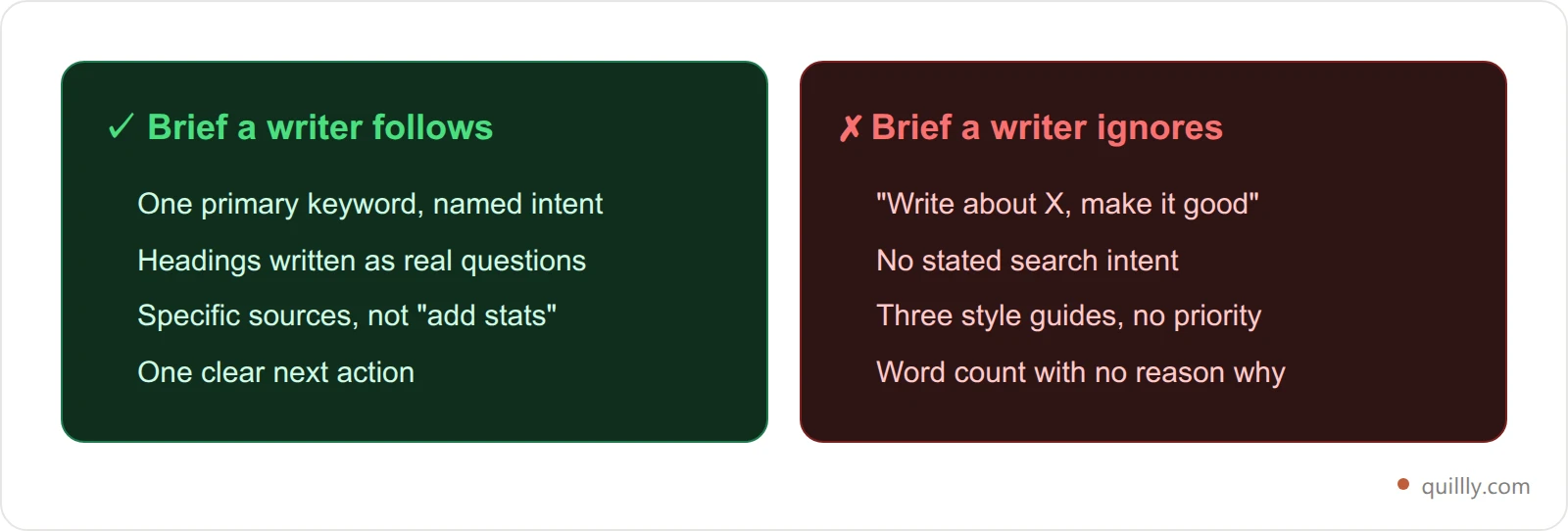
A brief earns its keep by being specific, not long. These are the fields that actually change what gets written:
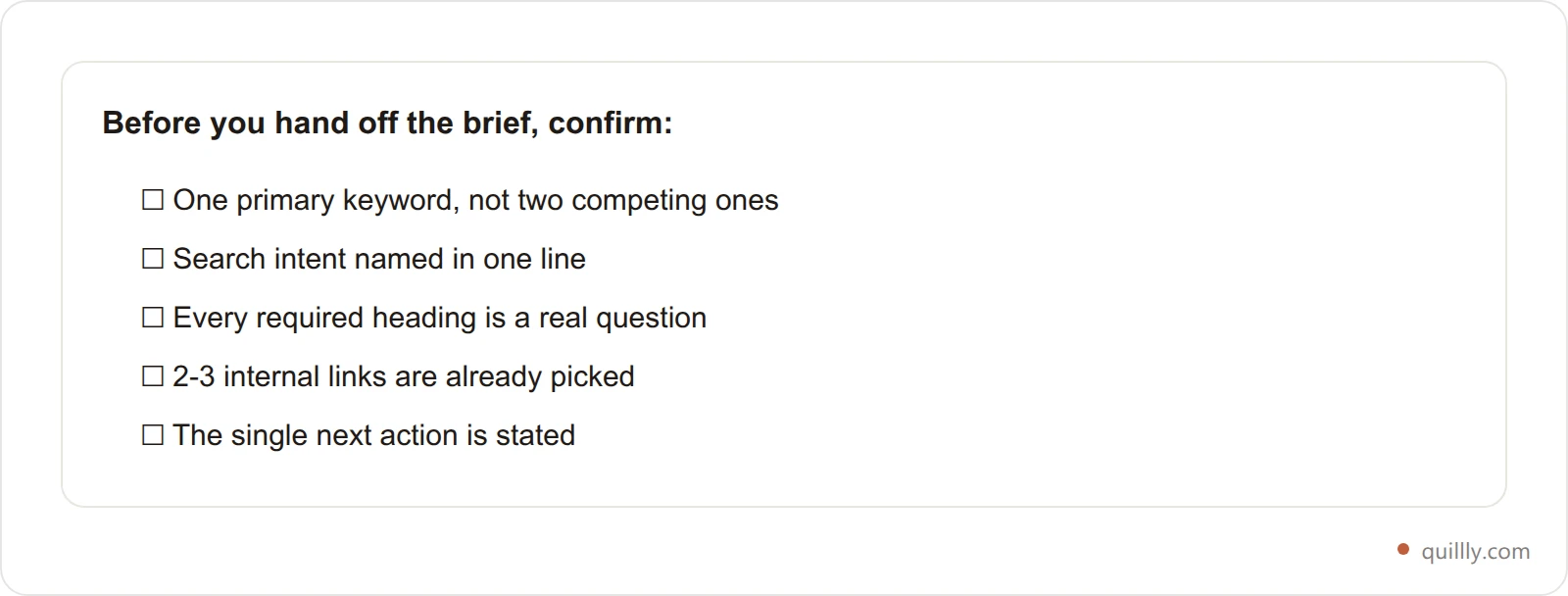
Primary keyword and 2-4 secondary terms — the exact phrases to rank for, pulled from real search volume, not guesswork.
Search intent — informational, commercial, or transactional, plus what the searcher wants to do next.
Target word count — a range, not a rule — long enough to answer the query fully, no padding required.
Required headings — the real questions the piece must answer, pulled from what's ranking and what people ask next.
Internal links to include — 2-3 related pages so the new post doesn't launch as an orphan.
Sources to cite — 3-5 places to pull real data or quotes from.
Meta title and description guidance — length limits and where the keyword needs to sit (more on writing titles that actually rank).
The one thing the reader should do next — a single call to action, not three competing ones.
The SEO Content Brief Template (Copy This)#
Here's the actual content brief template, field by field. Fill in the middle column and hand the whole thing to a writer — human or AI.
Field | What to fill in | Example |
|---|---|---|
Primary keyword | The one phrase this page must rank for | seo content brief |
Secondary keywords | 2-4 related terms to weave in naturally | content brief template, content brief generator |
Search intent | Informational, commercial, or transactional | Commercial — reader wants a template to use today |
Dominant SERP format | What's already ranking: guide, listicle, comparison, tool | Guide |
Target word count | A range that matches what's ranking | 1,500-2,200 words |
Required headings | The real questions the page must answer | What belongs in a brief, a copyable template, common mistakes |
Internal links | 2-3 existing pages to link to | Your related posts on this exact topic cluster |
Sources to cite | 3-5 places to pull real data or quotes | Named studies or surveys, not "research shows" |
Meta title / description | Length limits and keyword placement | Title ≤60 chars, description 140-155 chars |
Next action | The single thing you want the reader to do | Start a free trial, download the template, subscribe |
Keep this content brief template as a living doc — a spreadsheet row per post works fine. Skip a field because "the writer will figure it out," and you've reopened the guessing game.
How to Research Each Section Before You Write#
A brief is only as good as the research behind it. Three checks fill in most of the template above:
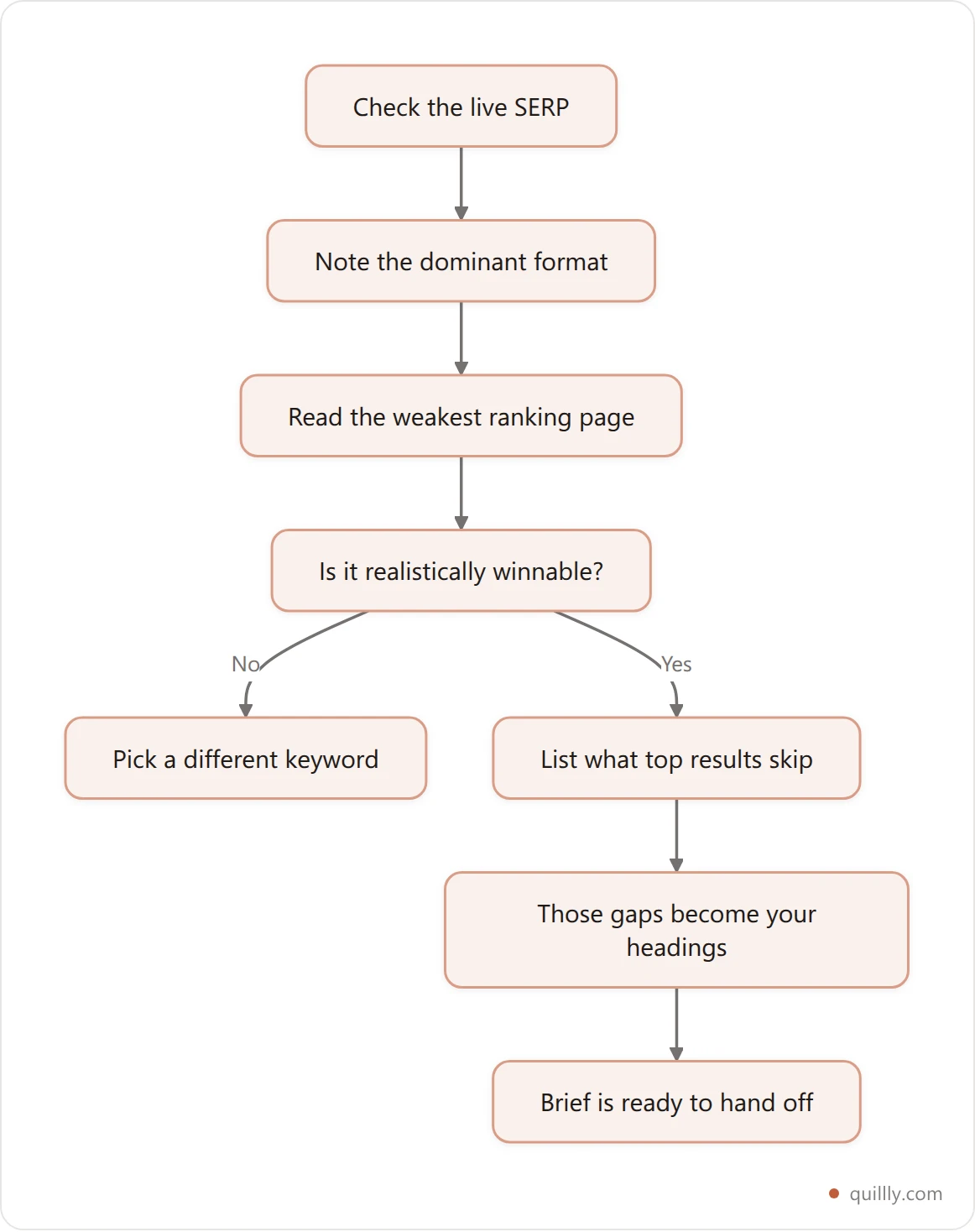
Check what's actually ranking. Pull the live top 10 for your target keyword and note the dominant format — if nine of ten results are guides and one is a tool page, write a guide. Matching the format the search engine already rewards is the single highest-impact decision in the brief.
Read the weakest page that's ranking, not the strongest. The site at position 8-10 with the lowest authority score is your realistic bar. If page one is all massive, decades-old domains, the keyword may not be winnable yet — better to learn that before writing than after.
Note what the top results skip. Read the top 3-5 results and list the questions none of them answer well. That gap becomes your differentiation angle and usually two or three of your required headings.
Why Good Briefs Still Get Ignored#
Writing a brief doesn't guarantee anyone uses it. In Verblio's 2022 survey of its freelance writer network, 80% said unclear requests from clients were their single biggest challenge — which means most of the briefs writers receive are still failing at the basics. The same survey found 48% of writers rated "the primary goal of the content" as the most useful thing a brief can tell them, ahead of style guides, audience notes, or example links.
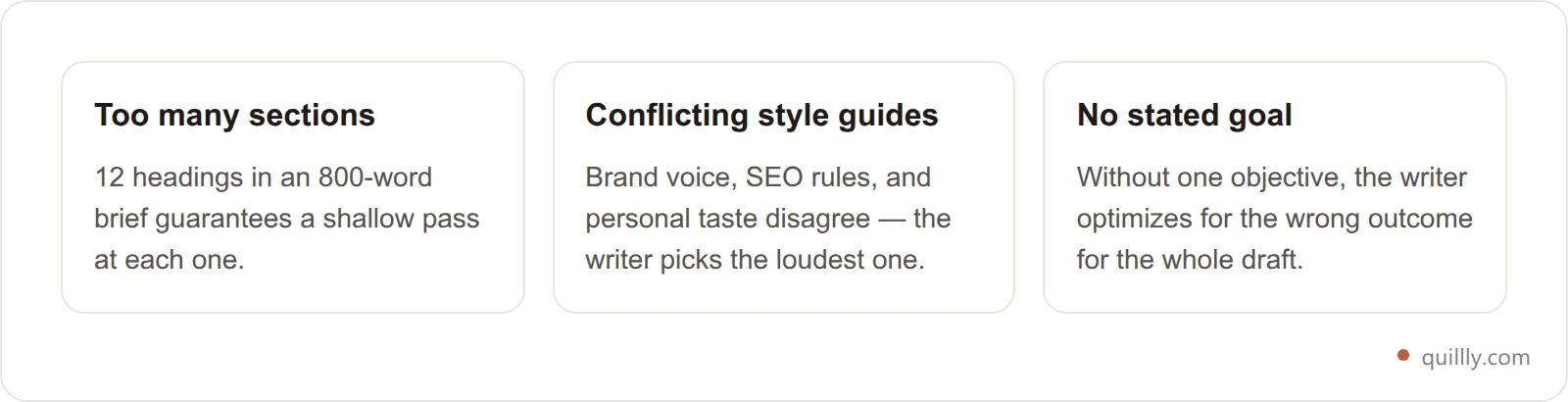
Three patterns explain most of the ignored briefs:
Too many required sections for the word count. Asking for 12 headings in an 800-word brief guarantees a shallow pass at each one.
Multiple, conflicting style guides bolted onto one brief. When brand voice, SEO rules, and a client's personal preferences disagree, the writer picks whichever is loudest and hopes for the best.
No stated goal. Semrush's own content brief guide puts it plainly: a brief that skips the objective increases editing and rewriting, because the writer is optimizing for the wrong outcome the whole time.
The fix isn't a longer brief. It's a brief that states one goal, one intent, and one set of rules — then gets out of the way.
SEO Content Brief vs. Content Brief Generator: Do You Need a Tool?#
A content brief generator automates the research half of this process — pulling ranking keywords, checking the live SERP, and drafting the field list. That's genuinely useful once you're briefing more than a few posts a week. It doesn't replace the judgment call on intent and angle; that still needs a person who's read the top results.
Manual brief | Content brief generator | |
|---|---|---|
Speed | 30-60 minutes of research per post | Minutes — pulls keyword and SERP data automatically |
Consistency | Depends on who's writing it | Same fields, every time |
SEO alignment | As good as the researcher's process | Built from live search data by default |
Judgment on angle | Strong — a person reads the SERP | Weak — still needs a human pass |
Best for | Occasional, high-stakes pieces | Teams publishing regularly |
If you're already publishing through an AI assistant, the more useful move is a generator that hands its output straight to the drafting step, so the brief and the first draft happen in the same session instead of two separate hand-offs. Quillly's free 14-day trial connects to Claude, ChatGPT, or Cursor and starts from exactly this kind of brief.
From Brief to Published Post: Closing the Loop#
The real value of a content brief shows up after the draft exists, not before. A brief without a quality check on the other end just moves the guessing from "what to write" to "is this actually good enough to ship."
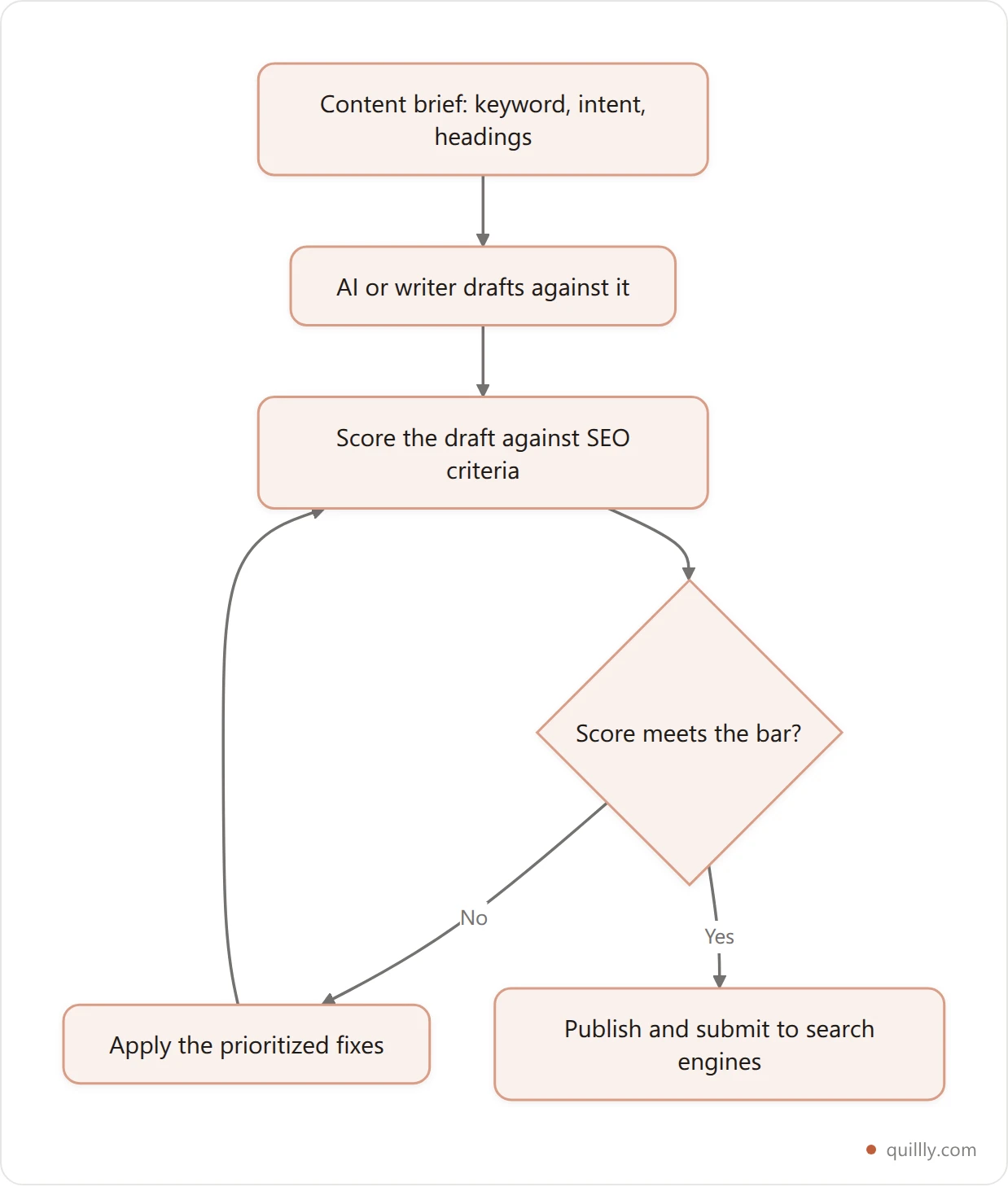
This is the loop we use on our own blog: a brief sets the keyword and headings, Quillly scores the resulting draft against 14 weighted categories — keyword use, meta tags, structure, links, and visual density among them — and returns a prioritized fix list before anything goes live.
That scoring step matters more now that first drafts are often AI-assisted. An Ahrefs study of AI content and rankings found essentially no correlation between AI authorship and ranking position — the quality gate separates a post that ranks from one that doesn't, not who typed the draft.
Frequently Asked Questions#
How long should an SEO content brief be?#
Long enough to cover keyword, intent, headings, links, sources, and the target action — usually one page or a single spreadsheet row. If it takes more than a page to say, most writers will skim past the parts that matter most.
Who should write the brief — the SEO strategist or the writer?#
Whoever has read the live search results for that keyword. That's usually the strategist or editor, since it requires checking what's currently ranking, not just knowing the topic. The writer can absolutely draft their own brief if they do that research first.
What's the difference between a content brief and a content outline?#
A brief defines the target — keyword, intent, format, links, and goal. An outline is the writer's plan for hitting that target, built from the brief. Briefs come first and rarely change mid-draft; outlines are expected to shift as the writing takes shape.
Do you need a brief for every single blog post?#
For anything meant to rank, yes, even a short one. Skipping it on "easy" topics is exactly how keyword cannibalization happens — two posts targeting the same query because nobody checked what already existed before writing the second one.
Can a content brief generator replace a human strategist?#
It replaces the manual research — pulling keywords, checking the SERP, drafting the field list. It doesn't replace the judgment call about which angle beats what's already ranking. Use the generator for speed and still read the top results yourself before finalizing the brief.
How much keyword detail is too much for a brief?#
More than one primary keyword and four or five secondary terms usually backfires — the writer starts stuffing phrases in instead of answering the query naturally. One primary keyword and a short secondary list beats a long one every time.
The Bottom Line#
A content brief is not busywork before the "real" writing starts — it is the writing decision, made once, before anyone opens a blank page. Get the keyword, intent, format, and goal right in the brief, and the draft that follows needs a polish instead of a rewrite.
Start with the template above, run the three research checks before you fill it in, and keep every field specific enough that a writer — human or AI — has nothing left to guess. See how a brief turns into a scored, published post in one AI session.


