
Here's a number that should reset how you think about finding keywords. In the first four months of 2026, 68% of US Google searches ended without a single click, up from 60% in 2024, according to SparkToro's clickstream study. The old game (pick a term with volume, write a page, collect the click) is quietly breaking.
AI keyword research is defined as the practice of finding the questions, entities, and prompts that AI-powered search actually answers, then building content that becomes the answer. It's less about chasing one high-volume term and more about owning a cluster of intent. The tools changed. The goal changed. Most guides ranking today haven't caught up.
This playbook fixes that. You'll get a named framework (the Query Ladder), a free research stack built on your own Search Console and your own AI, copy-paste prompts, and a way to check your work before you publish. No $99-a-month subscription required.
Keyword Research Didn't Die. It Inverted.#
Keyword research still matters in 2026. What changed is the starting signal. For twenty years you started with search volume: find a term thousands of people search, then work backward to content. That model assumed one query led to one page led to one click.
AI search broke that chain. Google's AI Mode passed 1 billion monthly users, and its queries run about three times longer than a classic search. ChatGPT hit 800 million weekly users. These engines don't hand back ten blue links. They read, synthesize, and answer, often without sending a click at all.
So the research flips. Instead of starting with a fat head term, you start with the question a person actually asks an AI. Then you map the entities and follow-up prompts around it. Volume becomes the last thing you check, not the first.
Old keyword research | AI-era keyword research | |
|---|---|---|
Starting signal | Search volume | Intent and questions |
Unit of work | One keyword, one page | One entity, one cluster |
Best data source | Paid keyword database | Your GSC, your AI, the SERP |
Success metric | Ranking position | Citations and entity recall |
Query shape | Short head terms | Long, conversational prompts |
Optimization | Passage-level relevance |
Why Search Volume Became a Vanity Metric#
Search volume is now the most overrated number in SEO. Here's the evidence.
About 93% of keywords in Ahrefs' US database get fewer than 10 searches a month. That's roughly 2.3 billion terms your keyword tool quietly labels "not worth it." Yet that long tail is exactly where conversational AI queries live.
It gets sharper. Kevin Indig's Growth Memo reports that ChatGPT fans a single prompt into two or more follow-up searches on close to 90% of queries, and that around 95% of those fan-out queries have zero classic search volume. Your keyword tool can't show you demand it can't measure.
Meanwhile AI Overviews now appear on roughly a quarter to a half of searches, depending on which tracker you read, and when one shows up it can cut clicks by nearly 60% (SparkToro). Chasing volume optimizes for a shrinking, hyper-competitive slice of search while ignoring the part that's actually growing.

The zero-click line has only bent one direction for a decade. Plan for it.
The Query Ladder: A Framework for AI Keyword Research#
The Query Ladder is a three-rung model for turning a topic into content that AI engines cite. You climb it from the bottom up, and volume never appears on a single rung.
Rung 1, Entity. An entity is the thing you want to be known for: a product, concept, person, or category. "AI keyword research" is an entity. Pick one you can plausibly own, not something as broad as "marketing."
Rung 2, Cluster. A cluster is the set of subtopics that prove you cover the entity in depth. For this entity, that's search intent, keyword clustering, long-tail keywords, query fan-out, and Search Console mining. Each subtopic becomes a supporting post, which is how you build topical authority.
Rung 3, Questions. Questions are the exact phrasings people type or speak. "Can ChatGPT do keyword research?" "Do keywords still matter in 2026?" These map straight to your headings, your FAQ, and the passages an AI lifts into its answer.
Intent, coverage, and specificity climb the ladder. Vanity numbers stay on the ground.

Where to Find Keywords When Volume Tools Go Blind#
Your best keyword tools in 2026 are mostly free, and you already own two of them.
Google Search Console. The single most underused source. It shows the exact queries you already appear for, including long-tail questions no paid tool would suggest. Sort by impressions with low click-through to surface striking-distance keywords.
Your own AI. Claude, ChatGPT, or Cursor will expand a seed into a question cluster in seconds. It won't give you volume, and in 2026 that's fine.
Autocomplete and People Also Ask. Google's own demand signals, straight from the source.
Perplexity and ChatGPT. Ask them about your topic and watch the follow-up questions they generate. That's fan-out you can see.
Reddit, forums, support tickets, sales calls. First-party intent in the exact language your buyers use.
Source | What it gives you | Cost |
|---|---|---|
Google Search Console | Real queries you already rank for | Free |
Your AI (Claude, ChatGPT) | Instant question clusters and intent labels | Free to cheap |
Autocomplete and PAA | Google's live demand signals | Free |
Perplexity and ChatGPT | Visible fan-out follow-up queries | Free |
Reddit, support, sales calls | First-party language and pain points | Free |
Paid tools (Ahrefs, Semrush) | Volume, difficulty, backlinks | $99+/mo |
Notice the pattern. Five of the six sources cost nothing, and the free ones are the ones AI search actually rewards.
How to Run AI Keyword Research With Claude or ChatGPT#
There are three ways to run AI keyword research, and they are not equal.
Mode | How it works | Best for |
|---|---|---|
Bare LLM | Prompt ChatGPT or Claude with no data connection | Brainstorming, clustering, intent labeling |
AI inside an SEO tool | The vendor's AI runs on their keyword database | Volume plus AI in one paid place |
LLM plus your data (MCP) | Your AI reads your live Search Console and site | Grounded, personal, and cheap |
The third mode is where it gets interesting for founders. Connect your AI to your own data through MCP and it stops guessing. It can read your Search Console, see what you already rank for, and cluster from reality instead of stale training data. That is the same plumbing behind a full Search Console AI workflow.
One rule holds across all three modes: never trust volume or difficulty numbers from a bare model. LLMs hallucinate metrics with total confidence. Use them for questions, intent, and clustering. Use real data for numbers.
Here's a prompt you can copy into Claude or ChatGPT right now. Save it. It does most of the Query Ladder for you.
You are my SEO keyword strategist. Topic: [YOUR TOPIC].

1. Name the core entity and 6-8 cluster subtopics I would
   need to cover to build topical authority on it.
2. For each subtopic, list 5 real questions a user would
   ask an AI, phrased in natural language.
3. Label each question by intent: informational,
   commercial, or transactional.
4. Flag which questions an AI Overview or ChatGPT is most
   likely to answer directly.

Return it as a table. No preamble, no fluff.
Run it, paste your Search Console queries underneath, and ask the AI to merge the two lists. Now your cluster is grounded in demand you can prove.
From Keywords to Citations: Optimizing for AI Overviews and ChatGPT#
Finding the questions is half the job. Getting cited is the other half.
Query fan-out is the behavior that matters most here. Mike King of iPullRank describes it plainly: "They have this idea that they call query fan-out where effectively they're doing query expansion based on what the user put in." One prompt becomes many hidden sub-queries. To get pulled into the answer, your content has to satisfy the whole fan, not one exact-match term. It's worth understanding how query fan-out works before you map a single cluster.
Three moves make your research citable:
Answer at the passage level. AI engines retrieve chunks, not whole pages. Lead each section with a direct, quotable answer in the first sentence.
Cover the entity, not the term. Amanda Natividad of SparkToro puts the goal bluntly: "Your goal is to become a named entity, not get a bunch of pages to rank."
Match the exact question. Put the user's real wording in a heading or FAQ, then answer it in 40 to 60 words.
This is answer engine optimization, and it's downstream of good keyword research, not a separate discipline. Your keywords tell you which answers to write. If you want the full method, see the answer engine optimization playbook.

If most of your AI-referral traffic comes from ChatGPT, research the questions its users actually ask.
A Worked Example: From Head Term to Cited Answer#
Here's the shift in practice. Say you sell invoicing software. This is an illustrative walkthrough, but the math is real.
The old approach targets "invoicing software," a head term with roughly 40,000 monthly searches and a keyword difficulty near 90. You'd never rank against Intuit and FreshBooks. And even if you sneaked onto page one, an AI Overview would likely eat the click before anyone saw you.
The Query Ladder approach starts one rung down. The entity is "freelance invoicing." The cluster covers late payments, tax, international clients, and recurring billing. The questions, harvested from Search Console and ChatGPT fan-out, sound like real people: "How do I chase a late invoice politely?" and "Do I charge tax on international invoices?"
Those questions have low or no measured volume. They also have almost no competition and near-perfect intent. Answer them at the passage level and you become the source an AI cites when someone asks, in whatever words they choose, how to get paid on time.
Head-term play | Query Ladder play | |
|---|---|---|
Target | "invoicing software" | "how to chase a late invoice" |
Volume | ~40,000/mo | Low or unmeasured |
Difficulty | ~90, brutal | Low |
Intent match | Broad | Exact |
Realistic outcome | Buried on page 5 | Cited in the answer |
The head term looks better in a spreadsheet. The ladder wins in the results.
Close the Loop: Research, Write, Score, Publish#
Keyword research only pays off if it survives all the way to a published page. The gap where most AI content dies is between the draft and the domain.
A clean loop looks like this. Pull your real queries from Search Console. Let your AI cluster them into a Query Ladder. Turn the winning question into a blog outline template that budgets headings, visuals and CTAs before a word is written. Draft the post. Then check that you actually used the primary keyword where it counts (the title, the first 150 words, at least one H2, and at a natural 0.5 to 2.5% density) before it goes live.
That last check is easy to skip and expensive to miss. It's also where a tool like Quillly fits. Its keyword-optimization check is the single highest-weighted of its 14 SEO criteria, and it flags a missing keyword in your title or headings before you publish. The Search Console integration surfaces the exact queries worth targeting next, so your research and your scoring run on the same data. Your AI writes; the score confirms the research made it into the page. You can see how the full SEO score is calculated if you want the breakdown.
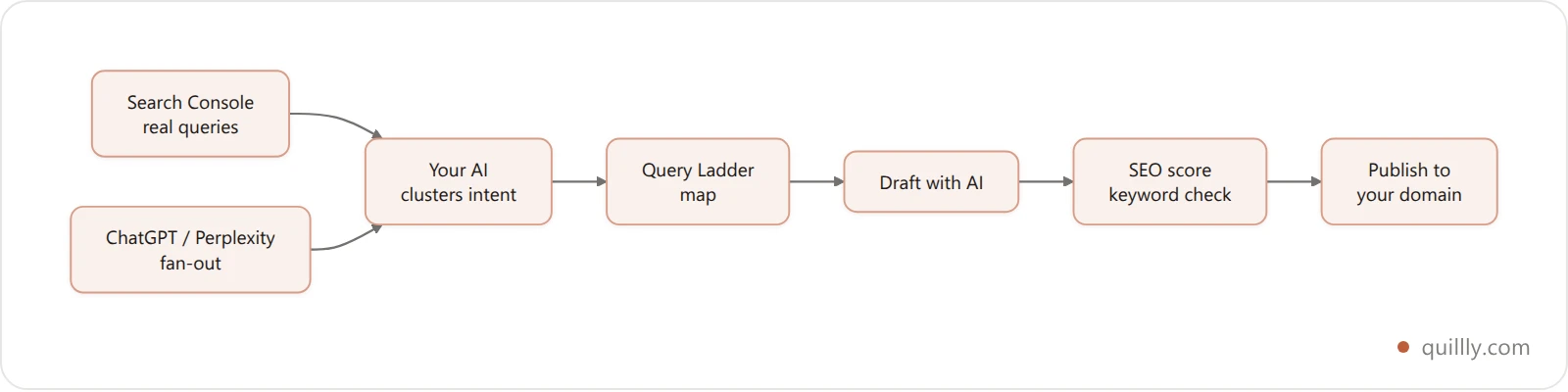
The point of the loop is speed without sloppiness. Research grounded in real demand, drafted by the AI you already use, scored against 14 criteria, and pushed live on your own domain with no copy-paste in the middle.
Keyword Mapping: Turn the Ladder Into a Content Plan#
A Query Ladder is a research output. Keyword mapping is what turns it into a calendar. Keyword mapping means assigning each cluster and question to a specific URL, so no two pages chase the same intent.
Do this and two problems disappear. First, you stop writing four thin posts about the same question, which is how keyword cannibalization starts. Second, you get a visible map of your topical coverage, so gaps are obvious before a competitor fills them.
The simplest map is a spreadsheet with four columns: entity, cluster subtopic, target question, and the URL that owns it. Your AI can draft the first version from the prompt you saved earlier. One entity usually becomes one pillar page plus six to ten supporting posts, each answering a distinct question. Give each post a title that states its question directly, because titles that answer questions get cited far more often than clever ones.
Map once, and every future post has a home before you write a word.
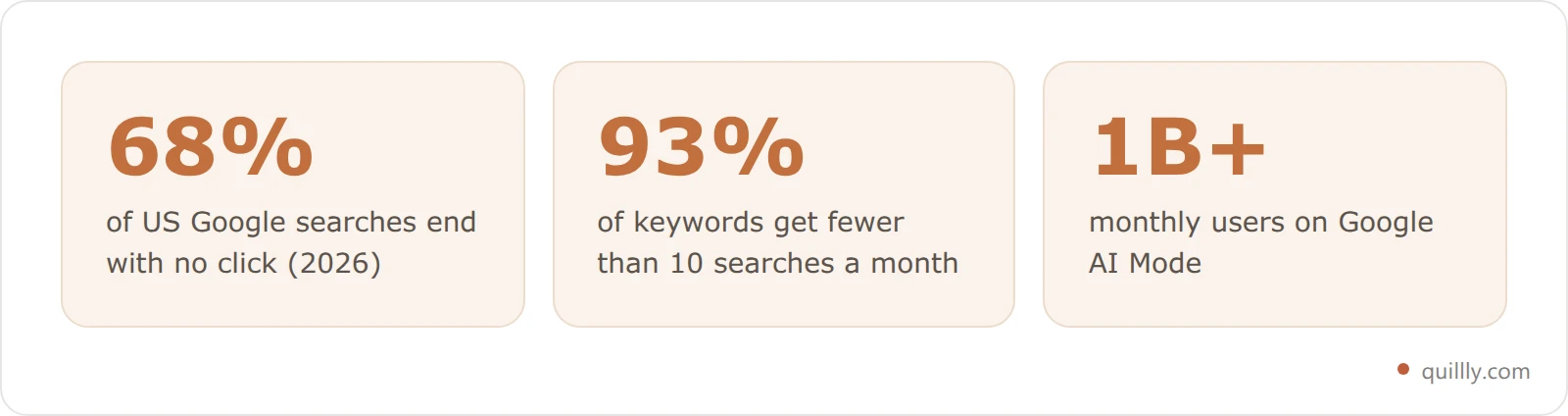
The demand didn't disappear. It moved somewhere your volume tool can't see.
Frequently Asked Questions#
Is keyword research still relevant in 2026?#
Yes, more than ever, but the method changed. You still need to know what people search for. What's different is that you research questions, entities, and AI prompts instead of starting from high-volume head terms. With 68% of searches now ending without a click, the goal shifted from winning the click to becoming the answer an engine cites.
Can ChatGPT do keyword research?#
ChatGPT is excellent at part of the job and useless at another part. It expands seeds into question clusters, labels search intent, and drafts a keyword map in seconds. It cannot give you accurate search volume or keyword difficulty, and it will invent numbers if you ask. Use it for ideas and structure. Use Search Console or a paid tool for hard metrics.
Does ChatGPT give search volume or keyword difficulty?#
No, and you should never trust it if it offers them. A bare language model has no live access to Google's search data, so any volume or difficulty figure it produces is a guess dressed up as a fact. Pull real numbers from Google Search Console, Google Keyword Planner, or a database tool like Ahrefs or Semrush instead.
What is the best free AI keyword research tool?#
The best free stack is the one you already own: Google Search Console for real queries, plus your own AI (Claude, ChatGPT, or Cursor) for clustering and intent. Add Google autocomplete, People Also Ask, and Perplexity to see live fan-out questions. Together they cover most of what a $99-a-month subscription does for a solo founder.
How do I find keywords for AI Overviews and ChatGPT?#
Start with the questions these engines answer. Type your topic into ChatGPT or Perplexity and note the follow-up queries they generate, since that's query fan-out you can watch happen. Cross-reference with the questions in your Search Console data. Then answer each one at the passage level, in your headings and FAQ, in the exact words people use.
Are zero-volume long-tail keywords worth targeting?#
Often, yes. Around 93% of keywords get fewer than 10 searches a month, and the fastest-growing conversational AI queries have no measured volume at all. A zero-volume question with clear intent and no competition is frequently a better bet than a head term you can't rank for. Target them in clusters, not one at a time.
How is keyword research different in the AI era?#
The starting signal inverted. Old research began with volume and worked toward content. AI-era research begins with intent and questions, then checks volume last, if at all. The unit of work grew from a single keyword to an entity cluster, and success is measured in citations and entity recall, not just ranking position.
Do keywords still matter for SEO in 2026?#
Keywords still matter as signals of intent and topic, but exact-match keyword density thinking is dead. AI search retrieves passages and reasons over entities, so cramming a phrase in at a target density does nothing. What matters is covering the entity thoroughly and answering the real questions around it in natural language.
The Takeaway#
Keyword research didn't die in 2026. It inverted. Three things to remember. First, search volume is now a lagging signal, not a starting one, because 93% of keywords get under 10 searches a month and the fastest-growing AI queries have no volume at all. Second, your best research tools are free: your Search Console and your own AI beat a $99 subscription for most founders. Third, the goal moved from ranking a page to becoming the answer an engine cites, which is why 68% of searches now end without a click.
Build your Query Ladder, map it to your content, and check that the keyword actually landed in the page before you ship. When the ladder spits out hundreds of near-identical long-tail variants, that's a programmatic SEO job, not a writing one — and worth knowing what programmatic SEO tools actually automate before you buy one. Want your AI to publish the post it just researched? Connect Quillly to Claude, ChatGPT, or Cursor in 30 seconds.
What to Read Next#
Gemini SEO: how to get cited by Gemini in 2026 — keyword research stops where prompt research starts.
Grok SEO: how to get cited by Grok in 2026 — a very different query distribution to plan for.
Content distribution automation for AI blogs — what to do with the keywords once you've picked them.
MarketMuse alternatives: 7 tools with public pricing — if you'd rather buy the research and briefing step than run it yourself, this prices the whole field, including the tools that won't tell you what they cost.
Examples of a blog post: 7 formats with real data — once the Query Ladder tells you which questions to answer, this shows which post shape to answer them in, with the impressions and positions each shape actually earned.
AI SEO agent: the 5 rungs of real autonomy — research is only the first rung of a much longer loop. This maps how far each tool actually goes before it hands the work back to you.
Research is only the first layer of the job. AI based SEO tools: who does the work sorts the wider category into advice, draft and execution tiers — useful context for deciding whether your next purchase should research keywords, write the post, or publish it for you. And if the question is whether to buy the whole job rather than a tool, AI SEO services: what you're actually paying for covers how to make a vendor state the keyword difficulty ceiling that fits your domain before you sign anything.