Open any "best AI SEO tools" roundup and read to tool number six. You'll notice they all end the same way: the tool finds a problem, scores it, color-codes it into a dashboard — and hands it straight back to you. The diagnosis is automated. The work isn't.
The short version: AI based SEO tools sort into three layers by how much work they actually remove. Advice tools diagnose and stop. Draft tools write copy you still paste in by hand. Execution tools connect to your site and ship the change themselves. Most of the market sits in layer one, which is why so many of these reviews read the same.
That one distinction predicts your real cost better than any feature table. Two products can both claim "AI-powered optimization" and differ by three hours of your week. Here's how to tell them apart before you pay.
The Three Layers of AI Based SEO Tools#
Sort by a single question: after the AI finishes thinking, who moves the bytes?
Layer | What the AI produces | What you still do | Where time goes |
|---|---|---|---|
1. Advice | Audits, scores, keyword lists, briefs | Interpret, write, edit, publish | Reading reports |
2. Draft | Finished paragraphs and posts | Format, paste into CMS, publish, track | Copy-paste and cleanup |
3. Execution | The published page itself | Review and approve | Approving |
Layer one is the most crowded because it's the easiest to build — you need a crawler and an API. Layer three is rare because it requires write access to somebody's live website, which is a trust problem long before it's an engineering problem.
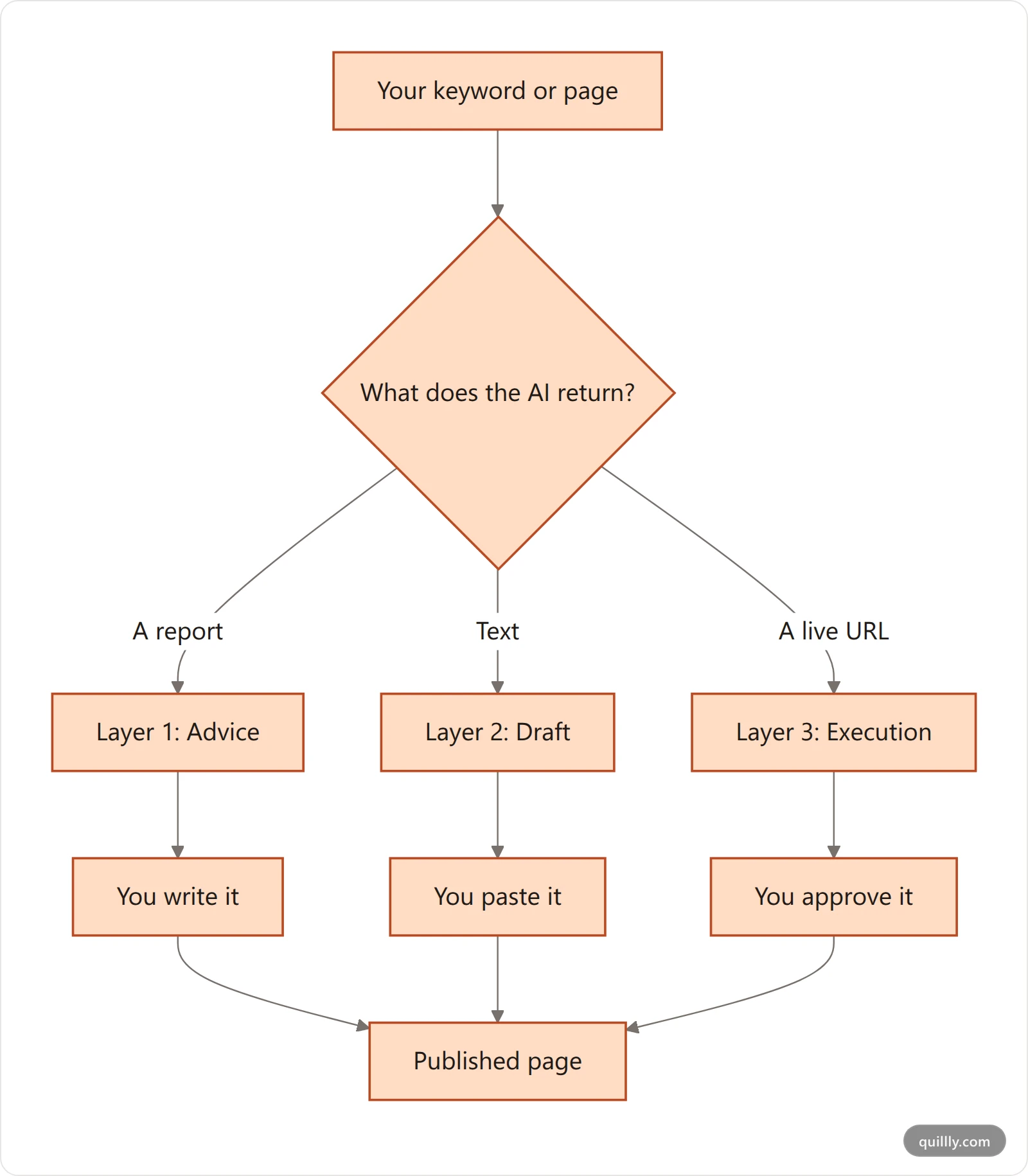
Nothing here says layer three is always correct. A solo consultant auditing client sites wants layer one and nothing else. The mistake is paying layer-three prices for layer-one output, or assuming a tool does more than read because the marketing page says "automated."
Layer 1: Advice Tools Diagnose, Then Stop#
This is the classic SEO platform with a model bolted on. It crawls your site, clusters keywords, flags thin pages, and generates a content brief. The AI mostly summarizes data you could already see, faster and in better prose.
They earn their price when the diagnosis is genuinely hard — competitive gap analysis across thousands of URLs, log-file patterns, or spotting a canonical problem buried three templates deep. Google's own helpful content guidance is a reminder of what these reports can't tell you: whether the page is actually worth reading.
Where they disappoint is the last mile. A 40-item audit is a to-do list, not a fix. If you've ever exported an audit to a spreadsheet and never opened it again, you've felt the gap. We wrote up the same problem from the other direction in our on-page SEO audit walkthrough — the findings are easy, the follow-through is where sites stall.
Buy layer one when: you have writers and developers who act on reports, and the bottleneck is knowing what to fix.
Layer 2: Draft Tools Write, You Still Paste#
Layer two is where most AI SEO tools moved in 2024 and 2025. Give it a keyword, get back 1,800 words with headings, an intro, and a FAQ. The quality is genuinely good now — good enough that the writing stopped being the bottleneck.
The bottleneck moved downstream. The draft arrives as text in a chat window or an editor, and someone has to reformat it, add the internal links, find an image, write the meta description, put it in the CMS, and publish. Then check it rendered. Then submit it for indexing.
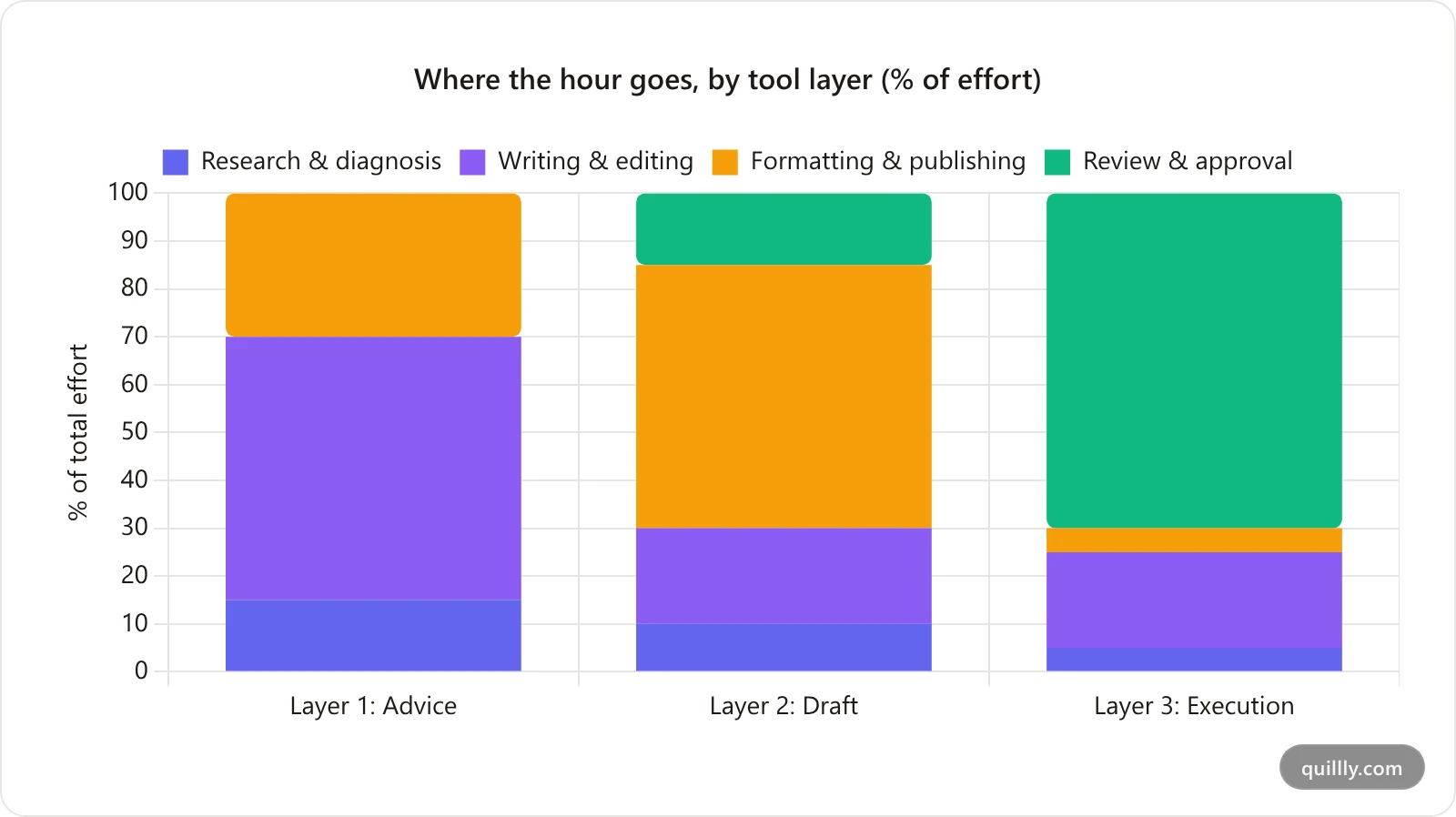
That's the honest trade: layer two deletes the blank page and leaves everything after it. If you publish once a month, that's fine. If you publish weekly, the paste step becomes the job. Our comparison of Surfer SEO alternatives covers this tier in depth, and the pattern holds across nearly all of them.
Layer 3: Execution Tools Publish and Measure#
Layer three tools hold credentials for your site and complete the loop. The AI doesn't hand you a draft — it creates the page, scores it, publishes it to your domain, notifies search engines, and reports back what happened.
The technical shift that made this practical is the Model Context Protocol, an open standard introduced by Anthropic for connecting assistants to external systems. Before MCP, "AI SEO software" meant a vendor's model inside a vendor's editor. With it, the assistant you already use can call real publishing tools directly.
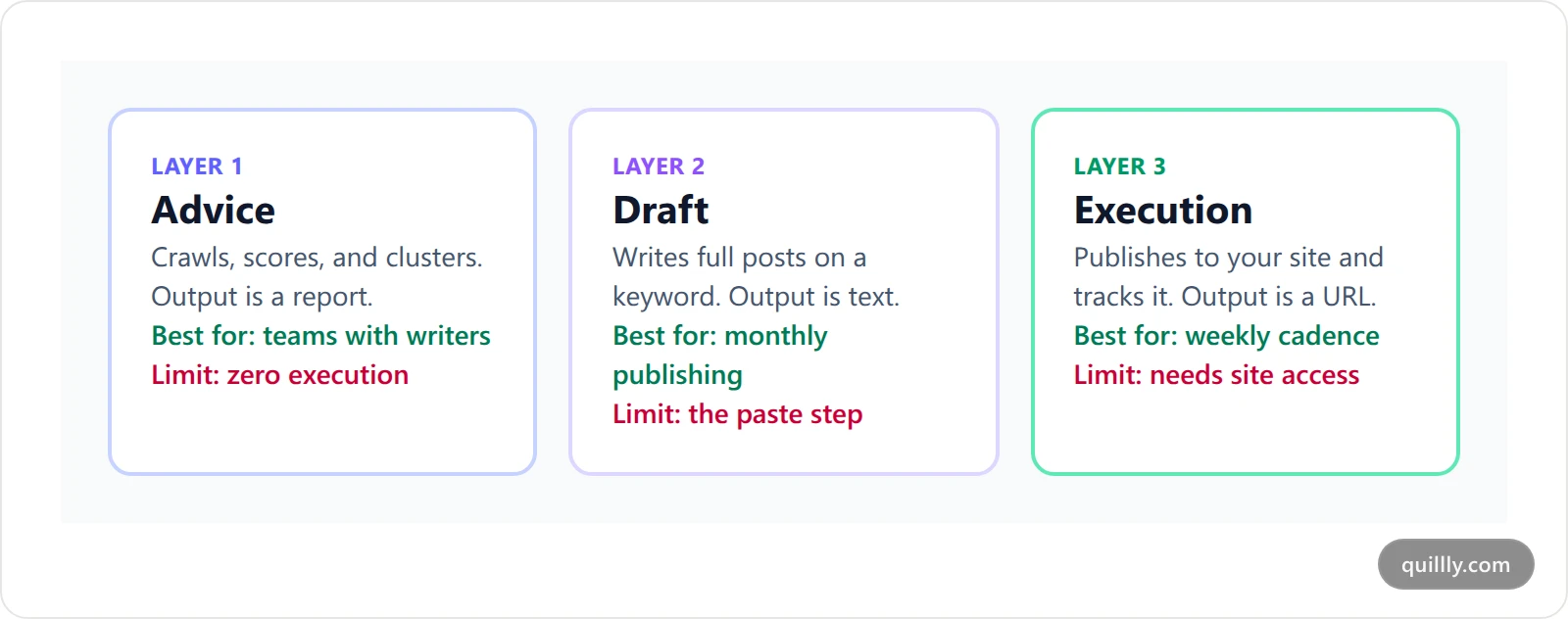
Quillly is built at this layer. You connect it once, and your assistant gets real tools: create a post, score it against 14+ SEO criteria, publish it to your own domain or push it into WordPress, Ghost, Webflow or Shopify, then read back rankings, impressions and indexing coverage. Posts go to Google through your sitemap and RSS feed in Search Console, and to the IndexNow network — Bing, Yandex, Naver, Seznam, Yep and more — for the engines that accept instant notification.
See how an AI assistant publishes straight to your domain
The Copy-Paste Tax Nobody Prices In#
Every tool review compares monthly subscription costs. None of them price the step between the draft and the live URL.
Run the arithmetic on your own process. Time one post end to end, starting the moment the draft is finished: formatting, internal links, image, meta description, CMS entry, preview, publish, indexing submission. For most people it lands somewhere between 20 and 45 minutes. At four posts a month, that's a workday a quarter spent on clerical work no reader ever sees.
We measure this on our own site. Quillly's blog runs the layer-three loop end to end — 154 posts live, 33 of them published in the last 30 days, every one scored before it shipped. The step that capped output was never the drafting. It was everything between a finished draft and a live, submitted URL.
That tax is invisible because it's split across small tasks that each feel trivial. It's also the only cost that scales linearly with output — better AI writing makes the draft cheaper and does nothing to the paste. This is exactly why a tool's layer matters more than its feature list: layer one and layer two both leave the tax fully intact.
How to Pick a Layer for Your Stack#
Pick by bottleneck, not by brand. If you don't know what to fix, buy advice. If you know but can't produce the words, buy drafting. If you know and can write, but finished posts pile up unpublished, buy execution. The layer that removes your slowest step is the one worth paying for.
Don't start from a shortlist. Start from where your process actually breaks.
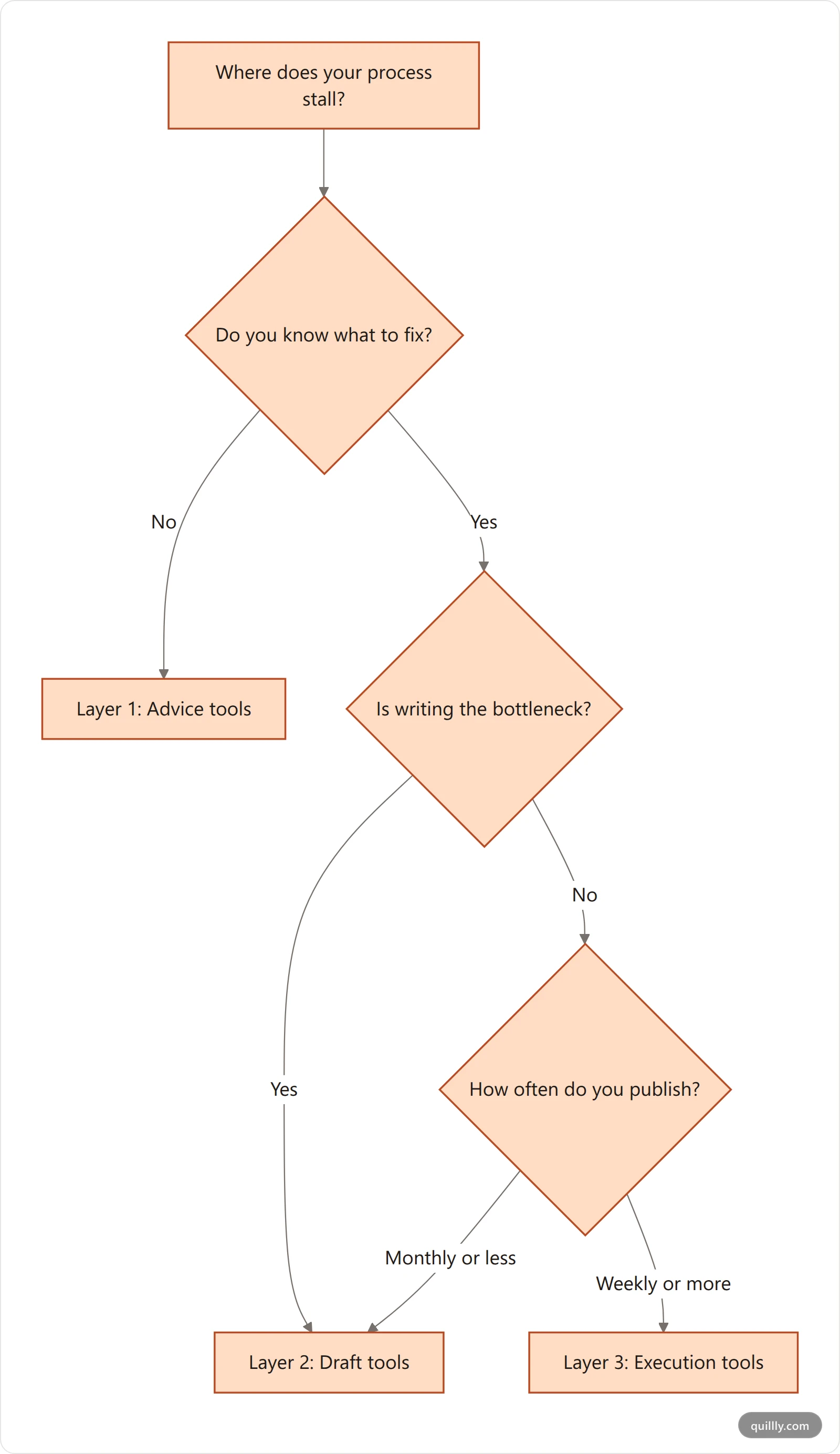
Three practical checks before you commit to any AI driven SEO tools purchase:
Ask what the output is. A report, a text file, or a URL. Vendors answer this in one sentence when asked directly, and the answer rarely matches the homepage headline.
Check whether it writes to your site. If it can't authenticate to your CMS or serve your pages, it cannot be layer three, whatever the marketing says.
Check what it reads back. Publishing without measurement is just faster guessing. You want rankings, impressions and indexing status returning to the same place that shipped the page — the argument we make in full in our guide to AI-powered blog SEO.
Layers also stack. Plenty of teams run an advice tool for quarterly audits and an execution tool for the weekly cadence, and that's a reasonable stack — as long as you're not paying twice for the same diagnosis.
What AI Driven SEO Tools Still Can't Do#
The ceiling is real. AI driven SEO tools can't build authority, can't force an engine to index a page, can't supply expertise the model never had, and can't rescue a bad strategy. They change how fast you execute, not whether the plan was right. Being fair about that matters more than the pitch.
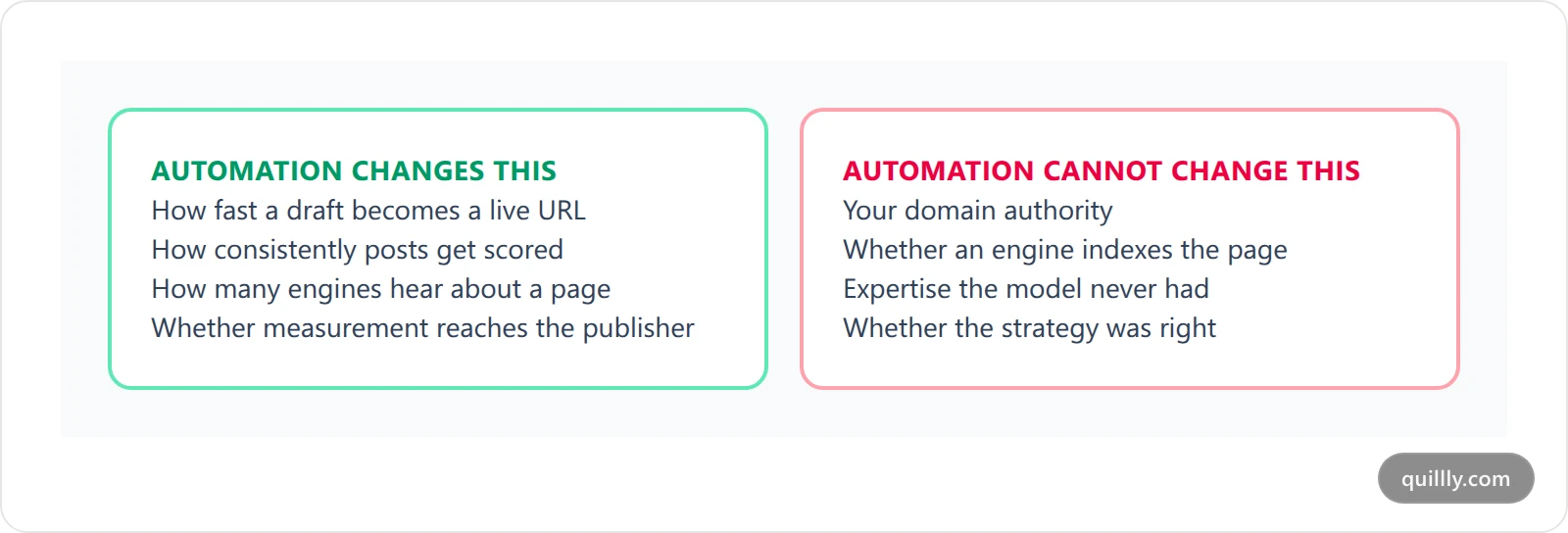
They can't manufacture authority. No tool moves your Domain Rating by writing faster. Links come from things worth linking to, and that's still a human problem.
They can't guarantee indexing. Notification is not acceptance. You can submit a URL to every engine on earth and still watch Google leave it as "Discovered – currently not indexed" for weeks. Engines decide; sitemaps only inform.
They can't replace subject expertise. A model writing about a field it has no data on produces confident, average text. The posts that rank carry something the training data didn't have — your numbers, your screenshots, your failures.
They can't fix a strategy problem. Publishing four mediocre posts a week faster is still publishing four mediocre posts a week. Picking winnable targets comes first, which is why keyword research stays upstream of any tooling decision. Moz's beginner's guide is still the clearest primer on those fundamentals.
Automation compounds a good strategy and accelerates a bad one. The layer you buy changes your throughput, not your judgment.
Score a post against 14+ SEO criteria before it ships
Key Takeaways#
AI based SEO tools split into three layers: advice (a report), draft (text), execution (a live URL).
Most of the category is layer one, which is why roundups feel interchangeable.
The copy-paste tax between draft and published page is the cost nobody quotes, and it's the only one that scales with output.
Pick your layer from where your process stalls, not from a shortlist.
No layer buys authority, guarantees indexing, or replaces expertise.
Match the layer to the bottleneck and the shortlist writes itself.
Connect your domain and let your assistant publish
Frequently Asked Questions#
What are AI based SEO tools?#
They're tools that apply language models to search optimization work — auditing pages, researching keywords, drafting content, or publishing it. They differ mainly in how far they go: some stop at a report, some produce text, and some connect to your website and publish the finished page themselves.
Are AI SEO tools against Google's guidelines?#
No. Google evaluates whether content is helpful and original, not how it was produced. Automation used to mass-produce thin pages violates its spam policies, but using AI seo software to research, draft and publish genuinely useful pages is entirely within the rules.
What's the difference between AI driven SEO tools and regular SEO software?#
Regular SEO software reports data — rankings, backlinks, crawl errors — and leaves interpretation to you. AI driven SEO tools add a model that interprets that data, and at the execution layer, acts on it by writing and shipping the change rather than describing it.
Can an AI SEO tool publish directly to my website?#
Only execution-layer tools can. That requires authenticated write access to your CMS or a way to serve pages on your domain. Quillly does this through the Model Context Protocol, so the assistant you already use can create, score and publish content on your own domain.
Do I still need a human editor?#
Yes. The model handles structure, formatting and consistency well, and it can't verify a claim it invented. Someone has to check the facts, add first-hand detail, and decide the page is worth publishing — which is the part that determines whether it ranks.
How many AI SEO tools should I actually run?#
Usually one per layer at most, and often just one total. Overlapping tools mostly duplicate diagnosis, which is the cheapest part of the pipeline. Start with the layer where your process stalls and add a second only when you can name what it does that the first doesn't.