

Our four best-performing pages have earned 2,143 search impressions between them, and between them they have earned zero clicks — a flawless record of being seen by a search engine and chosen by nobody.
That is not a hypothetical. It is this website's dashboard as of 8 September 2026 — 149 published pages, a Domain Rating of 16, and a top performer sitting at average position 23. Every number in this guide comes from that same dashboard, including the embarrassing ones.
An SEO content strategy is a standing set of rules for deciding what you publish, in what order, and when you stop. It is not a calendar and not a keyword list. On a low-authority site it reduces to four decisions taken in a fixed order — can the query be won, can your authority hold it, what format does the result page reward, and can your pages get indexed at all — where getting the order wrong wastes everything downstream.
Most strategy guides are written by sites with a Domain Rating above 300. This one is written from the other side of that gap.
What's in this guide
What an SEO content strategy actually decides#
An SEO content strategy decides four things: which queries you are allowed to target, what difficulty your domain can currently hold, which format each result page rewards, and how fast you can publish without outrunning your own indexing. Calendars, briefs and word counts are execution downstream of those four.
Strip away the templates and this content strategy framework answers four questions, and only four:
Winnability — is there a seat in the top 10 that a site like yours can take?
Authority fit — is the difficulty inside what your domain can currently hold?
Format — does this query want a guide, a listicle, a comparison, or a product page?
Throughput — how many pages can you publish and still get them indexed?
The order is the strategy. Question 4 gates questions 1–3, because a page that never enters the index cannot rank however good the keyword was. That inversion is the single most useful thing 149 posts taught us, and it is the opposite of how most editorial calendars are built.
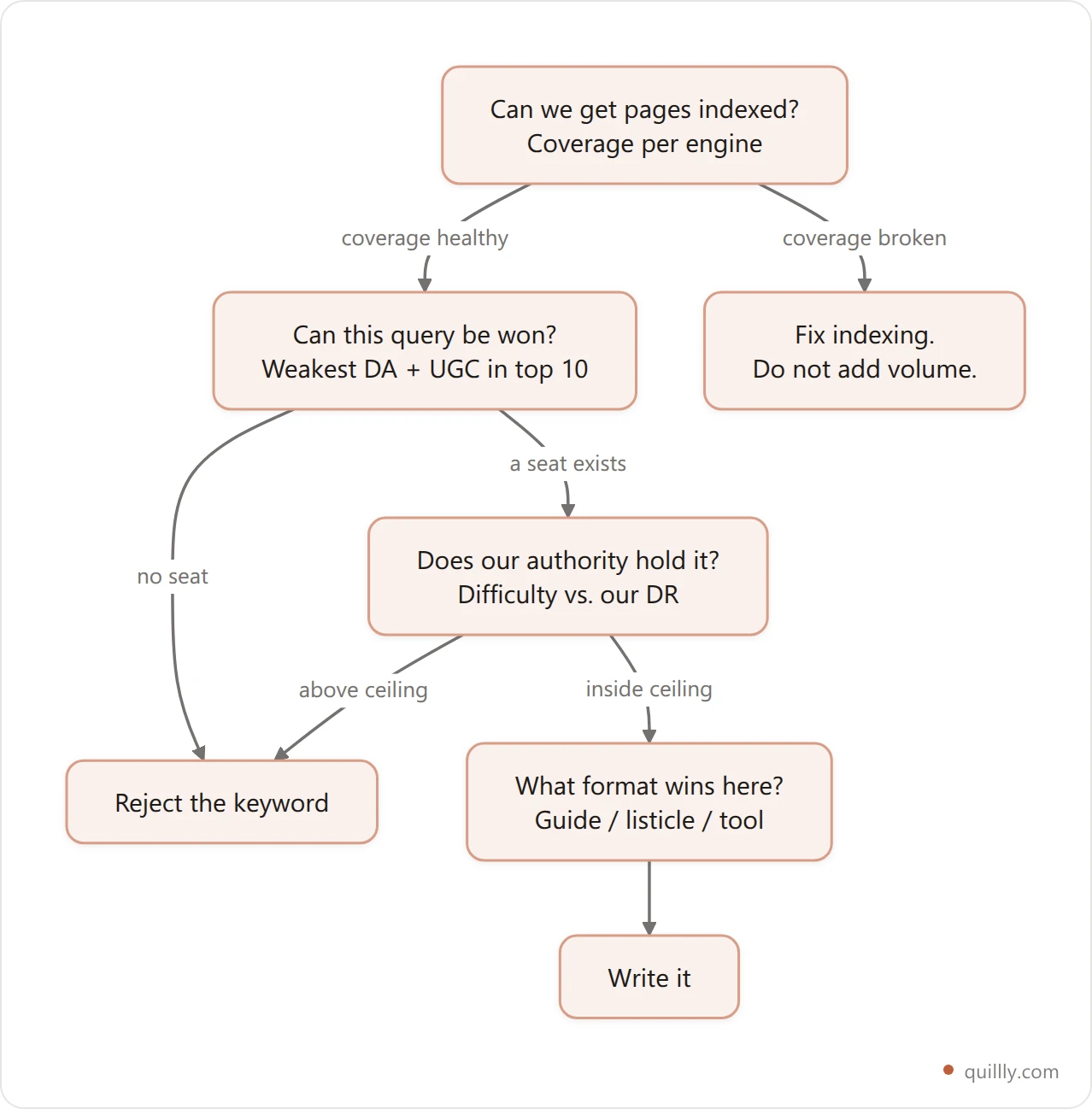
Google's own SEO Starter Guide makes the same point in gentler language: being crawlable and indexable comes before anything you do with words. The starter guide just doesn't tell you what to do when 47% of your library isn't indexed.
Decision 1: the rejection rule that saves the most time#
The highest-leverage part of a content strategy is not the ideas you add. It's the rule that throws them out.
Ours is a single line: before writing, pull the live top 10 and read two numbers — the weakest domain authority in it, and how many results are user-generated (Reddit, forums, Q&A). A weak seat means somebody small already ranks. A user-generated result means Google has not found a definitive answer and is filling the gap with a discussion thread. Either one is an opening. Neither one is guessable from keyword difficulty.
Here is every keyword we ran that check on recently, sorted by search volume:
Keyword | Volume/mo | Difficulty | Weakest DA in top 10 | UGC results | SERP format | Call |
|---|---|---|---|---|---|---|
content calendar template | 2,900 | 9 | 240 | 1 | tool | Reject |
seo content strategy | 720 | 16 | 322 | 2 | guide | Pass (thin) |
seo report template | 590 | 11 | 228 | 0 | tool | Reject |
seo automation tools | 480 | 12 | 172 | 0 | tool | Reject |
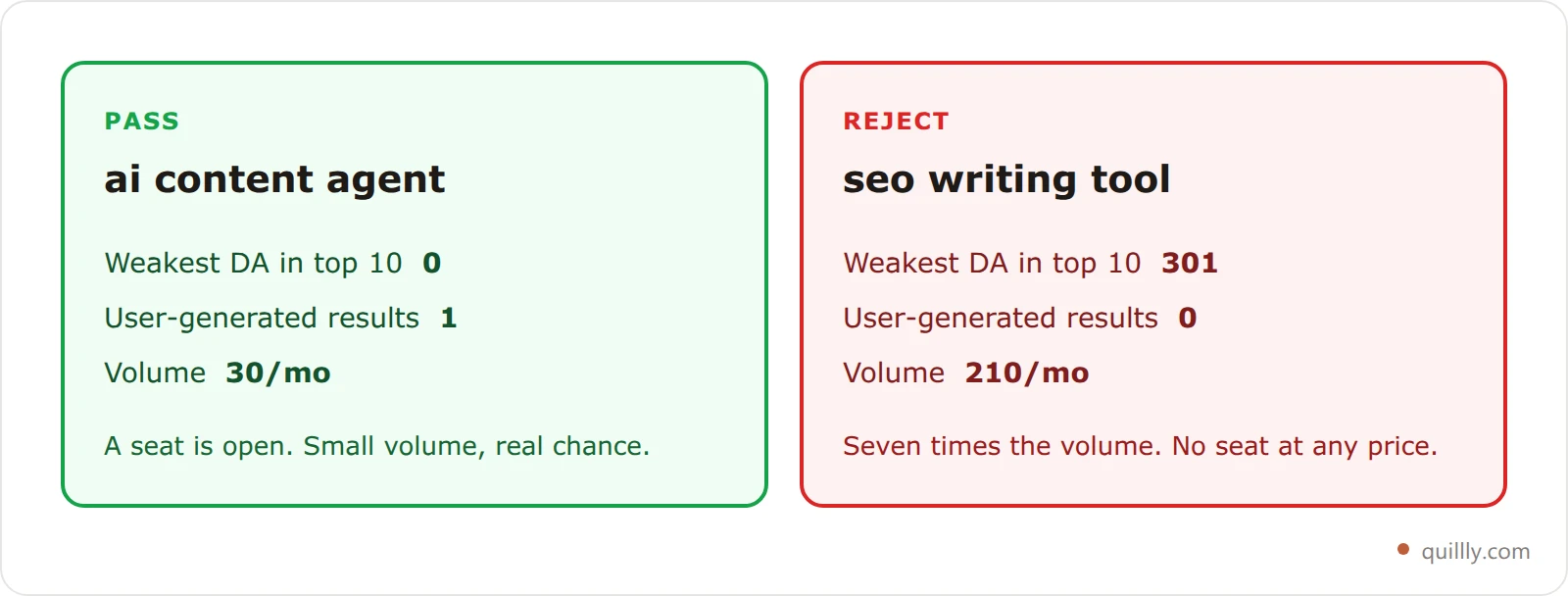
seo writing tool | 210 | 27 | 301 | 0 | tool | Reject |
blog ideas generator | 170 | 17 | 147 | 0 | tool | Reject |
ai content agent | 30 | 0 | 0 | 1 | listicle | Pass |
Read that table top to bottom and the strategy writes itself. Five of seven rejected. The two clean passes are the two smallest keywords on the list. A 2,900/mo keyword with a difficulty score of 9 looks like the obvious pick and is unwinnable; a 30/mo keyword with a competitor sitting at DA 0 in position 10 is the one that pays. That bottom row became a real post — our AI content agent guide — precisely because the gate said yes when the volume said no.
Keyword difficulty scores did not predict a single one of these calls. "Content calendar template" scores a 9 out of 100 and is guarded by Notion, Canva, Airtable and Adobe. "SEO writing tool" scores 27 and its weakest occupant is a DA-301 domain. Difficulty models the average query. Your specific query has actual companies sitting in it.
If you want the mechanics of finding these queries rather than judging them, we walk through the sourcing side in AI keyword research: the 2026 playbook. Or run the gate against your own shortlist and see how many survive it.
Decision 2: set a difficulty ceiling and let it reject things#
A keyword difficulty ceiling is the number above which you simply do not write, regardless of how attractive the keyword looks. Ours is 30, derived from a Domain Rating of 16.
The ceiling matters because it survives your enthusiasm. Every high-volume keyword makes a good case for itself in the moment. A stored number does not care. It is worth writing the ceiling down somewhere your process reads it automatically, rather than keeping it as a resolution — resolutions lose arguments with a 2,900/mo keyword.
Raising the ceiling is a decision about authority, not content. If you want to write harder queries, the lever is off-site: links, mentions, directory presence. We cover that path in how to increase domain rating. Until the number moves, writing above your ceiling is a way of producing pages that get indexed and then sit at position 40 forever.
Decision 3: write the format the result page is already rewarding#
The most expensive mistake in the table above isn't authority. It's format.
Look at the SERP format column: five of the six rejects are marked tool. Those queries — "seo report template", "seo automation tools", "blog ideas generator" — return free calculators, template galleries and product pages, not articles. You can write the best 3,000-word guide on earth for "blog ideas generator" and Google will keep showing ten tools, because ten tools is what people clicked.
This is where a lot of content strategies quietly fail. They pick a keyword on volume and difficulty, both of which look fine, and never check what kind of thing ranks. The tell is in the query itself: words like generator, checker, calculator, template and software resolve to product result pages far more often than to prose. Verify before you commit, not after.
The corollary is uncomfortable but useful: if a query wants a tool, the strategic answer is to build the tool. Which brings us to the most surprising number in our own data.
The uncomfortable finding: our top pages aren't posts#
We publish blog posts. Our four biggest impression earners are not blog posts.
/tools/seo-checker— 751 impressions/tools/word-counter— 584 impressions/tools/color-picker— 507 impressions/tools/character-counter— 301 impressions
Four free utility pages, 2,143 impressions, out-earning a library of 149 articles. Google put them on tool-shaped result pages because they are tools. That is decision 3 working in reverse — the pages that match format win, and format matched by accident here rather than by plan.
And yet all four have zero clicks. Here is why:

Three of the four sit at position 21 or worse — page three of the results, where impressions accumulate and clicks do not. Impressions are not a success metric. They are a measurement that you are visible enough to be counted and not visible enough to be chosen. The strategic response is to push existing near-miss pages up rather than add new ones, which is exactly what a striking distance keywords pass is for.
Decision 4: let indexing coverage set your publishing cadence#
This is the decision most calendars skip entirely, and it is the one that caps everything else.
We published 24 posts in the last 30 days. Here is what the engines actually did with the 143 pages they were offered:

Google has indexed 76 of 143 pages. Bing has indexed 29 — a fifth. Yandex has indexed 130.
The spread is the finding. The same pages, the same sitemap, the same submission pipeline, and a 71-point gap between the best and worst engine. We isolated that pattern across 284 URLs in crawled currently not indexed, where Google declined pages it had already crawled while Yandex accepted the same URLs over the same window. That rules out content quality as the explanation and points at engine-specific acceptance, which is a very different problem from "write better posts."
The strategic consequence is a hard cap: when your indexed share is under 70%, adding posts multiplies nothing. Each new page joins a queue that is already rejecting four out of five arrivals on Bing. The correct move is to stop scaling and repair — consolidate thin pages, strengthen internal links into unindexed ones, and re-submit. Google documents the diagnosis side in its Page Indexing report, and the IndexNow protocol covers the push side for Bing, Yandex and the rest.
Publishing cadence, in other words, should be an output of your coverage data rather than an input to your plan. We wrote up the frequency question separately in how often to publish blog posts, and the per-engine differences in multi-engine SEO.
Want the coverage number for your own site without building the pipeline? Connect your domain and read it from one dashboard.
The weekly loop this reduces to#
A strategy you cannot run every week is a document, not a strategy. Ours fits in one loop:
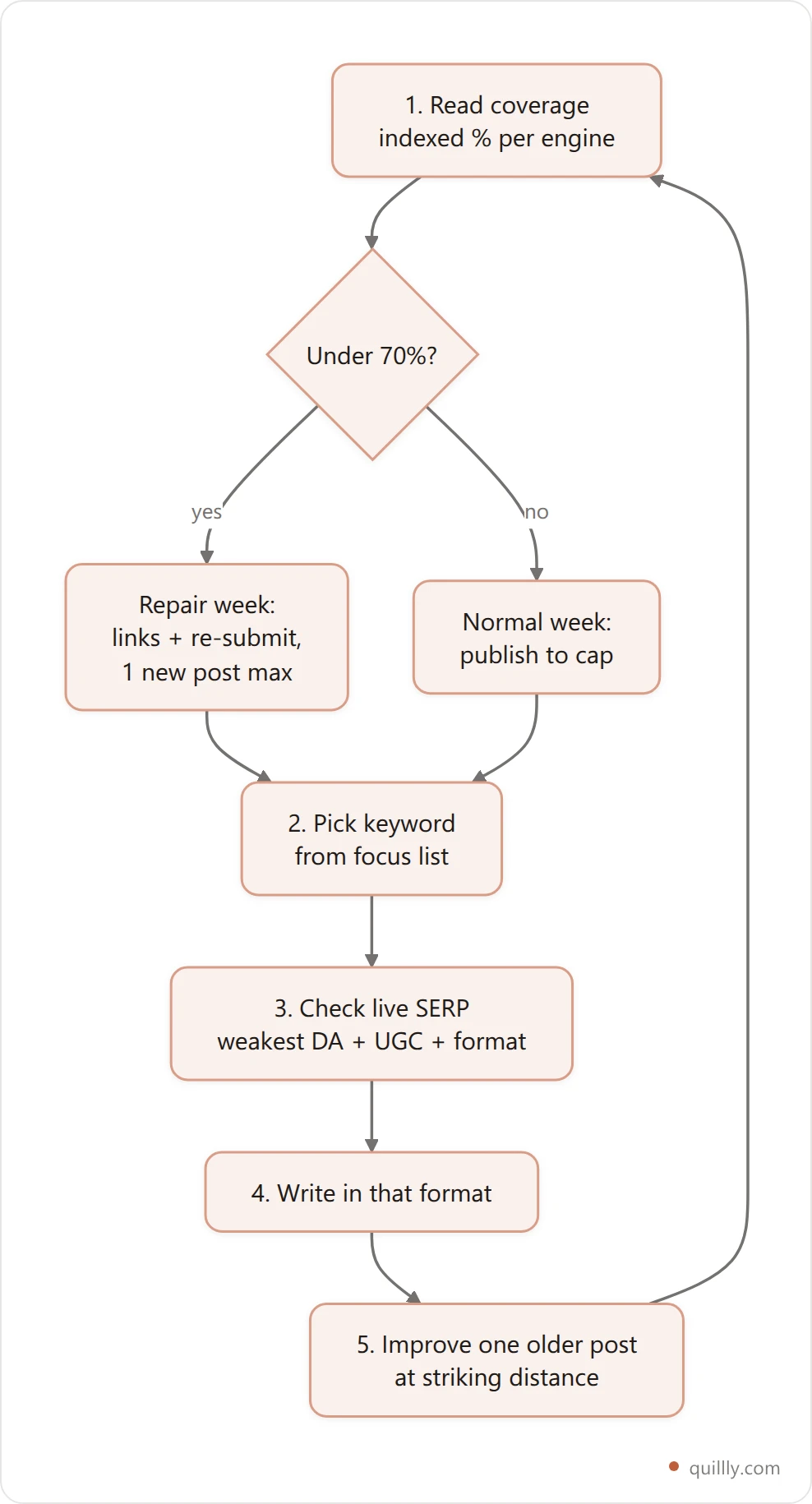
That loop is the whole of our SEO content planning — five steps, one new post, one improvement. The improvement half matters more than it sounds: a page already at position 21 with real impressions is closer to a click than any page you have not written yet.
Two rules keep the loop honest. Never edit the same post twice inside two weeks — engines need time to re-crawl before you can tell whether the edit helped, and a page edited weekly never generates a clean signal. And never write from a keyword snapshot older than a month; volumes and result pages both move, and the gate is only as good as the data you feed it.
Google's guidance on creating helpful, people-first content is the sanity check that sits over the whole loop. The gate tells you what you can win. It doesn't excuse writing something nobody needs.
What we would do differently at post 1#
Three things: check indexing coverage before scaling volume, run the result-page gate on every candidate rather than only the interesting ones, and build for the format that already ranks instead of defaulting to prose. In that order, because each one caps the value of the next.
Check coverage before scaling. We reached 149 published pages before treating a 20% Bing index share as a strategy problem rather than a technical footnote. Half that library and twice the indexing would have been the better trade.
Run the SERP gate on every keyword, not the interesting ones. Five of our seven recent checks came back reject. That ratio suggests plenty of earlier posts were written against result pages that were never going to yield.
Build for the format that ranks. Our tool pages out-earn our articles by a wide margin and we did not plan that. When the result page wants a tool, prose is a slower route to the same query.
Ready to run this loop on your own domain? Quillly scores every draft against 14 SEO criteria before it ships, publishes to your own domain, submits to eight search engines, and reports the indexing coverage this whole strategy depends on. Start with your first post.
Frequently Asked Questions#
What is an SEO content strategy?#
It's a standing set of rules for what you publish and in what order — which queries qualify, what difficulty you'll accept, which format each result page rewards, and how many pages you can publish while keeping them indexed. The rules matter more than the calendar, because they decide things the same way when a tempting keyword shows up.
How is an SEO content strategy different from a content calendar?#
A calendar answers when. A strategy answers whether. The calendar assumes the decision to write has already been made correctly; the strategy is the part that rejects five keywords out of seven before anything reaches the calendar. Sites that only keep a calendar publish on schedule into result pages they cannot win.
What keyword difficulty should a new site target?#
Set a ceiling from your own authority and enforce it. At Domain Rating 16 we cap difficulty at 30 and require a live check of the top 10 on top of that. Difficulty scores describe an average result page, so treat them as a first filter, never as the decision — the occupants of your actual top 10 are.
How many blog posts should I publish per month?#
Derive it from your indexing coverage, not from a benchmark. If under 70% of your published pages are indexed on your worst engine, adding volume compounds nothing — cap new posts at roughly one a week and spend the rest of the effort on recovery. Once coverage is healthy, scale up.
Do search impressions mean my SEO content strategy is working?#
Not on their own. Our four biggest impression earners have 2,143 impressions and zero clicks between them, because three of the four rank at position 21 or worse. Impressions confirm you're indexed and visible; only position and clicks confirm you're competitive. Track both.
Why is my content indexed on some search engines but not others?#
Engines apply their own acceptance thresholds to the same pages. Our library sits at 91% indexed on Yandex, 53% on Google and 20% on Bing — identical content and sitemap. That spread means the fix is usually engine-specific submission and internal linking rather than a rewrite.
The takeaway#
An SEO content strategy is not the list of things you're going to write. It's the set of rules that decides most of them aren't worth writing.
Three numbers from this site to keep:
5 of 7 recent keywords rejected on live result-page data, and the two that passed were the smallest.
53% / 20% / 91% — indexed share on Google, Bing and Yandex for the same 143 pages.
2,143 impressions, 0 clicks — what visibility without position actually looks like.
Start with coverage, gate every keyword against a live top 10, write the format that already ranks, and improve one existing page for every new one. Do that for a year and you'll have a smaller library than the calendar promised and more of it in the index. See what your current coverage looks like.


