


Ask three vendors what's in their AI SEO services and you'll get three different products billed under the same name. One is an agency that bought a few subscriptions. One is software with a support inbox attached. One is an agent that does the work in front of you while you approve it. The proposals look alike, the price gaps are enormous, and none of them will tell you which one you're reading.
The short answer: AI SEO services come in three shapes — an agency with AI inside, software sold as a service, and an agent that runs inside your own stack. What separates them isn't the model doing the writing. It's who owns the queue: who picks the topic, who presses publish, and who is accountable when six months of output ranks for nothing.
So the useful question isn't "is this AI or human?" It's "what am I actually buying hours of?" This piece breaks the category into the three businesses hiding inside it, the six questions that tell them apart on a sales call, and the handful of deliverables worth paying for.
What's on this page
The Three Businesses Sold as AI SEO Services#
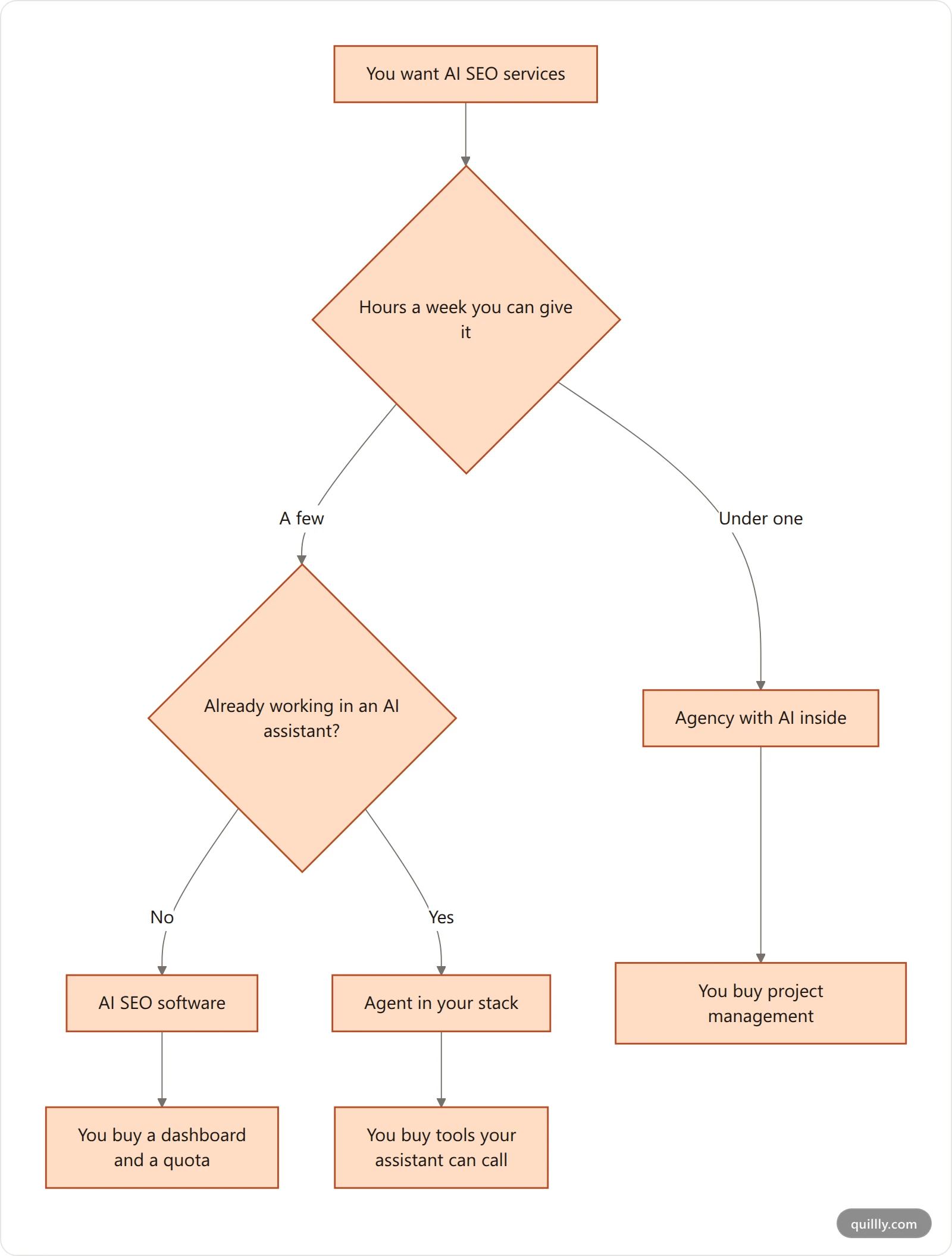
Every vendor in this category is running one of three business models. Read the table first, then find yours.
Agency with AI inside | AI SEO software | Agent in your stack | |
|---|---|---|---|
What you buy | Hours of a team | Seats and quota | Tools your assistant can call |
Who picks the topic | Their strategist | You, in a dashboard | You, in a chat |
Who presses publish | They do | You do | Your assistant, on your say-so |
Time to first post | 2–6 weeks of onboarding | A day or two | Minutes |
Where it breaks | Juniors running the prompts | Nobody logs in after month two | You stop reading the drafts |
Fits you if | You have no in-house time at all | You like the work and want speed | You already work in an AI assistant |
The agency with AI inside is a traditional retainer where the writing, the briefs and the reporting now come out of a model. That's not a scam — it's what most of the page-one results for this query are selling. It's the right call when you genuinely have nobody to do the work. Just know that you're buying project management, not technology, and the technology part is something you could license yourself for a fraction of the retainer.
AI SEO software sold as a service is a subscription with a strategy layer bolted on: keyword research, drafting, scoring, sometimes publishing. You're still the one driving. The honest ones say so. Our rundown of AI based SEO tools sorts this shelf by how much of the job each one really takes off your hands.
The agent in your stack is the newest shape and the one the category name fits worst. Instead of a dashboard you log into, the service exposes tools to an assistant you already use — so the research, the draft, the SEO score and the publish all happen in one conversation. The autonomy varies wildly between vendors, which is why we mapped it as five rungs of real autonomy rather than a yes/no.
When we pulled the live Google top ten for this query in September 2026, two of the ten results were Reddit threads — people asking each other which AI SEO services actually work. That's a useful signal: when a commercial query still sends buyers to forums, the vendors haven't answered the question honestly enough for Google to pick a winner.
What the AI Really Does, and Where a Human Still Has To#
Strip the branding off any of the three models and the pipeline underneath is the same six steps. The difference is where the handoffs sit.
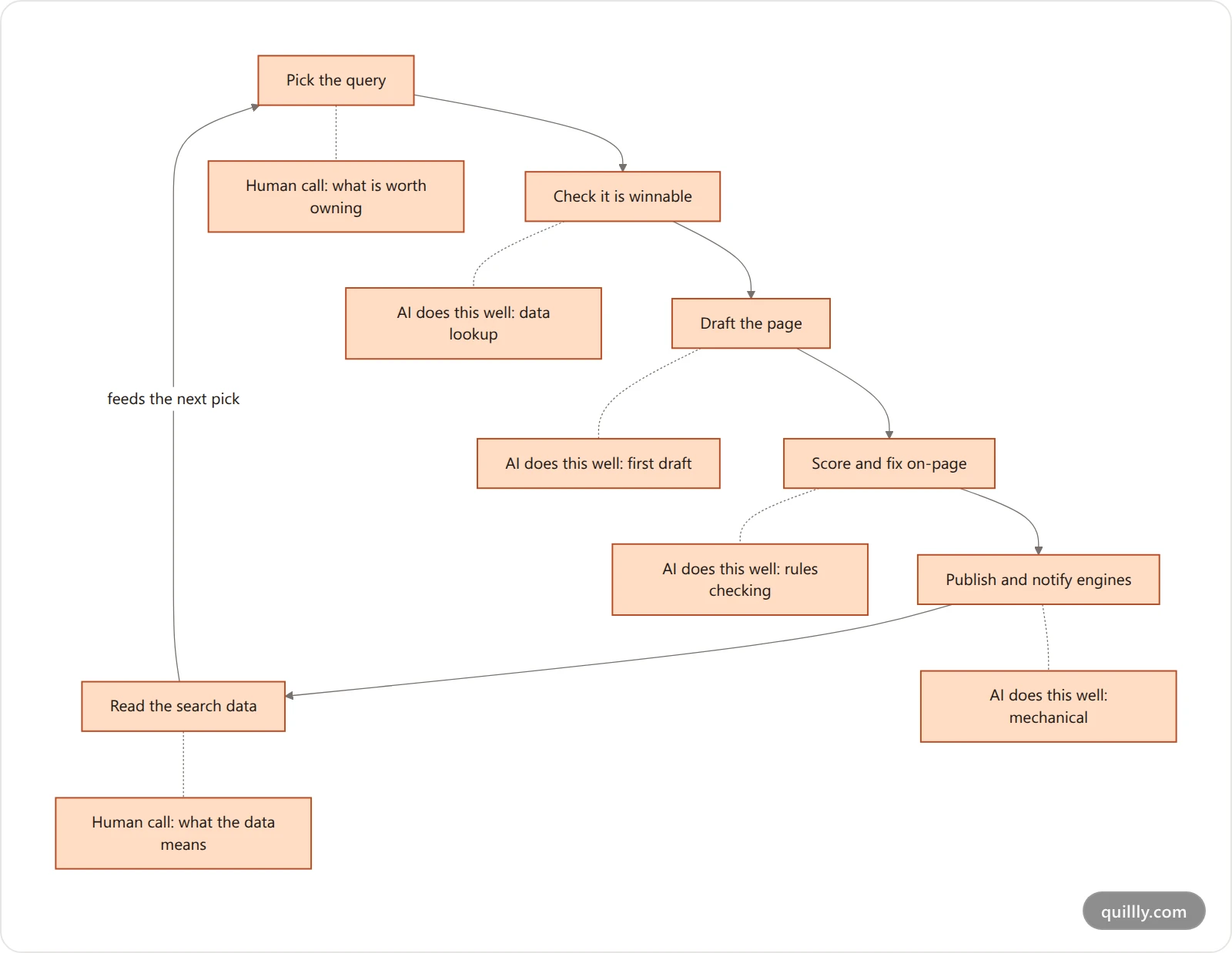
Notice the shape. The middle four steps — verify, draft, score, publish — are mechanical, and a model with the right tools does them faster and more consistently than a person will at 4pm on a Friday. The two ends are judgement calls, and they're where every disappointing engagement goes wrong.
The first end is topic selection. A model asked for "blog topics about accounting software" will happily produce forty, most of them targeting queries you cannot rank for at your current authority. Somebody has to hold the line on difficulty. If your domain rating is under 20, head terms owned by DR 70 sites are not reachable this year, whatever the content plan says — our explainer on what domain rating actually predicts covers where that ceiling sits.
The second end is reading results. Impressions with no clicks means one thing; indexed with no impressions means something else entirely; not indexed at all means the other two diagnoses were noise. Any vendor whose reporting stops at "we published 12 posts" has skipped the only step that compounds.
Want to see the middle of that pipeline run on one of your own pages before you buy anything? Our free SEO checker scores a live URL the way the drafting step would.
Six Questions That Separate Real Services From Repackaged Retainers#
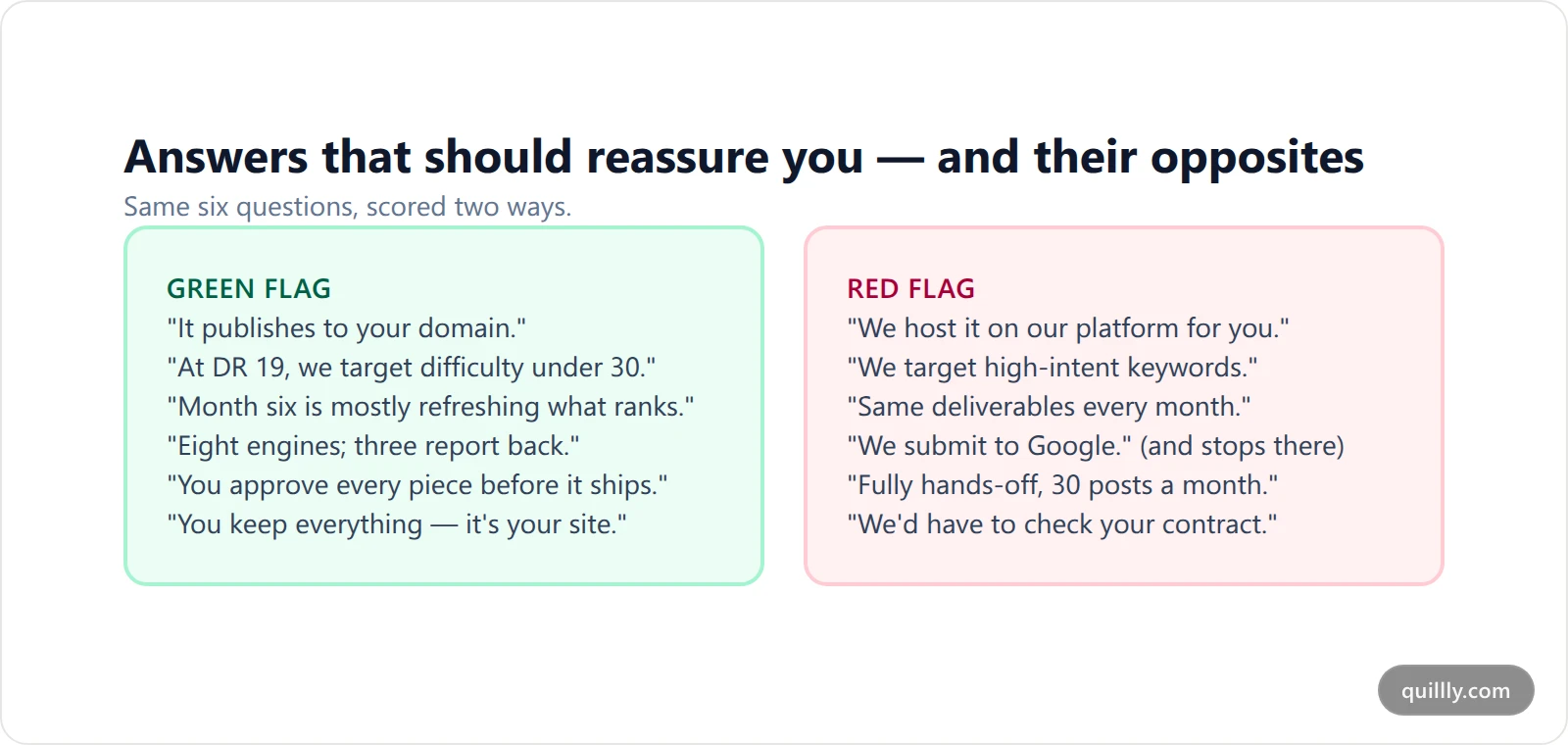
You can sort any vendor in about ten minutes. These six questions are ordered by how much the answers tend to cost you.
"Who owns the domain the content publishes to?" If the answer is anything other than "you do," walk. Content published on a vendor's subdomain builds the vendor's authority, and you lose all of it at cancellation.
"Show me your keyword difficulty ceiling for my site." A real answer is a number tied to your authority. A vague answer about "high-intent keywords" means nobody has checked whether you can win them.
"What happens in month one versus month six?" SEO compounds; retainers charge flat. A vendor who can't describe how the work changes as the library grows is selling you month one, twelve times.
"Which engines do you submit to, and how do you confirm?" Most answers stop at Google. Submission and confirmation are different things — only some engines report indexed status back at all, which we unpack in ranking beyond Google.
"How much content per month, and who reviews it?" Volume without review is how sites walk into Google's spam policies on scaled content abuse. Google's position on AI writing is about quality, not authorship — but unreviewed bulk output fails the quality half fast. We wrote up what that policy actually catches, and whether Google penalizes AI content at all.
"What do I keep if I cancel tomorrow?" The pages, the domain, the analytics history, the keyword research. If the honest answer is "the pages, if you can export them," price that risk in.
The Deliverables Worth Paying For#
Proposals pad. Here's the short list of line items that actually move a site, and the ones that exist to fill a slide.
Worth paying for:
A difficulty-gated topic queue. Not a list of topics — a list with volume, difficulty and a reason each one is reachable for your domain today.
Pages published to your own domain, server-rendered. If a crawler has to run JavaScript to see the words, indexing gets slower and less certain.
Submission to more than Google. Publishing should notify the engines that accept notifications, not just ping a sitemap.
Indexing coverage reporting. Published is not indexed. The gap between those two numbers is the single most useful metric in the whole engagement.
A refresh loop. Pages decay. A good SEO content strategy spends a rising share of its hours on existing pages as the library grows.
Filler:
Monthly "competitor analysis" decks that never change the queue.
Raw word counts. Two thousand words that answer nothing rank below eight hundred that do.
Backlink packages bundled into a content retainer. If links are in scope, they should be a separate, auditable line — the risk profiles differ enormously.
"AI-powered" as a feature. It describes how the work is done, not what you get.
See the pipeline before you sign anything
Connect a domain once and your own AI assistant gets the research, drafting, SEO scoring and publishing tools — so you can run a post end to end and judge the output yourself.
Try it on your domainWhat AI SEO Services Still Can't Buy You#
Three things no vendor in this category can sell you, whatever the deck says.
Authority on a schedule. Domain rating moves with links from other people's sites, and nobody controls that timeline. A service that promises a DR number by a date is either buying links or guessing.
Indexing. Submitting a URL is a request, not a command. On this site — which runs the whole pipeline we're describing — 156 items are published, 147 are indexed on at least one engine, and only 24% are indexed on Bing. That last number is ours, it's unflattering, and it's why our own content plan currently spends more effort on recovering existing pages than adding new ones.
An SEO content strategy that survives contact with your data. Vendors arrive with a template. Six months in, the plan should look different because the search data said so — and most retainers never revisit the original deck.
Taste. A model will match a brief. It won't notice that the brief is boring, that the comparison table is missing the column readers care about, or that the claim in paragraph three isn't actually true. That's still a person's job, and it's the job that decides whether the page gets cited.
Anyone shopping this category should also price the alternative honestly. Our breakdown of what each SEO price tier actually buys is a useful reality check before a retainer conversation, and blog management services covers the done-for-you end of the same spectrum.
Monitoring SEO Performance After You Sign#
Most engagements fail quietly because the reporting measures activity instead of outcomes. Monitoring SEO performance properly means watching four numbers in a fixed order, because each one only makes sense if the one above it is healthy.
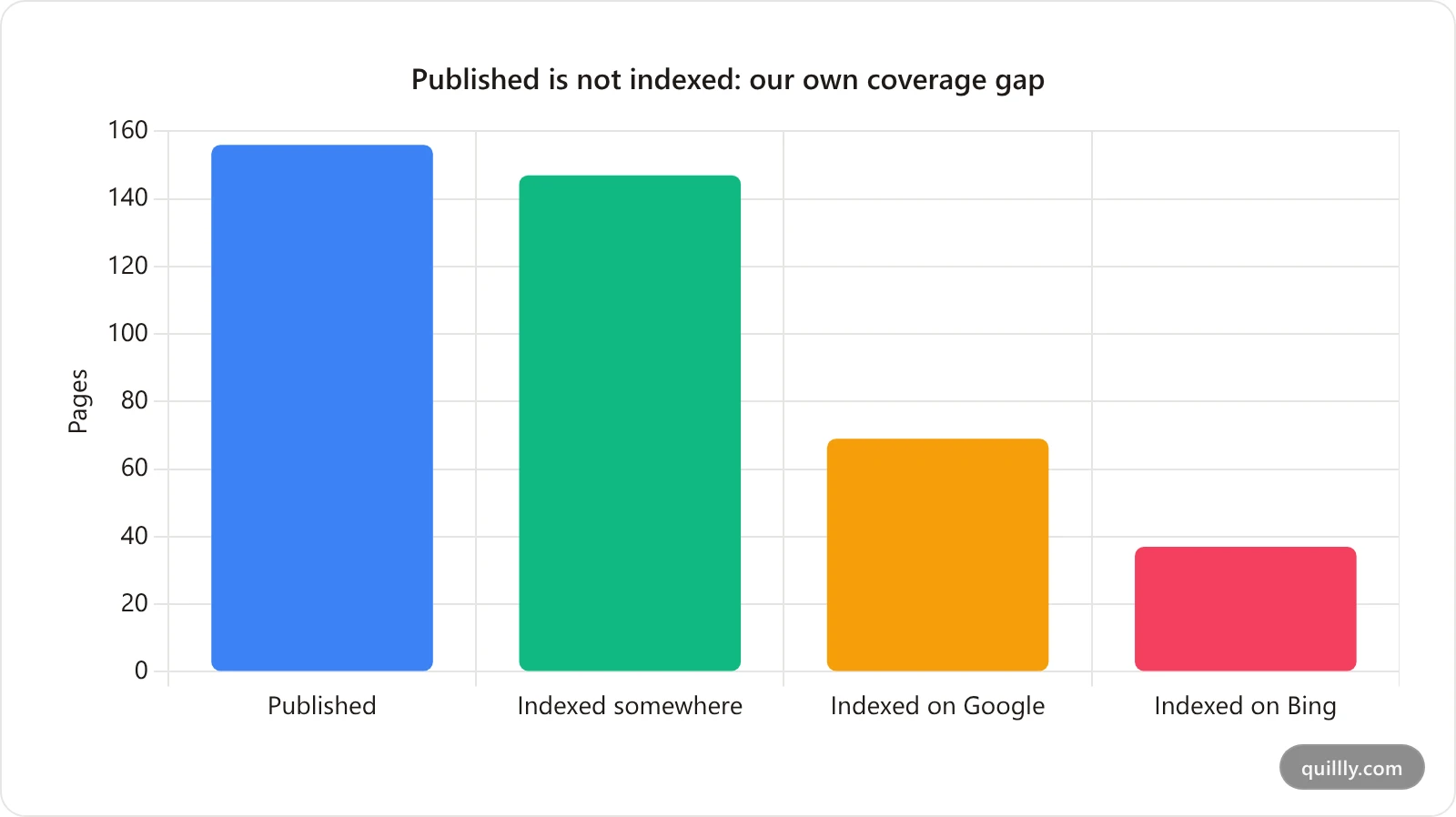
Read it top down:
Published. The only number a bad vendor reports. On its own it means nothing.
Indexed. Per engine, not pooled. A page in Yandex and nowhere else is invisible to almost everyone, and pooled reporting hides that. If pages sit at "crawled, currently not indexed," our guide to that status explains what it does and doesn't mean.
Impressions. Indexed pages that earn zero impressions are usually aimed at queries you can't reach yet, not badly written.
Clicks and position. Last, because everything above has to be true first.
You can verify step two yourself without the vendor's dashboard: Google's URL Inspection tool reports coverage for any page on a property you own. Ask for read access to Search Console on day one. A vendor who won't give it is reporting numbers you can't check.
When the Software Alone Is Enough#
For a lot of teams, the honest answer is that you don't need services at all — you need the pipeline and an hour a week. That's a real option now in a way it wasn't three years ago, because the tooling got good enough that the expensive part is the judgement, not the typing.
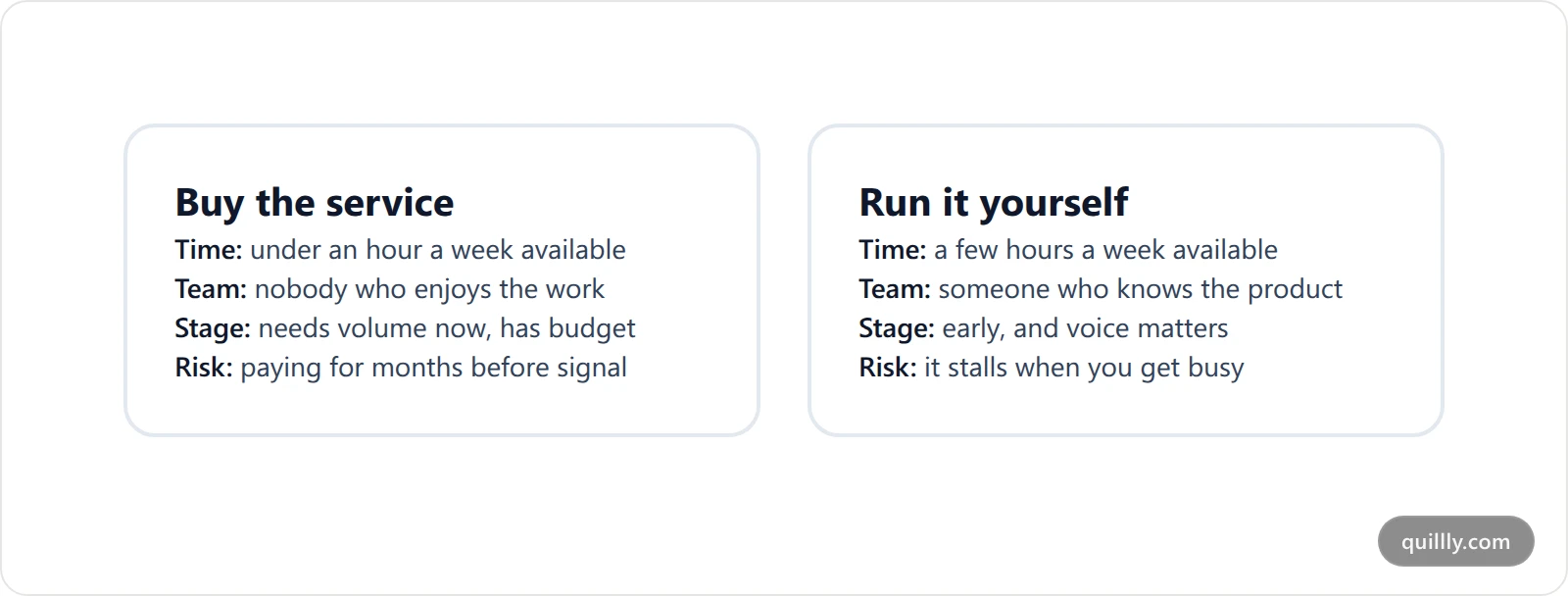
If you go the second route, the thing to shop for isn't the best SEO software by feature count — it's whichever tool closes the loop from topic to published URL without a copy-paste step, because that's the step where the habit dies.
That's the shape Quillly takes. You connect a domain once, and your AI assistant — Claude, ChatGPT, Cursor, anything that speaks the Model Context Protocol — gets real tools: keyword research, drafting, a score against 14+ SEO criteria, publishing to your own domain, and submission to eight engines on publish. Google gets the sitemap and RSS feeds through Search Console; Bing, Yahoo, Yandex, Naver, Seznam, Yep and Amazon get a single IndexNow notification — the mechanism we explain in getting indexed in Bing and ChatGPT. Only Google, Bing and Yandex report indexed status back, so those are the three numbers in the coverage chart above.
Judged that way, the best SEO software for this job is whichever one your team still opens in month four — and the getting-started guide shows how short that setup is.
The honest caveat: that's a pipeline, not a strategist. It won't decide what's worth writing, and it won't tell you your last idea was dull. You still own the two ends.
Run the whole pipeline from your AI assistant
Research, draft, score against 14+ SEO criteria, publish to your own domain and notify eight search engines — without leaving the chat you already work in.
Connect your domainKey Takeaways#
AI SEO services split into three businesses — agency with AI inside, software as a service, and an agent in your stack. Price the model, not the acronym.
The AI genuinely handles the middle of the pipeline: verify, draft, score, publish. Topic selection and reading the data are still human calls, and that's where engagements fail.
Six questions sort any vendor: who owns the domain, what difficulty ceiling fits your site, how month six differs from month one, which engines get submissions, who reviews the output, and what you keep if you cancel.
Published is not indexed. Ask for per-engine coverage, not a pooled number, and get Search Console access on day one so you can check it yourself.
Nobody can sell you authority on a schedule, guaranteed indexing, or taste. Treat any promise in those three areas as a reason to read the contract harder.
If you have a few hours a week and someone who knows the product, running the pipeline yourself is now a legitimate alternative to buying AI SEO services at all.
Frequently Asked Questions#
What do AI SEO services actually include?#
Usually keyword research, content drafting, on-page optimization and publishing, with reporting on top. The variable is how much a human still does. Ask which steps are automated and which are staffed — the answer tells you whether you're buying software, hours, or a mix of both.
Are AI SEO services worth it for a small site?#
Often not, at first. A site under roughly fifty pages usually needs topic judgement more than production capacity, and that's the part services automate least. Licensing the tooling and writing two posts a week yourself tends to beat a junior-staffed retainer at the same monthly cost.
Will Google penalize content from AI SEO services?#
Not for being AI-written. Google's guidance targets low-quality content produced at scale regardless of who or what wrote it. The risk comes from unreviewed bulk publishing, which trips the scaled content abuse policy. Volume with genuine review is fine; volume without it isn't.
How is an AI SEO agent different from AI SEO software?#
Software gives you a dashboard to work in. An agent gives your existing AI assistant tools to call, so research, drafting and publishing happen in one conversation instead of across tabs. The practical difference is friction — fewer handoffs means the workflow survives a busy week.
How long before AI SEO services show results?#
Plan on three to six months before rankings move meaningfully, and watch indexing coverage in weeks one to four as the early signal. If pages aren't getting indexed by month two, nothing downstream will happen, and that's the point to renegotiate rather than wait.
What should the monthly report contain?#
Four numbers in order: pages published, pages indexed per engine, impressions, then clicks and average position. Anything that reports only the first one is measuring the vendor's activity rather than your results. Ask for the underlying Search Console access too.


