

The top result for "ai seo agent" isn't a product page. It's a Reddit thread titled "Do AI SEO Agents actually work? Looking for real results." When a forum question outranks every vendor on the market, it means the vendors haven't answered it.
Here's the answer they're dodging. An AI SEO agent is software that runs SEO work on its own — research, writing, publishing, or measurement — without a human driving each step. The word "agent" says nothing about how far that autonomy goes. Most tools sold as agents stop at recommendations or a draft, and hand the last mile back to you. The useful question isn't "is it an agent?" It's "which rung does it reach?"
The category picked up a name — agentic SEO — well before it picked up a definition. Here's a definition: five rungs, and a straight answer about which one a given tool actually stands on.
The autonomy ladder, in one picture#
Publishing a post is a loop, not a task. Something has to pick the topic, write it, judge it, ship it, tell the engines, then watch what happened and feed that back into the next decision. Every tool in this category climbs some part of that loop and stops.
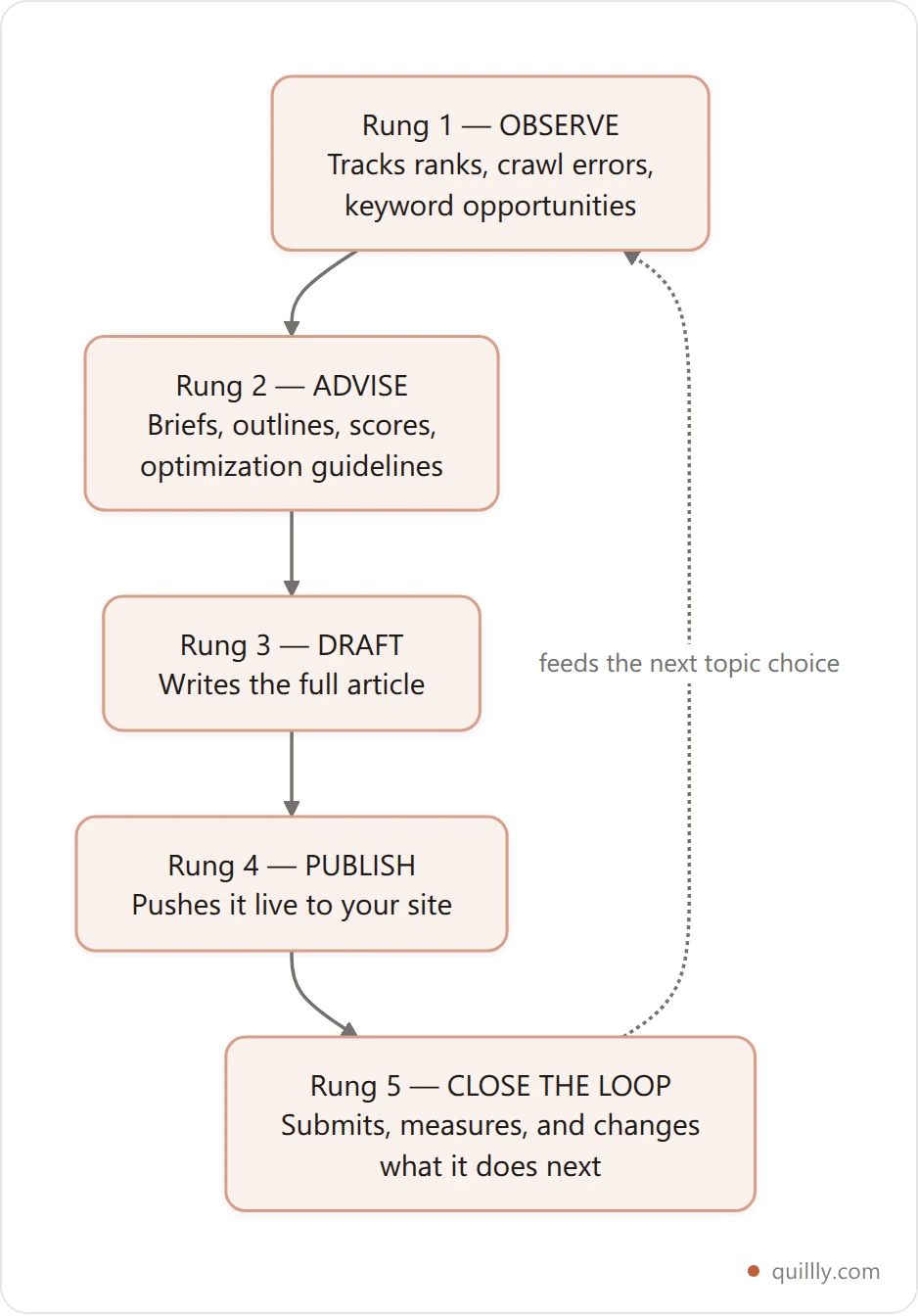
The dotted line is the whole argument. Rungs 1 through 4 are a straight line that ends when the post goes live. Rung 5 bends it into a circle. A tool that publishes but never reads its own results isn't an agent — it's a very fast intern who never asks how it went.
Rung 1: Observe — it watches, you act#
The first rung is monitoring. The tool tracks your rankings, flags broken links and crawl errors, and surfaces keyword opportunities. Nightwatch's SEO AI Agent is a clean example: its page describes continuous monitoring, technical issue detection, and "clear recommendations" for fixing them (Nightwatch).
That's genuinely useful. It's also not autonomy — it's a dashboard with better prose. Nothing changes on your site unless you change it. If your bottleneck is knowing what's wrong, rung 1 solves your problem. If your bottleneck is doing the work, it doesn't touch it.
Rung 2: Advise — it grades, you write#
Rung 2 tools take a target keyword and tell you what a winning page looks like: term coverage, headings, word count, a score out of 100. Surfer is the category's reference point — its site describes real-time optimization guidelines, AI-assisted drafting inside its editor, and content audits, but publishing to your site isn't part of it. Its own MCP connector and an automation agent are both listed as coming soon (Surfer).
This rung is where most "AI SEO" spend goes, and it has a specific failure mode: it optimizes the thing you already decided to write. It won't tell you the topic was unwinnable. That judgment lives one level up, in how you pick keywords in the first place.
Rung 3: Draft — it writes, you ship#
Rung 3 is where ChatGPT and Claude sit by default. You ask for a post, you get a post. It's genuinely good writing, and then it dies in a chat window until you paste it somewhere.
This is the rung almost everyone is actually on, and the gap it leaves is bigger than it looks. The draft isn't the work. Formatting it, adding internal links, writing the meta description, checking it against a scoring rubric, uploading it, setting the slug, submitting it for indexing — that's forty minutes per post, every post, forever. Multiply by a publishing cadence and the drafting was never the bottleneck.

Rung 4: Publish — it ships without asking#
Rung 4 is the first rung that feels like an agent. SEObot is the honest example here: it states that it runs "100% autopilot by default," produces articles weekly, handles internal and external linking, and pushes to WordPress, Webflow, Ghost and Shopify. Human approval exists as an option — a moderation mode that emails you articles to accept or decline — not a requirement (SEObot).
That's real autonomy — autonomous SEO in the literal sense, not a dashboard wearing the word — and it's also the rung where the risk shows up. An agent that publishes without review will publish its mistakes without review too. Ahrefs makes the point bluntly in its own guide: agents without solid data connections "fill the gaps with whatever sounds plausible," and one practitioner watched an agent invent API parameters that didn't exist (Ahrefs).
The mitigation isn't refusing to automate. It's putting a machine-checkable gate in front of the publish step, so "plausible" isn't enough to get through. We've written about what makes AI publishing safe rather than reckless — the short version is that a hard quality threshold beats a human skim, because humans skim.
Rung 5: Close the loop — it reads its own results#
Here's the rung almost nothing reaches, and the reason the Reddit thread outranks the vendors.
A post going live isn't the end of the job. Search engines have to be told it exists. Somebody has to check whether it got indexed, what it ranks for, whether it earned impressions, and whether the next post should be about something else entirely. A rung 4 tool publishes into a void. A rung 5 agent publishes, then reads the outcome and lets it change the next decision.

This is the loop Quillly was built around. It connects to Claude, ChatGPT, Cursor or Codex over the Model Context Protocol — an open standard Anthropic released for wiring AI applications to external tools, described in its own docs as "a USB-C port for AI applications." Your assistant gets real publishing tools instead of a text box: it researches, writes, scores the draft 0–100 against 14 criteria, publishes to your own domain, submits to all 8 engines Quillly notifies — Google, Bing, Yahoo, Yandex, Naver, Seznam, Yep and Amazon — and then reports indexing coverage and ranking data back into the next session. That's the dotted line, in software.
Connect your AI and watch one full loop run.
Five questions that place any tool on the ladder#
Vendor copy won't tell you the rung. These five questions will, and every one has a yes/no answer you can check in a trial.
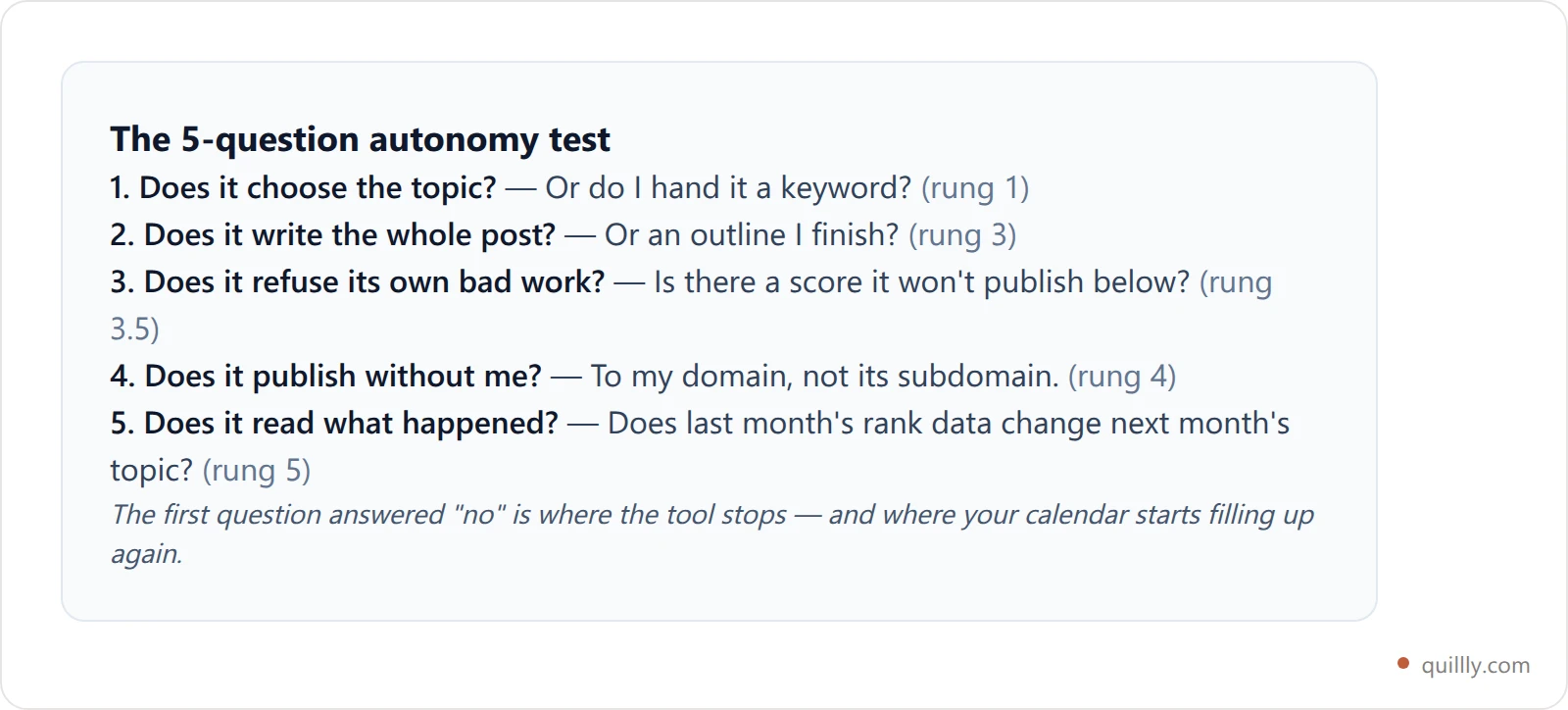
Question 3 is the one people skip, and it's the one that decides whether rung 4 is safe. An agent that will publish anything is worse than no agent. An agent that scores its own draft and refuses to ship below a threshold can be trusted with the publish button, because its floor doesn't move when it's tired.
Which rung do you actually need?#
Higher isn't automatically better. Most AI SEO automation gets sold as a straight upgrade when it's really a different tool for a different problem, so match the rung to the bottleneck.
You have writers and no visibility. Rung 1. Buy monitoring, not automation. Your people are fine; your dashboard isn't.
You have writers who guess. Rung 2. Scoring and briefs turn opinion into a target. Pair it with a striking-distance keyword list so they're optimizing pages that can actually move.
You have ideas and no hours. Rung 3. Drafting is your gap. Accept that shipping stays manual.
You publish weekly and hate the CMS. Rung 4. The forty minutes per post is the cost you're removing.
You publish daily and can't tell what's working. Rung 5. At this volume, measurement isn't a nice-to-have — it's the only thing stopping you from writing 200 posts nobody reads.
Most teams need rung 2 or 3 and buy rung 5, or need rung 5 and buy rung 2. Diagnose the bottleneck first.
See what a rung-5 setup looks like in practice.
Where the agent hype actually breaks#
Three failure modes show up repeatedly, and none of them are about writing quality.
The loop never closes because nothing tells the engines. Publishing a page doesn't notify anyone. If nothing submits your URL, discovery can take weeks — which is why IndexNow-style submission matters more than another 500 words of prose.
The agent has no memory. A fresh session that can't read what the last one did will re-pick the same topics and repeat the same mistakes. Continuity is a feature, not a nicety.
Autonomy gets confused with unsupervised. Ahrefs puts it well: "SEO agents don't need to be fully autonomous. Most good ones have human approval steps built in" (Ahrefs). The goal isn't removing judgment. It's removing the forty minutes of mechanical work between a decision and a live page — which is also the argument for MCP replacing the headless CMS rather than another dashboard.
Frequently Asked Questions#
What is an AI SEO agent?#
It's software that performs SEO work without a human driving each step — monitoring rankings, researching keywords, writing drafts, publishing pages, or measuring results. The term covers a huge range of autonomy, from a dashboard that only reports problems to a system that publishes and then reads its own performance data.
Can an AI SEO agent publish to my website automatically?#
Some can. SEObot publishes to WordPress, Webflow, Ghost and Shopify on autopilot by default, and Quillly publishes to your own domain over MCP. Many tools marketed as agents — including Nightwatch and Surfer — stop at analysis or optimization and leave publishing to you, so check before you buy.
Is it safe to let an agent publish without review?#
It's safe when a machine-checkable gate sits in front of the publish step. A fixed quality score the agent can't publish below catches thin or broken output far more reliably than a human skim, because the threshold doesn't get tired. Without that gate, autonomous publishing ships mistakes at scale.
Do I still need an SEO person if I use an agent?#
Yes, for judgment. Agents are strong at sequential, high-volume work — clustering keywords, auditing pages, mapping internal links. They're weak at deciding what's worth writing and whether a claim is true. Ahrefs' guidance is that most good agents keep human approval steps built in.
What's the difference between an AI writer and an AI SEO agent?#
An AI writer produces a draft and stops — you handle formatting, links, publishing and measurement. An agent covers more of the loop. If a tool gives you text you then paste into a CMS, it's a writer regardless of what its marketing calls it.
The takeaway#
"Agent" is a marketing word. The ladder is the real spec.
Ask which rung a tool reaches, and the category sorts itself out fast: monitoring at rung 1, scoring at rung 2, drafting at rung 3, publishing at rung 4, and — rarely — a closed loop at rung 5, where the results of the last post change the choice of the next one.
Then pick the rung that matches your actual bottleneck, not the one with the best landing page. If yours is the forty minutes between a finished draft and a live, indexed, measured page, that's a rung-5 problem, and no amount of rung-2 scoring will fix it.
Start a 14-day trial and let your AI run the whole loop on your domain.


