

This site recently sent the identical IndexNow notification to two search engines. Yandex accepted 110 URLs out of 110. Bing accepted zero out of 233 and rejected 19 outright. Same pages, same markup, same ping. No on-page automation tool on the market would have changed either number.
Otto SEO is Search Atlas's automation layer. You install a pixel or route DNS through Cloudflare, and it deploys technical, on-page, content, local and off-page fixes to your live site without a developer touching anything. It genuinely removes implementation work. What it can't do is make a search engine decide your pages are worth keeping.
That gap is the whole review. AI SEO automation has gotten very good at the half of the job that has correct answers, and it is still stuck on the half that doesn't. Below is what Otto automates according to Search Atlas's own product page, what it leaves on your plate, and the numbers from our own library that show where the automation stops paying.
What Otto SEO Actually Automates#
Search Atlas groups OTTO's capabilities into six working modules. Here's each one against the honest question: does it still need a person?
Module | What Search Atlas says it does | Still needs you? |
|---|---|---|
Technical SEO | Titles, schema, canonical URLs, broken and redirect links, Open Graph, Twitter cards | Rarely — this is the strongest case |
On-Page SEO | Headings, meta tags, meta keywords, alt text, internal links | Sometimes — anchor choices need judgment |
Content | Topical maps, SEO articles, optimizing existing content, landing pages | Yes — originality can't be delegated |
Off-Page SEO | Automated link building ("WILDFIRE"), press release syndication, cloud stacks, digital PR | Yes — and read the fine print |
Local SEO | Google Business Profile optimization, GBP posts, Ask Maps Q&As, review replies | Sometimes — review replies are brand voice |
Dynamic Indexing | Reindexing low-traffic or newly optimized pages | Yes — see the indexing section below |
Two supporting features sit alongside those. OTTO Grade is a performance dashboard. Deep Freeze keeps optimizations live after you cancel, which is a meaningful detail given that pixel-injected changes normally vanish the moment the script stops loading.
The technical column is where Otto is least arguable. Canonical tags, redirect chains, missing Open Graph cards — these are deterministic problems with correct answers, and a machine that applies them consistently across a thousand URLs beats a human doing it by hand. If that's your bottleneck, this is a real product.
How Otto Deploys: The Pixel, the DNS, the Trade-off#
Search Atlas Otto ships changes one of two ways, per its product page: you place the OTTO Pixel in your site header, or you install via Cloudflare DNS for a no-code setup. It also lists direct deployment into WordPress, HubSpot, Webflow, Shopify, Contentful and Duda, plus GitHub, Vercel and Netlify for code pipelines, and pushes to Google Search Console and IndexNow for indexing.
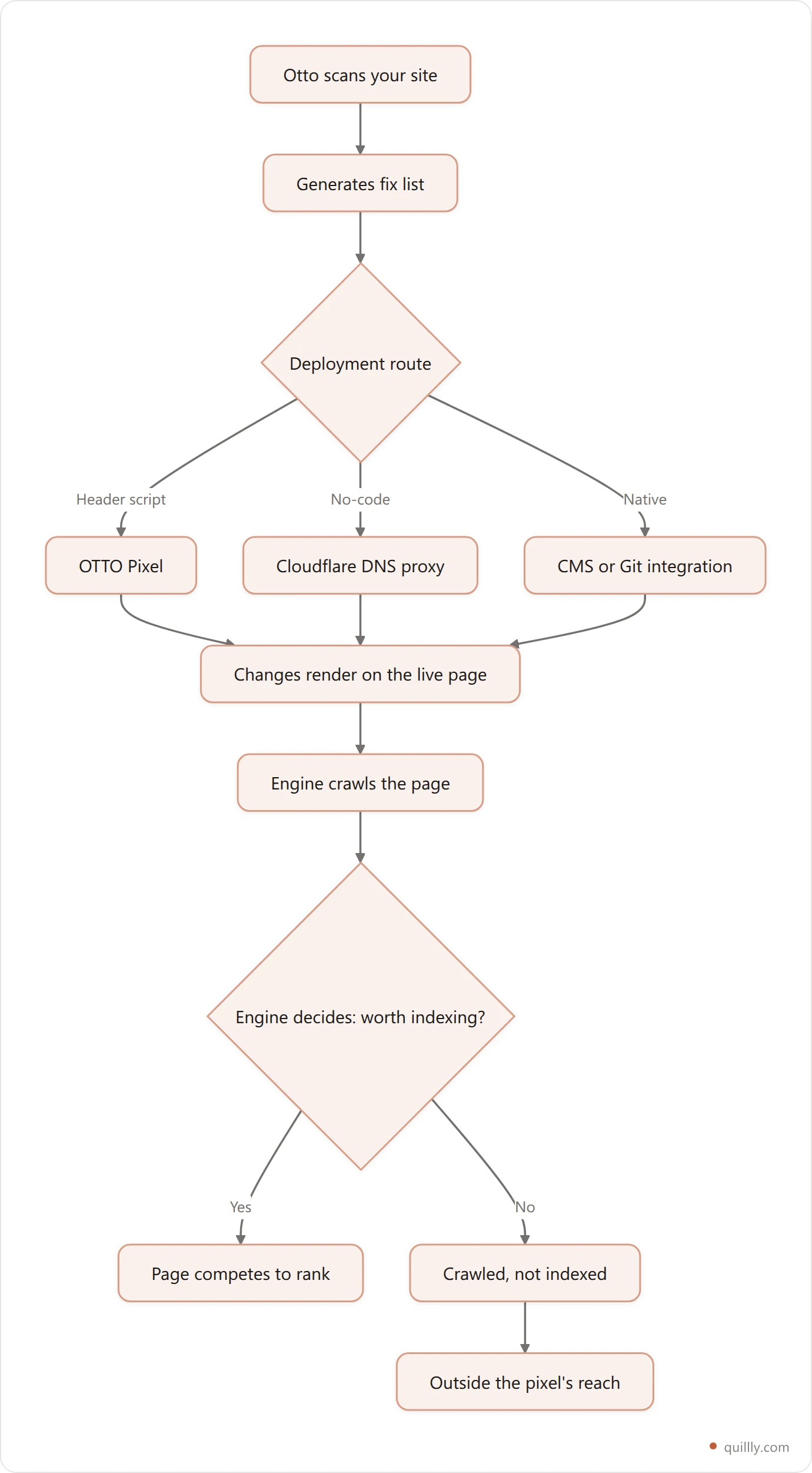
The trade-off is worth naming out loud. A pixel that rewrites your page after load is a dependency: your titles and schema now live in a third party's runtime, not your repo. Deep Freeze addresses the cancellation case, but it doesn't change the fact that your on-page SEO is being served by someone else's JavaScript. The DNS route has the same shape at the edge. Teams that already deploy from Git may prefer the native integration precisely because it puts the change back in source control.
The Three Things No Pixel Can Fix#
This is where most Otto SEO reviews stop short. Every vendor of autonomous SEO tools sells the same promise, and the promise is half true: automation solves implementation. It does not solve acceptance, authority, or intent.
1. Indexing acceptance. "Instantly reindex" means the notification goes out instantly. It does not mean the engine accepts. Our own 233-URL Bing revalidation returned 0 passed, 19 failed, and the rest still pending — while the same protocol against Yandex cleared 110 of 110. An engine that has decided your pages aren't worth its crawl budget will keep deciding that after every ping. Google's crawling and indexing documentation is explicit that submission is a request, not an instruction.
2. Domain authority. At DR 19, this site's ceiling is set by who else is on the SERP, not by whether our alt text is perfect. We've walked away from keywords with a weakest-competitor authority above our threshold no matter how good the on-page score was. Automated link building is Otto's answer here, and it's the module to scrutinize hardest — what domain rating actually predicts is narrower than most tools imply.
3. Search intent and format. If the top ten results for your keyword are all interactive tools, a perfectly optimized article loses. No amount of schema fixes that. Reading the live SERP before committing to a format is a judgment call that stays human.

Look at that spread. Three engines, one library, identical technical setup on every page. The variance isn't explained by anything a pixel controls — it's explained by how much each engine trusts the domain. That's the number Otto's technical module can't move.
What Our Data Says About Where Automation Stops#
Over the last 90 days this site recorded 6,225 impressions and 18 clicks across Google, Bing and Yandex — a 0.29% click-through rate at an average position of 40. The prior window was 5,187 impressions and 10 clicks at position 43.9, so the direction is right and the absolute numbers are still small.
The per-engine split is the interesting part:

Bing ranks our indexed pages at position 4.4 on average. It just refuses to index most of them. Google indexes roughly half and buries them at position 39.8. Those are two completely different problems, and only one of them — the Google one — responds to better on-page work. The Bing problem is an acceptance problem, which is exactly the class of issue crawled but not indexed describes and exactly the class automation can't ping its way out of.
Our best-performing page earned 751 impressions at position 23 and zero clicks. Perfect technical hygiene, no traffic. That page doesn't need another schema fix; it needs to rank ten positions higher, which needs authority.
Score a page before it ships, not after
Quillly runs every post against 14 SEO checks — keyword coverage, internal links, meta length, alt text, link health — and refuses to publish below your minimum score. Then it submits to Google plus the IndexNow network automatically.
Start a 14-day trialWho Otto SEO Is Actually For#
Otto makes sense when implementation is your bottleneck:
Agencies running many client sites. Deploying canonical fixes across fifty domains by hand is the problem Otto was built for.
Local businesses with active Google Business Profiles. The GBP module — posts, Q&As, review replies — has no obvious equivalent in most content tools.
Sites with real technical debt. Broken redirect chains and missing schema at scale are worth paying to automate.
Teams without developer access. The no-code DNS route is a genuine unlock if shipping a header change takes two sprints.
It makes less sense when your problem is that nobody has heard of you yet. A new domain with twenty pages doesn't have a technical debt problem; it has a trust problem, and the fixes for that are slower and less automatable. We reached the same conclusion reviewing Outrank's auto-pilot approach: the automation is real, and it's solving the step that wasn't the constraint.
Search Atlas doesn't publish OTTO pricing on the product page itself, so check their current plans directly before budgeting — and confirm what happens to your on-page changes if you leave.
Otto SEO vs a Publishing Pipeline#
These get compared, but they sit at different points in the workflow. Otto optimizes pages that already exist. A publishing pipeline creates them.
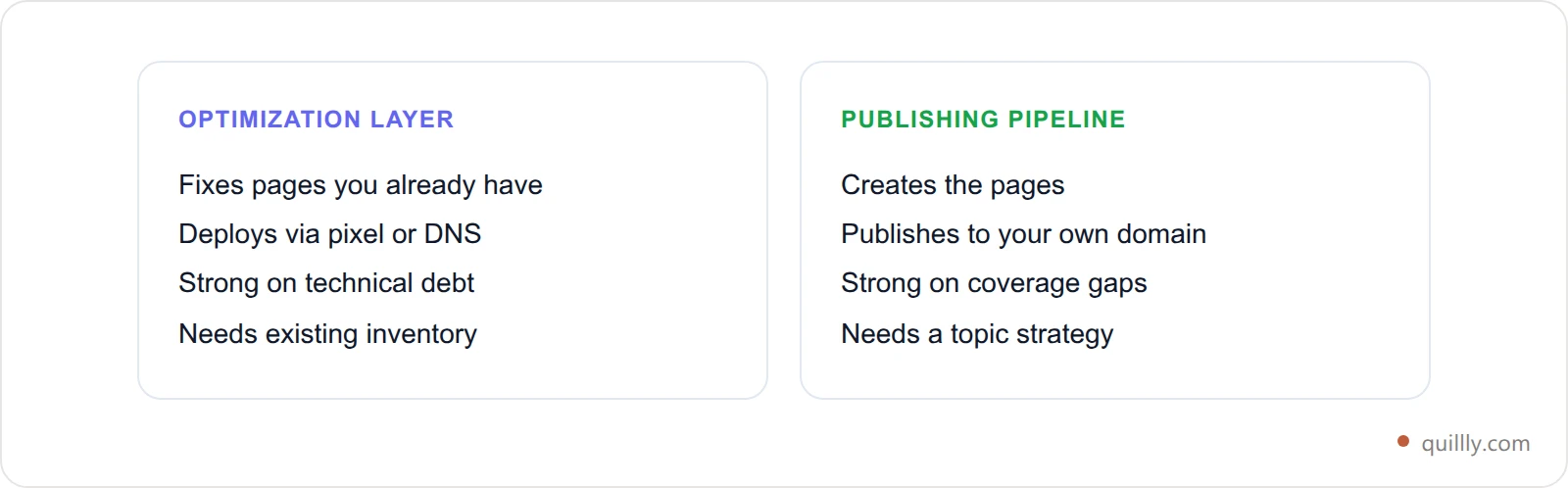
If you have 400 pages and no time, the optimization layer wins. If you have 12 pages and no coverage, no amount of optimization creates the other 388. Most sites eventually need both, in that order — pages first, polish second. Our own take on where machine autonomy genuinely helps is in the five rungs of AI SEO autonomy; the short version is that the rungs get harder as they get closer to judgment.
One practical note for anyone comparing: whatever you pick, make sure it reports on more than Google. Bing, Yandex, Naver, Seznam, Yep and Amazon all accept IndexNow notifications through the open protocol, and multi-engine visibility is where a small site's easiest wins hide. Bing's own webmaster guidelines differ from Google's in ways worth knowing before you assume one tool covers both.
What to Check Before You Buy#
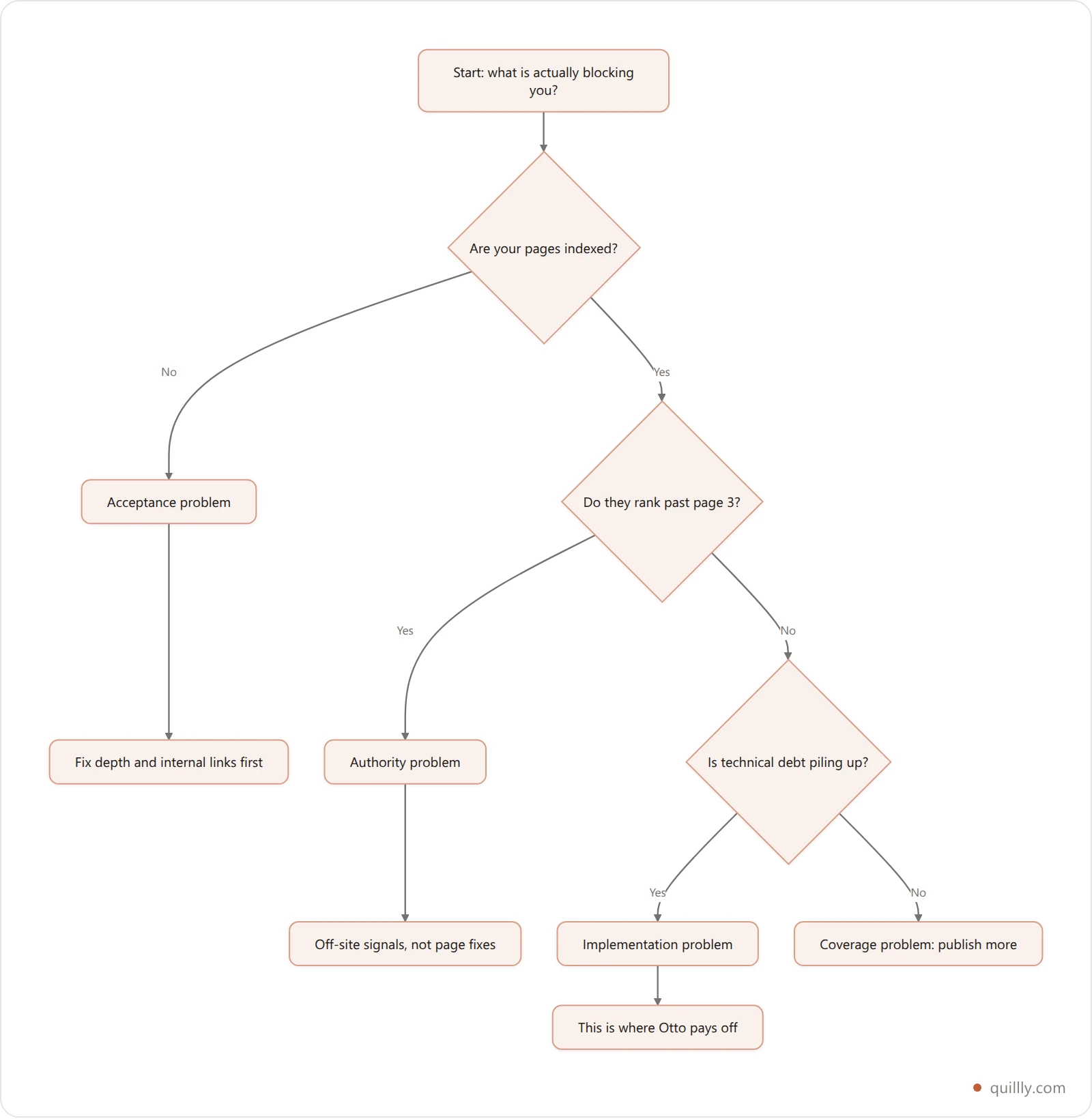
Five questions worth answering during a trial, regardless of which automation tool you're evaluating:
What happens when you cancel? Pixel-delivered changes can disappear with the script. Otto's Deep Freeze is designed for this — verify it on a real page.
Where do the changes live? If your titles are generated at runtime, your repo is no longer the source of truth. Decide whether that's acceptable.
Does it fix your actual constraint? Run the diagnosis first. If your pages aren't indexed, more on-page polish is the wrong lever.
How does the link building work? Automated link acquisition is the highest-risk module in any SEO suite. Ask exactly what's being built and where.
Does it write anything original? Google's helpful content guidance rewards first-hand experience and original data. Generated topical maps don't supply either.
See how a page gets scored before it publishes if you want the pre-publish version of that checklist rather than the post-hoc one.
Frequently Asked Questions#
What is Otto SEO?#
Otto SEO is Search Atlas's automation product. It scans your site, generates a fix list, and deploys technical, on-page, content, local and off-page changes to live pages through a header pixel, a Cloudflare DNS route, or native CMS and Git integrations — without requiring developer work for each change.
Does Otto SEO actually get pages indexed faster?#
It sends indexing notifications instantly through Google Search Console and IndexNow, which is the fastest available submission path. Acceptance is separate. Our own data shows one engine accepting 110 of 110 notified URLs while another accepted zero of 233 — the protocol worked in both cases.
Is Otto SEO worth it for a brand-new site?#
Usually not first. Otto optimizes existing pages, so it pays off when you have inventory and technical debt. A new domain's constraint is usually trust and coverage — you need more good pages and more authority before page-level polish becomes the limiting factor.
What happens to Otto's changes if you cancel?#
Search Atlas lists a feature called Deep Freeze that keeps optimizations live after cancellation. Because pixel-injected changes normally depend on the script continuing to load, this is worth testing on a real URL during a trial rather than taking on faith.
Can Otto SEO replace a content writer?#
No. It generates topical maps and articles, but originality — your own data, worked examples, first-hand experience — is the thing search engines increasingly reward and the thing generation can't manufacture. Treat generated drafts as a starting point, not a shipping artifact.
What are the main Otto SEO alternatives?#
The category splits in two. Optimization layers compete with Otto directly on deploying page fixes at scale. Publishing pipelines solve the earlier problem of producing the pages. Which one you need depends on whether your bottleneck is the quality of pages you have or the number of pages you don't.
Conclusion: Diagnose Before You Automate#
Otto SEO automates a real and genuinely tedious job: applying correct technical and on-page fixes across a site at a scale humans don't enjoy. If that's your bottleneck, it earns its keep, and the Cloudflare route makes it viable for teams without developer bandwidth.
But automation compounds what you already have. Our 147-page library is technically clean, averages a high score before anything publishes, and still sits at position 40 on Google with a 22% indexed share on Bing. Those aren't implementation failures — they're authority and acceptance problems, and they're the ones that decide whether the polish ever gets seen. Diagnose which problem you actually have before you buy the tool that fixes the other one.


