

Thirty articles a month, written and published for you, for $99. That's the Outrank pitch, and on paper it's a strong one. The problem tends to surface around week six, when you open Search Console and discover that a good chunk of those articles never made it into the index at all.
The short answer: Outrank is a capable auto-publishing SEO platform — $99/month for 30 articles, wide CMS coverage, backlinks sold as an add-on. It suits founders who want hands-off volume and have nobody to run SEO. It suits young domains far less well, because publishing volume is rarely the constraint that's actually holding a new site back.
This review sticks to things you can check. Every price below was pulled from Outrank's own pricing page in August 2026. Every indexing figure comes from a real site's Search Console data — ours — published in full, including the unflattering parts.
Most of what turns up when you search for an Outrank.so review is affiliate content with a discount code attached. This isn't that. It's an evaluation of one AI SEO content software product against the single constraint that decides whether any of this category works for you.
What's in this review
What Outrank actually does
Outrank pricing in 2026: the real numbers
The number every Outrank review skips
Cost per indexed article, not per article
Where Outrank genuinely earns its price
Where auto-pilot breaks down
Outrank vs. an MCP-native workflow
Who should buy it — and who shouldn't
Frequently asked questions
What Outrank Actually Does#
Outrank sells a single loop: analyse your niche and competitors, pick keywords, then generate and publish SEO articles to your site every day without you touching them. Its own homepage puts it plainly — "We create and publish SEO-optimized articles from your plan every day. Your blog grows automatically while you focus on your business."
It plugs into a genuinely broad set of destinations: WordPress, Webflow, Shopify, Framer, Wix, Notion, Ghost, WordPress.com, Next.js blogs, and a generic webhook. That's wider CMS coverage than most tools in the category, and it's the part of the product that works exactly as advertised.
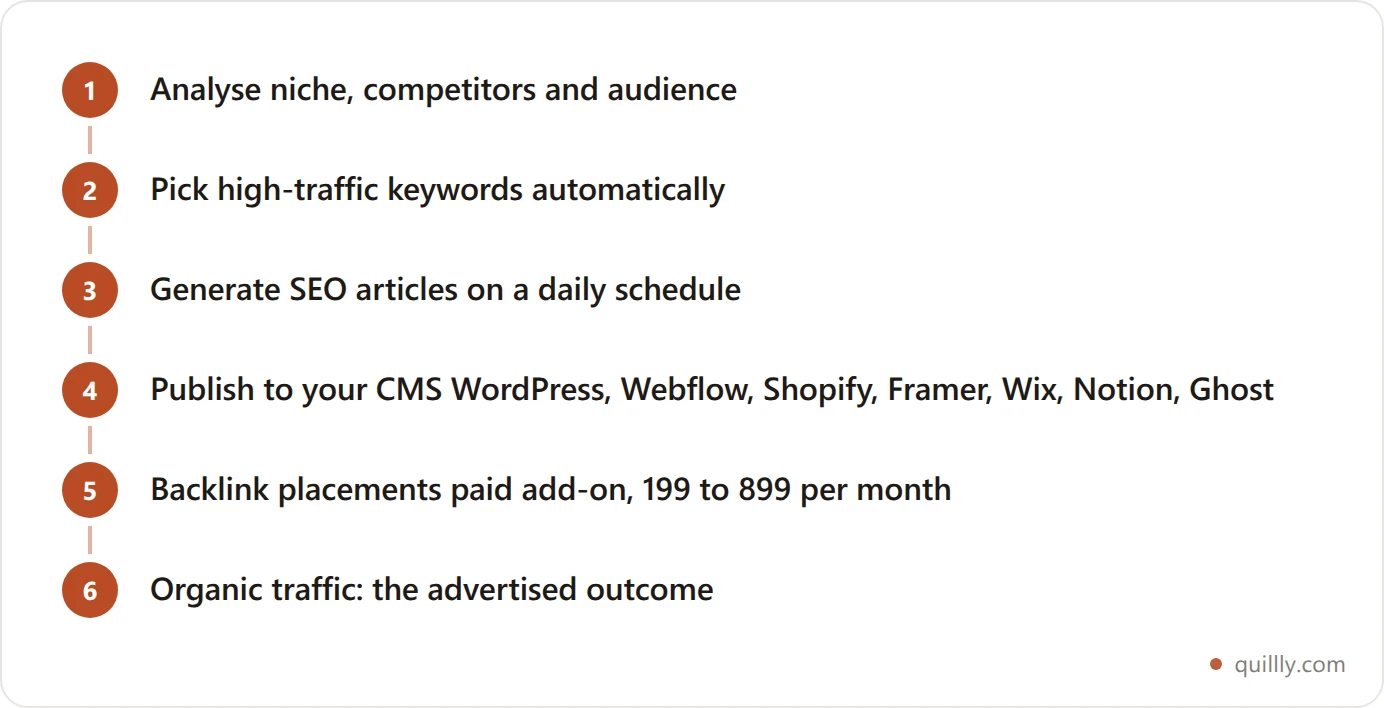
You configure that loop once and it runs. Nothing in it asks you to approve a piece before it goes live, and that single design choice is what everything else in this review follows from.
Two things it is not. It isn't a writing assistant you collaborate with — you configure it and it runs. And it isn't driven from your AI tools; there's no Model Context Protocol server, so you can't ask Claude or ChatGPT to draft, score and publish a piece in your own voice. The trade is deliberate: you give up control to gain hands-off consistency.
Outrank Pricing in 2026: The Real Numbers#
Outrank runs one core plan with a stack of paid add-ons. These were the listed prices in August 2026:
Item | Price | What you get |
|---|---|---|
All-in-One (monthly) | $99/month | 30 articles/month, generated and published |
All-in-One (annual) | $999/year | Same, ~$189 cheaper than paying monthly |
60 articles/month | +$85/month | Doubles output |
90 articles/month | +$160/month | Triples output |
Backlink Premium | +$199/month | Link placements |
Backlink Enterprise | +$899/month | Higher-volume link placements |
Human Curated Service | $1,399/month | Editors in the loop |
Premium Images | +$49/month | Better image generation |
Free Tools Builder | +$199/month | Hosted mini-tools |
Directory Submission | $500 one-time | Directory listings |
Websites are unlimited, with volume discounts (10% off for 2–4 sites, 15% for 5–19, 20% for 20–25). There's a free trial, but the articles it produces are watermarked — you can evaluate the writing, not ship it.
Read the table honestly and the headline price is a floor, not a ceiling. The base plan is $99. A setup with meaningful link-building runs $298/month. Add human editing and you're past $1,400. That's normal for the category, but "auto-pilot from $99" and "what most buyers actually end up paying" are different numbers.
The Number Every Outrank Review Skips#
Here's the part the affiliate roundups leave out, and it has nothing to do with Outrank specifically.
Publishing an article is not the same as having an article. Between the two sits a pipeline you don't control, and every stage of it leaks.
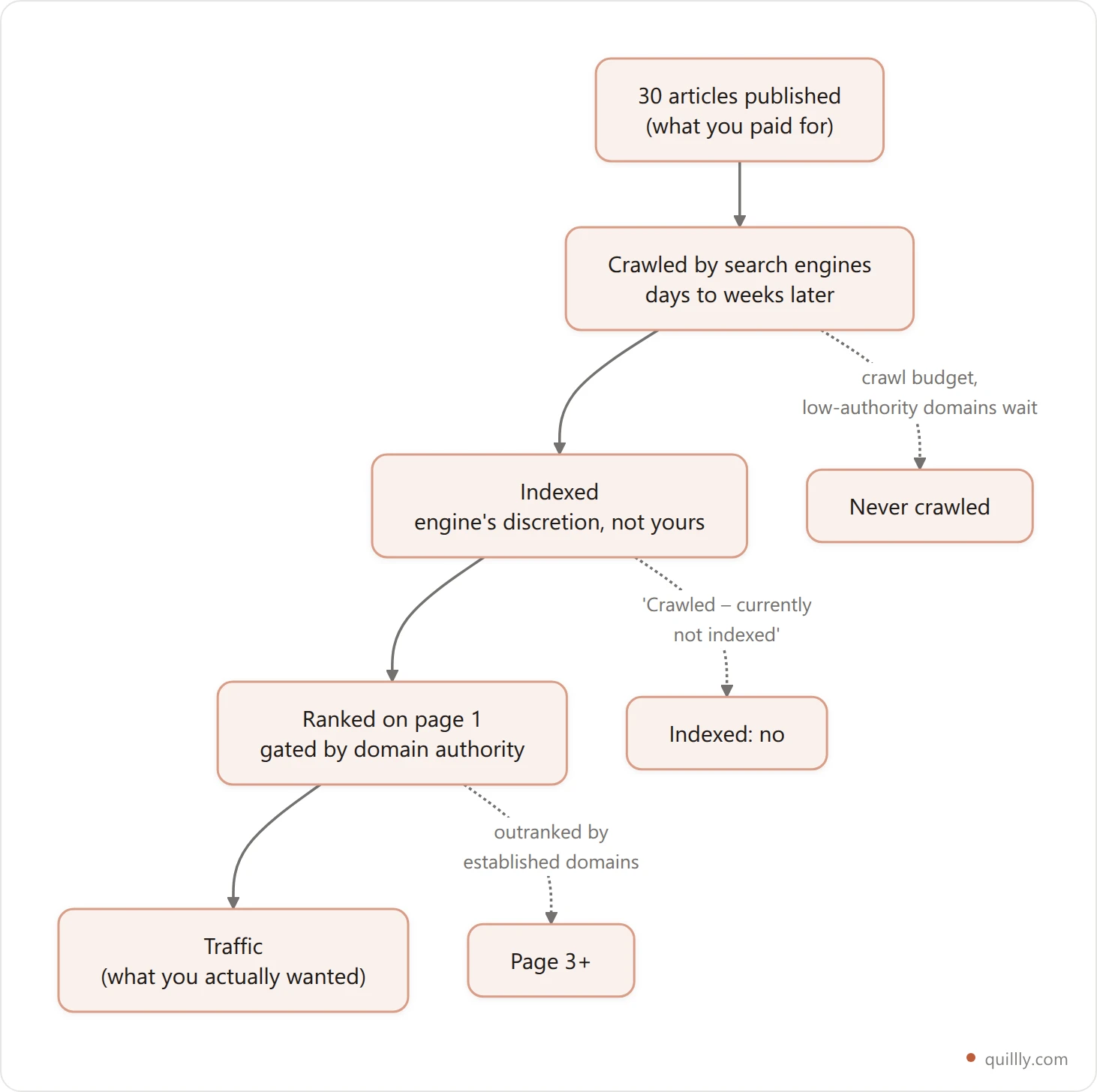
Every tool in this market sells you stage one and quietly implies stages two through five. Nobody controls indexing. As search engines put it themselves, indexing is at their discretion — you can request a recrawl, and that's the extent of your leverage.
So the useful question isn't "what does an article cost?" It's "what does an indexed article cost?" And that answer depends almost entirely on your domain's authority, not on which tool wrote the words.
Cost Per Indexed Article, Not Per Article#
We can put real numbers on this because we publish ours. quillly.com is a Domain Rating 12 site with 129 published pages. Here's where those pages actually stand across engines:

Now apply those rates to Outrank's $99 for 30 articles. Sticker price is $3.30 an article. But if 59% of them get into Google, you paid for 30 and got 17.7 — which is $5.59 per article that Google can actually serve. On Bing's 19%, you got 5.7 pages, at $17.37 each.

To be scrupulously fair to Outrank: these are our indexing rates, not theirs, and a stronger domain would post better ones. That's the whole point. The multiplier that turns $3.30 into $5.59 or $17.37 is your domain authority, and no content tool sets it. If you're buying volume to fix a traffic problem, you may be buying the wrong input entirely — we've written up [what actually moves the needle on Domain Rating](https://quillly.com/blogs/increase-domain-rating-2026) and [why publishing frequency should be capped by your indexing rate](https://quillly.com/blogs/how-often-should-you-blog) if you want to go deeper. And if you'd rather test the cheap end of this market before committing $99 a month, you can start a 14-day trial with no card and compare on your own domain.
Where Outrank Genuinely Earns Its Price#
It would be dishonest to spend a whole review on one caveat, so here's the case for it.
The integrations really are broad. Ten publishing destinations including Shopify and Notion is more than most competitors ship, and the webhook covers the rest.
Hands-off consistency beats sporadic effort. A site that publishes 30 mediocre-to-decent posts a month will out-perform one that publishes three excellent posts a quarter and then stops. Consistency is the most underrated variable in content, and automation genuinely delivers it.
Backlinks are bundled into the same workflow. Most content tools ignore off-page entirely and leave you to solve the harder half yourself. Whether the placements are worth $199/month is a separate question, but at least the problem is acknowledged.
It's the right answer for non-technical operators. If nobody at your company will ever open Search Console, a system that just runs is worth more than a better system that needs a driver.
If you're a local business or an e-commerce store on an established domain with no in-house SEO, Outrank is a reasonable purchase. That's a real segment and it's well served here.
Where Auto-Pilot Breaks Down#
Volume is a policy risk on a weak domain. Google's spam policies name scaled content abuse — generating pages at scale primarily to manipulate rankings — as a violation. Automated publishing isn't automatically abuse, but the faster you publish thin pages, the closer you sit to that line. We've covered how the scaled content abuse policy is being enforced in detail.
You can't steer it mid-flight. The product's virtue is that it runs without you. Its cost is that when it writes something off-brand or factually wrong about your product, you're editing after publication rather than before.
The watermarked trial limits evaluation. You can judge the prose, but you can't run a real end-to-end test on your own domain before committing.
Publishing isn't submission. Getting a page live and getting engines to notice it are separate jobs. If your tool stops at the CMS, getting indexed quickly is still your problem — and on most domains it's the binding one. Tools that submit on publish close that gap for you; you can see how automatic submission works before you commit to anything.
Outrank vs. an MCP-Native Workflow#
The obvious disclosure: we build Quillly, so treat this section as a vendor's argument rather than a neutral verdict. The comparison is still worth making because the two products solve the same problem from opposite directions.
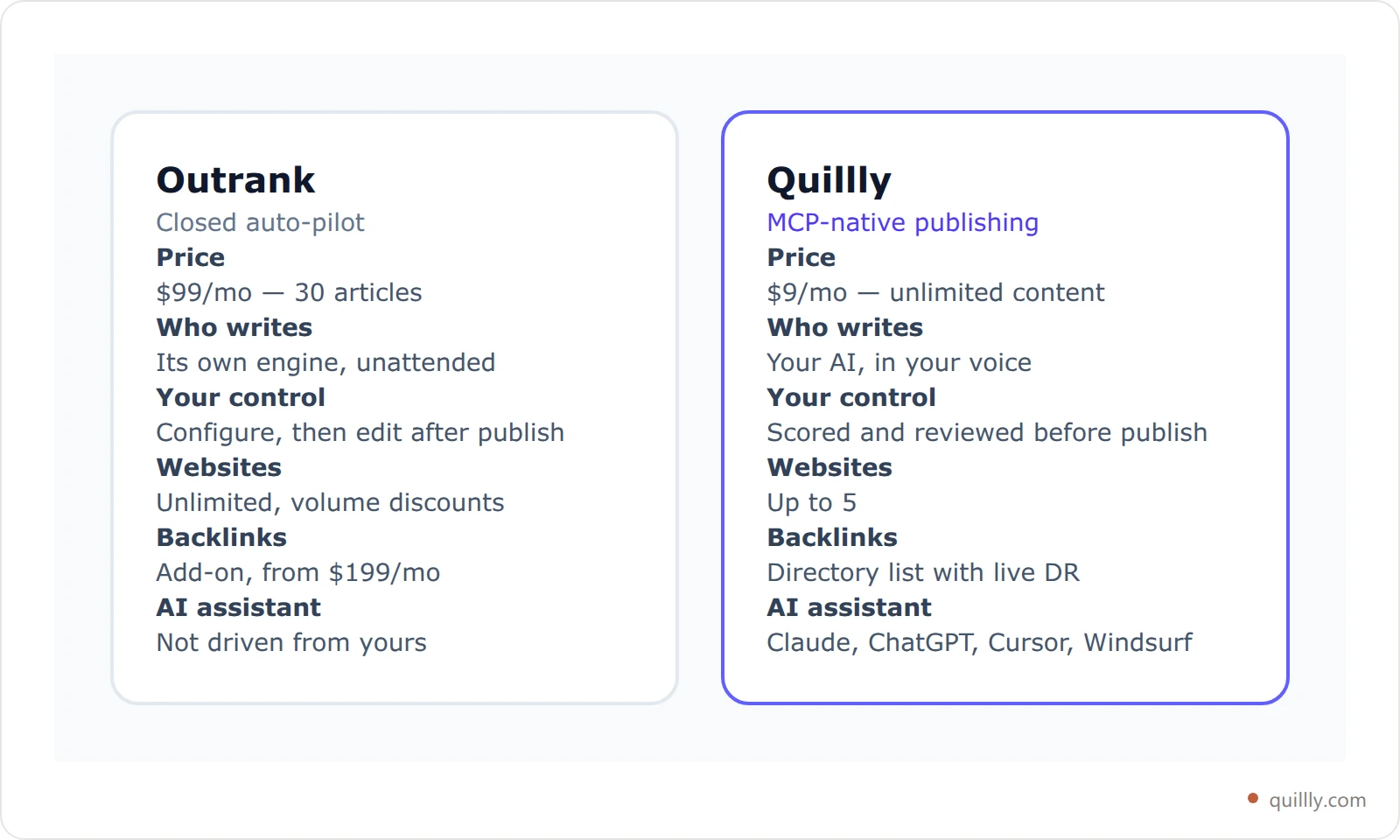
The philosophical split is about where the human sits. Outrank puts you before the process — you set it up, then it runs. Quillly puts you inside it: you connect an MCP server to the assistant you already use, and your AI gets real publishing tools, scores every draft against 14+ SEO criteria before it ships, and submits the result to 8 search engines — Google via sitemap and RSS through Search Console, and Bing, Yahoo, Yandex, Naver, Seznam, Yep and Amazon through the IndexNow network.
Worth noting honestly: only three of those eight (Google, Bing, Yandex) report indexing status back, so "submitted to 8" and "indexed on 8" are not the same claim. That distinction is exactly the sort of thing this whole review is about. If multi-engine coverage is new to you, ranking beyond Google covers why the smaller engines are often the easier win on a young domain.
Neither model is universally right. If you want to stop thinking about content, buy the auto-pilot. If you'd rather publish from the AI you already work in and keep a hand on the wheel, the MCP route costs an order of magnitude less and gives you veto power over every page.
Who Should Buy Outrank — and Who Shouldn't#
Buy Outrank if your domain is already established, nobody in-house will ever run SEO, and you want auto-pilot SEO that doesn't need a driver. Skip it if your site is new, if indexing rather than output is your real bottleneck, or if you need to approve what your brand publishes before it goes live rather than after.
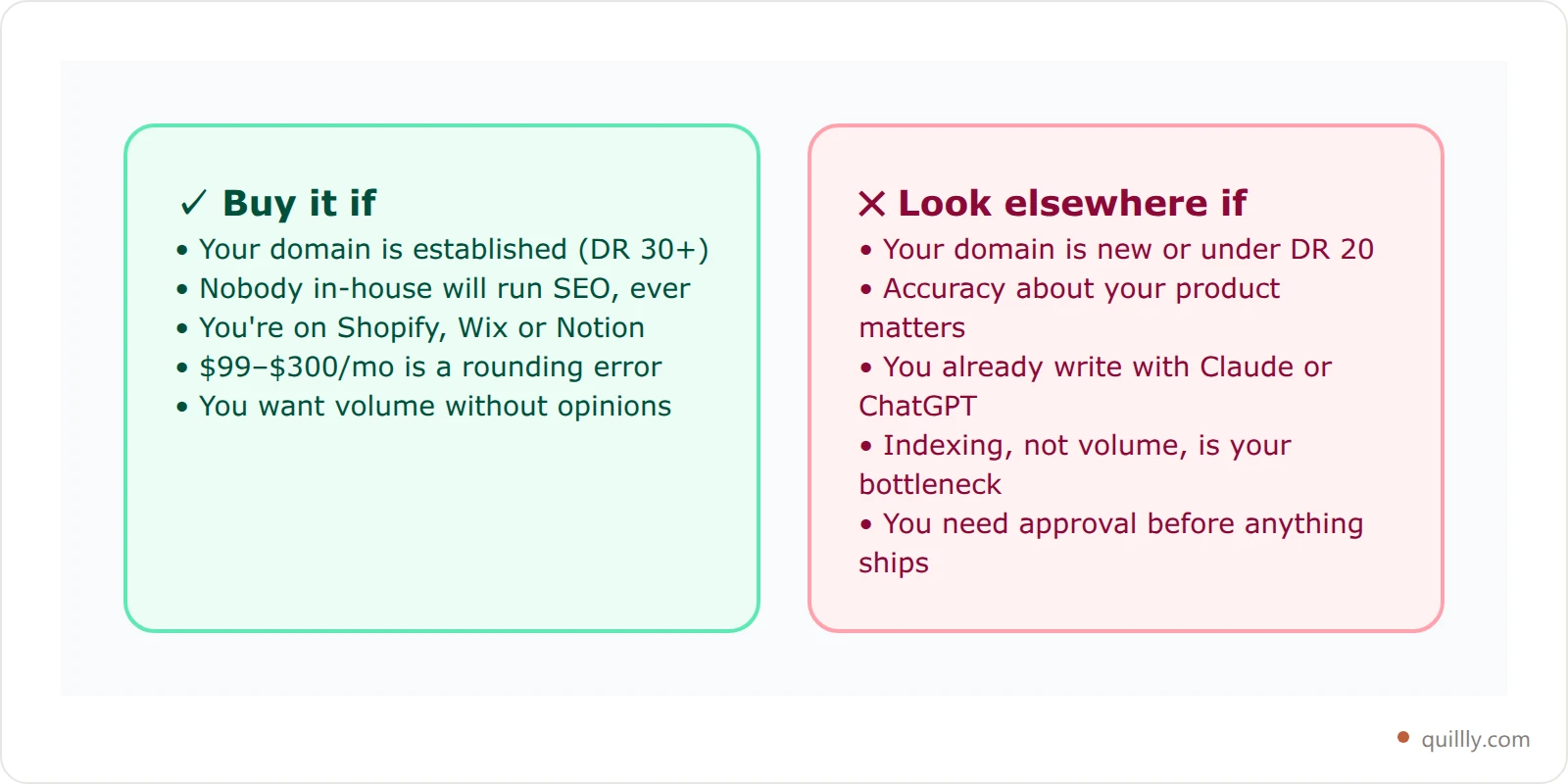
The dividing line isn't budget or taste. It's whether volume is genuinely your constraint. On an established domain where new pages get crawled within days, 30 articles a month compounds beautifully and Outrank is a fine way to buy them. On a young domain where over 40% of what you publish never reaches Google's index, buying three times the volume mostly buys three times the unindexed pages — and, per Google's own spam policies, edges you toward a risk you didn't need to take.
Spend that budget on authority first. Then automate.
Publish from the AI you already use
Connect Quillly's MCP server to Claude, ChatGPT, Cursor or Windsurf. Every draft scored against 14+ SEO criteria before it ships, published to your own domain, submitted to 8 search engines. 14-day free trial, no card — then $9/month for unlimited content on up to 5 websites.
Start free trialKey Takeaways#
Outrank lists at $99/month or $999/year for 30 published articles. A realistic setup with link-building runs $298/month, and human editing pushes it past $1,400.
The free trial watermarks its articles, so a true end-to-end test on your own site isn't possible before you buy.
Sticker price works out to $3.30 an article. Measured against a real DR 12 site's indexing rates, the cost per *indexed* article is $5.59 on Google and $17.37 on Bing.
Your indexing rate is the multiplier, and no content tool sets it. Volume amplifies whatever rate you already have; it doesn't improve it.
Buy the auto-pilot when volume is genuinely the constraint. When it isn't, spend the same budget on authority and indexing first.
Frequently Asked Questions#
How much does Outrank cost in 2026?#
The All-in-One plan is $99/month or $999/year and includes 30 generated and published articles per month across unlimited websites. Add-ons extend it: 60 articles for $85/month more, 90 for $160, backlink packages at $199 or $899, and a human-curated service at $1,399/month. Prices checked August 2026.
Does Outrank have a free trial?#
Yes, but with a meaningful limit — trial articles are watermarked. You can evaluate the quality of the writing before paying, but you can't publish trial output to your live site, so a genuine end-to-end test isn't possible until you're a customer.
Is Outrank's automated content against Google's guidelines?#
Not inherently. Google's spam policies target scaled content abuse — mass-producing pages mainly to manipulate rankings rather than to help readers. Automation itself is fine; the risk rises with volume and falls with genuine usefulness. Publishing 30 thin pages a month on a young domain is a materially different risk profile from 30 substantive ones.
What's the main alternative to Outrank?#
It depends what you're optimising for. For hands-off volume on an established site, tools like Outrank and its direct competitors are the category. For control and cost, an MCP-native platform lets your existing AI assistant write and publish, typically at a fraction of the price. We've written about how to structure an alternatives comparison if you're evaluating several.
Will 30 articles a month actually grow my traffic?#
Only if they get indexed and rank. On a low-authority domain, a large share of new pages never enter the index at all — our own DR 12 site sits at 59% on Google and 19% on Bing. Volume multiplies whatever your indexing rate already is; it doesn't improve it. Fix authority and indexing first, then scale output.
Can I use Outrank alongside my own AI assistant?#
Not directly. Outrank runs its own generation pipeline and doesn't expose an MCP server, so you can't drive it from Claude, ChatGPT or Cursor. If working inside your assistant matters, that's the clearest functional difference between it and MCP-native tools — you can connect one to your AI in about 30 seconds and compare directly.


