In February 2026, a wave of AI-built blogs woke up to Search Console graphs that looked like a cliff. One site publishing 1,800 auto-generated posts lost most of its Google traffic in nine days. There was no manual action, no email, no warning. It got caught by scaled content abuse — Google's spam policy for mass-produced pages, and the single biggest reason AI blogs collapse in 2026.
Here's the part most founders get wrong. Google didn't punish the site for using AI. It punished the site for shipping volume with no value. The March 2026 spam update — the fastest in Google's documented history, wrapping in under 20 hours — was built to find exactly that pattern automatically, at scale.
If you publish from Claude, Cursor, or ChatGPT and the word "penalty" makes your stomach drop, read on. The line between safe and doomed is clear, and it's not the tool you used.
The short answer: Scaled content abuse is Google's spam policy against producing many pages primarily to manipulate rankings rather than help people — no matter whether a human or an AI wrote them. It targets low-value volume, not automation. AI content is fine. Unedited AI content shipped at scale is not.
What scaled content abuse actually means#
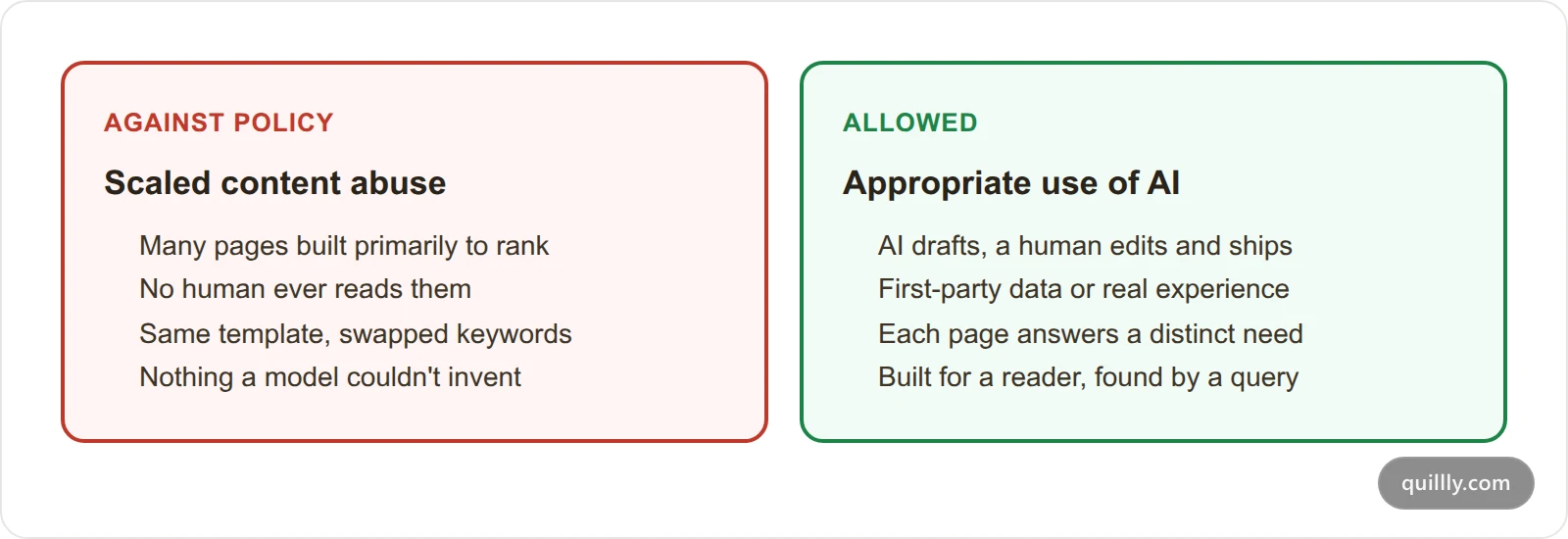
Scaled content abuse is Google's name for producing many pages primarily to game search rankings instead of helping readers. The policy is deliberately origin-blind: human spam and AI spam are judged by the same rule and face the same consequences.
Google renamed the policy from "spammy auto-generated content" to "scaled content abuse" in March 2024, then spent 2025 and 2026 sharpening enforcement. The official language is blunt:
"Using automation — including AI — to generate content with the primary purpose of manipulating ranking in search results is a violation of our spam policies." And: "Appropriate use of AI or automation is not against our guidelines." — Google Search Essentials, Spam Policies
Read those two sentences together and the rule snaps into focus. The trigger word is primarily. If a page exists first to catch a query and only incidentally to help a person, it's exposed — whether you wrote 3 pages or 3,000.
It's not an AI penalty, it's a quality penalty#
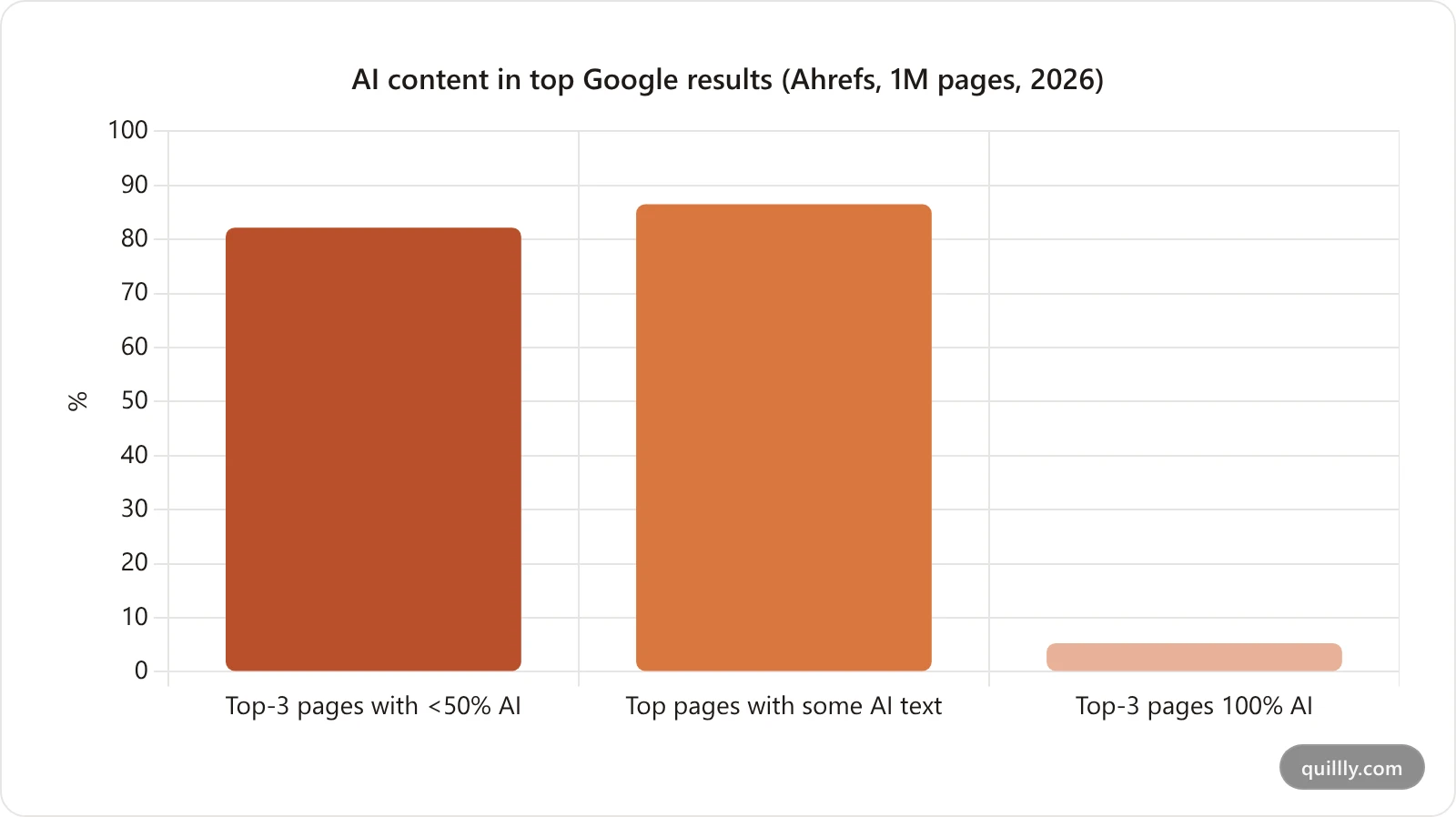
The data is emphatic: Google does not downrank pages for containing AI text. In June 2026, Ahrefs analyzed one million pages pulled from the top 10 results across 100,000 searches. The finding, from Ahrefs' Ryan Law, was that 86.5% of top-ranking pages contain some AI-generated text — and higher rankings correlate with more human involvement, not the absence of AI.
82.2% of top-3 results are pages with under 50% AI content.
Only 5.3% of top-3 pages are 100% AI-generated — a small minority, but proof fully-AI pages can still rank.
Very-high-AI pages get indexed 40.35% of the time versus 49.28% for low-AI pages: a gap driven by quality, not a switch that flips on "AI detected." A separate Rankability study of 487 top results reached the same verdict: what decides rankings is quality, not origin.
"I don't think Google is trying to punish AI-generated content. I think it is relying on the same old hallmarks of content quality that it always has." — Ryan Law, Director of Content Marketing, Ahrefs
John Mueller put the same point more plainly in late 2025: Google's systems don't care whether a human or an AI created the content — only whether it's helpful, accurate, and made to serve people rather than manipulate rankings. If your AI blog is sinking, the AI isn't the problem. The missing quality layer is. (We break the myth down further in Does Google Penalize AI Content?.)
What the March 2026 update actually did#
The March 2026 spam update turned scaled content abuse from a policy on paper into a purge. It was the fastest spam update Google has documented, completing in under 20 hours, and it shipped with a sharper version of SpamBrain — the machine-learning system that flags mass-produced, low-value pages regardless of who made them.
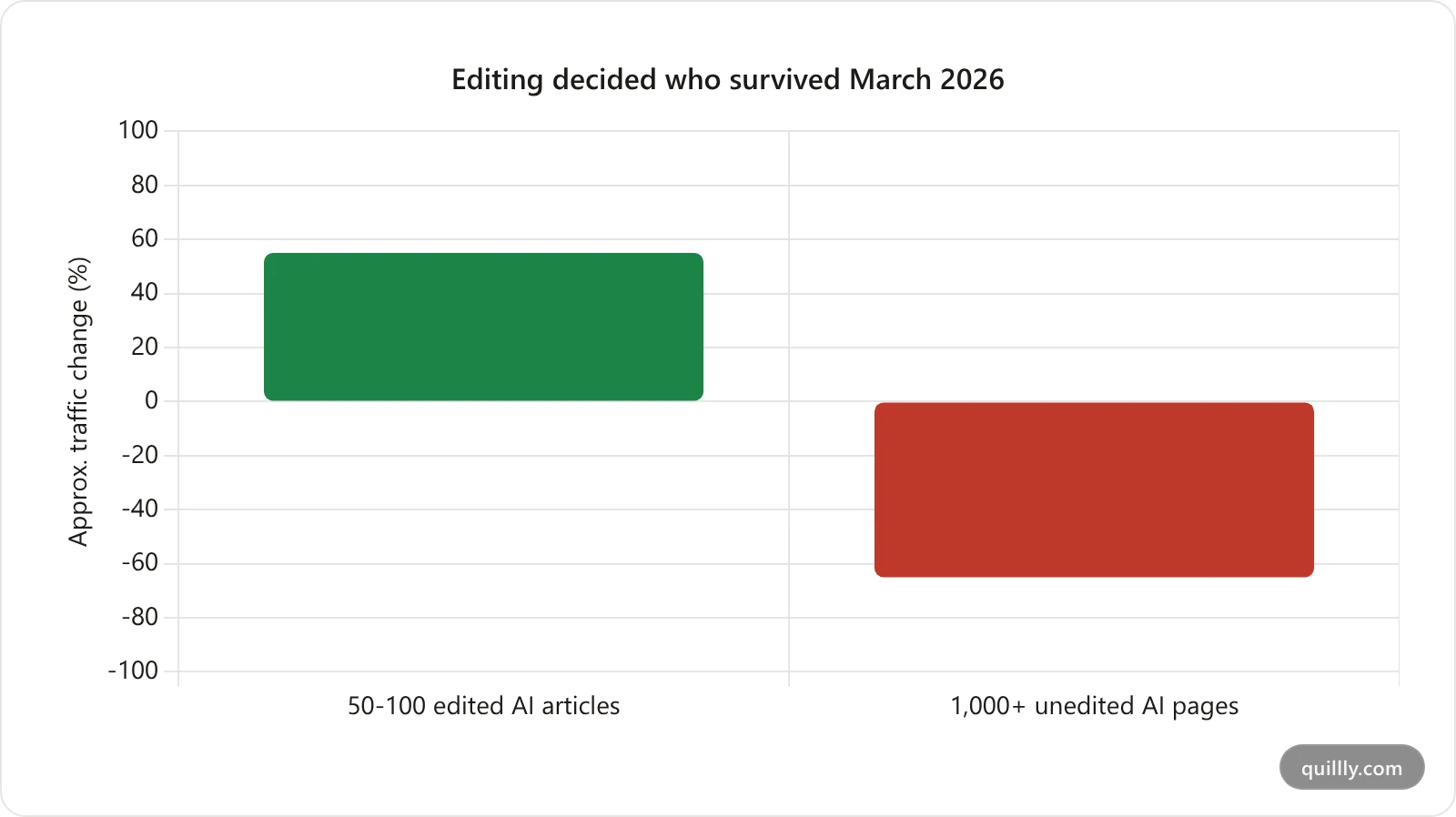
The split in outcomes was stark, and it tracked one variable: editorial investment.
Sites publishing 50 to 100 quality AI-assisted articles with human editing saw traffic climb 30% to 80%.
Sites publishing 1,000 or more unedited AI pages saw traffic fall 40% to 90%.
Same underlying tool. Opposite results. The update didn't ask "was this AI?" It asked "did a person make this worth reading?" That's the whole 2026 story in one question, and it's why "just generate more posts" is now the fastest way to lose a site.
The 5 signals that trigger scaled content abuse#
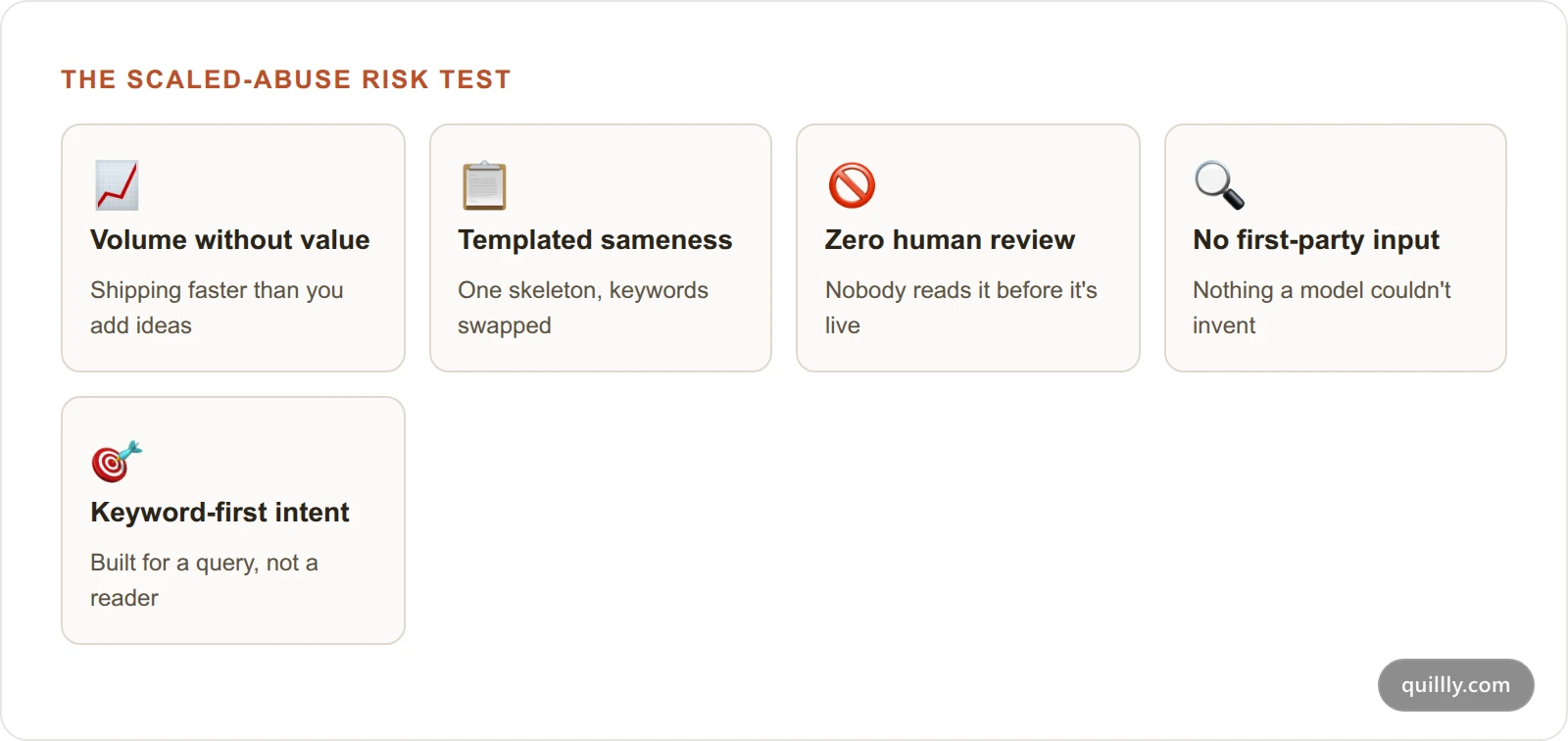
Most penalized sites share the same fingerprints. Use this as a repeatable check before you publish anything at volume — call it the Scaled-Abuse Risk Test. If a batch of posts trips three or more of these five signals, you're building the exact pattern SpamBrain is trained to catch.
# | Signal | Risky version | Safe version |
|---|---|---|---|
1 | Volume without value | Publishing faster than you can add a single new idea | Each post carries one thing readers can't get from the model alone |
2 | Templated sameness | One skeleton, keywords swapped per page | Structure varies with the actual question |
3 | Zero human review | Nobody reads it before it goes live | A named person edits and approves |
4 | No first-party input | No data, examples, or experience | Original numbers, screenshots, or lived detail |
5 | Keyword-first intent | Page built for a query, not a reader | Page built for a reader, found by a query |
The test isn't about hitting a magic word count or a page limit — Google has never named one. It's about whether volume is outrunning value. Two hundred pages with real first-party insight are safe. Twenty near-identical pages built only to rank are not.
Scaled vs. scaled abuse: where's the line?#
Scaling content is not the crime. Google indexes millions of legitimately templated pages — product listings, location pages, data tables. The crime is scaling emptiness. The difference between programmatic SEO that ranks and scaled abuse that gets deindexed comes down to five dimensions.
Dimension | Legit scaled content | Scaled content abuse |
|---|---|---|
Primary intent | Serve a real user need | Manipulate rankings |
Uniqueness | Each page adds distinct value | Spun or near-duplicate |
Data source | First-party facts, live data | Whatever the model guessed |
Human role | Reviews, edits, approves | None |
Typical outcome | Indexed, ranks, holds | Crawled-not-indexed, then dropped |
Programmatic publishing done right — unique data per page, a human in the loop, a genuine reason each URL exists — is one of the strongest plays in 2026. We walk through the safe version in Programmatic SEO With MCP. The failure mode is always the same: teams keep the scale and drop the substance.
How to publish AI content at scale without a penalty#
The winners and losers of March 2026 differed by one thing: the quality investment after generation. Drafting is where AI saves you time. Editing is where you earn the ranking. Here's the pass that keeps volume from tipping into abuse:
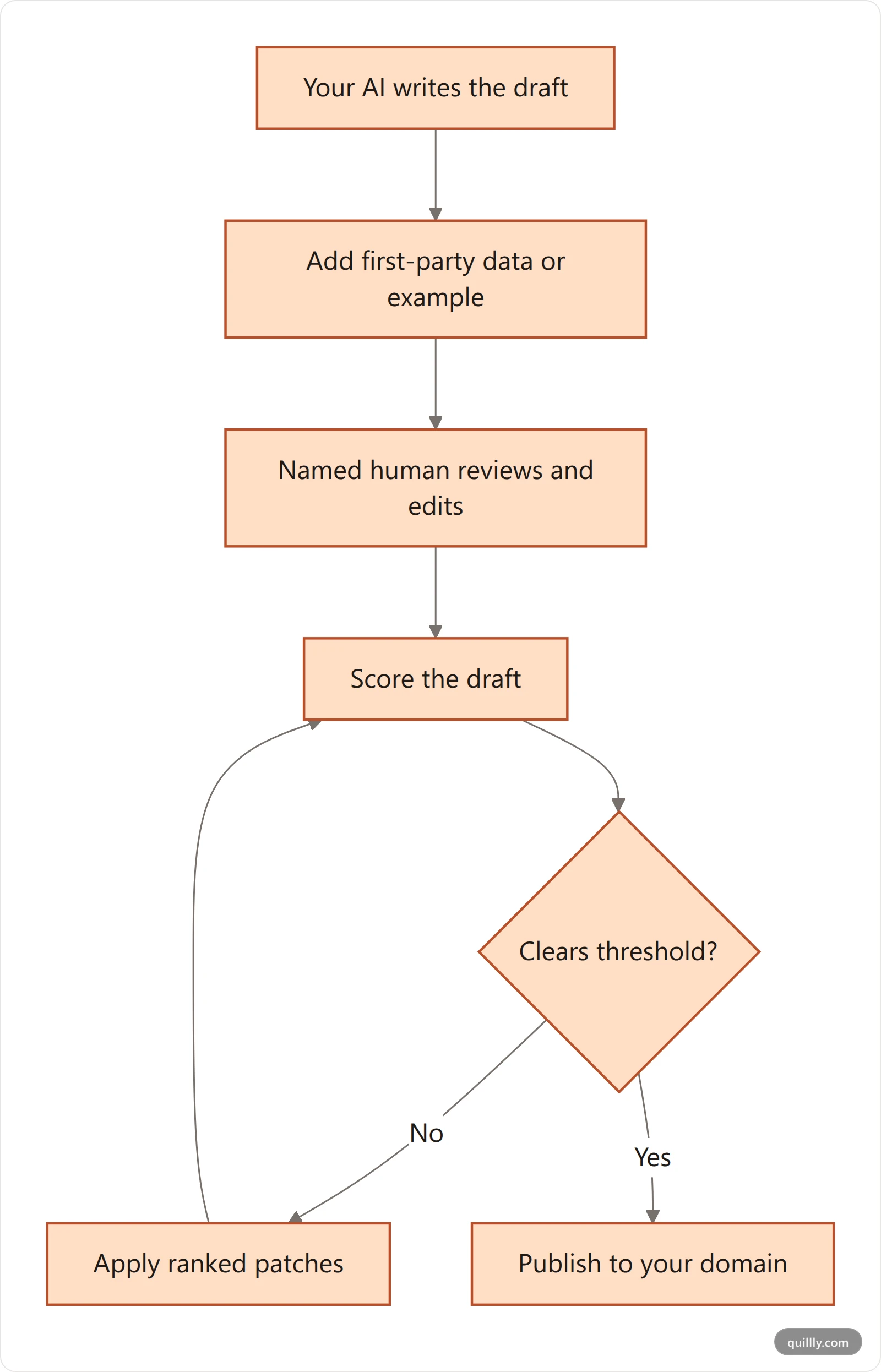
Add first-party value. Inject one thing the model can't produce — your own numbers, a screenshot, a customer story, a tested result. This is the anchor no other AI page has. Our guide to turning original data into ranking content covers how.
Name a human reviewer. Real authorship and editorial sign-off are core E-E-A-T signals. Don't ship anything nobody read. See the E-E-A-T playbook for AI content.
Fact-check the claims. Google rewards accuracy; a confident hallucination is a trust killer and, at scale, a footprint.
Vary structure to the question. Kill the one-template-fits-all skeleton that makes a batch look mass-produced.
Score every draft before it goes live. Give yourself an objective gate that catches thin, duplicated, or under-linked pages before Google does.
Want your AI to actually publish the post it just wrote — with that gate built in? Connect Quillly to Claude or ChatGPT in 30 seconds.
The pre-publish quality gate#
The cheapest insurance against scaled content abuse is a gate every post has to clear before it goes live. Instead of eyeballing quality, you score it — the same way Google's systems do, only before publish instead of after. In practice that's three tool calls between your AI's draft and a live URL.
# 1. Score the draft your AI just wrote
check_blog_seo(website_id, blog_id)
  -> { score: 71, criticalIssues: ["thin section", "no internal links"] }

# 2. Get the exact fixes, ranked by point impact
get_blog_seo_patches(website_id, blog_id)
  -> ["+8 add first-party example", "+5 fix meta", "+4 add 2 internal links"]

# 3. Publish only once the gate clears
publish_content(website_id, blog_id)   # after score >= your threshold
This is the difference between publishing volume and publishing volume that holds. A draft that scores 71 with two thin sections is exactly the kind of page the March 2026 update flagged — so it never ships until it's fixed. The score isn't vanity; it's the footprint check you run on yourself. You can see every criterion in how the blog SEO score is calculated and in the scoring docs.
Already been hit? How to recover#
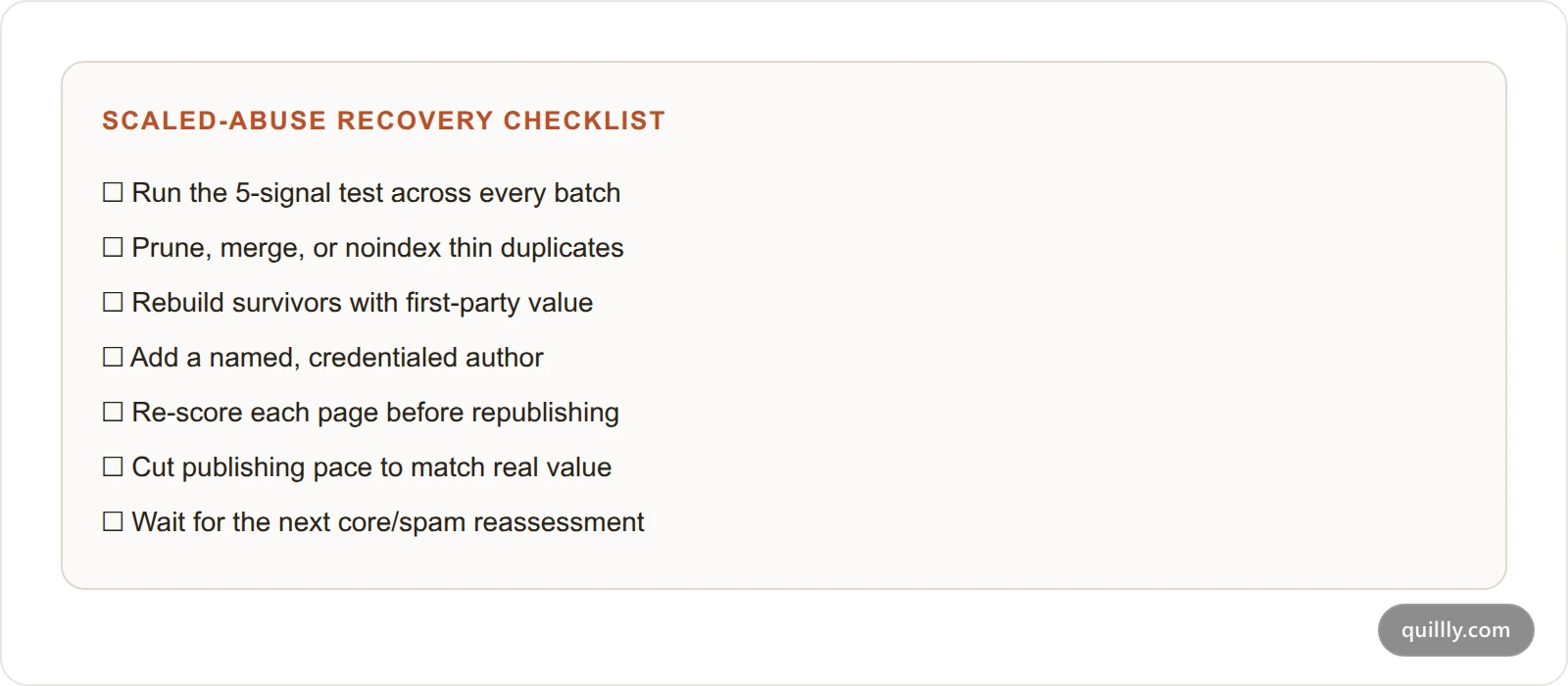
Scaled content abuse enforcement is algorithmic, so recovery is too — there's usually no manual action to appeal, and you climb back at the next assessment, not the next hour. Set expectations for weeks, not days, and work the pattern, not individual pages — the same discipline covered in our Google core update recovery playbook.
Audit against the 5 signals. Run the Scaled-Abuse Risk Test across your library. The batches that trip three or more are your problem set.
Prune ruthlessly. Delete, merge, or
noindexthe thin, near-duplicate pages. Fewer strong pages beat thousands of empty ones — pruning dead weight is itself a ranking signal.Rebuild the survivors. Rewrite keepers with first-party data, a named author, and a real reason to exist. Re-score each one before it goes back up.
Slow the firehose. Match publishing pace to the value you can genuinely add, then let the next core or spam update re-read your site.
Frequently asked questions#
Does Google penalize AI-generated content?#
No. Google's systems don't care whether a human or an AI wrote a page — only whether it's helpful, accurate, and made for people. An Ahrefs study of one million top-ranking pages in 2026 found 86.5% contain some AI text. What gets penalized is low-value content produced at scale to manipulate rankings, no matter the author.
What exactly counts as scaled content abuse?#
Scaled content abuse is producing many pages primarily to game search rankings rather than help users. The keyword is "primarily." A page that exists first to catch a query and only incidentally to help a reader is exposed, whether it's AI-written, human-written, or a mix. Intent and value decide it, not the tool.
How many pages does it take to count as "scaled"?#
There's no magic number — Google has never published a page limit or an AI-percentage cap. Ten near-identical, keyword-first pages can trip the policy while 500 genuinely useful ones stay safe. The threshold is qualitative: is your volume outrunning the value you can add per page?
Can AI content still rank on Google in 2026?#
Yes. Fully AI-generated pages appear in 5.3% of top-3 results, and 86.5% of top pages use some AI. AI-assisted content that's edited, fact-checked, and enriched with first-party detail ranks as well as anything. The pattern that fails is unedited AI shipped at scale with nothing a model couldn't invent.
How do I recover from a scaled content abuse hit?#
Because enforcement is algorithmic, recovery is too. Audit your library against the five risk signals, prune or noindex the thin duplicates, rebuild survivors with real data and named authorship, then slow your publishing pace. You regain visibility at the next core or spam reassessment — expect weeks, not days.
Is programmatic SEO the same as scaled content abuse?#
No. Programmatic SEO built on unique first-party data, genuine user intent, and human oversight is a legitimate, powerful strategy. It becomes abuse only when you keep the scale and drop the substance — spun text, no review, pages that exist only to rank. Same mechanism, opposite intent.
Does adding an author byline stop the penalty?#
A byline alone won't save thin content, but real, credentialed authorship is a genuine E-E-A-T signal and part of the fix. It works only alongside the rest: first-party value, editorial review, accuracy, and a reason each page exists. Signals stack; a name on empty content is still empty content.
The bottom line#
Three numbers tell the whole 2026 story. Unedited AI at scale lost 40-90% of its traffic in the March update. Edited, first-party AI content gained 30-80%. And 86.5% of top-ranking pages use AI anyway. The tool was never the problem — the missing quality layer was.
So treat scaled content abuse as a design constraint, not a threat. Publish as much as you want, as long as every page clears a real gate: a human read it, it carries something a model couldn't invent, and it earned its score before it earned a URL. That's the entire difference between a content engine and a liability.
Your AI writes. Quillly handles the scoring, the gate, and the publish. Connect Quillly to Claude or ChatGPT in 30 seconds.
Related Reading#
The easiest way to avoid scaled-content signals in the first place is to not publish thin pages on a new domain to begin with. Our SEO checklist for new websites covers the content-depth bar to clear before launch, not just the technical setup.