
Quick answer: AI generated original data for content means publishing first‑party numbers — surveys, benchmarks, or model‑generated datasets — that no competitor has. Because AI Overviews increasingly cite unique, structured, verifiable data over generic articles, original data is the fastest way for a small business to earn a citation and win zero‑click visibility in 2026.
By late 2025, only about 17% of AI Overview citations came from pages ranking in the organic top 10 — down from roughly 76% in mid‑2024 (industry analysis of AI Overview citations). Ranking is no longer enough. The pages the model pulls into the answer box are the ones offering something it can't find anywhere else: original, cited data.
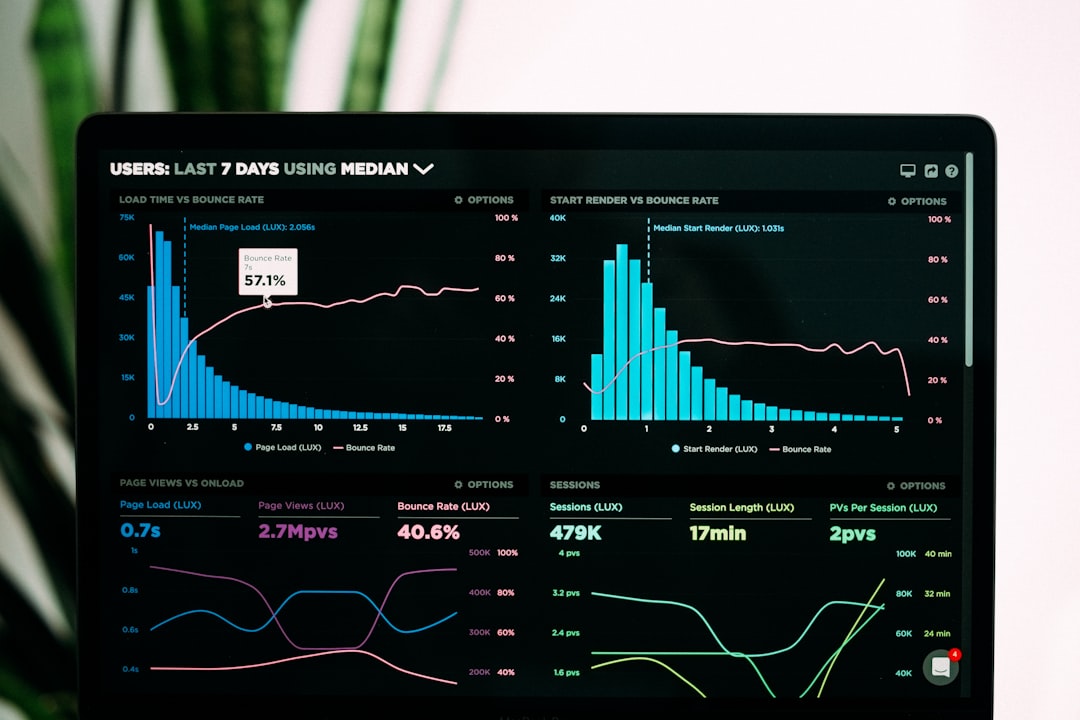
Photo by Luke Chesser on Unsplash
In this guide you'll learn:
Why original data is the secret weapon behind AI Overview citations.
A step‑by‑step workflow to generate, clean, and publish original data that fuels your content creation and SEO optimization.
Citation and schema tactics that make your data AI‑ready and lift small business ranking.
An illustrative worked example, a copyable checklist, and an FAQ you can act on today.
Why Original Data Is the Secret Weapon for AI Overviews#
Takeaway: AI Overviews reward data the model can't get anywhere else. Search has shifted from keyword matching to knowledge synthesis. When someone asks, "What's the average class attendance for boutique studios in 2026?", the AI Overview stitches together a factual answer from sources it trusts. Trust rests on two pillars:
Originality — the AI prefers data that can't be found elsewhere.
Structure — schema and citation signals tell the engine the data is reliable.
Publish a unique survey of local studio owners and that data becomes a first‑hand source. The AI can quote your numbers directly, handing you a slot in the Overview without a click — the zero‑click benefit small businesses need most.

The AI‑Ready Website connection#
Original data works best on a technically sound site. Our companion post, AI‑Ready Website 2026: Redesign Your Small Business Site for Generative AI Search, covers the foundation — structured data, schema.org markup, and fast, mobile‑first pages. Pair that base with differentiated data and the AI sees a complete, trustworthy package.
Data differentiation beats generic content#
Generic listicles can rank, but they rarely earn an Overview because the AI can pull the same list from dozens of sites. Content differentiation with data gives you a unique angle:
Exclusive survey results (e.g., 312 local coffee shops rate their Wi‑Fi reliability).
Synthetic data generated from AI models that mimic real‑world patterns tailored to your niche.
Customer insights collected via low‑cost, AI‑assisted surveys.
When the AI detects an answer backed by a dataset no other site owns, it's far more likely to elevate your snippet to the Overview slot.
"Original, AI‑generated data is quickly becoming the lifeblood of marketing, especially for brands that need to stand out in crowded search results." — Synthetic Data Is the Lifeblood of AI in Marketing, Advertising Week
A Step‑by‑Step Workflow to Create Original Data#
Takeaway: you can ship a citable dataset in a weekend, no research team required. The process below is modular — start with a simple survey and scale up as you learn.
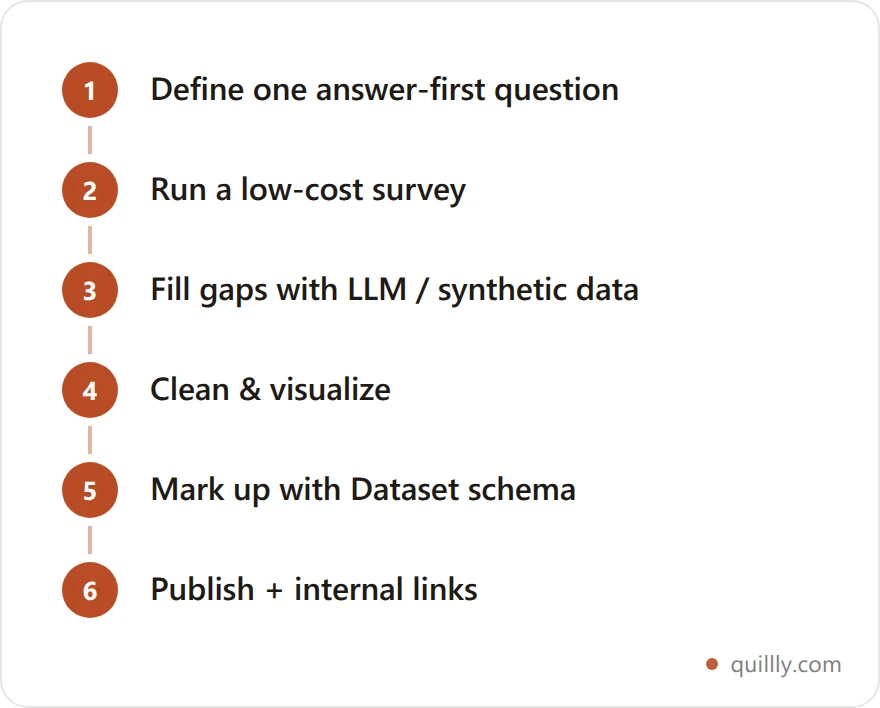
1. Define the research goal and audience#
Question | Why it matters |
|---|---|
What problem am I solving? | Aligns data with search intent. |
Who is the audience? | Determines survey language and channels. |
Which AI Overview topics are relevant? | Guides keyword and schema selection. |
Example: a boutique fitness studio wants to rank for "average class attendance for boutique studios in 2026." The goal is a dataset that answers that exact query.
2. Design low‑cost surveys with AI tools#
Choose an AI‑assisted survey builder (e.g., Typeform plus prompt templates).
Write concise, unbiased questions — keep them under 15 words.
Target distribution — email list, social channels, or local business groups.
Incentivize — offer a free class or discount for completion.
Prompt example: "Create a 5‑question survey for boutique fitness studio owners about weekly class attendance, peak hours, and member demographics."
3. Fill gaps with LLM‑powered synthetic data#
When real responses are limited, augment with synthetic data:
LLM‑generated personas that reflect typical customers.
Statistical models (e.g., Bayesian networks) that simulate realistic variation.
Synthetic data can safely fill gaps while preserving privacy — a good fit for small businesses that lack large datasets (The Rise of Synthetic Data in Marketing, CMSWire). Label synthetic figures clearly so readers — and the AI — know what's modeled versus measured.
4. Collect, clean, and visualize#
Cleaning checklist
Remove duplicate entries.
Standardize units (e.g., "hrs" vs "hours").
Flag outliers for manual review.
Visualization tips
Bar charts for categorical data, line graphs for trends.
Add a concise caption that restates the key insight.
5. Store the data in a structured schema#
Create a JSON‑LD block that follows the Dataset schema (schema.org/Dataset):
{
  "@context": "https://schema.org/",
  "@type": "Dataset",
  "name": "Boutique Fitness Studio Weekly Attendance 2026",
  "description": "Average weekly class attendance collected from 42 boutique studios across the United States.",
  "url": "https://www.yourbusiness.com/data/fitness-attendance-2026",
  "creator": { "@type": "Organization", "name": "Your Business Name" },
  "datePublished": "2026-02-01",
  "distribution": [{
    "@type": "DataDownload",
    "encodingFormat": "CSV",
    "contentUrl": "https://www.yourbusiness.com/data/fitness-attendance-2026.csv"
  }]
}
This markup tells the AI the numbers are machine‑readable, raising the odds of being pulled into an Overview. For a broader look at how AI reads and answers with your pages, see Google AI Mode SEO: How to Get Cited in 2026.
Citing, Embedding, and Leveraging Your Data#
Takeaway: citations are concentrated, so a unique dataset is your way in. Getting cited is winner‑take‑most. Semrush's analysis of AI Overview citations found the top 20 domains control about 66% of all citations — a handful of big sites soak up most of the answer box. Generic listicles compete head‑to‑head with those giants and lose. A dataset only you own doesn't.

A citation template with schema.org and JSON‑LD#
Element | Example | Reason |
|---|---|---|
|
| Tells the AI you're providing data. |
| "Local Retailer Net‑Promoter Score 2026" | Human‑readable title. |
|
| Direct link for verification. |
| Organization name | Establishes authority. |
|
| Freshness signal. |
| CSV download link | Enables downstream analysis. |
Link your data to answer engines#
Inline the key figure within the first 100 words of the article.
Reference the JSON‑LD — the AI crawls both the HTML and the structured data.
Add a "read the full dataset" call‑to‑action to signal depth.
Internal linking strategy#
Hub page — create a "Data Hub" that lists every published dataset.
Contextual links — from related posts (e.g., AI Blog Automation in 2026) using anchors like "see our original survey results." For the full method, read AI Internal Linking: The 2026 Playbook for Topical Authority.
Breadcrumbs — keep a clear path like Data → Industry Insights → Retail.
Best practices for data storytelling#
Narrative arc — problem, data, implication.
Visual hierarchy — highlight the single most important number.
Answer‑focused summary — mirror the neutral, factual tone AI Overviews favor.
An Illustrative Example: Boutique to AI Overview in 8 Weeks#
The numbers below are illustrative — a realistic model of the mechanics, not a specific client's reported results.
Picture a sustainable boutique that runs a small survey and publishes the results with Dataset schema. Here's the kind of movement the workflow is designed to produce:
Metric | Before | After (8 weeks) |
|---|---|---|
Organic sessions (monthly) | 1,200 | 2,850 |
AI Overview impressions | 0 | 4,300 |
Average session duration | 1:12 | 2:45 |
Newsletter conversion rate | 1.2% | 3.4% |
What drives that kind of lift:
Survey 50–60 real shoppers about a specific preference using an AI‑assisted form.
Model the gaps with a clearly labeled synthetic dataset.
Publish on a dedicated page with JSON‑LD Dataset markup.
Cross‑link from related posts and a Data Hub.
The mechanism is simple: when Google's AI needs a figure like "average spend on sustainable products 2026," a unique, well‑structured dataset is the easiest thing to cite.
Three Assets to Build (Then a Checklist to Ship Today)#
You don't need a resource library — you need three reusable assets you can create once and reuse for every dataset:
Data‑driven brief — a one‑page worksheet defining the research goal, audience, and KPI.
Citation cheat‑sheet — the JSON‑LD Dataset fields above, saved as a snippet.
AI data‑publishing checklist — the steps below.
Quick‑start checklist (publish today)#
☐ Define a single, answer‑oriented research question.
☐ Draft a 5‑question survey using an AI prompt.
☐ Collect at least 30 responses (or generate clearly labeled synthetic equivalents).
☐ Clean the data and standardize units.
☐ Create one clear visual (chart or table).
☐ Write a 300‑word article that opens with the key figure.
☐ Add JSON‑LD Dataset markup.
☐ Publish on a
/data/sub‑directory.☐ Add internal links from two related posts.
☐ Submit the URL in Google Search Console → URL Inspection.
☐ Watch impressions and rich‑result coverage in the Performance report.
If you'd rather not hand‑score every post, tools like Quillly grade your structure against 14+ SEO criteria and publish your schema straight to your own domain.
Frequently Asked Questions#
What is AI generated original data for content?#
It's first‑party data — surveys, benchmarks, or model‑generated datasets — that you produce and publish yourself, structured so search engines and AI Overviews can cite it. Unlike recycled statistics, it exists only on your site, which makes it uniquely citable.
Does original data really help you rank in Google AI Overviews?#
Yes. With only ~17% of AI Overview citations now coming from top‑10 organic pages, uniqueness matters more than raw ranking. A dataset the model can't find elsewhere is one of the strongest citation signals a small business can send.
Can small businesses create original data without a big budget?#
Absolutely. A 5‑question survey to 30–60 customers, cleaned and marked up with Dataset schema, is enough to become a first‑hand source. Total cost is usually an afternoon plus a free survey tool.
Is synthetic data safe and accurate to use?#
Synthetic data is useful for filling gaps while protecting privacy, but it must be labeled as modeled — never presented as measured. Use it to illustrate patterns, and lead with real responses wherever you have them.
What schema markup should I use for a dataset?#
Use JSON‑LD with @type: Dataset, including name, description, url, creator, datePublished, and a distribution block linking a downloadable file. This tells AI crawlers the data is machine‑readable and verifiable.
How long until AI Overviews cite my data?#
After publishing and submitting the URL for indexing, expect days to a few weeks. Fresh, well‑structured data on an indexed page tends to surface faster than generic content competing with established domains.
Conclusion#
Original, AI‑generated data is no longer a nice‑to‑have — it's the clearest way for a small business to earn AI Overview citations in 2026. By running focused, low‑cost surveys, filling gaps with clearly labeled synthetic data, structuring everything with schema.org Dataset markup, and linking it well, you turn ordinary content into a search‑engine‑ready asset that drives zero‑click visibility and builds authority.
Ready to start? Build your brief, run your first survey, and publish an AI‑ready dataset this week. For the technical foundation, revisit AI‑Ready Website 2026; to get cited beyond Google, see Perplexity SEO: How to Get Cited in 2026.
Sources#
Google AI Overviews Statistics 2026 — Omnibound (citation share, top‑10 shift, domain concentration)
Synthetic Data Is the Lifeblood of AI in Marketing — Advertising Week