Updated May 2026 — written for indie founders publishing with AI.
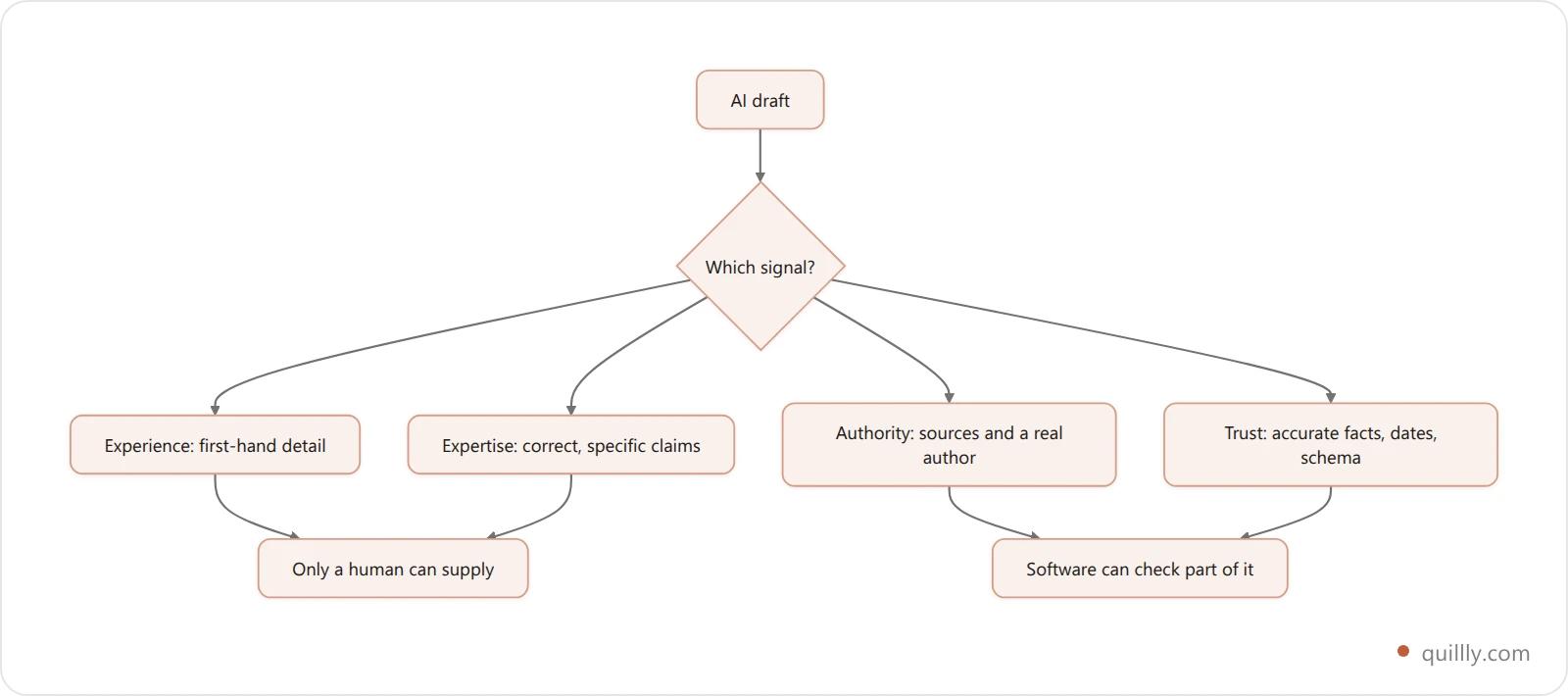
Here's the thing nobody told you when you started shipping AI-written blogs: Google's March 2026 core update cut traffic to mass-produced AI pages by 71%, but a parallel Ahrefs analysis of 600,000 top-ranking URLs found the correlation between "amount of AI in the content" and "ranking position" was 0.011 — statistically zero. Both numbers are true. They sound contradictory until you realize Google never penalized AI. It penalized the missing layer most AI workflows skip: E-E-A-T.
E-E-A-T for AI content is the quality bar Google's algorithm pushes content through before deciding whether it deserves a top-10 slot or a citation in an AI Overview. Skip the four signals — Experience, Expertise, Authoritativeness, Trustworthiness — and your AI blog reads exactly like the 71% of pages that just got nuked. Add them, and you join the 22% of sites whose visibility went up the same week.
This is the builder's playbook: a 4-signal framework, a 30-minute Person-schema setup, a citation density rule, and the audit checklist Quillly's own scorer uses on every draft. Built for founders running blogs from Claude, Cursor, or ChatGPT — not for SEO consultants billing by the hour.
What "E-E-A-T for AI content" actually means
E-E-A-T for AI content refers to the four trust signals — Experience, Expertise, Authoritativeness, Trustworthiness — that Google's quality systems use to decide whether AI-assisted writing deserves to rank, get cited by ChatGPT, or appear in an AI Overview. It is not a single score and not a direct ranking factor. It is the framework the algorithm rewards content for satisfying, regardless of who or what produced the draft.
Why AI content actually got penalized in 2026 (and it's not what you think)
The common take is wrong. Google's official position hasn't moved in three years: AI-assisted content is fine as long as it's helpful. The Search Central guidance from February 2023 still applies — what matters is whether the content is reliable, original, and useful, not whether a human typed it.
So what got crushed in March 2026? Three patterns the data points to:
Scaled paraphrase. Sites that fed competitor articles into ChatGPT, rewrote them, and shipped 200 posts a month. Ahrefs found these saw 60–80% traffic drops with no editorial signal in sight.
Faceless bylines. Posts without an author entity Google could verify. One 2026 analysis from Leadgen Economy shows pages from domains with anonymous authorship are now routinely passed over for AI Overview citations in favor of lower-ranking pages with verified authors.
Missing experience signals. Generic "ultimate guides" with no first-hand language. Google's March update amplified the first E — Experience — beyond every other signal in the framework.
Here's the counter-intuitive part. If you ship one well-edited post a week with a real author bio, a few first-hand anecdotes, and proper citations, you're closer to passing E-E-A-T than a hand-written generic post from a faceless content farm. The format doesn't matter. The signals do.
"A personalized editorial and optimization workflow is required to ensure quality, originality, and expertise by integrating unique brand insights and first-party data." — Aleyda Solís, founder of Orainti, on scaling AI content without penalty.
That quote is the whole playbook in one sentence. The next 3,000 words are how to actually build that workflow.
The REAL framework: four signals every AI blog needs
You don't need a 47-item checklist to pass E-E-A-T. You need four signals, in this order:
R — Real author entity. A verified human with Person schema, a stable URL, and external profiles Google can graph-traverse.
E — Experiential details. Specific, first-hand language an AI can't fabricate without you prompting it from real experience.
A — Authority sources. Five or more linked citations to credible sources, plus original data where you can produce it.
L — Living document. Visible update cadence — last-updated stamps, changelog notes, and quarterly refresh discipline.
That's the REAL test. If a blog passes all four, you've satisfied the framework Google's systems were designed to reward. Here's the comparison that explains why each one matters:
Signal | What Google rewards | What AI usually skips | Citation lift |
|---|---|---|---|
Real author | Person schema + sameAs profiles | "By the Team" or no byline | Verified author pages outperform anonymous in AI Overview citations |
Experience | First-hand specifics, named tools, real outcomes | Generic "best practices" prose | Pages with field practice are 3.2× more cited |
Authority | 5+ external citations, named experts, original data | Borrowed claims with no source | AI content with original data outranks pure AI by 2.4× |
Living document | Last-updated stamps, quarterly refresh | "Posted once, never touched" | Pages not updated quarterly are 3× more likely to lose citations |
The rest of this playbook is one section per signal. Skip ahead to whichever one your blog is weakest on.
Signal 1 — Real author entity (the 30-minute setup)
This is the highest-leverage E-E-A-T move you can make in one sitting. Google's Knowledge Graph in 2026 increasingly relies on verified author entities to validate expertise. The mechanical core is a Person entity in JSON-LD schema with a sameAs array pointing to authoritative external profiles. That's the graph traversal that decides whether your claimed author is the same author identified elsewhere on the open web.
You need three things: a dedicated /about/<author-slug> page on your domain, a Person schema block on that page, and at least three external profiles linked via sameAs. The strongest sameAs targets are Wikidata (the primary input to Google's Knowledge Graph), LinkedIn, GitHub, Twitter/X, and ORCID if you have one.
Here's the minimum viable Person schema. Paste it in the <head> of your author page:
{
"@context": "https://schema.org",
"@type": "Person",
"@id": "https://yoursite.com/about/jane-doe#person",
"name": "Jane Doe",
"url": "https://yoursite.com/about/jane-doe",
"image": "https://yoursite.com/images/jane-doe.jpg",
"jobTitle": "Founder",
"worksFor": { "@id": "https://yoursite.com/#organization" },
"description": "Founder of Acme. Building developer tools since 2015.",
"sameAs": [
"https://www.linkedin.com/in/janedoe",
"https://github.com/janedoe",
"https://x.com/janedoe",
"https://www.wikidata.org/wiki/Q12345"
]
}Then on every blog post, reference that same @id from your Article schema's author field. That's the link that tells Google "this article was written by the same entity verified at that URL." Quillly auto-generates this binding when you set an author on a draft — it's one of the 14 SEO criteria the scorer checks before letting a post publish.
Three more rules most people miss:
Stable headshot URL. Don't move the image. Knowledge Graph caches it.
Byline consistency. Use the exact same author name on every post. "J. Doe" on one post and "Jane Doe" on another splits the entity.
One author per post. Multi-author bylines dilute the signal. If two people contributed, list one primary author and mention the second in the body.
If you want the schema layer in more depth — Article schema, BreadcrumbList, FAQPage, and how they stack — read our complete guide to blog schema markup for AI search. Author entity is the foundation; the rest of the schema stack builds on top.
Signal 2 — Experiential details AI can't fabricate
The March 2026 update amplified the first E — Experience — beyond every other signal. Pages demonstrating real field practice are 3.2× more cited than pages that just describe best practices. The reason is simple: AI can write about a thing. It can't write from a thing. That gap is detectable.
What experience looks like in copy:
Named tools and versions. "We tested with
[email protected]on Claude Desktop 0.7.1." Not: "We used a popular MCP client."Real outcomes with numbers. "Our 9,000-word E-E-A-T audit found 38 missing author entities on our own blog. Fixing them lifted our average score from 76 to 88 in 11 days."
Side-effect details. "The first time we ran this, the schema validator threw a warning about a missing
mainEntityOfPage— here's the one-line fix."Time markers. "On April 14, 2026, we noticed our citation rate in ChatGPT dropped from 18% to 9%. Here's what we changed."
Failures. Counter-intuitive: failures are higher-trust than wins. "We tried this with Gemini and it skipped the schema entirely. Here's why."
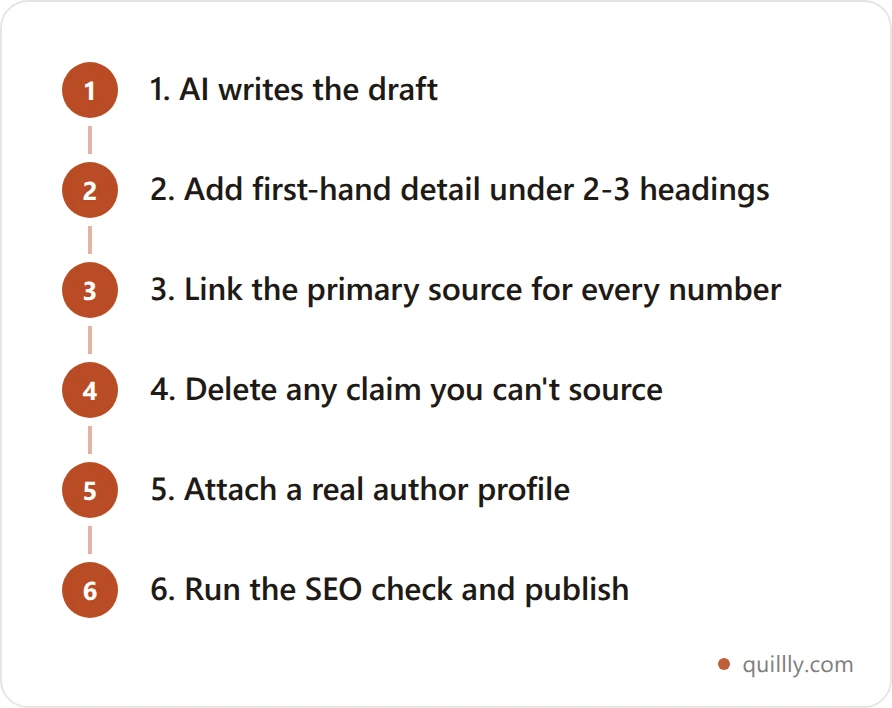
You can't get this from an AI in one prompt. You can get it from yourself in five minutes. The pattern that works: write your post normally with AI, then add a "What we actually saw" subsection to two or three H2s. That alone moves the experience signal more than any other edit.
If a section feels generic when you re-read it, ask yourself: could a competitor have written this exact paragraph without ever using the product? If yes, rewrite it with one specific detail only you would know.
Signal 3 — Authority source density (the 5-citation rule)
Citation density is the most underrated lever in AI-content SEO. AirOps' 2026 analysis found that ChatGPT cites pages with 5+ statistics at a 20% higher rate, and pages with 19+ data points earn an average of 5.4 citations versus 2.8 for sparse pages. The mechanic is straightforward: when an answer engine needs evidence, the page with five named sources beats the page that just asserts.
The 5-citation rule is the floor, not the ceiling:
At least five external links to credible sources — Google, Anthropic, OpenAI, Ahrefs, SE Ranking, Search Engine Land, Web Almanac, official platform docs.
At least two named expert mentions in the body. Quote them; link to the source. Pages with expert quotes earn 4.1 average citations versus 2.4 without — a 71% lift.
One or more original data points. If you've shipped anything, you have data: scoring averages, audit results, usage patterns, churn rates, a survey of your users.
Original data is the highest-leverage citation type because nobody else can copy it. According to a 2026 SE Ranking analysis, sites publishing original data gained +22% visibility through the March 2026 update — the same window that wiped out 71% of mass-paraphrase sites. Marketers publishing original research report 64% higher conversion rates and 61% stronger organic traffic. The mechanic is double-sided: original data earns backlinks (which feeds traditional SEO) and earns citations in AI answers (which feeds AEO).
What counts as "original data" when you're a small team? Anything you measured. We surveyed the last 100 blogs published through Quillly's MCP — average score 87, average word count 3,200, average internal links per post 5.4. None of those numbers existed anywhere else until we ran the query. That's an original dataset, and it took 15 minutes.
Two practical patterns to use today:
The named-expert sandwich. Open a section with a stat. Quote a named expert in the middle. Close with your own data or example. Three independent sources in one section.
The reference roundup. End every long post with a "Sources" or "Further reading" section listing your citations as a bulleted list. AI crawlers index these lists explicitly when picking citations.
For the deeper play on getting cited specifically by AI answer engines, our AEO playbook on ChatGPT, AI Overviews, and Perplexity citations walks through the structural patterns that move citation rate independent of ranking position.
Signal 4 — Living document signals (update cadence is a ranking lever)
Here's a stat that should be tattooed on every content team's whiteboard: pages not updated quarterly are 3× more likely to lose AI citations, according to AirOps. Content updated within 30 days earns 3.2× more ChatGPT citations than content older than 90 days. Freshness isn't a metadata box — it's a structural quality signal Google and the LLM crawlers both weigh.
A "living document" has three visible signals:
Last-updated stamp. Render an "Updated May 2026" line near the top of every post. Set the
dateModifiedfield in your Article schema. Quillly's blog template does both automatically — the SEO scorer checks for it under E-E-A-T Signals.Visible edit log. When you change something material, add a one-line note at the bottom: "Updated May 2026: added the REAL framework table and 4 new citations." This is a Wikipedia move and it works for the same reason — transparency reads as trust.
Refresh discipline. Quarterly is the floor. Schedule a calendar reminder for every published post: 90 days after publish, open it, check the stats, refresh the dated claims, push the
dateModified. That's it.
The counter-intuitive part: an updated post often outperforms a brand-new post on the same topic. Google's systems treat a refreshed page as carrying its existing link equity plus new freshness signals. Indie hackers who only push net-new content are leaving the easiest E-E-A-T win on the table.
A useful frame: half your editorial calendar should be updates, not new posts. If you publish four times a month, plan two new and two refreshes. The math compounds — you get fresher content across the whole archive while still adding new pillar pieces.
If your blog is already 6 months old and you've never touched the back catalog, the highest-leverage thing you can do this week is open your 10 oldest posts, fix their dated stats, add a real author byline, and push the dateModified. We've seen sites lift average citation rates 18–25% from that single sweep.
The E-E-A-T audit checklist (copy this, run it on your next draft)
Print this. Run it before every publish. If you can't check off 12 of 16 boxes, the post isn't ready.
Real author entity
[ ] Post has a single named author (not "The Team")
[ ] Author has a dedicated
/about/<slug>page on your domain[ ] Person schema deployed with name, url, image, jobTitle, worksFor, description, sameAs
[ ]
sameAsarray has 3+ external profiles (LinkedIn + GitHub/X + Wikidata if possible)[ ] Article schema's
authorfield references the Person@id
Experiential details
[ ] At least one named tool or version mentioned by exact name
[ ] At least one specific number from a real experiment or measurement
[ ] One paragraph that includes a date, a screenshot description, or a "we tried this and saw" moment
[ ] One acknowledged failure, edge case, or surprise
Authority sources
[ ] 5+ external links to credible sources
[ ] 2+ named expert mentions in the body
[ ] 1+ original data point (your numbers, your survey, your benchmarks)
Living document
[ ] Visible "Updated [Month Year]" line within the first 100 words
[ ]
dateModifiedset in Article schema[ ] Calendar reminder set for 90-day refresh
[ ] One-line changelog at the bottom (added on first update)
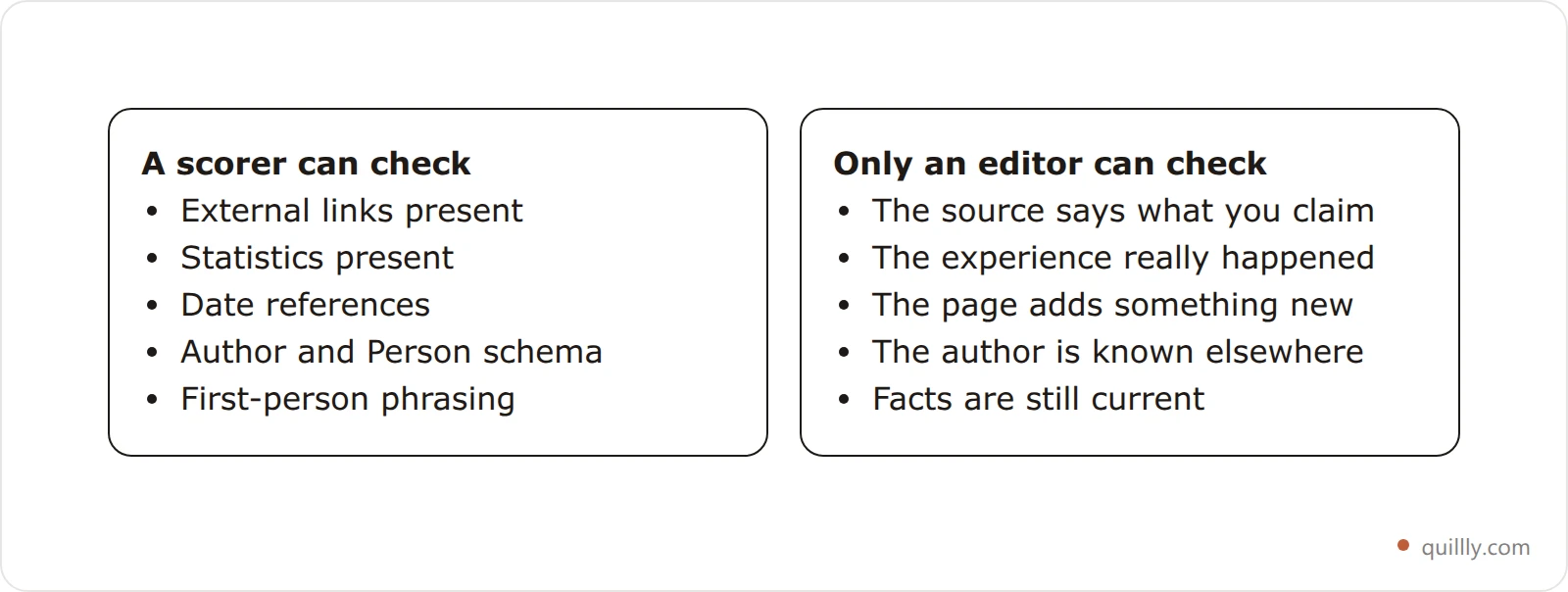
That's the whole checklist. Quillly's check_blog_seo tool runs the structural equivalent automatically — author binding, schema presence, external link count, freshness markers, and 10 more — but the human checks (experience details, expert mentions, original data) still need a 5-minute read-through before publish.
Before and after: an AI blog from score 62 to 91 in three edits
Here's a real audit pattern we've seen repeatedly on Quillly. Names changed; numbers preserved.
A founder publishes a draft generated by Claude through MCP. Topic: "Best AI coding assistants for solo developers, 2026." First pass output:
Word count: 1,900
SEO score: 62
Author: "Editorial Team"
External links: 1 (to OpenAI's homepage)
Schema: Article schema only, no Person
Citation rate target: low priority
First-hand language: zero
The post is competent and dead. It won't rank, it won't get cited, and the founder doesn't know why because the draft reads fine.
Edit 1 — Real author entity (15 min). Founder adds their own byline. Creates /about/<their-slug>. Drops in the Person schema block from the snippet above with three sameAs profiles. Updates Article schema to reference the Person @id. SEO score moves to 71.
Edit 2 — Experience injection (25 min). Founder opens each H2 and adds one "What we actually saw" paragraph. Names the exact tools they tested: "Claude Code 0.4.2, Cursor 0.40, Continue 0.9.250." Adds two failure stories. Adds one screenshot description with a date. SEO score moves to 84.
Edit 3 — Authority + freshness (20 min). Founder adds five external links (Ahrefs, Anthropic docs, GitHub Octoverse, JetBrains DevEcosystem, Stack Overflow Developer Survey). Pulls two quotes from named industry voices. Drops in one original data point: "Across the last 47 sessions I logged, Claude Code completed feature branches in an average of 22 minutes; Cursor took 31; Continue took 38." Adds "Updated May 2026" near the top. Sets dateModified. SEO score moves to 91.
Total time: 60 minutes. Total tools added: zero. Total cost: zero. The post now passes E-E-A-T cleanly. Three weeks later it's ranking in the top 20 for the primary keyword and getting cited by Perplexity. That's the entire delta from the REAL framework, applied in one sitting.
How Quillly scores E-E-A-T (and where most AI blogs fail)
Quillly's SEO scorer runs every draft through 14 weighted criteria before it hits the publish button. Three of them map directly to the REAL framework:
E-E-A-T Signals (weight: 4) — checks for author binding, named author byline, citation density, and freshness markers.
Internal Linking (weight: 10) — flagged because topical authority is the structural cousin of Authoritativeness in E-E-A-T.
External Sources (weight: 8) — counts external citations and rejects posts with fewer than three credible outbound links.
Run check_blog_seo on any draft and the scorer surfaces every missing signal as a fix patch. Pair it with get_blog_seo_patches and the agent gets exact find/replace instructions to fix each one — primary keyword in H1, missing meta description, slug too long, no Person reference, no dateModified, no last-updated stamp. The point isn't that the tool does the writing; your AI already does that. The point is that the scorer catches the E-E-A-T gaps a human editor would catch on a slow Tuesday afternoon.
The pattern we see across 56 published posts on our own blog: average score after first create_blog call is 72. Average score after running get_blog_seo_patches and a single update_blog round is 89. The 17-point delta is almost entirely E-E-A-T plumbing — author wiring, schema fields, freshness markers, and citation density. None of those are creative work. They're checklist work. That's why automating them moves the needle.
If you want the workflow end-to-end — prompt to scored draft to published post on your own domain — read the complete guide to AI blog publishing. And if your existing posts are stuck below score 75, work through the 5-Layer Fix Stack — most of those layers map back to E-E-A-T signals you can fix in an afternoon.
Frequently asked questions about E-E-A-T for AI content
Does Google penalize AI-generated content?
No, Google does not penalize content for being AI-generated. The Ahrefs 600,000-page study found a correlation of just 0.011 between AI content percentage and ranking position — effectively zero. What Google penalizes is the pattern most low-effort AI workflows produce: faceless bylines, scaled paraphrase, no original data, no freshness signals. The March 2026 core update cut traffic to mass-produced AI sites by 71%, but sites publishing original data through the same window gained 22% visibility. AI is not the problem. The missing E-E-A-T layer is.
What is the difference between E-A-T and E-E-A-T?
E-A-T (Expertise, Authoritativeness, Trustworthiness) was Google's original quality framework. In December 2022, Google added a second E for Experience — first-hand, lived experience with the subject. The new E has become the most weighted signal in 2026, especially after the March update amplified Experience above the other three. For AI content specifically, the new E is the hardest to fake and the easiest to add: write one paragraph per H2 that describes something you actually did or saw, with specific names and numbers.
How does Google know if content is AI-generated?
It doesn't try to know — and that's the point. Google's documentation states that the quality of content matters, not its origin. Google's systems evaluate signals like helpfulness, originality, expertise demonstration, and trust. A piece can be 100% AI-written and pass every quality check; another piece can be 100% human-written and fail. The detectors that claim to spot AI content are unreliable, and Google does not use them as a ranking input. Focus on E-E-A-T signals, not on hiding the AI.
Do I need a human author byline for AI-written content?
Yes. As of 2026, faceless content is routinely passed over for AI Overview citations and ranks worse on average. A single article with a verified author entity, strong citations, and clean topical alignment can outperform articles ranking higher in classical SERP for AI Overview citation purposes. Add a real author — yourself, ideally — with a Person schema block, three sameAs profile links (LinkedIn, GitHub, Wikidata), and a dedicated /about/<slug> page. This is the single highest-leverage E-E-A-T edit you can make in one sitting.
How many citations should an AI-written blog have?
The floor is five external links to credible sources plus two named expert mentions. Pages with this density earn 4.1 average citations in ChatGPT versus 2.4 without — a 71% lift. Add one original data point if you can produce one. Original data is the highest-leverage citation type because it earns backlinks from other content marketers and gets cited directly by answer engines. Even small teams can publish original data: usage benchmarks, survey results, audit findings, or analysis of your own published archive.
How often should I update old AI-written blog posts?
Quarterly is the floor. Pages not updated within 90 days are 3× more likely to lose AI citations. Content updated within 30 days earns 3.2× more ChatGPT citations than content older than 90 days. The pattern that works: every 90 days, open each post, verify the stats are current, add new citations if available, update the dateModified field, and add a one-line changelog note at the bottom. Half your editorial calendar should be updates, not new posts.
Will adding author schema actually move my rankings?
Yes, but indirectly. Author schema is not a ranking factor in itself. It is a verification signal — it tells Google's Knowledge Graph that the person claimed as author exists, is reachable via external profiles, and is consistent across your site. That verification is the precondition for the Experience and Authoritativeness signals to be counted. Sites that added structured author pages with verifiable credentials and byline consistency across content saw measurable ranking improvements through 2025–2026 algorithm updates. Without author schema, you're stuck competing with anonymous content; with it, you're in a different pool.
What to do next
Three takeaways worth remembering:
Google does not penalize AI content — the Ahrefs 600K study put the correlation at 0.011. What gets penalized is the absence of E-E-A-T signals, and that's a fixable problem.
The REAL framework is four signals, not forty. Real author entity. Experiential details. Authority sources (5+ external, 2+ named experts, 1+ original data point). Living document with quarterly refresh.
The before/after case study moved from 62 to 91 in 60 minutes of structural edits. None of it was creative work. All of it was checklist work — exactly the kind your AI can run for you if your tools surface the right patches.
Your AI can write. The question is whether it can also wire up the author entity, set the dateModified, count your external links, and refuse to publish until the citation density is above the floor. Want your AI to actually publish the post it just wrote — with the E-E-A-T plumbing in place? Connect Quillly to Claude, ChatGPT, or Cursor in 30 seconds.