


AI blog publishing is the end-to-end workflow of generating, scoring, and shipping blog content with AI agents — from a one-line prompt to a live URL on your domain, indexed by Google, scored against measurable SEO criteria, and ready to be cited by ChatGPT, Perplexity, and Google AI Overviews. In 2026 it has finally become a real category, distinct from "AI writing", because the publishing layer — not the writing — is where most workflows break.
The writing problem is solved. Claude, GPT-5, and Gemini Ultra all produce a serviceable 2,000-word draft in under two minutes. That is not the bottleneck and has not been for a year. The bottleneck is everything between the draft and a ranked, indexed, cited live URL: the SEO scoring loop, the meta tag limits, the slug rules, the featured image, the internal linking pass, the sitemap update, the Google Indexing API ping, and the post-publish freshness cycle. Glue all of that together by hand and your "10-minute AI blog" turns into a 90-minute slog.
This guide is the canonical 2026 playbook for AI blog publishing — the loop, the tools, the comparison matrix, the SEO scoring rubric, the AEO citation rules, the cost model, and the autonomous content calendar that turns the whole thing into something you supervise instead of operate. 44.2% of all citations from ChatGPT and other large language models come from the first 30% of a page, so the first move is making sure your post exists at all (Profound, 2026). The second move is making it inevitable.
What "AI blog publishing" actually means in 2026#
Most "AI blog" content from 2024 and early 2025 conflated three different things — drafting, editing, and publishing — into a single fuzzy "AI writes my blog" pitch. By 2026 the categories have separated. Use the right one and you'll buy the right tool. Use the wrong one and you'll buy a writing tool to solve a publishing problem.
AI writing is what Claude, ChatGPT, Cursor, Windsurf, and Gemini already do natively. Type a prompt, get markdown back. No tooling required.
AI editing is the layer of grammar checks, brand-voice enforcement, and style guides. Tools like Grammarly and style-specific linters live here. Most posts don't need it; AI drafts in 2026 are clean.
AI blog publishing is the missing middle: the agentic workflow that takes the draft from the AI's response window and turns it into a live, indexed, scored, internally-linked post on a domain you control. This is the layer Quillly, WP-MCP, and similar platforms occupy.
The distinction matters because purely AI-generated content claims the #1 Google ranking only 9% of the time, versus 80% for human-written or properly AI-assisted content, per a Semrush analysis of 42,000 blog posts (Search Engine Land, 2026). The publishing layer is what turns "AI text" into "AI-assisted content with editorial oversight" — by enforcing SEO criteria, surfacing fix patches, and adding the structural signals (internal links, schema, meta tags, indexing pings) that move you from the 9% bucket to the 80% one.
The 4-phase Prompt-to-Published Loop#
Every reliable AI publishing workflow in 2026 — whether you build it yourself with cron and shell scripts, glue it together with Zapier, or use a dedicated MCP layer like Quillly — follows the same four phases. Name the loop and you can debug any link in it.
Phase 1 — Prompt. Your AI generates a draft from a brief. Output is markdown, with an inferred slug, a meta title, and a meta description.
Phase 2 — Score. The draft is checked against a quantitative SEO rubric. Quillly's rubric checks 14 criteria: keyword placement, heading structure, meta tag length, internal and external links, image alt text, schema potential, readability, and word count. The output is a 0–100 score plus a category breakdown. A score under 70 means the draft is not publishable.
Phase 3 — Patch. Specific find-and-replace edits are applied to lift the score. Patching preserves voice and avoids the "now everything is slightly different" tax of a full rewrite. Each patch comes with a projected score impact ("+8 points if you fix Meta Tags") so you know which fixes are worth applying.
Phase 4 — Publish. The post is committed to your domain, the sitemap is updated, the RSS feed is rebuilt, and Google's Indexing API is notified. From here a background job tracks indexing status, search position, and any coverage issues Google flags.
If any phase is missing, you have a content workflow with a hole in it. The point of an MCP-based publishing layer is to give your AI the tools to run all four phases inside the same conversation, with no human bottleneck between them.
The four publishing layers compared#
There is no single right place to land your AI-written blog. The right one depends on whether you want to manage infrastructure or not, and how much of the SEO scoring, internal linking, and indexing logic you're willing to write yourself.
Layer | Setup time | Lives on your domain | SEO scoring built in | Auto sitemap + indexing | Best for |
|---|---|---|---|---|---|
Manual copy-paste into WordPress | 0 min | Yes | Whatever you remember | Partial — Yoast/RankMath | The 2024 stack you should leave behind |
WordPress + WP-MCP plugin | 30–60 min | Yes | No — needs Yoast/RankMath | Partial | Existing WordPress sites that already work |
Headless CMS + custom code | 1–2 days | Yes (with build pipeline) | No — you build it | No — you build it | Engineering-heavy teams who want full control |
MCP-native platform (Quillly) | 5–10 min | Yes — | Yes — 14-criteria scoring + patch suggestions | Yes — sitemap, RSS, Google Indexing API automatic | Indie hackers, solo founders, agencies who want zero plumbing |
Substack/Beehiiv/Notion subdomain | 5 min | No — separate subdomain | No | Partial | Newsletter-first publishers who don't care about ranking |
The honest summary: WordPress is fine if you already run it. A headless setup gives you total control and a real maintenance burden. Newsletter platforms are great for distribution but not for ranking, because they rarely give you control over the URL structure, schema, or canonical tags. An MCP-native platform is the no-plumbing option — you connect, you publish, the SEO and indexing layer is already built. Pick whichever matches your appetite for owning infrastructure.
Pick your AI: Claude, ChatGPT, Cursor, Windsurf, or Gemini#
The choice of AI matters less than most people think — every modern model can write a competent 2,000-word post. What matters is which AI you already live in. Pick the one that already has your context.
Claude (Desktop or Code). Best for builders who think in long-form. Claude's writing voice is the closest to "smart founder explaining something" out of the box, and Claude Desktop's MCP support is the most mature for chained tool workflows. Claude is the default recommendation if you're picking from scratch in 2026.
ChatGPT. Best for distribution-first publishers. ChatGPT's MCP support has caught up; the upside is the audience reach when GPTs cite back to your domain. Voice tends to be slightly more polished and slightly less distinctive than Claude.
Cursor. Best for developers who already write changelogs and docs in their IDE. Publishing from Cursor is a natural extension — you're already in the editor, the context window already has your codebase, and the resulting posts have a builder-to-builder voice that ranks well for technical audiences.
Windsurf. Best for teams running Codeium-based workflows. Functionally similar to Cursor for blog publishing; pick whichever your team standardized on. Publishing from Windsurf covers the MCP setup specifics.
Gemini. Best for content with Google Workspace context. If your briefs live in Google Docs and your data lives in Sheets, Gemini's tight integration shortens the prompt-to-draft step. Publishing from Gemini end-to-end covers the full setup.
The publishing layer is decoupled from the AI. The same Quillly MCP server works inside Claude, ChatGPT, Cursor, Windsurf, and Gemini — meaning you can switch AIs next quarter without re-platforming your blog.
Subdirectory vs subdomain: settle this once#
The subdomain-versus-subdirectory question is the single biggest structural decision you'll make about your blog, and the answer is settled enough in 2026 to call. Default to a subdirectory — yourdomain.com/blog, not blog.yourdomain.com. The exceptions are narrow: a true second product, regional sites under different country-code TLDs, or a docs site that already has its own brand.
Authority is the reason. Google's John Mueller has said publicly for years that "subdomains and subdirectories are seen as equal" for ranking, and that's technically true at the algorithmic level. In practice, link equity and topical authority flow more cleanly to a subdirectory. Multiple case studies from Semrush, Ahrefs, and Backlinko show traffic uplifts of 15–45% when blogs migrate from a subdomain to a subdirectory, with one widely cited example seeing a 40% organic boost after moving from blog.brand.com to brand.com/blog (Embarque, 2026).
For an AI-written blog this is doubly important. Your posts will need every signal of trust they can borrow. Slotting them into yourdomain.com/blog/[slug] lets them inherit the authority you've built on the rest of the site — your homepage, your docs, your changelog. A purpose-built MCP publishing layer should set this up by default. If yours requires a subdomain, switch.
The 14 SEO criteria your AI-written post must clear#
Quillly scores every saved blog against 14 criteria. The categories are not secret SEO sauce — they are the same signals every modern ranking system rewards. Knowing them helps your AI write posts that pass on the first try.
The 14 criteria break into four buckets:
Structure (4 criteria): H1 contains the primary keyword in the first 5 words. H2 hierarchy is logical (no H2 → H4 jumps). Heading count matches word count (a 3,000-word post with 2 headings is a wall of text). Section depth lands in the 120–180 word sweet spot — pages with sections in that range earn 4.6 average ChatGPT citations versus 2.7 for sections under 50 words (Profound, 2026).
Metadata (4 criteria): Meta title under 60 characters with the primary keyword front-loaded. Meta description under 160 characters with a benefit hook. Slug 3–5 kebab-case words with the primary keyword and no stop words. Schema potential (FAQ, HowTo, Article) detected for rich-result eligibility.
Content density (3 criteria): Word count meets the topic's competitive bar (typically 1,800+ for tool comparisons, 3,000+ for guides, 4,500+ for pillars). Primary keyword density between 0.5% and 2%. Five or more sourced statistics — the floor for ChatGPT citation eligibility.
Linking and media (3 criteria): At least 3 internal links to existing posts on the same domain, 3–5 external links to authoritative sources, and every image has a descriptive alt attribute.
A post that hits all 14 lands in the 90+ score band. A post that hits 11 of 14 typically scores in the high 70s. The patches Quillly returns with get_blog_seo_patches tell you exactly which criteria you missed and how many points each fix is worth.
Internal linking at scale#
Internal links are the single most undervalued ranking signal for indie blogs in 2026, and the easiest one to automate. Every published post should link to 3–5 other posts on your domain. Done right, this builds topical authority — the property Google's March 2026 core update explicitly rewards over raw domain authority (Evertune, 2026).
The mechanic to use is suggest_internal_links. It analyzes a draft, scans the existing published catalog on the same website, and returns target blogs with descriptive anchor text already chosen. Apply the suggestions that make contextual sense via update_content, skip the ones that feel forced.
Two rules that matter:
Anchor text should describe the destination, not the action. "How Quillly's 14 SEO criteria work" beats "click here". Descriptive anchors carry topical signal.
Link upward and downward. Pillar pages link out to supporting posts. Supporting posts link back up to the pillar. This bidirectional pattern is what creates a real topical cluster instead of a list of orphan posts.
Run suggest_internal_links on every new draft before publishing. Then quarterly, run it on existing posts to catch links that didn't exist when the post was first published — every new post on your site is a fresh opportunity for old posts to link out.
Getting indexed: sitemaps, RSS, and the Indexing API#
Publishing a post is not the same as Google seeing the post. The lag between "live URL" and "indexed and rankable" is where indie blogs lose weeks of traction.
A correctly configured publishing layer notifies Google in three ways the moment you call publish_content:
Sitemap update. The new URL is appended to
/sitemap.xmland the sitemap's<lastmod>is bumped. Google's crawler picks this up on its next visit, which for verified sites is typically within hours.RSS feed update. A regenerated
/rss.xmlis what Google News, IFTTT-style mirrors, and AI training crawlers consume. RSS is unfashionable but it is still one of the most reliable freshness signals.Google Indexing API submission. Direct push notification to Google that a new URL exists. The Google Indexing API was originally for job postings and livestreams, but Google has become more accepting of general content submissions when the publishing layer is well-behaved.
Quillly handles all three automatically on publish_content. The indexing status is then tracked by a background job, so calling list_content or get_content later shows you whether each post is indexed, what its current search position is, and whether Google flagged any coverage issues. You don't have to manually submit URLs in Google Search Console for every new post — though connecting GSC to Quillly is what unlocks per-post performance data (clicks, impressions, CTR, position) inside the dashboard.
If a post sits in "submitted, not indexed" status for more than 14 days, the cause is almost always one of: thin content (under 800 words), duplicate content (similar to an existing post), missing internal links from indexed pages, or a robots/canonical misconfiguration. Each of these has a fix patch in the Quillly SEO rubric.
Answer Engine Optimization: getting cited by ChatGPT, Perplexity, and AI Overviews#
Ranking on Google in 2026 is no longer the only goal. Citations inside ChatGPT, Google AI Overviews, Perplexity, and Claude itself drive a growing share of high-intent traffic — and getting cited by AI search is now a measurable goal in itself — and the patterns for what gets cited are now measurable.
The 2026 numbers worth knowing:
Pages with 5 or more statistics earn a 20% higher ChatGPT citation rate, and pages with 19+ data points earn 5.4 citations on average versus 2.8 for minimal-data pages.
Pages with named expert quotes average 4.1 citations versus 2.4 without them — a 71% lift.
Sections in the 120–180 word sweet spot earn 4.6 average citations versus 2.7 for sections under 50 words.
85% of Google AI Overview citations are from content published in the last two years, with 44% from the most recent year alone — freshness compounds.
Organic CTR inside AI Overviews moved from 1.3% in December 2025 to 2.4% by February 2026, while industry data suggests 93% of AI Mode searches now resolve without a click (SQ Magazine, 2026).
The implications for your publishing playbook:
Front-load the answer. Open every post with a 40–60 word direct-answer paragraph. That paragraph is what AI Overviews lift verbatim.
Pack the data density. Five sourced statistics is the floor.
Update relentlessly. Pages updated within 30 days get cited 3.2× more often than pages older than 90 days.
Kevin Indig, writing in his Growth Memo State of AI Search Optimization 2026, frames it bluntly: "A piecemeal approach to targeting SEO keywords based on search volume, stage of the search journey, or even BOFU or pain point intent can be wasted time" — the move is to own topics, not chase queries (Growth Memo, 2026). Aleyda Solis has shared similarly that adding unique survey data to her guides is what got her pages lifted into AI search summaries. For the tactical breakdown, the 2026 AEO playbook walks through the specific patterns that earn citations.
The autonomous content calendar#
The 2026 frontier of AI blog publishing is not single-post automation — it is the autonomous content calendar. A workflow where the AI:
Generates topic ideas from your existing content gaps and Google Search Console keyword data.
Drafts the highest-priority topic.
Scores and patches the draft to a publish-ready threshold.
Schedules the post to go live at a specified date and time.
Reports back to you with a single message: "Published. Score 92. URL. Monitoring indexing."
Every step in that chain is already a single MCP tool call. research_keywords returns per-source search volumes for a set of seed topics, plus where your site already ranks for each one. get_content_suggestions analyzes your existing catalog and surfaces thin content, outdated posts, missing internal links, and keyword cannibalization risks. bulk_create_content lets you draft up to 10 posts in a single call. Scheduled publishing (Pro tier) lets you queue up a full month's calendar in one conversation and walk away.
This is what indie hackers actually want. The pitch is no longer "AI writes my blog" — it's "the blog writes itself, and I review on Friday." A solo founder running a SaaS in their off-hours can credibly own 20+ posts a month using this loop, with maybe 90 minutes of total weekly review time. That is content output that used to require a full-time content marketer or a $4,000/month agency retainer.
The contrarian point worth saying out loud: most people overestimate the value of writing every post and underestimate the value of publishing consistently. A topical cluster with 30 decent posts will out-rank a topical cluster with 5 brilliant ones for almost every query that matters, because the ranking algorithm rewards topical coverage and the AI-citation algorithm rewards depth of evidence across a domain. The autonomous content calendar is what closes the gap.
What AI blog publishing actually costs per post#
The all-in cost of an AI-published blog post in 2026 breaks down into three lines:
Model cost. A 2,500-word draft from Claude Sonnet 4.6 or GPT-5 costs roughly $0.03 to $0.10 in API calls. Even a heavy round of revision keeps you under $0.25. If you're using Claude Desktop or ChatGPT directly, the marginal model cost is zero — it comes out of your existing subscription.
Publishing-layer cost. Quillly Pro is $9 per month (or $96 per year), covering up to 5 sites, unlimited content, unlimited traffic, custom theming, scheduled publishing, and the full MCP tool set at 1,500 requests per day. It opens with a 14-day trial that needs no card. There is no permanent free tier and no credit system, so nothing meters how many posts you publish. WordPress hosting plus Yoast Premium runs roughly $20–60 per month for comparable functionality but without the SEO scoring rubric or auto-indexing.
Infrastructure cost. Effectively zero if your publishing layer hosts the /blog route. If you're rolling your own headless setup, add another $20–50 per month for hosting, CDN, and image storage.
The total: most indie hackers ship a fully-published, SEO-scored, indexed AI blog post for between $0.04 and $0.20 in marginal cost, on top of a sub-$10/month platform subscription. Compare to the $400–$800 per post charged by mid-tier content agencies — without the SEO scoring loop or the autonomous calendar layered on top — and the economics make the choice obvious.
The 12-month roadmap from one post to topical authority#
A single blog post does not move the needle. A topical cluster does. Here is the realistic 12-month roadmap for an indie SaaS team using an MCP-native publishing layer.
Months 1–2: foundation cluster (10 posts). Pick one head topic. Publish a pillar (4,500+ words) plus 8–10 supporting posts that each cover one sub-topic in depth. Every supporting post links up to the pillar. The pillar links down to every supporting post. This is the bidirectional pattern that creates topical authority. Expect zero meaningful traffic in this period — Google needs time to crawl, index, and assess the cluster.
Months 3–4: second cluster + refresh (12 posts). Pick the next adjacent topic. Repeat the pillar-plus-supporting pattern. Simultaneously, run bulk_seo_audit on your first cluster — refresh anything scoring below 85 or older than 90 days, since pages updated within 30 days get cited 3.2× more often. First impressions in Google Search Console show up around month 3.
Months 5–8: scale + GSC-driven posts (40 posts). Use get_gsc_top_queries to find queries you're already semi-ranking for and write the post that should win them. Use generate_blog_ideas to surface adjacent topics. Switch on scheduled publishing and queue 3–4 posts a week. By month 6 you should be earning consistent organic clicks; by month 8, AI Overview citations on long-tail queries inside your clusters.
Months 9–12: refresh-heavy + backlink earning (30 posts + 60 refreshes). New post output drops as your refresh load grows. Posts published in months 1–4 are now in their primary refresh window. The named frameworks and original statistics from earlier posts start earning backlinks naturally — these are the assets that move you from 5-figure monthly traffic to 6-figure.
Total output: ~90 fresh posts plus ~60 refreshes over 12 months. With an MCP publishing layer that runs the full Prompt-to-Published Loop, this is achievable in roughly 4–6 hours of human review time per week.
Common failure modes and how to fix them#
Three failure modes account for almost every "I set this up and it doesn't work" report.
Meta description too long. Quillly's publish_content rejects any meta description over 160 characters. Most LLMs will overshoot to 180+ if not told otherwise. The fix is to put the constraint in your prompt template (meta_description ≤ 160 chars) and to call get_blog_seo_patches before publish_content — the patches will include a trimmed version.
SEO score below the publish threshold. Quillly will not let you publish a post scoring below 70. The cause is usually missing internal links, missing image alt text, or an H1 that doesn't include the primary keyword in the first 5 words. The patch tool returns a fix string for each issue with the projected score impact ("+8 points if you fix Meta Tags"). Apply every patch, re-check, publish.
Slug collisions. If you ask your AI to write three posts on similar topics in one session, you'll get three slugs sharing 80% of their words. Your CMS will append -1 and -2 and your internal linking will silently break. The fix: run list_content first and tell your AI to pick a slug not in the existing list.
Cannibalization. This is the silent killer of AI publishing programs — alongside the deeper ranking issues that need a 5-layer fix. Publishing 30 posts a month means publishing 30 chances to compete with yourself for the same query. The fix is the same list_content call before drafting — and the discipline to refresh an existing post instead of creating a duplicate.
Indexing stall. Posts in "submitted, not indexed" status for 14+ days usually have one of: thin content, duplicate content, no internal links from indexed pages, or a canonical/robots misconfiguration. Each has a corresponding fix in the Quillly rubric.
Published is not indexed: the funnel nobody shows you#
Every guide to AI blog publishing, this one included, ends at publish_content returning success. That is the wrong finish line, and here is our own data to prove it.
These are quillly.com's numbers on 9 August 2026 — a DR 12 domain running exactly the workflow described above:
Funnel stage | Count | Survival rate |
|---|---|---|
Posts published | 125 | — |
Indexed by Google | 76 | 61% |
Queries earning impressions | 100 | — |
Impressions (28 days) | 2,620 | — |
Clicks (28 days) | 7 | 0.27% CTR |
Every one of those 125 posts returned a successful publish response. The sitemap regenerated, the Indexing API was pinged, the status came back green. And 49 of them are not in Google's index at all.
The drop-offs are worth naming, because each has a different fix:
Published → indexed (61%) is a crawl budget and authority problem. Google fetches roughly in proportion to your domain's authority. Publishing more does not raise the ceiling; it divides the same allocation further.
Indexed → impressions is a topic selection problem. A page indexed for a query nobody searches earns nothing. This is where most AI publishing programs quietly fail, because the AI will happily write 3,000 excellent words about a topic with no demand.
Impressions → clicks (0.27%) is a position problem. Our average position is 39.6 — page four. Nobody clicks page four, so impressions there are a vanity metric.
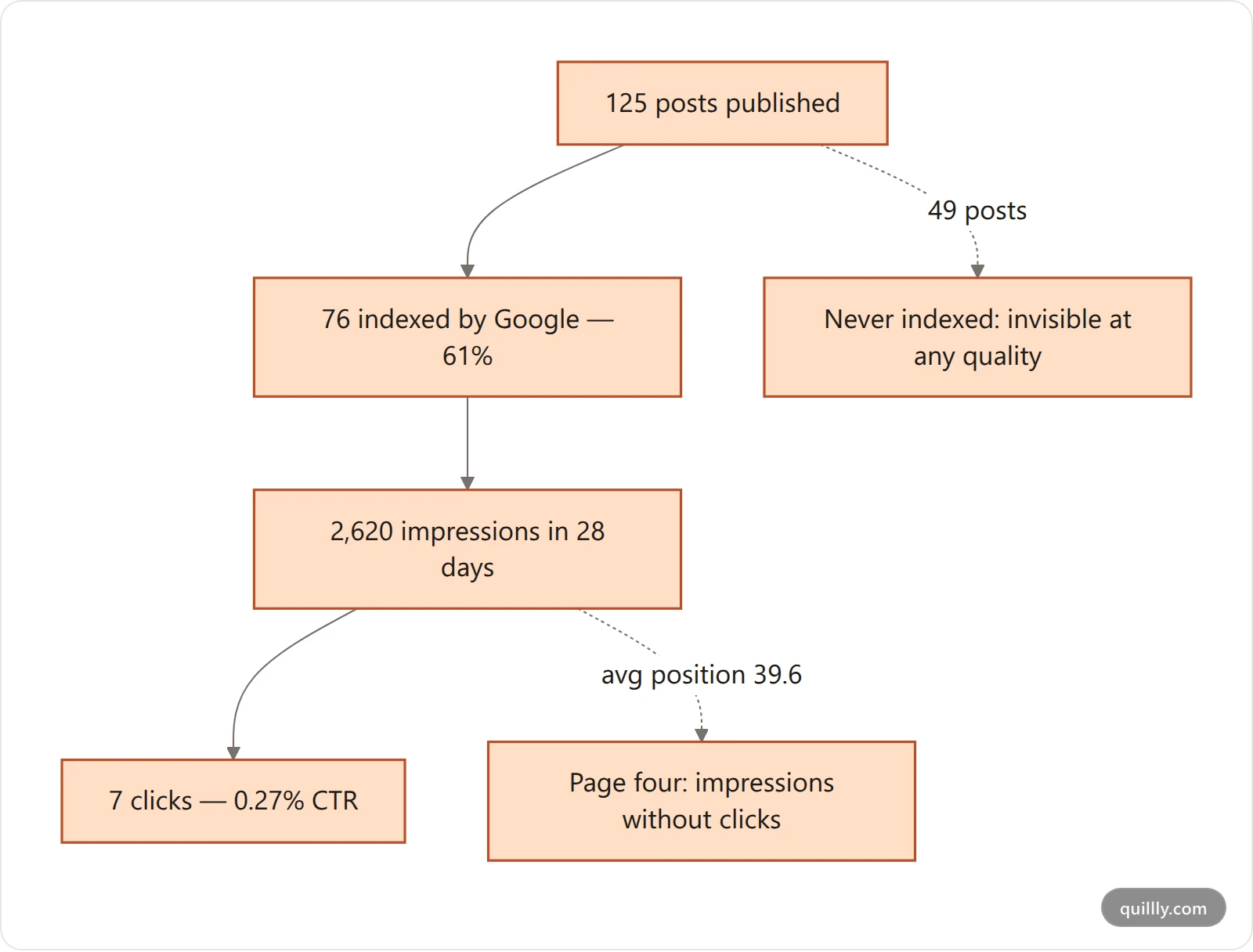
So change what you measure. "Posts published this month" is the metric an AI publishing workflow makes trivially easy to move, which is exactly why it is the wrong one. Track indexed share and clicks, in that order, and treat your publish rate as something to tune against them rather than maximise. When indexed share falls below about 70%, the correct number of new posts is zero — spend the session strengthening what you have and fixing what Google will not index instead.
The workflow above still stands. It just isn't finished when the post goes live.
Frequently asked questions#
What is AI blog publishing?#
AI blog publishing is the agentic workflow of generating, scoring, and shipping a blog post from a single conversation — including SEO scoring, internal linking, sitemap and RSS updates, and Google Indexing API notifications. It is distinct from AI writing (which only produces a draft) and AI editing (which polishes copy). In 2026 it is delivered through MCP-compatible publishing platforms like Quillly that connect directly to Claude, ChatGPT, Cursor, Windsurf, or Gemini.
Can AI-written blog posts rank on Google in 2026?#
Yes, but only with editorial oversight and original signal. Google's March 2026 core update penalizes purely AI-generated content with no original data, no named author, and repetitive sentence cadence. AI-assisted content that is substantially edited, adds original statistics, includes a real byline, and earns internal links from a topical cluster ranks comparably to all-human content. Per Semrush, properly assisted AI content holds the #1 spot at rates close to fully human content; purely AI output ranks #1 only 9% of the time.
Do I need WordPress to publish AI blogs?#
No. Modern MCP-native publishing platforms host your /blog route directly on your domain, manage the sitemap and RSS feed, and submit URLs to the Google Indexing API automatically. WordPress is one option (especially with the WP-MCP plugin), but it adds plugin maintenance, hosting cost, and an SEO plugin layer. Headless CMS setups add even more engineering. Indie builders and small SaaS teams typically ship faster with an MCP-native platform.
How do I connect Claude Desktop to my blog for publishing?#
Add an MCP server entry to claude_desktop_config.json (located at ~/Library/Application Support/Claude/claude_desktop_config.json on macOS, %APPDATA%\Claude\claude_desktop_config.json on Windows). For Quillly, the config block uses npx -y @quillly/mcp-server with your API key in the env block. Restart Claude Desktop and the blog publishing tools appear in any new conversation.
What's the difference between AI blog publishing and AI blog generation?#
AI blog generation produces text — a draft. AI blog publishing covers the full lifecycle: draft, SEO scoring, patch application, internal linking, image attachment, sitemap update, RSS regeneration, Indexing API submission, and post-publish performance tracking. Most "AI blog generators" stop at step 1. A complete publishing platform runs all 9 steps in a single conversation.
How much does AI blog publishing cost?#
The marginal cost per post is between $0.04 and $0.20 if you're using a managed publishing layer. Quillly Pro is $9 per month or $96 per year and covers 5 sites with unlimited content, 1,500 daily MCP requests, custom theming, and scheduled publishing, after a 14-day no-card trial. Compare with mid-tier content agencies at $400–$800 per post.
Should my AI blog live at a subdomain or a subdirectory?#
Subdirectory. Use yourdomain.com/blog, not blog.yourdomain.com. Multiple case studies show 15–45% traffic uplifts when blogs migrate from subdomain to subdirectory because authority and backlinks flow naturally to the parent domain. Subdomains are treated by Google more like separate sites that must build their own authority. The only good reasons to use a subdomain are a true second product, regional ccTLD content, or an existing docs site with its own brand.
What does Quillly's SEO score actually measure?#
Quillly checks 14 criteria across structure (heading hierarchy, section depth), metadata (meta title and description length, slug rules, schema potential), content density (word count, keyword density, statistics count), and linking (internal links, external links, image alt attributes). The output is a 0–100 score plus a category breakdown. The companion get_blog_seo_patches tool returns ready-to-apply find-and-replace patches with the projected score lift for each one.
Your next post in 10 minutes#
Three takeaways. One: AI blog publishing is the missing middle between AI writing and a ranked, indexed, cited post — and in 2026 it's a real category, not a feature of the writing tools. Two: the 4-phase loop (Prompt → Score → Patch → Publish) is the model every reliable workflow follows; an MCP-native publishing layer collapses all four phases into one conversation. Three: the autonomous content calendar — schedule, draft, score, publish, monitor — is what turns publishing from a chore into infrastructure. A solo founder can credibly ship 20+ posts a month with 90 minutes of weekly review.
If you want your AI to actually publish the post it just wrote — to your own domain, scored against 14 SEO criteria, with the sitemap and Google Indexing API handled for you — connect Quillly to Claude, ChatGPT, Cursor, Windsurf, or Gemini in under 10 minutes. 14-day trial, no card, and your first publish runs in the same conversation as your first prompt.