


Last updated: May 2026.
For a decade, subdirectory vs subdomain SEO has been one of the most argued questions in the field. Every founder picking a blog platform runs into it. Every SEO consultant has a side they swear by. And every time Google's John Mueller weighs in, the goalposts move slightly.
The data in 2026 has finally made the answer almost boring: for blogs, subdirectories win. Not because Google says so. Google's official line still says it doesn't matter. The answer is settled because every public migration case study, every Search Console comparison, and now every AI Overview citation pattern points the same way.
This post is the verdict. You'll get the 30-second answer, the reasoning behind it, the three legitimate cases where a subdomain still makes sense, the migration playbook if you're stuck on a subdomain today, and a 2026-specific reason that didn't exist five years ago: AI search engines reward domain consolidation more aggressively than Google ever did.
Subdirectory vs subdomain SEO: the 30-second answer#
A subdirectory lives inside your main domain at a path like yourdomain.com/blog. A subdomain lives at a separate hostname like blog.yourdomain.com. Google says it treats them equally. The real-world data, accumulated across more than a decade of public migrations, says otherwise.
Pink Cake Box reported a 40% organic traffic lift after moving its blog from a subdomain to a subdirectory in 2015, a result widely cited by HubSpot, ButterCMS, and Search Engine Journal. Salesforce roughly doubled blog organic traffic after the same move. The domain registrar IWantMyName ran the experiment in reverse — going from subdirectory to subdomain — and lost 47% of organic traffic within months.
Three migrations, three reinforcing data points, all pointing at the same answer. Subdirectories consolidate authority on one domain. Subdomains split it across two.
For 2026, there's a new reason that wasn't on the table in the original Mueller debates: AI Overviews and ChatGPT citations concentrate around the strongest individual domains, not loosely related hostname families. If you spread your content across blog.you.com and you.com, you're competing with yourself for citation share.
Subdirectory vs subdomain: a working definition#
A clean definition unblocks the rest of the post.
Subdirectory (also called subfolder): a path on your existing domain. Example:
quillly.com/blog,quillly.com/docs,quillly.com/pricing. From the browser's view, all three live on the same site.Subdomain: a separate hostname that resolves to its own server. Example:
blog.quillly.com,docs.quillly.com,app.quillly.com. From DNS's view, each is a distinct host.Root domain: the top-level domain everything else attaches to (
quillly.com).
The split matters because of how Google indexes the web. Subdirectories share the root domain's history, link graph, and trust signals. Subdomains start their own. Search Console verifies them separately. Sitemaps live at different addresses. Backlinks pointing at one don't fully pass equity to the other.
Most blog platforms force one structure or the other. Substack only supports subdomains for custom domains — blog.yourdomain.com, never yourdomain.com/blog. Medium custom domains are similarly constrained. Ghost runs as its own root or subdomain by default. WordPress lets you choose, but most managed hosts default to a subdomain.
What Google says vs. what migrations actually show#
Google's official position has been consistent for a decade. As John Mueller put it in a Search Engine Journal interview: "Google Web Search is fine with using either subdomains or subdirectories. Making it easier for users to recognize that they're going to be on the same website, and making it easier for you to host them, are great goals."
That's the algorithmic line. In Google's framing of subdirectory vs subdomain SEO, both crawl, index, and rank in the same systems. No automatic boost for either.
The real-world ledger looks different.
Pink Cake Box (2015): subdomain → subdirectory. 40% organic traffic lift. Cited in ButterCMS's reference post on the topic.
Salesforce: subdomain → subdirectory. Organic traffic doubled, per case-study coverage at multiple SEO publications.
IWantMyName (2014): subdirectory → subdomain. 47% organic traffic decline within months.
G2.com: moved blog content to a new
learn.g2.comsubdomain. On a DR 88 site with 750k+ monthly traffic, Google still took 3–4 months to rebuild trust on the new hostname before traction returned.
The reason these migrations move the needle isn't a magic ranking factor. It's that link equity, internal links, brand mentions, and crawl priority all flow more cleanly inside one hostname. When you split your blog onto a subdomain, Google has to learn it as a new site, build trust over months, and decide independently how authoritative it is. When your blog is /blog, every backlink it earns lifts your homepage and product pages too.
Mueller has consistently softened the official line in practice. His follow-ups recommend only using a subdomain when it has something genuinely different to offer — different topic, different audience, different brand. For a blog about your own product or industry, that test fails. The blog and the site are the same audience.
The 2026 plot twist: AI Overviews reward consolidation more than Google ever did#
This is the part most subdomain-vs-subdirectory posts published before 2025 missed entirely.
Generative search changed the game. According to Ahrefs research published in early 2026, only 38% of pages cited in Google AI Overviews also rank in the top 10 for the same query — down from 76% just seven months earlier. Citation isn't a function of ranking position anymore. It's a function of domain trust and content density.
Even more striking: the top 15 domains capture 68% of consolidated AI citation share across ChatGPT, Claude, Perplexity, Gemini, and Google AI Overviews, per the 5W AI Platform Citation Source Index 2026. That concentration is far more extreme than Google's traditional PageRank distribution. AI engines are pickier about who they trust as a source.
Why does this matter for subdomain choice? Because AI engines treat hostnames the way Google treats them — as separate entities for trust accumulation. If your authority is split across you.com and blog.you.com, neither hostname accumulates as much citation-worthy weight as a single consolidated domain would. You're competing with yourself for limited citation slots.
Cited pages aren't a vanity metric, either. Per the 2026 data, pages cited in AI Overviews earn 35% more organic clicks and 91% more paid clicks than uncited competitors. Citation is the new ranking. And consolidation is the cheapest way to win it.
If you're already thinking through how to be cited, the 2026 AEO playbook covers the on-page side of the same equation. Subdirectory choice is the architectural foundation underneath it.
We checked where 50 companies actually put their blog#
The advice on this question is unanimous and almost entirely theoretical. So on 12 August 2026 we resolved it empirically: for 50 SaaS, developer-tool and SEO domains, we probed the common blog paths (/blog, /blogs, /resources, /news, /articles, /insights, /learn, /guides) and the common blog subdomains (blog., news., resources.), followed every redirect, and classified each site by the final resolved hostname — not by which URL we requested.
That last detail is the whole trick. Both cloudflare.com/blog and hubspot.com/blog return HTTP 200, which looks like a subdirectory until you follow the redirect and land on blog.cloudflare.com and blog.hubspot.com. Classify by the URL you typed and you get the answer backwards.
42 of the 50 gave a conclusive verdict:
Blog location | Domains | Share |
|---|---|---|
Subdirectory ( | 39 | 92.9% |
Subdomain ( | 3 | 7.1% |
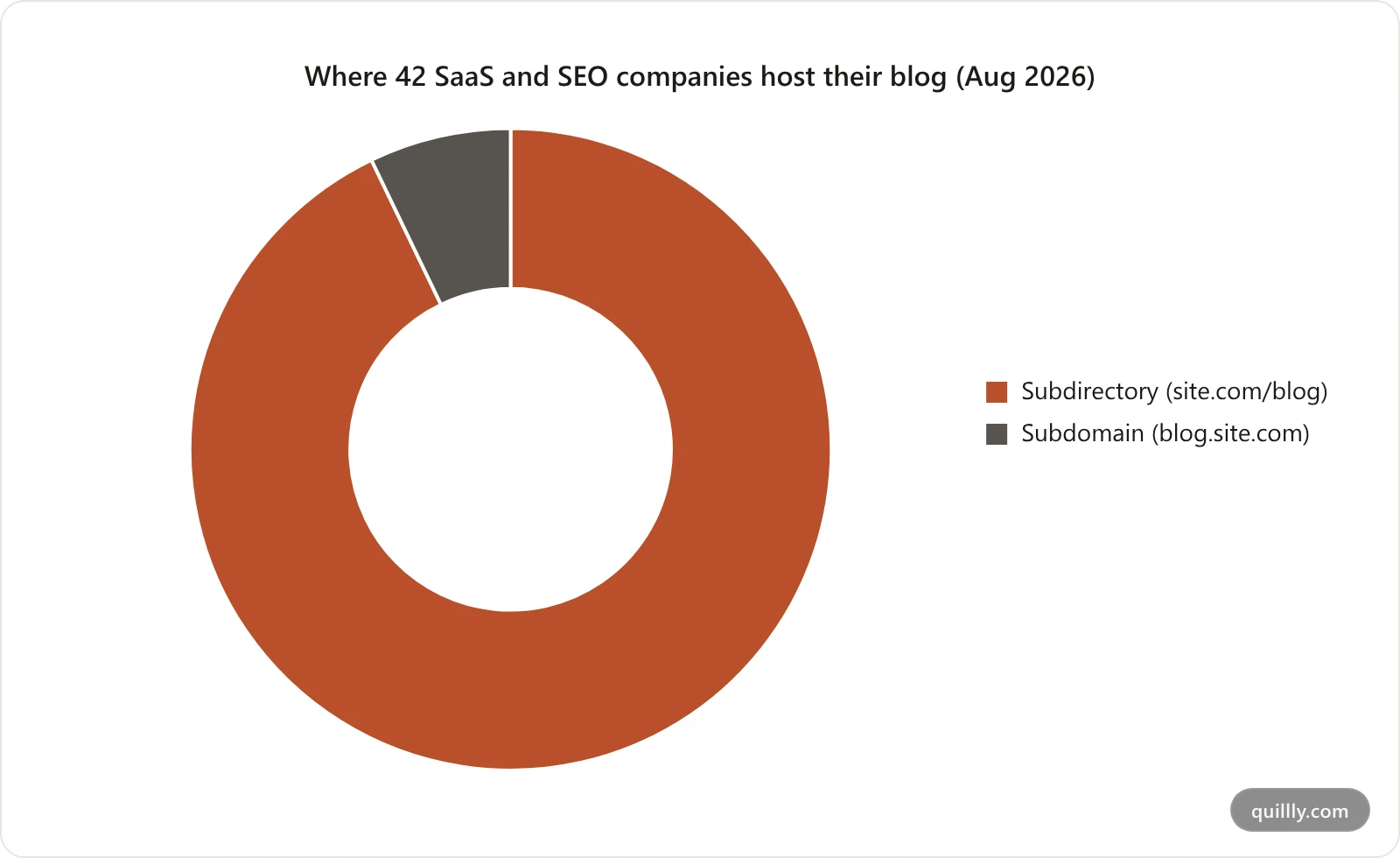
The three holdouts are all legacy, not strategy. blog.hubspot.com predates the modern hubspot.com site and now carries more authority than most companies' entire domain — migrating it would be the riskiest SEO project in marketing. blog.cloudflare.com is a separate application, not a marketing decision. And on.substack.com is Substack publishing on its own product, which is the one honest reason to sit on a subdomain.
The detail that settles the argument: every SEO tool vendor in the sample uses a subdirectory — Ahrefs, Semrush, Moz, Surfer SEO, and Backlinko all serve from /blog. These are the companies with the most rank data on earth and the most to gain from being right. They all made the same call. So did Stripe, Vercel, Supabase, PostHog, Linear, Resend, Render, Clerk, Webflow, Shopify, and Notion.
One genuine oddity worth flagging: notion.so/blog redirects cross-domain to www.notion.com/blog — an artifact of their domain change, and a reminder that a hostname migration leaves redirect chains behind for years.
Method and limits: convenience sample of 50 SaaS, developer-tool and SEO domains, probed 12 August 2026. 8 were inconclusive and excluded rather than guessed: 4 had no discoverable blog at a standard path (medium.com, openai.com, perplexity.ai, penfriend.ai), 2 resolved only to their homepage, 1 returned an image asset, and 1 (notion.so) resolved off-domain. This measures where companies put their blog, not what it earned them — it's evidence of revealed preference among sophisticated teams, not a controlled ranking experiment.
When a subdomain still makes sense (the three valid cases)#
Subdomains aren't wrong. They're wrong for blogs. Here are the three cases where they're the right call.
Genuinely different audience or topic. If you run an e-commerce store and decide to launch a community forum that has nothing to do with your products,
forum.yourdomain.comis reasonable. It matches Mueller's exact recommendation: different audience, different content type, different ranking targets.Different application, different stack. SaaS apps live on subdomains for a reason.
app.yourdomain.comkeeps cookies, auth, and security boundaries separate from the marketing site. That's an engineering decision, not an SEO one.International sites with strong country signals. Some teams choose
de.yourdomain.comfor German market content. Others chooseyourdomain.com/de/. Both can work. International SEO consultants like Aleyda Solis lean toward subdirectories for new markets unless the country has unusual hosting or compliance constraints.
Note what's missing: "my blog is on a different theme than my product." That's the #1 false reason teams pick subdomains and the #1 case where the data says you're leaving traffic on the table. If your blog covers topics adjacent to what your business does, it belongs at /blog.
The Single-Domain Doctrine#
Here's the framework. Three rules to commit to memory and quote back to anyone defending the subdomain choice on a whiteboard.
Rule 1: One hostname accumulates all signals. Backlinks, brand mentions, internal links, click-through behavior, trust history, citation share — every signal a search engine or AI engine uses to rank or cite you accrues to a single hostname. Picking one hostname and routing everything through it compounds those signals. Picking two splits them.
Rule 2: Internal links are domain glue. A subdirectory blog links freely into your product pages, pricing, docs, and case studies. Search engines follow those links and learn that all of it is one site, one topic graph. A subdomain blog has to link "across" hostnames, and while those links count, they don't bind the two as one site the way an internal link does. Internal linking matters even more in 2026's topical authority models.
Rule 3: One root domain is the only domain you need to defend. Migrations, redesigns, platform changes, server moves — every one of these is twice as expensive on two hostnames. One canonical root domain means one sitemap, one robots.txt, one Search Console property, one analytics setup, one security perimeter to harden.
The doctrine is short on purpose: pick one domain, route everything through it, defend it forever. Subdirectories are how you keep that doctrine intact.
How to migrate from subdomain to subdirectory without losing rankings#
If you're stuck on a subdomain today and want to move, here's the step-by-step. This is a real migration, not a "set up a redirect and pray" job.
Audit and map every URL. Crawl the subdomain. Export every indexed URL. Build a one-to-one mapping spreadsheet:
blog.you.com/old-post→you.com/blog/old-post. Don't merge multiple posts. Don't decide which to drop yet.Set up the new path structure first. Build out
you.com/blog/*to serve the same content with the same slugs. Verify rendering, canonical tags, and structured data on the new URLs before flipping any redirects.301 redirect the entire subdomain to its new path mapping. Every old URL gets a permanent redirect to its exact new equivalent. Avoid redirect chains. Avoid redirecting everything to the new homepage — that's a known traffic killer.
Update internal links sitewide. Don't rely on the redirects. Open every internal link to the old subdomain and rewrite it to the new path directly. Search engines follow the cleaner signal.
Submit the new sitemap and remove the old one. Add the subdirectory URLs to your root domain's sitemap. Remove the old subdomain sitemap from Search Console. If indexing stalls, the 2026 fix stack covers what to try next.
Watch Search Console for both properties for 90 days. The subdomain property won't disappear immediately. Impressions migrate from the old property to the new one over weeks. Watch coverage errors carefully — they're the early signal of a redirect breakage.
Expected timeline: 2–6 weeks for most rankings to settle, 90 days for full equity transfer. Plan around it. Don't migrate during a launch week.
The platform tax: why most blog hosts can't put your blog at /blog#
Here's the trap nobody mentions on the platform comparison pages.
Substack supports custom domains, but only as a subdomain — newsletter.yourdomain.com or blog.yourdomain.com. The Substack support docs are explicit: subdirectory hosting isn't supported, and users have been requesting it for years specifically for SEO reasons. Medium custom domains have similar constraints.
Ghost can technically be reverse-proxied to a subdirectory, but the documentation pushes you toward a subdomain or a root install, and most managed hosts ship the subdomain default. WordPress.com's hosted plans use subdomains by default.
This is the platform tax. You're paying for someone else's hosting convenience with the SEO performance the data above shows you're leaving on the table. For a personal newsletter where reach doesn't matter, fine. For a business blog where every backlink should reinforce your product domain, it's a real cost.
The alternative — and one of the reasons Quillly exists — is publishing infrastructure that ships your blog at yourdomain.com/blog by default. The MCP-based publishing model lets your AI of choice (Claude, ChatGPT, Cursor, Gemini, Windsurf) push posts to your own root domain, not a hosted subdomain. The full builder's guide to MCP-based SEO covers the broader workflow.
Subdirectory vs subdomain SEO: the head-to-head comparison#
Dimension | Subdirectory ( | Subdomain ( |
|---|---|---|
Domain authority flow | Concentrates on one root domain | Splits between two hostnames |
Backlink equity | Lifts entire site | Lifts only the subdomain |
Internal linking | Native — all links count fully | Cross-hostname — partial signal |
Search Console properties | One | Two (must verify each) |
Sitemap & robots.txt | Single root files | Separate per hostname |
Crawl trust ramp | Inherits root domain history | Starts from zero, ~3–6 months |
AI Overview citation share | Compounds on one domain | Splits across two |
Migration cost | Low — single property | High — coordinate two properties |
When it's the right call | Blogs, docs, resources, related content | Apps, forums, genuinely different audiences |
Real-world migration data | Pink Cake Box +40%, Salesforce 2x | IWantMyName -47%, G2 3–6 months trust ramp |
The structural advantage shows up across every dimension that matters for either traditional ranking or AI citation. If you're publishing content adjacent to your business — which is almost every blog that exists — the comparison isn't close.
Common subdirectory mistakes to avoid#
A clean architecture decision still leaves room for execution mistakes. The five that come up most often:
Using
**/blog/**and**/blog**interchangeably. Pick one canonical form and 301 the other. Mixed signals confuse crawlers and split internal link weight across two URLs that should be one.Forgetting trailing-slash redirects on subpaths.
/blog/post-nameand/blog/post-name/are different URLs to a search engine. Pick one. Your CMS or edge worker should redirect the other consistently.Letting the blog and root share a sitemap silently. A subdirectory blog should appear in your single root sitemap at
yourdomain.com/sitemap.xml. Splitting intositemap-blog.xmlis fine if it's referenced from a sitemap index. Hiding it in a separate file Google doesn't know about is not.Publishing canonical tags pointing at the wrong domain. A surprising number of subdirectory migrations leave canonicals pointing at the old subdomain. Audit canonical tags on every post after migration. They should match the page URL exactly.
Treating
**/blog**as a second-class section. Subdirectories work because they share authority with the rest of the site. That assumption breaks if your nav, breadcrumbs, and internal links treat/blogas a silo. Every product page should link to relevant posts. Every relevant post should link to product or pricing pages. The whole point is that they're one site.
Even teams that get the architecture right miss two or three of these in practice. Run a 30-minute audit after launching a new subdirectory blog to catch them before they cost a quarter of indexing time.
Frequently asked questions#
Does Google really treat subdomains and subdirectories the same?#
Google's official answer, repeated by John Mueller across years of office hours and Twitter threads, is yes. The systems are the same. But Mueller also acknowledges subdomains need to be verified separately and built up independently. In practice, that "same" treatment produces measurably different real-world outcomes, which is why every public migration case study favors subdirectories for blogs.
My blog is already on a subdomain and ranking. Should I migrate?#
Maybe not immediately. Migrations cost time and carry risk. The right trigger is when your subdomain is hitting a ceiling — link equity isn't compounding, AI Overview citations are sparse, or you're spending engineering time maintaining two SEO setups. If the subdomain is performing well and your team is small, the cost of migration may exceed the lift.
Will I lose rankings during a subdomain-to-subdirectory migration?#
Short-term, almost certainly. Plan for a 2–6 week dip while Google reprocesses redirects and rebuilds context. Long-term, the consolidated domain typically recovers and exceeds the prior subdomain rankings. The IWantMyName case (47% loss going the wrong direction) is the inverse of what most teams see going the right direction.
What about international sites — is you.com/de better than de.you.com?#
For most teams, yes. Subdirectories let your international content benefit from your root domain's authority. Subdomains are reasonable for very large markets where you want regional autonomy and you're willing to invest in independent link building per country. ccTLDs (you.de) are a third option with stronger geo-signals but higher overhead.
Do AI engines like ChatGPT actually distinguish between subdomain and subdirectory?#
Yes. Citation studies in 2026 show AI engines accumulate trust at the hostname level, mirroring how Google treats them. Splitting your content across two hostnames means each accumulates less citation weight than a single domain would. With AI Overview citations earning 35% more organic clicks per cited page, that distinction has real revenue impact.
Can I use a subdomain for my app and still keep my blog at /blog?#
Absolutely. app.you.com for your product, staging.you.com for testing, and you.com/blog for content is the standard SaaS layout. The Single-Domain Doctrine says route public-facing content through one root, not that you can never use subdomains for anything. Apps and staging environments are a separate question from blog architecture.
How long does it take a new subdirectory blog to rank vs a new subdomain blog?#
A new /blog path inherits your root domain's existing trust. New posts can rank within days or weeks if the rest of the site has established authority. A brand-new subdomain starts from zero. The G2 case study is illustrative: a DR 88 root domain, but the new subdomain still took 3–4 months to gain meaningful traction.
The bottom line#
The 2026 verdict on subdirectory vs subdomain SEO for blogs comes down to three numbers: +40% (Pink Cake Box's organic lift after the right migration), -47% (IWantMyName's loss after the wrong one), and 68% (the share of AI citations now consolidated in the top 15 domains, where every additional hostname dilutes your slice).
Pick one domain. Route every piece of content through it. Defend it forever. The Single-Domain Doctrine isn't a clever framework — it's just what the migration data has been telling us since 2015, now amplified by an AI search era that rewards domain consolidation more aggressively than the old Google ever did.
Want your AI to actually publish to yourdomain.com/blog instead of someone else's subdomain? Connect Quillly to Claude, ChatGPT, or Cursor in 30 seconds.