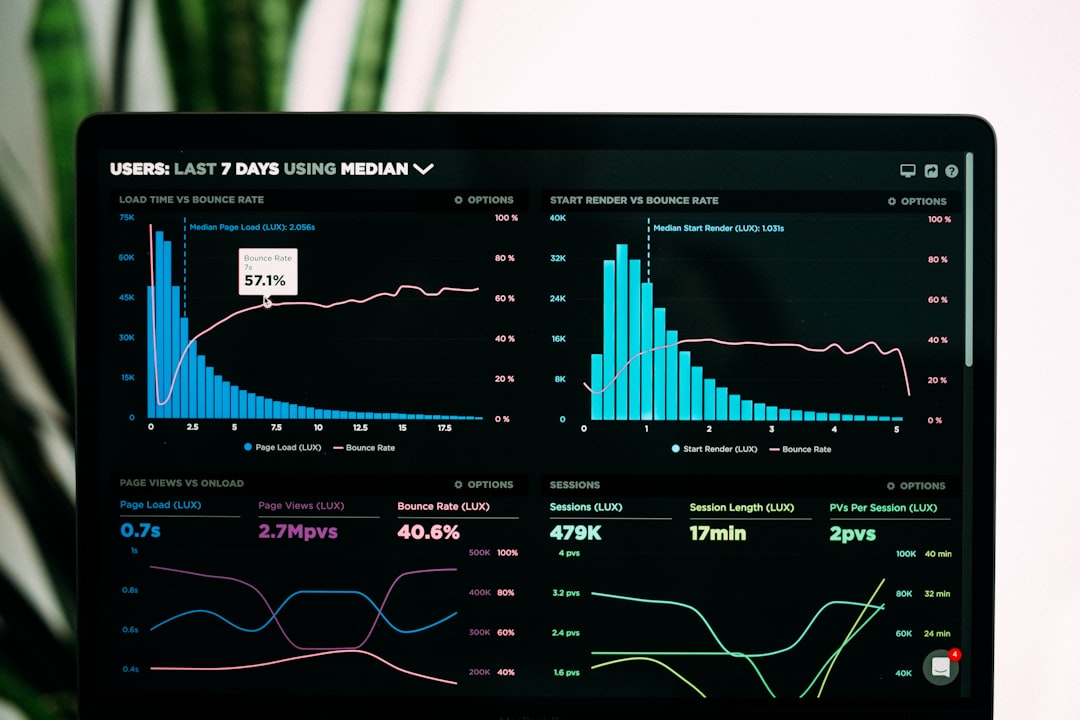
Your traffic looked fine on a Tuesday. By Friday, organic sessions were down 40% and nothing on the site had changed. If the drop lines up with a Google core update window, you weren't penalized and nothing is technically "broken." Google re-rated how your whole site's quality compares to everyone else's, and Google core update recovery is a months-long rebuild, not a weekend fix.
That's not doom. It's a process with a predictable shape. In 2025 alone Google shipped three broad core updates, and independent analyses put the share of sites affected between 40% and 60%, with affiliate-heavy sites hit hardest at around 71%. The May 2026 core update was the most volatile yet. Plenty of sites came back. The ones that did followed roughly the same path.
To recover from a Google core update: confirm the update actually caused your drop, segment which pages and queries lost visibility, strengthen E-E-A-T and topic depth on the pages worth keeping, prune thin or off-topic content, then wait for the next core update to re-rate your site. Most sites recover meaningfully in three to six months.
This playbook turns that into five repeatable steps you can run today.
What a Google core update actually does to your site#
A core update is not a penalty. It's a recalibration of how Google scores content quality across billions of pages at once. When your rankings fall, Google is usually saying your pages now compare less favorably to competitors for the same queries, not that you committed a violation.
The important shift: since March 2024, Google folded the old Helpful Content system into the core algorithm. Before that, a separate site-wide classifier could suppress a whole domain. Now that quality assessment lives inside core ranking and gets recomputed mainly when the next core update rolls out. That's why you can't "fix" your way back overnight. The signal that dropped you only re-evaluates on Google's schedule.
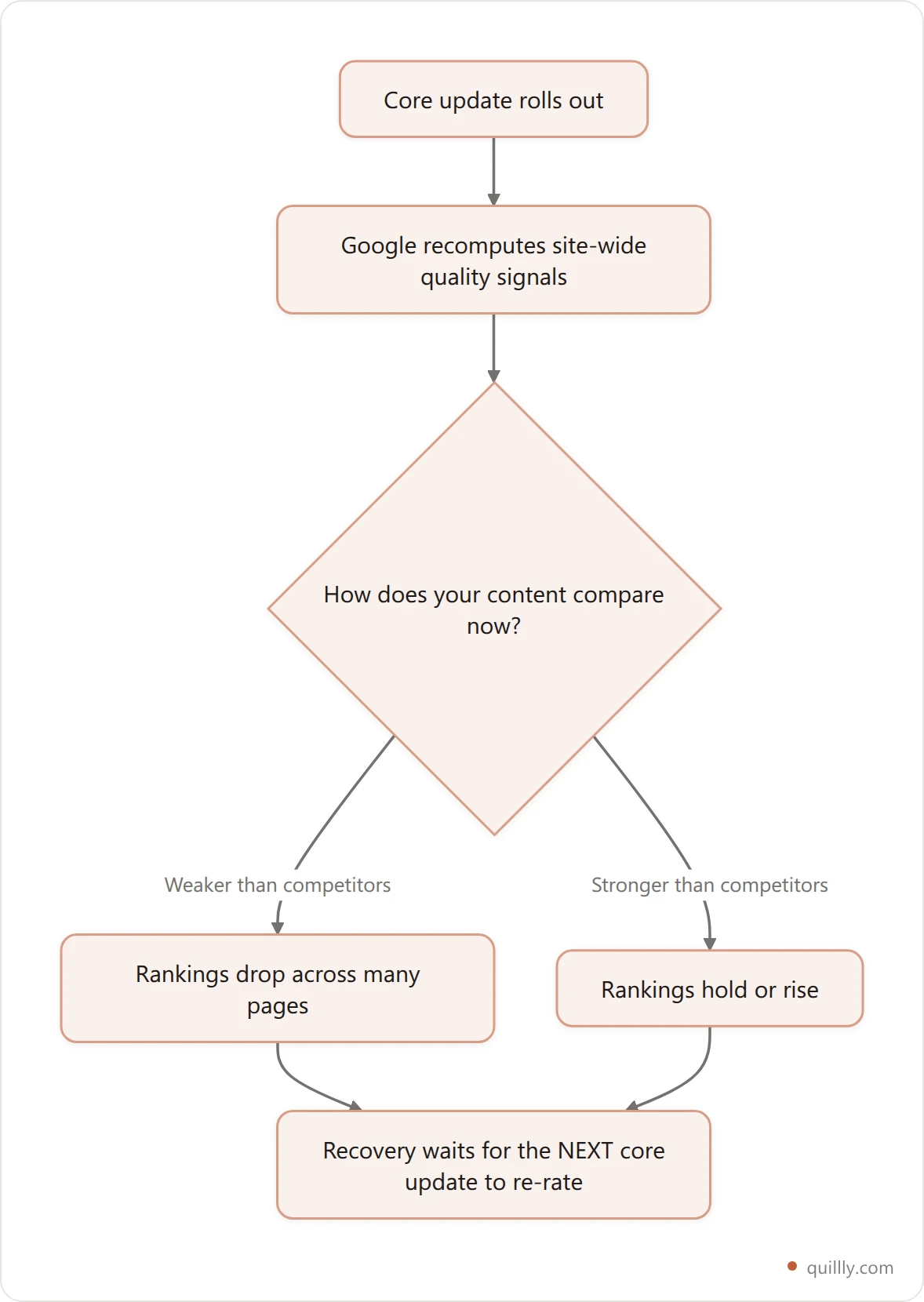
Google's own guidance is blunt about it. Search Central states there "aren't specific actions to take to recover. A negative rankings impact may not signal anything is wrong with your pages." Read that as: stop hunting for a single broken setting and start raising real quality. Google also confirmed core updates now affect AI Overviews, so a drop can cost you classic rankings and AI citations at the same time.
Step 1: Confirm the core update is the real cause#
Takeaway first: don't touch a single page until you've proven a core update caused the drop. Changing the wrong thing first almost always delays recovery.
Pull up Google Search Console, switch to the date-comparison view, and compare the 7 days before the update started against the 7 days after it finished. Sort by clicks lost. If the decline is broad across many pages and started inside the rollout window, a core update is the likely cause. If only a handful of URLs dropped, you may be looking at a targeted issue or a technical bug instead. Cross-check the timing against the Google Search Status Dashboard and a volatility tracker like Semrush Sensor.
Rule out the impostors before you commit to a recovery plan:
Signal | Core update | Spam update / manual action | Technical issue |
|---|---|---|---|
Trigger | Quality recalibration | Policy violation | Crawl, index, or config error |
Scope | Broad, site-wide | Specific pages or tactics | Specific pages or templates |
Manual Actions report | Empty | May show a notice | Empty |
Fix path | Improve quality, wait for next update | Fix violation, file reconsideration | Fix the bug, request re-crawl |
Timing | Matches a confirmed update window | Matches a spam update | Any time |
Check the Manual Actions report in Search Console first. If it's empty and the timing matches a confirmed core update, you're in recovery territory, not penalty territory. For deeper triage, walk your on-page SEO audit before assuming the algorithm is the whole story.
The RESET framework for core update recovery#
Here's the whole playbook in one named, repeatable loop. Call it RESET: Rule out, Examine, Strengthen, Eliminate, Track. You run it in order, then loop it every core update until traffic returns.
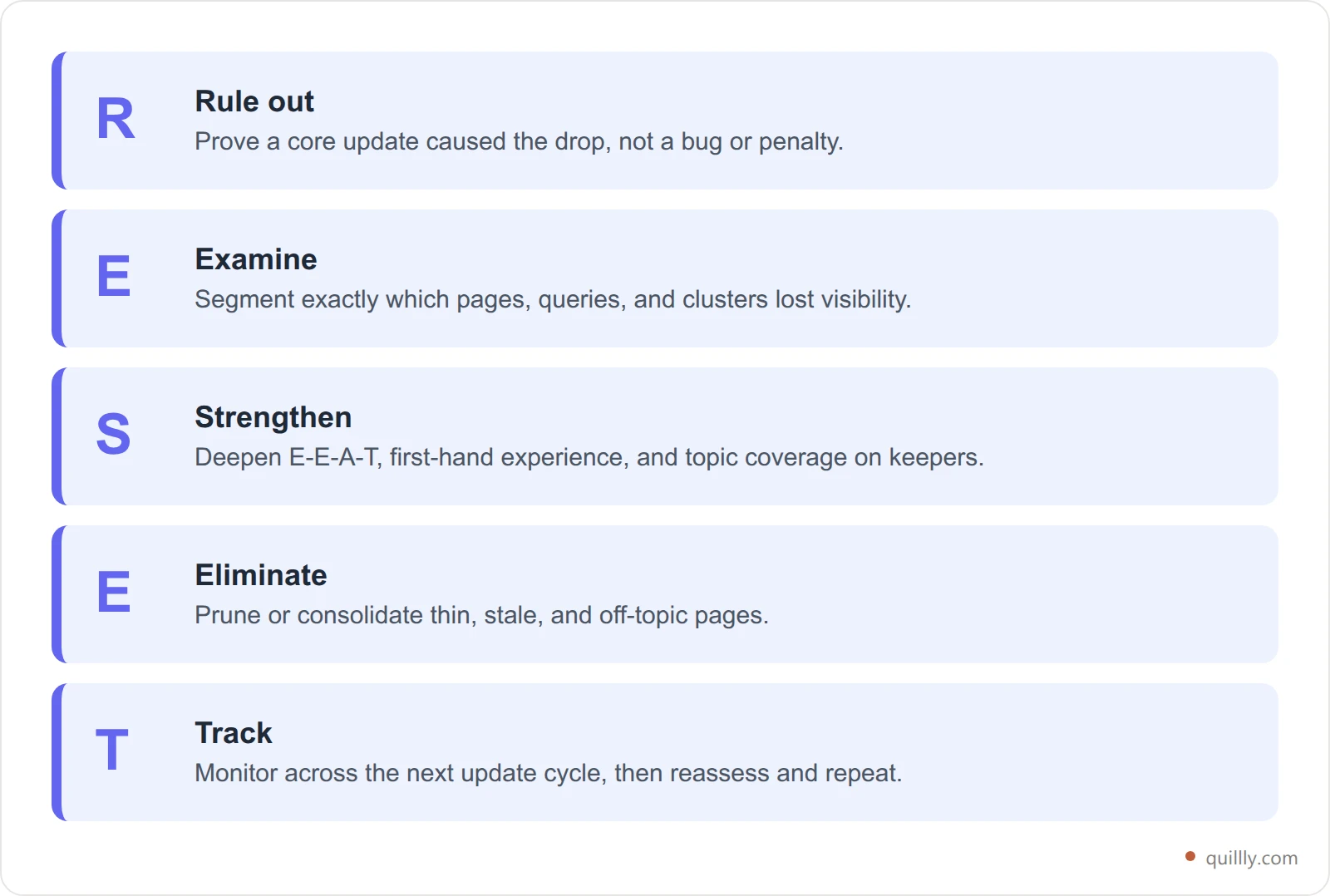
You already ran Rule out in Step 1. The next three steps are where the real work happens, and Track is what keeps you honest while Google takes its time.
Step 2: Examine what dropped and why#
Takeaway: recovery starts with a diagnosis, and the diagnosis lives in your own data. Blanket rewrites waste months. Surgical fixes don't.
In Search Console, export the queries and pages that lost the most clicks. Then classify each loss. Is it ranking-led (you fell from position 3 to 12), click-led (same position, worse CTR), or intent-led (Google now shows a different content type for that query)? Group the losers into topic clusters. If an entire cluster fell together, that's a quality-perception problem for that topic, not a one-page issue.
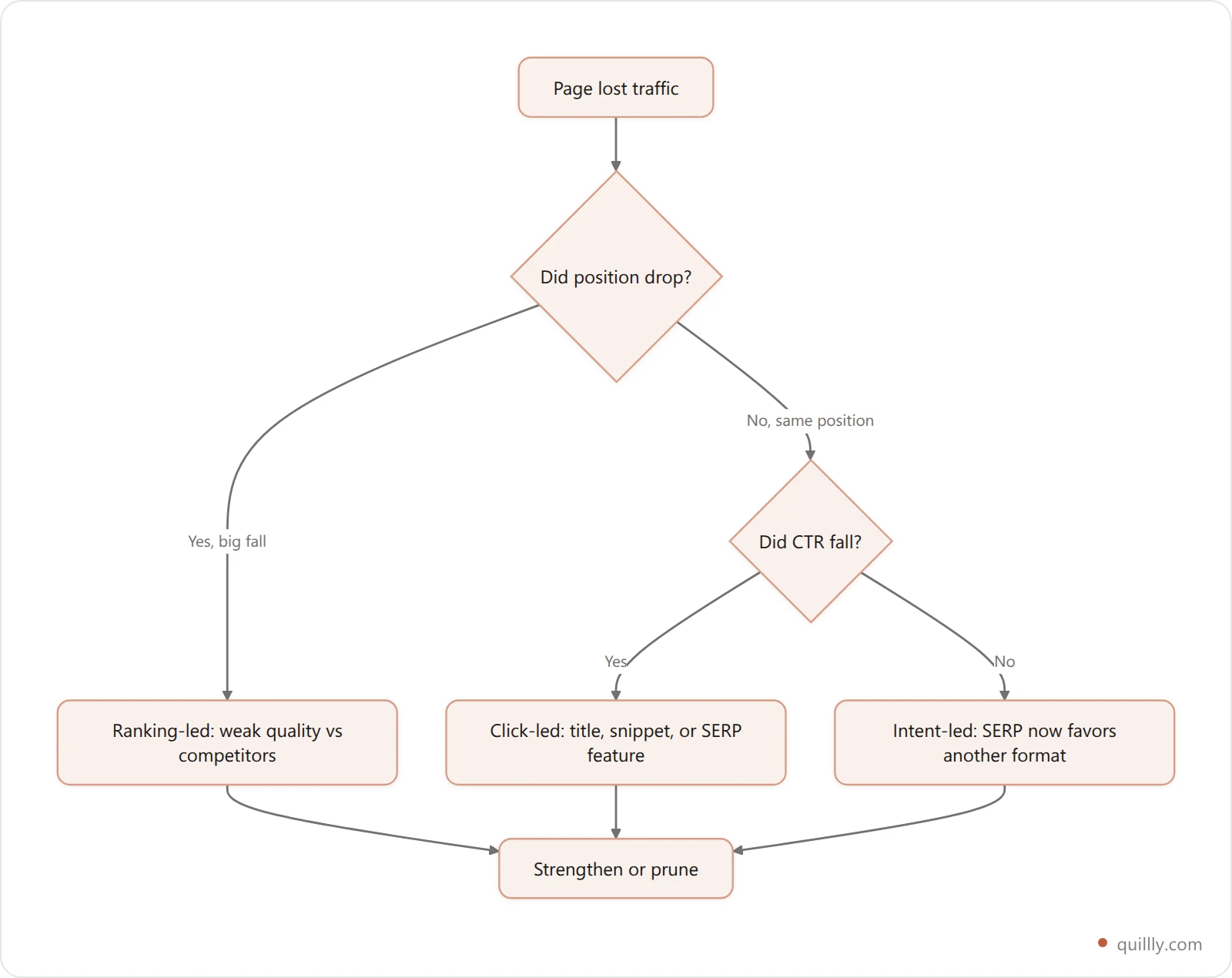
Map affected pages against a simple rule: pages that lost the most and matter least to your business are prune candidates. Pages that lost traffic but serve real buyers are strengthen candidates. This two-list split drives every decision that follows. If several near-duplicate pages compete for one query, you may also be dealing with keyword cannibalization, which core updates punish hard.
Step 3: Strengthen E-E-A-T, depth, and topic coverage#
Takeaway: core updates reward demonstrable expertise and full topic coverage, so this is where keepers earn their rankings back. SEO analyst Lily Ray, reviewing 2026 recoveries, flagged four recurring traits in sites that gained ground: stronger E-E-A-T signals, cleaner entity clusters, better engagement metrics, and content that answers fan-out questions instead of head terms only.
Work through your strengthen list with that in mind:
Add first-hand experience. Original screenshots, test results, and specifics you can't get from a competitor's page. This is the "E" competitors skip.
Show the author. Real bylines, credentials, and an about page. For E-E-A-T on AI-assisted content, provenance matters more than word count.
Cover the full topic, not one keyword. Google's AI systems decompose a query into many sub-questions. A SurferSEO analysis of 173,902 URLs found a 0.77 correlation between how many query fan-out sub-queries a page answers and its odds of being cited in AI Overviews. Breadth is a ranking asset now.
Answer the whole entity cluster. Add the definitions, comparisons, and edge cases a genuine expert would include.
John Mueller reinforced the point in November 2025: "Our systems don't care if content is created by AI or humans. What matters is whether it's helpful for users." Creation method is neutral. Helpfulness is not.
Step 4: Eliminate thin and off-topic pages (the contrarian move)#
Takeaway, and it's the one most people get wrong: recovery usually comes from subtraction, not from publishing more. Your instinct after a drop is to add content and edit the losers. The evidence points the other way.
Glenn Gabe of GSQI documented a commercial site that lost 41% of its organic traffic across four consecutive updates in 2023. Recovery began only after the team cut roughly 38% of its editorial content. As Gabe put it, the removed pages "weren't broken. They were tangential to the core business, written for traffic rather than customers." Pruning concentrated the site's quality signal on the pages that actually deserved to rank.
Use a clear triage rule for every low-value page:
Page type | Traffic | Business value | Action |
|---|---|---|---|
Thin, no rankings, off-topic | None | None | Delete (410) or noindex |
Overlapping near-duplicates | Split | Some | Consolidate into one strong page |
On-topic but shallow | Some | High | Strengthen and expand |
Outdated but relevant | Falling | High | Refresh and re-date |
Consolidation is often better than deletion. Merge three shallow posts into one authoritative guide, 301 the old URLs, and you hand Google a stronger single page instead of three weak ones. Treat this as an ongoing habit, not a one-time purge, and pair it with a content decay refresh routine so pages don't quietly rot between updates.
Step 5: Track, wait, and recover AI citations too#
Takeaway: recovery is measured across update cycles, and in 2026 "recovered" means winning back both blue links and AI answers. Google confirmed core updates affect AI Overviews, so your rebuild has two fronts. Mueller also explained that different components, content quality, link authority, and E-E-A-T assessment, settle at different points during a rollout, which is why traffic often wobbles before it climbs.
Set realistic expectations by site type:
Site type | Typical recovery window | Notes |
|---|---|---|
Standard blog / SaaS | 2 to 6 months | Often partial gains before the next core update lands |
Affiliate / thin-heavy | 3 to 9 months | Needs the deepest pruning and E-E-A-T work |
YMYL (health, finance) | 6 to 12 months | Highest trust bar, slowest to re-rate |

Because rollouts now run two to three weeks, resist the urge to change everything mid-update. Make your quality fixes, then hold the line and let the next core update re-rate the site. To keep AI visibility intact while you wait, make sure your pages are crawlable by AI bots and structured for extraction, the same fundamentals behind ranking in AI Overviews and ChatGPT. Recovery that ignores the AI surface leaves half your visibility on the table.
Recover faster with automated quality audits#
Takeaway: the RESET loop is mechanical enough to automate most of the diagnosis. That's exactly where an MCP-connected workflow saves you days.
Instead of eyeballing 200 URLs, you can point your AI at the data. Connect Quillly to Claude or ChatGPT and the model runs the audit for you: get_page_issues surfaces the technical and quality problems on tracked pages, check_blog_seo scores each post against 14 criteria so your strengthen list writes itself, and suggest_internal_links rebuilds the topical connections that pruning disrupts. When a page is ready, publish_content pushes the fix live and pings IndexNow so Google and Bing re-crawl it fast.
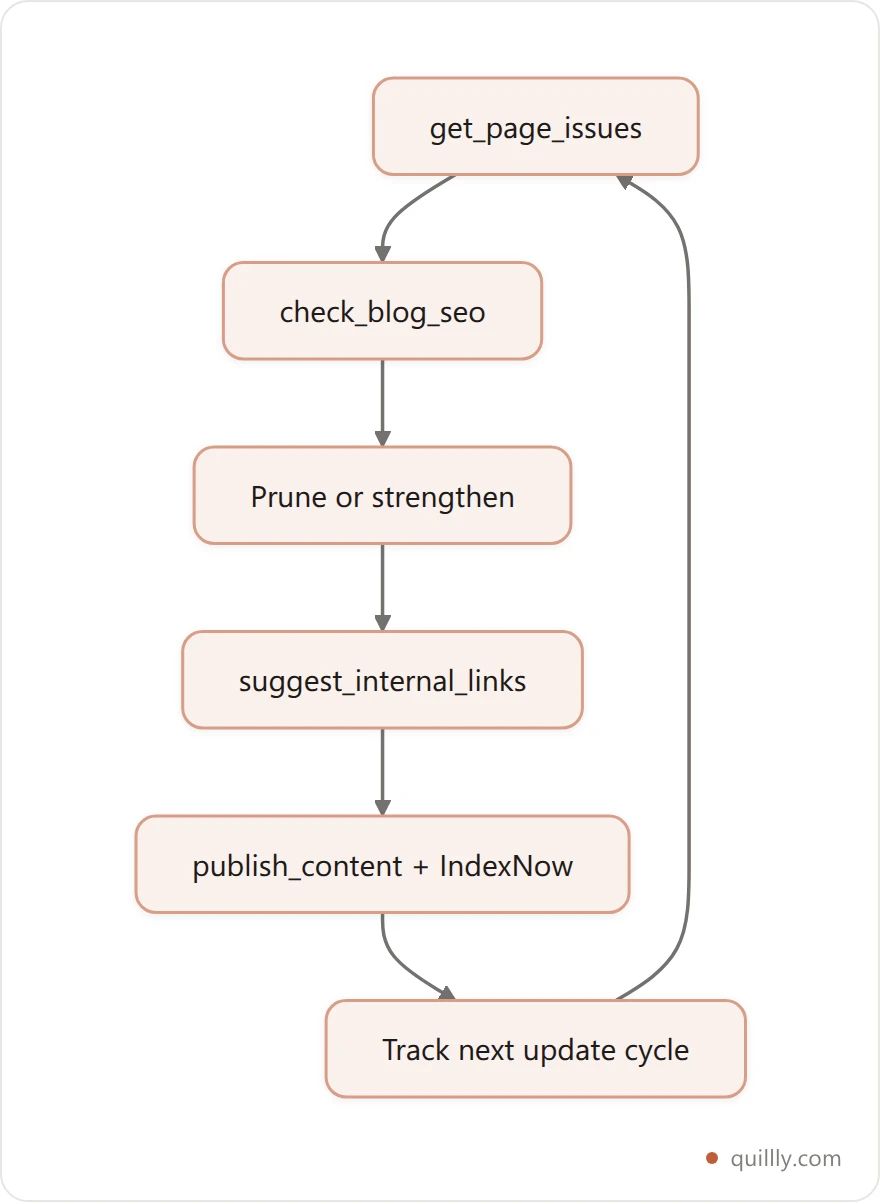
The point isn't automation for its own sake. It's that recovery is a repeatable loop, and loops are what software runs well. Your AI does the diagnosis and drafting. Quillly handles the scoring, publishing, and indexing on your own domain.
Your copyable core update recovery checklist#
Takeaway: recovery works best as a repeatable list you run every update, not a scramble. Copy this into your project tracker and work top to bottom. It maps one-to-one onto the RESET framework, so nothing gets skipped when you're stressed and staring at a red traffic graph.
GOOGLE CORE UPDATE RECOVERY CHECKLIST (RESET)

RULE OUT (Days 1-3)
[ ] Confirm the drop timing matches a core update window (Search Status Dashboard)
[ ] Check the Manual Actions report in GSC -- is it empty?
[ ] Rule out technical causes: robots.txt, noindex, 404s, canonical errors
[ ] Rule out seasonality (compare year-over-year, not week-over-week)

EXAMINE (Week 1)
[ ] Export GSC: 7 days before vs 7 days after, sorted by clicks lost
[ ] Tag each loss: ranking-led / click-led / intent-led
[ ] Group losing URLs into topic clusters
[ ] Split pages into two lists: STRENGTHEN vs PRUNE

STRENGTHEN (Weeks 2-5)
[ ] Add first-hand experience, data, and original screenshots
[ ] Add or verify author bylines, credentials, and an about page
[ ] Expand coverage to answer fan-out sub-questions, not just the head term
[ ] Fix Core Web Vitals (LCP under 2.5s) on key templates

ELIMINATE (Weeks 2-5)
[ ] Delete or noindex thin, off-topic, zero-value pages
[ ] Consolidate near-duplicates into one page + 301 redirect
[ ] Rebuild internal links broken by pruning
[ ] Refresh outdated but relevant pages

TRACK (Ongoing)
[ ] Log every change with a date
[ ] Monitor rankings AND AI Overview / ChatGPT citations
[ ] Wait for the next core update before judging results
[ ] Re-run RESET each cycle until traffic returns
Print it, pin it, and run it in order. The teams that recover treat this as a standing process, not a one-off panic. If you connect your content to an AI assistant, most of the Examine and Strengthen boxes can be scored automatically, which is the difference between a two-week audit and a two-hour one.
Frequently asked questions#
How long does Google core update recovery take? #
Most sites recover meaningfully within three to six months, but the exact window depends on your niche. Standard blogs and SaaS sites often see partial gains before the next core update fully re-rates them. YMYL sites in health or finance can take six to twelve months because the trust bar is higher. Recovery almost never happens between updates.
Can I recover before the next core update? #
Rarely in full. Because Google recomputes site-wide quality mainly during core updates, most significant recovery lands when the next update rolls out. You can see small gains from Google's continuous updates, but plan your quality work to be complete and indexed before the next core update begins.
Was I penalized or just re-ranked? #
Check the Manual Actions report in Search Console. If it's empty and your drop matches a confirmed core update window, you weren't penalized. Google re-rated how your content compares to competitors. A manual action is a separate, explicit notice that requires fixing the violation and filing a reconsideration request.
Should I delete or improve pages that lost traffic? #
Both, depending on the page. Delete or noindex thin, off-topic pages with no traffic and no business value. Consolidate near-duplicates into one strong page with a 301 redirect. Strengthen shallow pages that serve real buyers. Documented recoveries often involve pruning 30% or more of low-value content before rankings return.
Does removing AI content help recovery? #
Not by itself. John Mueller confirmed Google's systems don't care whether content is written by AI or humans, only whether it's helpful. Removing unhelpful, thin content helps regardless of who wrote it. Removing helpful AI-assisted content because it's AI-made does nothing. Focus on quality, not creation method. See our data on whether Google penalizes AI content.
How do I know which core update hit me? #
Compare the seven days before and after each update window in Search Console and note when your decline started. Cross-reference the Google Search Status Dashboard for confirmed rollout dates. If your drop aligns with a specific window and stays down after the rollout completes, that's your update.
Do core updates affect AI Overviews and ChatGPT citations? #
Yes. Google confirmed core updates influence the content shown in AI Overviews, and Bing's index feeds ChatGPT citations. A core update can cost you traditional rankings and AI visibility together, so recovery work should target both. Structured, crawlable, genuinely helpful content is the shared foundation for both surfaces.
What if my rankings never come back? #
Some sites don't fully recover, usually because the underlying quality gap is real and unaddressed. If you've pruned aggressively, strengthened E-E-A-T, and waited through two full core updates with no movement, treat it as a signal to rethink the site's core value proposition rather than tweak pages. Sometimes the honest answer is that the content wasn't differentiated enough.
The bottom line on core update recovery#
Three things to hold onto. First, a core update is a re-rating, not a penalty, so the fix is real quality, not a hidden setting. Second, the biggest lever is usually subtraction: the site in Gabe's case study recovered only after cutting 38% of its content, and pruning beats publishing when your quality signal is diluted. Third, recovery runs on Google's clock, three to six months across at least one full update cycle, so make your fixes, then hold the line.
Run the RESET loop, keep your pages genuinely helpful, and track both classic rankings and AI citations while you wait. That's the whole game.
Want your AI to actually publish the fixes it just drafted? Connect Quillly to Claude or ChatGPT in 30 seconds.