
You ranked #1. You're still not in the answer. That's the gut-punch of search in 2026. Google AI Mode now has over 1 billion monthly users, and it cites the same URLs as a normal Google result only 13.7% of the time. Your top-10 ranking buys you a 1-in-7 shot at the part of the page people actually read.
Google AI Mode SEO is the practice of structuring content so Google's conversational, Gemini-powered search experience cites your page as a source. It's different from ranking blue links. AI Mode breaks one question into many, retrieves passages instead of pages, and stitches an answer with a short list of citations. You optimize for that pipeline, or you stay invisible.
This guide skips the fluff. You'll get the real numbers behind the May 2026 search update, how query fan-out actually works, a repeatable method called the Fan-Out Coverage Method, and the exact passage structure that wins citations. Whether your AI writes in Claude, ChatGPT, or Cursor, you'll know how to make every post extractable.
On this page
What Google AI Mode actually is#
Google AI Mode is defined as a dedicated, conversational search experience powered by Gemini that answers a query with a synthesized response plus cited sources, instead of a page of ten blue links. You open it as its own tab or surface inside Google Search, ask a question in plain language, and get an answer you can follow up on.
It's not the same thing as AI Overviews. AI Overviews are the summary box bolted on top of a normal results page. AI Mode is the whole experience: chat-style, multi-turn, and far more aggressive about pulling from many sources at once. The average AI Mode query runs about 7.22 words versus 4.0 for traditional search, because people ask full questions, not keyword fragments.
The two surfaces look similar and even reach the same conclusion 86% of the time. But they pick different sources to get there. That gap is the whole game, and it's where most brands are quietly losing visibility.

Feature | Traditional Search | AI Overviews | Google AI Mode |
|---|---|---|---|
Format | 10 blue links | Summary box + links | Full conversational answer |
Retrieval | Page-level ranking | Passage + ranking blend | Passage-level, query fan-out |
Citations shown | None | A few | ~7 unique domains per query |
Avg query length | ~4 words | ~4 words | ~7.2 words |
Follow-up queries | New search | No | Yes, multi-turn chat |
The numbers behind AI Mode's 2026 surge#
AI Mode stopped being a side experiment. At Google I/O 2026, Sundar Pichai confirmed AI Mode passed 1 billion monthly active users roughly a year after launch, with queries more than doubling every quarter and availability in nearly 200 countries. This is now mainstream search behavior, not an early-adopter toy.
The usage pattern matters as much as the size. More than 1 in 6 AI Mode searches in the U.S. are multimodal, using voice or image, and image-based searches are growing over 40% month over month. People ask longer, messier, more conversational questions here. Desktop share data shows the curve bending up fast: U.S. AI Mode share of desktop occasions rose from 0.06% in December 2025 to 0.16% in March 2026, a 2.5x jump in one quarter, while EU and UK adoption climbed nearly 4x and overtook the U.S.
And almost every answer hands out credit. Research found 97% of AI Mode responses include at least one citation, referencing around 7 unique domains per query. There is real estate to win here. The only question is whether your passages are built to claim it.
The contrarian truth: ranking #1 no longer gets you cited#
Here's the part that breaks old SEO playbooks. A top-10 Google ranking is no longer the ticket into the answer. Across 540,000 query pairs, AI Mode and AI Overviews cited the exact same URLs only 13.7% of the time, even while reaching matching conclusions 86% of the time. They agree on the answer and disagree on who gets credit.
The source pool has also widened dramatically. One study of 863,000 keywords and 4 million AI Overview URLs found just 38% of citations now come from pages ranking in Google's top 10, down from 76% in mid-2025. Pages ranked 11 to 100 supply 31.2% of citations. Pages beyond rank 100 supply another 31%.

Read that again. Roughly six in ten AI citations go to pages that do not rank on page one. The conventional wisdom, "get to the top 10 and you'll get pulled into AI," is measurably wrong. AI Mode builds its own source list based on passage relevance, not blue-link position.
How query fan-out works: one question becomes 16#
Query fan-out is the engine under AI Mode, and it's why your strategy has to change. When someone asks a question, AI Mode doesn't run one search. It silently spawns a cluster of related sub-queries, runs them in parallel, then synthesizes the results into one answer with citations.
"Query fan-out looks at the subintents behind a search query."
Google's own framing confirms the mechanism: AI Mode issues multiple related searches across subtopics and data sources, then synthesizes them. Independent analysis pegs it at up to 16 parallel searches per query, with Gemini handling passage-level retrieval across roughly 8 to 12 sub-queries.
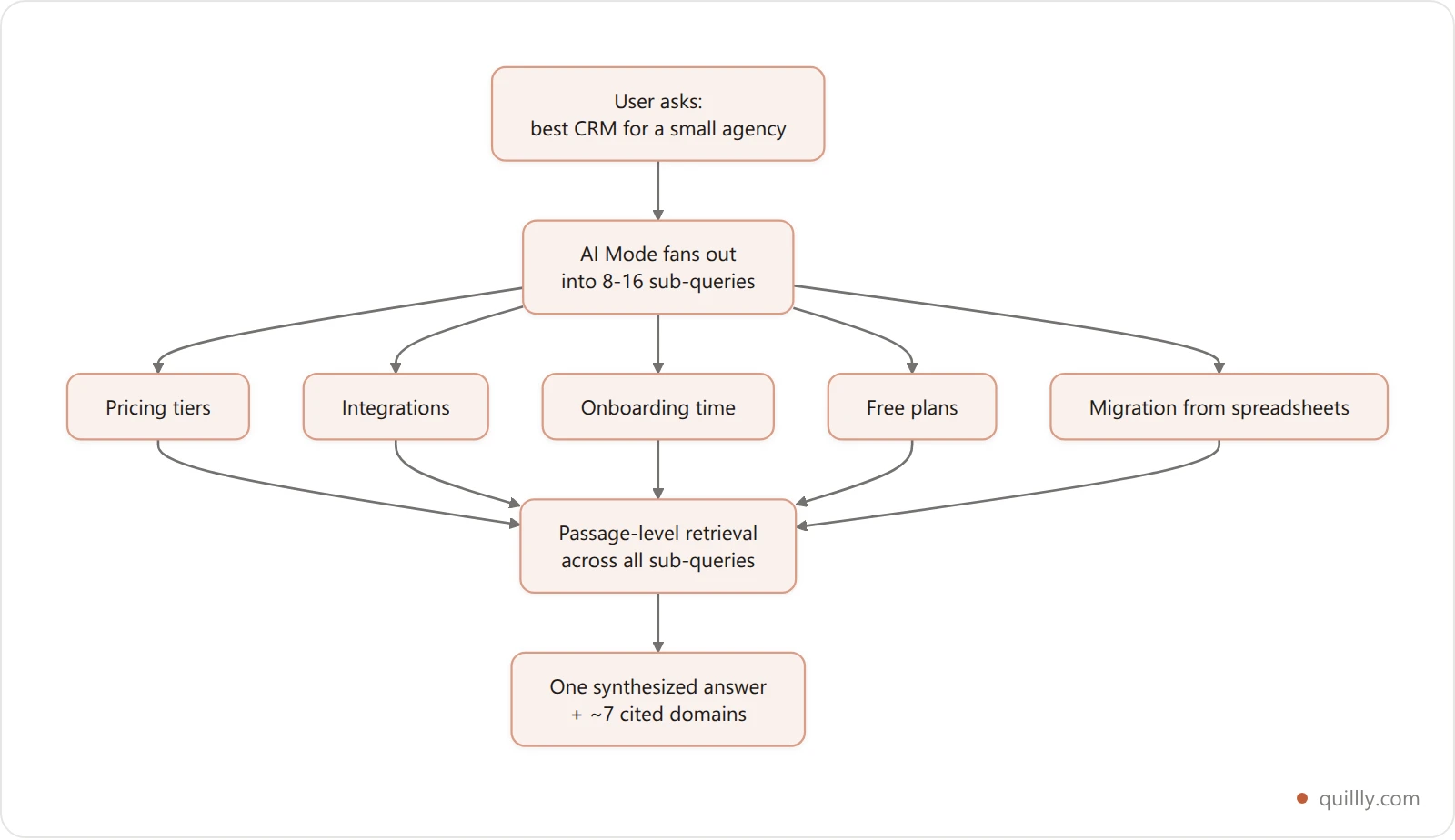
Picture someone searching "best CRM for a small agency." AI Mode quietly also asks about pricing tiers, integrations, onboarding time, free plans, and migration from spreadsheets. If your page only answers the headline question, you miss every sub-query you didn't anticipate. The pages that get cited are the ones that already answered the fan-out.
Want this handled for you? Connect Quillly to Claude, ChatGPT, or Cursor and every post gets scored for AI Mode structure before it ships.
The Fan-Out Coverage Method#
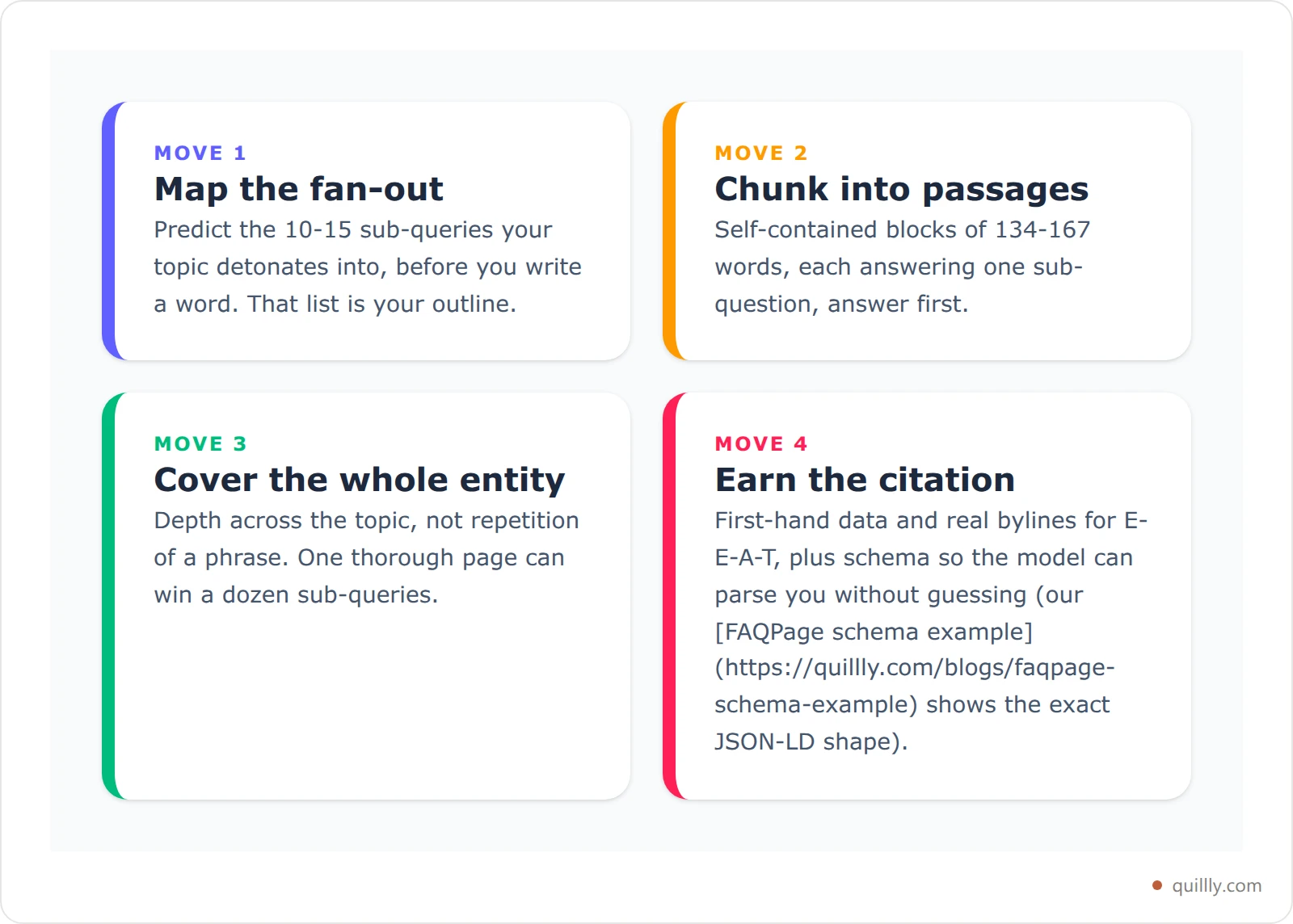
The Fan-Out Coverage Method is a four-move framework for making any post citation-ready in AI Mode. It flips the workflow: instead of writing for one keyword, you write for the cluster of sub-queries that keyword detonates into. Map the fan-out, chunk into passages, cover the full entity, then earn the citation.
The logic is simple. AI Mode retrieves passages, not pages, and it retrieves them against many sub-queries at once. So the unit of optimization is no longer the article. It's the self-contained passage that answers one specific sub-question completely. Win enough of those passages and you show up across the fan-out, even on queries you never explicitly targeted.
"GEO and AIO are pretty much the same tactics, but in different environments."
That's the encouraging part. You're not throwing out SEO. You're applying it at passage resolution. The four moves below turn that idea into something your AI can execute on every post.
Move 1: Map the fan-out before you write#
Start by predicting the sub-queries your topic will trigger. List the headline question, then brainstorm every follow-up a curious reader would ask next. For "best CRM for a small agency," that's pricing, integrations, free trials, onboarding, and switching costs. Each of those becomes a section or passage with its own clear heading.
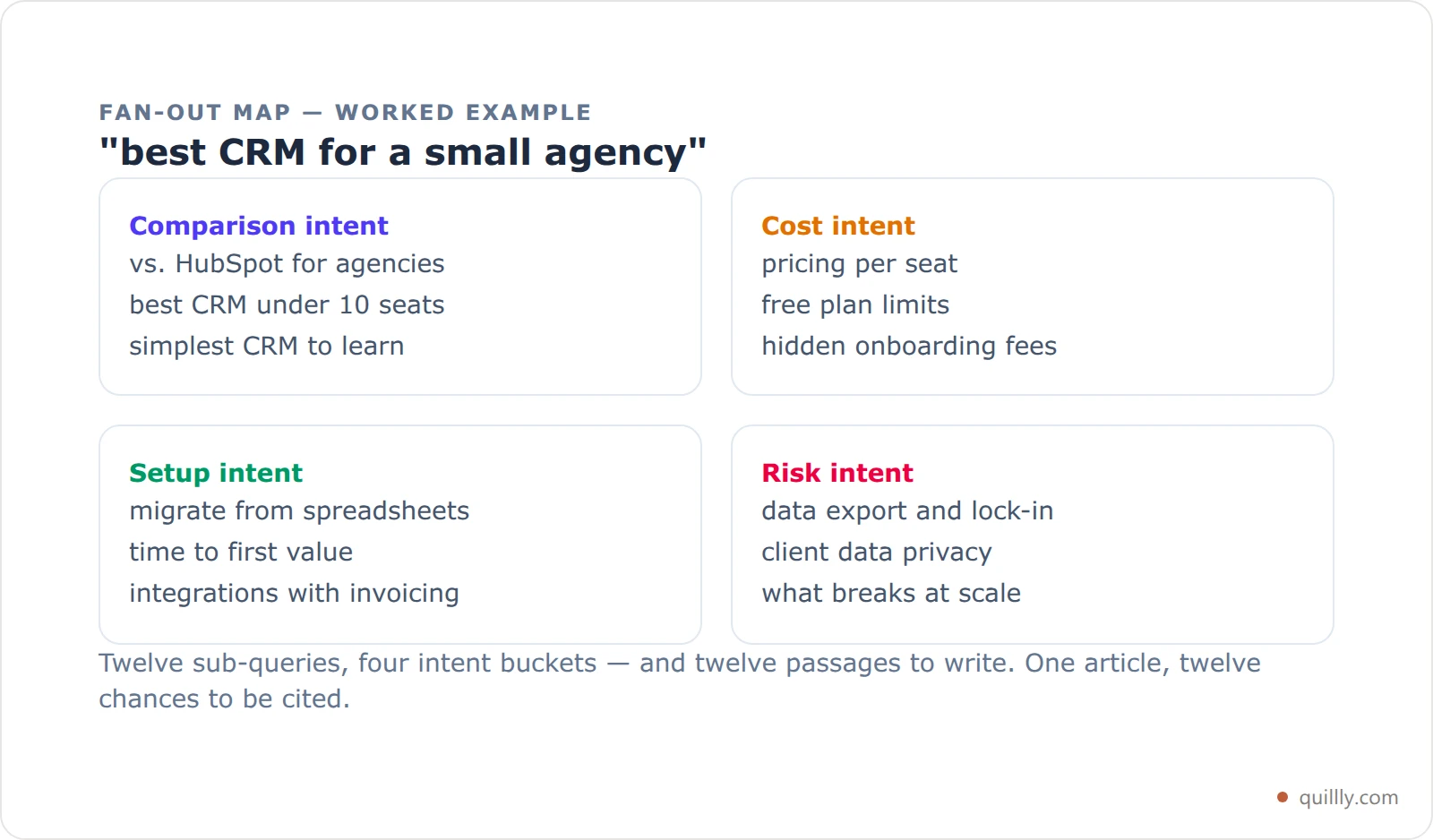
Group the map by intent rather than listing it flat. Comparison, cost, setup and risk questions each pull a different kind of passage, and seeing the buckets side by side makes the gaps obvious: most drafts cover comparison and cost thoroughly, then say nothing at all about risk — which is exactly where the fan-out finds a competitor instead.
You can do this with your AI in one prompt. Ask it: "I'm writing about [topic]. List the 10 to 15 sub-queries Google AI Mode would likely fan out to for this, ordered by search intent." The output is your outline. This single step is the difference between a post that answers one question and a post that blankets the entire fan-out, which is what wins topical authority.
Don't guess in a vacuum. Pull real People Also Ask questions and related searches, then fold them into your map. The wider and more accurate your fan-out map, the more sub-queries your page can quietly win.
Move 2: Chunk content into answer-first passages#
This is the most underrated tactic in AI Mode SEO. Structure your content as self-contained passages of roughly 134 to 167 words, each answering one sub-question completely. A Wellows analysis of 15,847 AI Overview results found passages in that 134-to-167-word band earn the highest citation rates.
Lead every passage with the answer in the first sentence. AI Mode lifts the chunk that states the conclusion up front, not the one that builds to it over three paragraphs. Kevin Indig's analysis of 1.2 million ChatGPT citations found a "ski ramp" pattern: 44.2% of all citations come from the first 30% of the text. Front-load, every time.
Chunking isn't just cosmetic. Mike King, presenting at SparkToro Office Hours in January 2026, noted that clean content chunking improves semantic relevance by 9 to 15% in vector-space retrieval. Clear section boundaries literally make your passages easier to retrieve and cite.
Move 3: Cover the whole entity, not just the keyword#
AI Mode rewards depth across an entity, not repetition of a phrase. Because fan-out pulls from many subtopics, a page that covers a topic comprehensively can get cited on a dozen related queries from a single article. Thin pages targeting one keyword get cited on none.
Practically, this means longer, structured pillar content. Pages that thoroughly cover a topic, typically 2,500 to 4,000 words organized into clear passages, consistently outperform short posts in AI citations. Length alone isn't the goal. Coverage is. The word count is just what real coverage costs.
"From Google Search's perspective, optimizing for generative AI search is optimizing for the search experience, and thus still SEO."
So don't chase a separate trick. Build genuine topical authority and a tight cluster map around your subject. Use definite language, name your entities clearly, and connect related posts with internal links so both Google and Gemini understand how your content fits together.
Move 4: Earn the citation with E-E-A-T and schema#
AI Mode picks sources it can trust and parse. Two things move that needle: demonstrated experience and machine-readable structure. Add real author bylines, first-hand data, original examples, and clear sourcing. These E-E-A-T signals are what large language models measurably reward when choosing citations.
Then make the page trivially easy to parse. Implement Article, FAQ, How-to, and Product schema markup so AI systems can extract your answers without guessing. Structured data won't fake authority, but it removes friction between your content and the model trying to cite it.
"Mature, sophisticated SEO already overlaps heavily with what AI-driven search requires."
The payoff is real. Mike King has reported AI-visibility gains of 253 to 661% when content is restructured specifically for how each platform retrieves and cites it. That's not a tweak. That's the difference between being in the answer and being nowhere.
What SparkToro's zero-click research says about AI Mode#
SparkToro, Rand Fishkin's audience-research company, has spent years documenting zero-click search — the growing share of queries that end without anyone clicking through to a website. Google AI Mode is that trend's logical end point: a complete answer, assembled partly from your passages, delivered without a visit.
Fishkin's August 2026 essay Does Your Website Still Matter in the Zero-Click Era? lands on the conclusion that matters for Google AI Mode optimization: your site will be visited by fewer people, but it remains the only place where you fully control your message. The page still does the work — it just does it through a citation instead of a session.
That reframes three practical things:
Citations are the impression, clicks are the bonus. If you measure only sessions, a page that gets cited on ten sub-queries a day looks dead. Track appearance in the answer first.
The passage is the deliverable. When the visit is optional, the excerpt AI Mode lifts is your marketing. Write it so it reads well out of context and names you inside it.
Brand mentions outlive the click. Being named in the answer builds the recall that later produces direct visits and branded searches — neither of which appear in your organic-click column.
What to measure when the click never lands#
The practical problem with zero-click search is that every dashboard you own is built to count visits. If a citation is the outcome, sessions are the wrong denominator, and a page doing its job will read as a failure all quarter. Swap the metric before you judge the page.
What you probably track | What it misses | Track instead |
|---|---|---|
Organic sessions | Citations that never produce a click | Share of target queries where you appear in the answer |
Bounce rate | Readers who got what they needed from the excerpt | Passage-level appearance across the fan-out |
Keyword position | AI Mode builds its own source list | Citation frequency per topic cluster |
Direct traffic (unattributed) | Recall built by being named in answers | Branded search volume over time |
The shift is uncomfortable because the replacement metrics are harder to collect and slower to move. But measuring citations badly beats measuring sessions precisely when sessions are no longer where the value lands. Start with a weekly manual check on ten queries — crude, but honest — and let the trend, not any single week, tell you whether the structural work is paying.
SparkToro's own venue is where some of the sharpest chunking research surfaced: Mike King's SparkToro Office Hours session in January 2026 is the source of the 9-15% semantic-relevance lift from clean content chunking cited above. If you want the short version of how to rank in Google AI Mode in a zero-click world: make the passage worth quoting, and make sure your name is in it. Score your next draft on exactly those signals.
How to track whether you're actually getting cited#
Google AI Mode SEO is the rare discipline where the main result is invisible in the dashboards you already watch. You can't optimize what you don't measure, and AI Mode citations don't show up in standard rank trackers. Start with a manual baseline. Pick your 10 most important informational queries, run them in AI Mode, and record whether your domain appears in the citation list. Repeat weekly. It's crude, but it's a real signal in week one.
Layer in referral data next. Visits from AI surfaces show up under referrers like google.com AI surfaces and chat-based sources. Tracking that traffic separately tells you when citations turn into clicks. Our guide to tracking AI search traffic walks through the setup in GA4.
Finally, watch the leading indicators. Striking-distance keywords, impression growth on question-shaped queries, and rising citations in AI Overviews all hint that AI Mode is starting to trust your pages. Treat them as the early warning system they are.
Mistakes that keep good content uncited#
Most pages lose AI Mode citations for boring, fixable reasons — and nearly all of them are Google AI Mode SEO problems rather than content-quality problems. The biggest one is burying the answer. If your passage spends three sentences warming up before it states the point, AI Mode skips it for a competitor who led with the conclusion. Front-load or get passed over.
The second mistake is the one-keyword thin page. A 600-word post targeting a single phrase answers maybe one sub-query out of a dozen in the fan-out. It can't compete with a structured pillar that covers the whole entity. Third, walls of text with no clear section boundaries are hard to chunk, which directly lowers retrieval. Clean headings aren't decoration; they're how the model finds your passages.
The rest of the list is quick. No schema means the model has to guess at your structure. No author or first-hand data means weak E-E-A-T. And ignoring multimodal and conversational phrasing means you miss the long, natural questions AI Mode users actually type. Fix these six and most pages move from invisible to citable.
Run the Fan-Out Coverage Method with your AI#
The whole method is more powerful when your AI executes it end to end. The bottleneck was never writing. It was the copy-paste loop between your AI and your CMS, plus the SEO checks nobody enjoys doing by hand. Connect an MCP server to Claude, ChatGPT, or Cursor and that loop disappears.
Here's the copyable fan-out prompt to start any post:
You are my SEO writer. Topic: [TOPIC].
1. List the 12 sub-queries Google AI Mode would fan out to.
2. Outline one 150-word answer-first passage per sub-query.
3. Draft each passage, leading with the direct answer.
4. Add Article + FAQ schema and 3 internal links.
From there, your AI can score and publish the result without you touching a dashboard. A typical sequence with Quillly looks like this:
create_content        → save the draft to your domain
check_blog_seo     → score it against 14+ criteria
get_blog_seo_patches → get exact fixes, applied via update_content
publish_content       → go live on yourdomain.com/blog
Your AI writes the passages. Quillly handles the SEO scoring, schema, internal linking, and publishing to your own domain. That's the entire fan-out workflow in one conversation, repeatable on every post. If you're building a content engine, see how this scales in building a content engine with Claude Code and MCP.
Write for the fan-out, not the keyword
Quillly scores every draft on passage length, entity coverage, and schema — the structural signals AI Mode actually reads — then publishes to your own domain.
Start your 14-day trialFrequently Asked Questions#
What is Google AI Mode SEO?#
Google AI Mode SEO is the practice of structuring content so Google's conversational, Gemini-powered search experience cites your page as a source. It focuses on passage-level extractability, entity coverage, and trust signals rather than blue-link ranking. Because AI Mode retrieves passages and runs query fan-out, the goal is to answer many related sub-queries clearly, not to rank a single keyword.
How is AI Mode different from AI Overviews?#
AI Overviews is a summary box on a normal results page. AI Mode is a full conversational search experience with multi-turn chat and heavier use of query fan-out. They reach the same conclusion about 86% of the time but cite the same URLs only 13.7% of the time. AI Mode also references more sources, around 7 unique domains per query, so the citation competition is different.
Does ranking #1 on Google get me cited in AI Mode?#
Not reliably. Only about 38% of AI citations come from pages ranking in Google's top 10, down from 76% in mid-2025. Roughly 60% of citations now go to pages ranked 11 or lower. A strong ranking helps, but AI Mode builds its own source list from passage relevance, so you have to optimize content structure separately.
What is query fan-out?#
Query fan-out is the technique AI Mode uses to break one question into multiple related sub-queries, run them in parallel, and synthesize one answer. Analysts estimate up to 16 parallel searches per query across roughly 8 to 12 sub-intents. To win, your content should anticipate and answer those sub-queries in clearly labeled, self-contained passages.
How long should passages be for AI Mode citations?#
Aim for self-contained passages of about 134 to 167 words, each answering one sub-question. A Wellows study of 15,847 AI Overview results found that band earns the highest citation rates. Lead each passage with the answer in the first sentence, since roughly 44% of AI citations come from the first 30% of a page.
Can my AI optimize for AI Mode automatically?#
Yes. With an MCP server connected to Claude, ChatGPT, or Cursor, your AI can map the fan-out, draft answer-first passages, add schema, score SEO, and publish to your domain in one conversation. You bring the AI and the topic. The MCP layer handles scoring, internal linking, and publishing, which removes the copy-paste step entirely.
Does zero-click search make AI Mode citations worthless?#
No — it changes what a citation buys. SparkToro's zero-click research shows fewer searches ending in a visit, and Rand Fishkin's August 2026 essay argues your site is still the only place you fully control the message. So a citation delivers reach and brand recall even when the click never lands.
Do I need a separate AEO or GEO strategy for Google?#
No. Google states that optimizing for its generative AI search is still SEO. The tactics shift toward passage structure, entity coverage, and E-E-A-T, but the foundation is the same. If you want the cross-platform version, see the answer engine optimization playbook. As Kevin Indig puts it, these are "the same tactics, in different environments." Build genuine authority and structure it for extraction.
The bottom line#
Search changed underneath you, and the scoreboard moved. Three numbers tell the whole story: Google AI Mode passed 1 billion users, it cites top-10 pages just 13.7% of the time, and nearly 60% of AI citations now go to pages that don't rank on page one. Old rankings don't guarantee new visibility.
The fix is structural, not magical. Map the fan-out your topic triggers. Write self-contained, answer-first passages in the 134-to-167-word band. Cover the full entity, and back it with E-E-A-T and schema so AI Mode can trust and parse you. Do that consistently and you show up across queries you never explicitly targeted.
Want your AI to actually publish the post it just wrote, scored and structured for AI Mode? Connect Quillly to Claude, ChatGPT, or Cursor in 30 seconds.
Keep Reading#
Gemini SEO: how to get cited by Gemini — the model behind AI Mode, covered on its own terms.
How AI search chooses citations in 2026 — the selection mechanics underneath every AI answer.
AI search statistics 2026 — how much traffic AI Mode is really moving.