AI search is rewriting the traffic math (and 2026 has the receipts)#
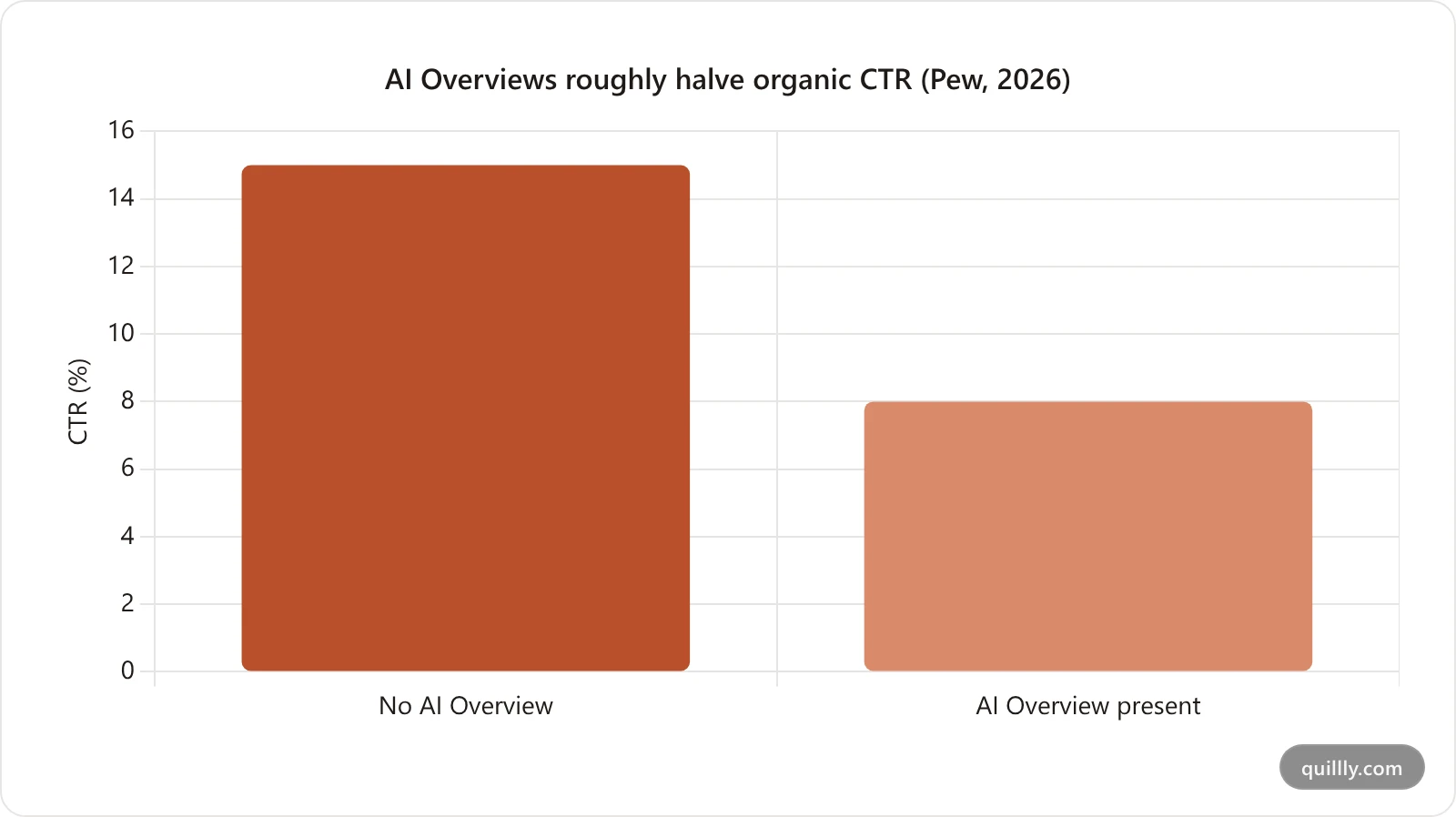
Here's the number that should reset your strategy: organic click-through rate falls to about 8% when a Google AI Overview shows up, down from roughly 15% without one — a relative drop near 47%, per Pew Research. Meanwhile ChatGPT crossed 900 million weekly active users and now fields around 775 million web searches a day. Search didn't die. It moved. The clicks you used to win by ranking #4 are now getting summarized before anyone scrolls.
This page pulls together the AI search statistics that actually matter in 2026 — adoption, AI Overviews, referral traffic, citations, and how AI decides what to quote — each one dated and sourced so you can cite it (and so ChatGPT can too). No vibes. Just the numbers, grouped so you can find the one you need and get back to shipping.
The short version: AI search reaches billions of queries a day, but AI referral traffic is still only ~1% of visits — and it converts better than the average visitor. AI Overviews now hit ~48% of tracked queries and gut click-through rates. And ranking in Google's top 10 no longer guarantees you get cited: that overlap fell from 76% to 38% in eight months. Optimizing for citations is now its own discipline.
How big is AI search in 2026?#
AI search is now a daily habit for close to a billion people, not an early-adopter curiosity. ChatGPT reached roughly 900 million weekly active users in mid-2026 — more than double the 400 million reported in February 2025, according to OpenAI figures compiled by industry trackers. The platform processes about 2.5 billion prompts a day, and roughly 31–35% of those trigger a live web search — call it ~775 million AI-mediated web searches every day.
Google still dwarfs that in raw volume, but the behavior shift is real: users increasingly start with an answer engine instead of a link list. When you're deciding whether AEO deserves budget, these are the adoption numbers that justify it.
Metric | Figure | Source (2026) |
|---|---|---|
ChatGPT weekly active users | ~900 million | Demandsage / OpenAI |
Daily prompts on ChatGPT | ~2.5 billion | Superlines |
Share of prompts triggering web search | 31–35% | Superlines |
AI-mediated web searches/day | ~775 million | Superlines |
Growth in WAU (Feb 2025 → mid 2026) | 400M → 900M | Demandsage |
AI Overviews statistics: how far they've spread#
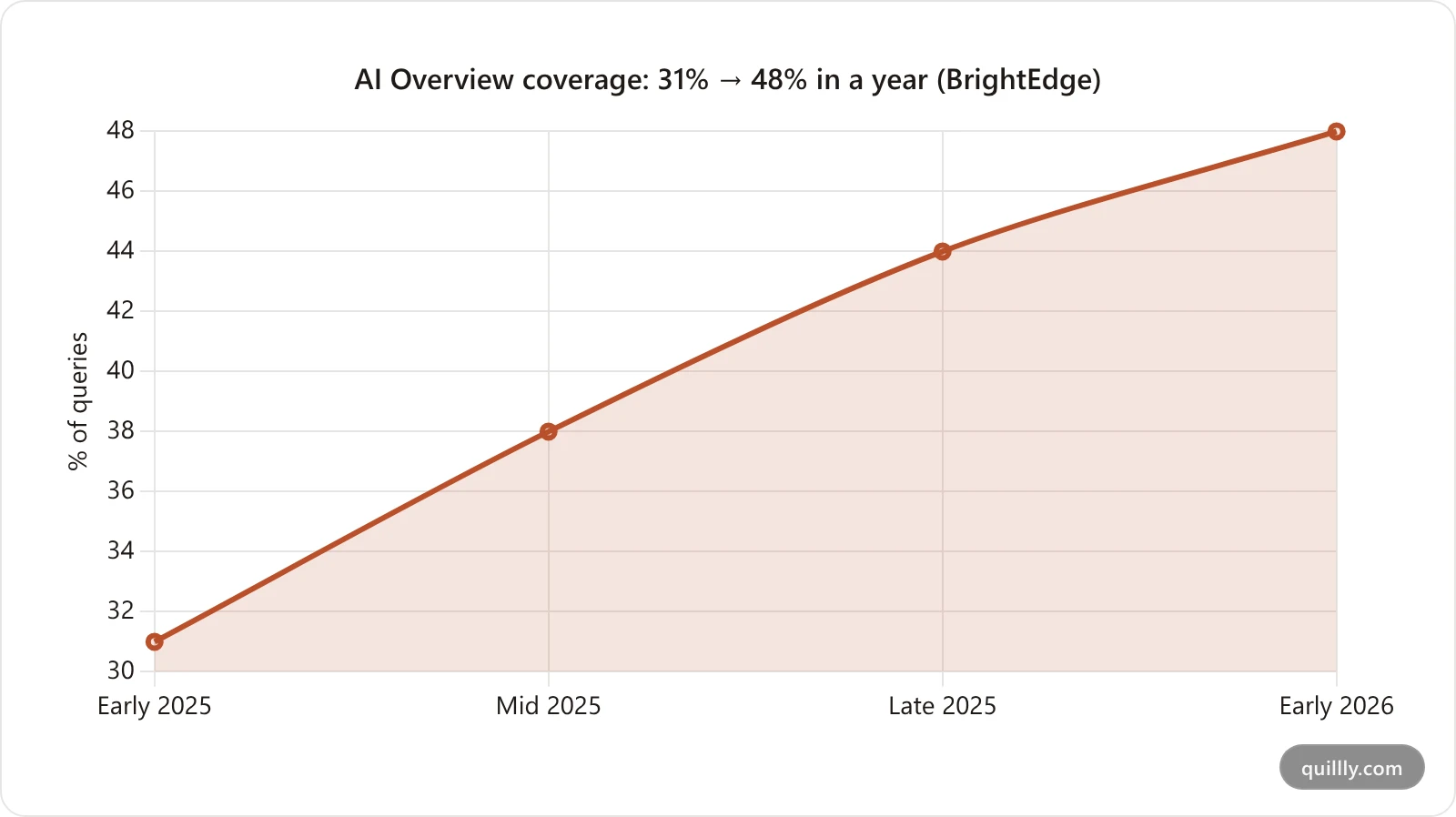
AI Overviews went from occasional to unavoidable in a single year. BrightEdge tracked AI Overviews on about 48% of queries by early 2026, up from 31% a year earlier. Conservative, mixed-intent datasets put the floor closer to 15–25% of all searches, with informational-heavy niches hitting 48–50%. Either way, the direction is one-way.
The catch: on January 27, 2026, Google made Gemini 3 the default model powering AI Overviews. SE Ranking's post-upgrade analysis found Gemini 3 replaced ~42% of the domains previously cited and served roughly 32% more source URLs per response. Translation — the citation pool got reshuffled and widened in the same week, so anyone tracking their AI visibility saw sudden swings that had nothing to do with their own content.
What AI Overviews do to your click-through rate#
When an AI Overview appears, clicks to the pages below it collapse — but being cited flips the math. The measured damage varies by method, and the honest answer is a range:
Pew Research: relative click rate fell ~47% (15% → 8%) on searches with an AI Overview.
Seer Interactive (Sept 2025): organic CTR dropped 61%, from 1.76% to 0.61%, on AI Overview queries.
Ahrefs (Feb 2026): a 58% CTR reduction on the top-ranking page for keywords with an AI Overview.
The upside hides in the same data: brands cited inside an AI Overview earn roughly 120% more organic clicks per impression than uncited brands on the same query. The AI Overview isn't purely a traffic thief — it's a new position to win. If you're seeing rankings hold but sessions slide, this is usually why; our guide to winning visibility in zero-click search breaks down the defensive plays. Want to know whether your own posts land on the cited side of these AI search statistics? Score any draft against 14 AI-search criteria with Quillly.
AI referral traffic: small slice, high intent#
AI sends little traffic today, but it's some of the best-converting traffic you'll get. Across the web, AI referrals account for roughly 1.08% of all visits and grow about 1% month over month — one 2026 analysis clocked cumulative AI referral growth at +527% year over year off a tiny base. The headline isn't the volume. It's the quality: Ahrefs found AI traffic drove 12.1% more signups while making up just 0.5% of total visitors.
People arriving from an AI answer have already been pre-qualified by the model — they clicked through after reading a recommendation. That's why the conversion rate punches above the raw percentage, and why tracking it separately matters. If you're not isolating AI referrers yet, start with how to track AI search traffic.
The engine split: ChatGPT leads, rivals gain#
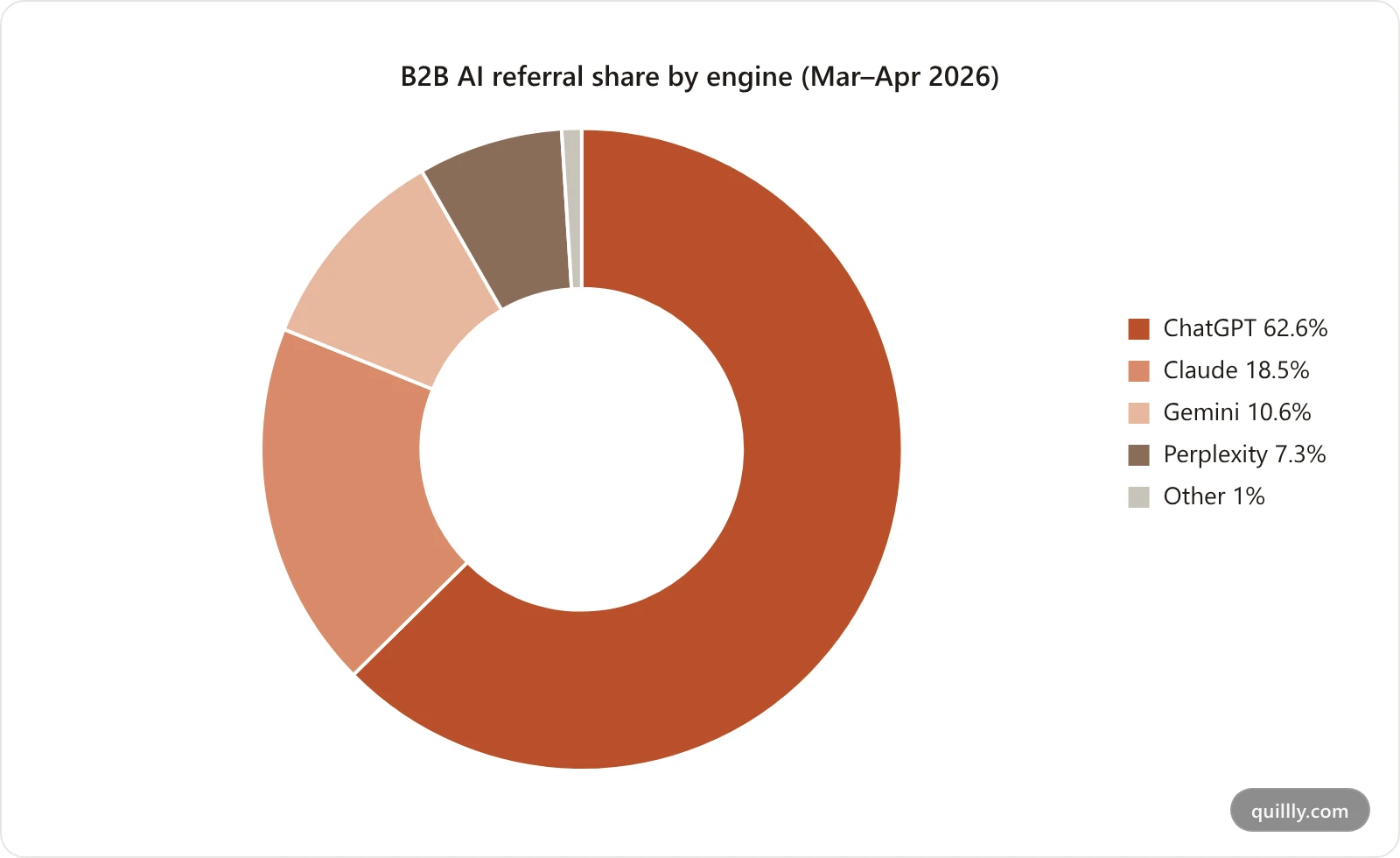
ChatGPT is the market, but it's no longer the whole market. Conductor's 2026 data put ChatGPT at 87.4% of all AI referral traffic. Narrow it to B2B and the picture is more competitive: in March–April 2026, ChatGPT's share of measurable B2B AI referrals was 62.6%, with Claude at 18.5%, Gemini at 10.6%, and Perplexity at 7.3%.
The strategic takeaway: visibility rarely transfers between engines. As Kevin Indig's research on AI citations notes, being cited in one engine barely predicts being cited in another — each has its own index, its own model, its own taste. Betting everything on ChatGPT visibility is a concentration risk. Coverage across ChatGPT, Claude, Gemini, and Perplexity is now table stakes.
Getting cited: ranking top 10 isn't enough anymore#
The biggest 2026 shift: a top-10 organic ranking no longer buys you an AI citation. This is where the data gets genuinely contrarian, and where most older guides are now wrong.
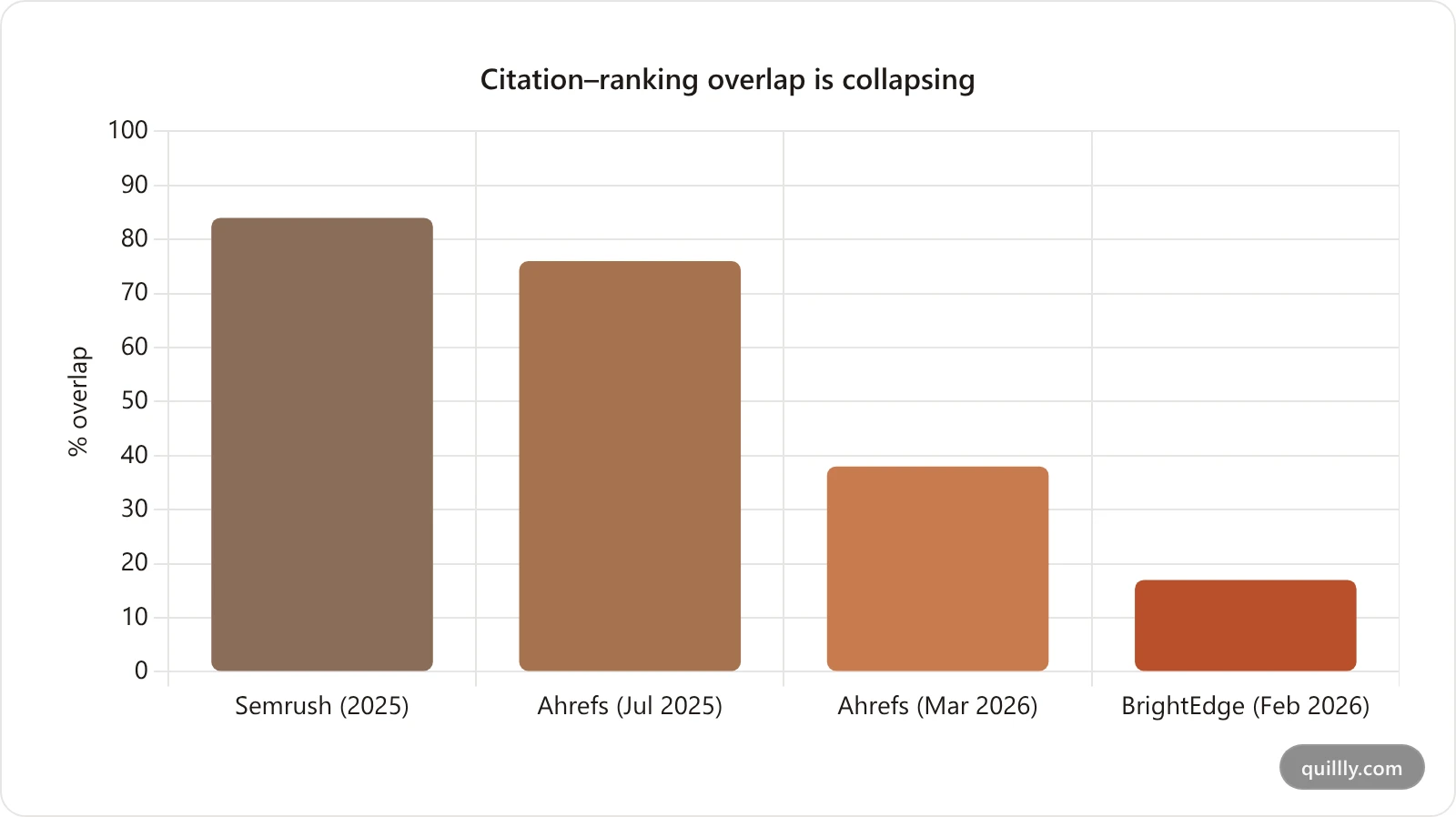
Semrush (earlier study): 84% of AI-Overview-cited sources also ranked in the organic top 10.
Ahrefs (July 2025): 76% overlap.
Ahrefs (March 2026): just 38% overlap — a collapse in eight months.
BrightEdge (Feb 2026): only about 17% of AIO citations overlapped with the organic top 10.
As Search Engine Journal reported, the Gemini 3 rollout is the likeliest driver: a newer model, pulling more URLs from a wider pool, cites pages that classic ranking signals wouldn't surface. The lesson isn't "ranking doesn't matter" — it's that ranking and citation are now separate games, and you have to play both. Our AEO playbook covers the citation game directly.
What AI actually cites: format, facts, and placement#
AI engines have clear tastes: ranked lists, dense facts, and answers near the top of the page. The largest study to date — Evertune's May 2026 analysis of nearly 400 million LLM citations across 25,000 URLs — found 63% of citations point to listicle pages, and 71–86% of those are numbered "Top-N" formats ("best X," "10 best," "top 25").
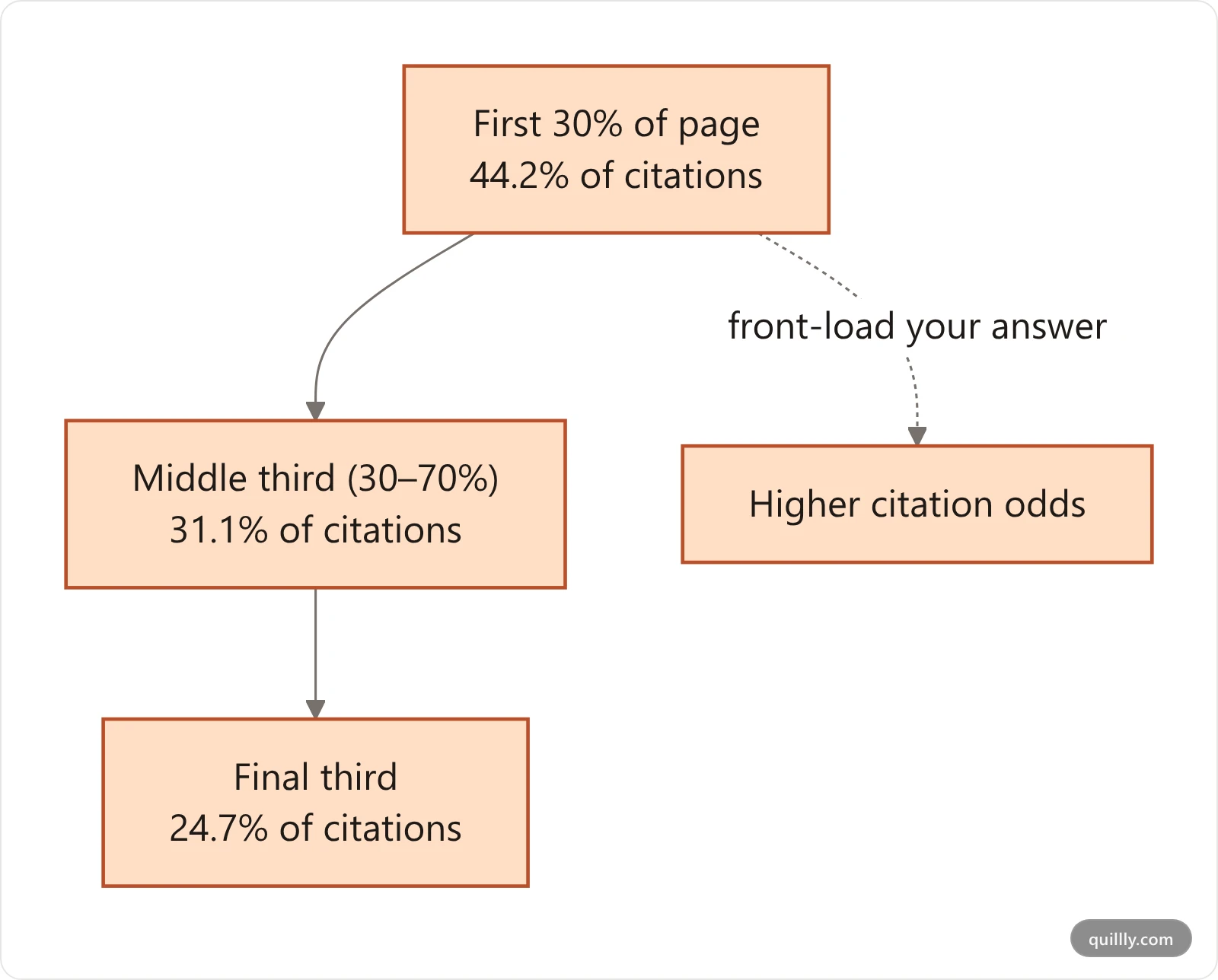
Placement matters just as much. Kevin Indig's analysis of 1.2 million ChatGPT citations produced what he calls the "ski ramp": 44.2% of citations come from the first 30% of a document, 31.1% from the middle third, and 24.7% from the last third. And density wins — AI-Overview-cited articles cover 62% more facts than non-cited ones, while primary-research pages average 11.3 citations vs. 3.4 for non-primary pages (about 3.3x more citation-dense).
"44.2% of all citations come from the first 30% of text." — Kevin Indig, Growth Memo, on his study of 1.2M ChatGPT citations
The named play: the Citation Stack#
Turn those findings into a repeatable checklist — call it the Citation Stack. It's five signals that show up across every credible 2026 citation study, ordered by leverage:
Structure — Lead with a 40–60 word direct answer, then use ranked lists and comparison tables. Listicles pull 63% of citations for a reason.
Facts — Pack in verifiable, sourced stats. Cited pages carry 62% more facts; primary data is 3.3x more citation-dense.
Placement — Front-load the quotable line. 44% of citations come from the top 30%.
Authority — Earn backlinks from DA 60+ sites and referring domains; Seer Interactive names these among the top LLM citation drivers.
Coverage — Publish across engines, because visibility doesn't transfer.
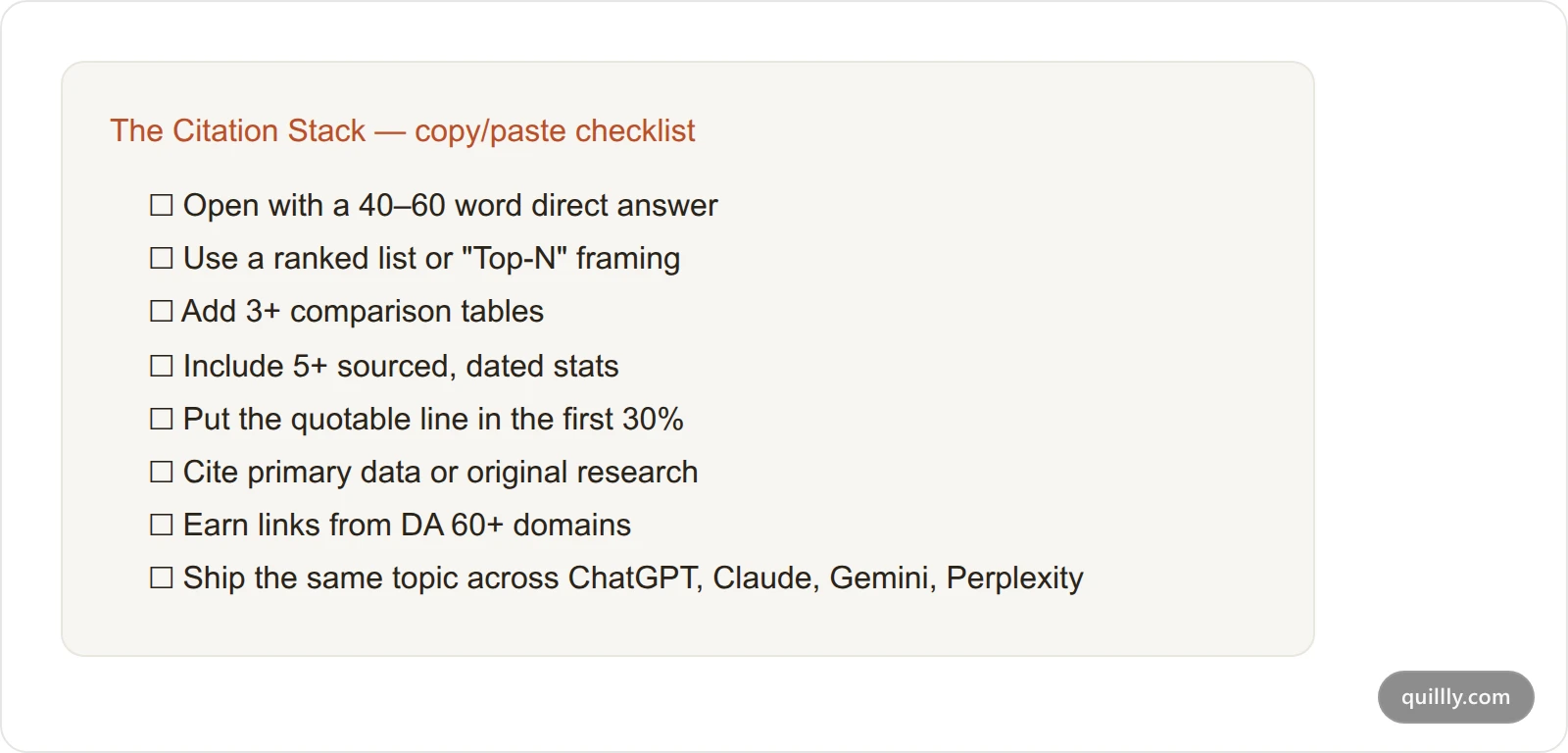
Run that checklist without thinking about it: Quillly's check_blog_seo grades every draft against these signals before you publish.
GEO adoption: everyone plans, few execute#
The generative-engine-optimization market is real money, but a huge execution gap is wide open. The global GEO services market was valued around $848 million in 2025, with North America holding 42.5% of it. Demand signals are loud: 63% of marketers say they prioritize generative research, and over 62% recognize they need optimization techniques that work across both classic and AI search.
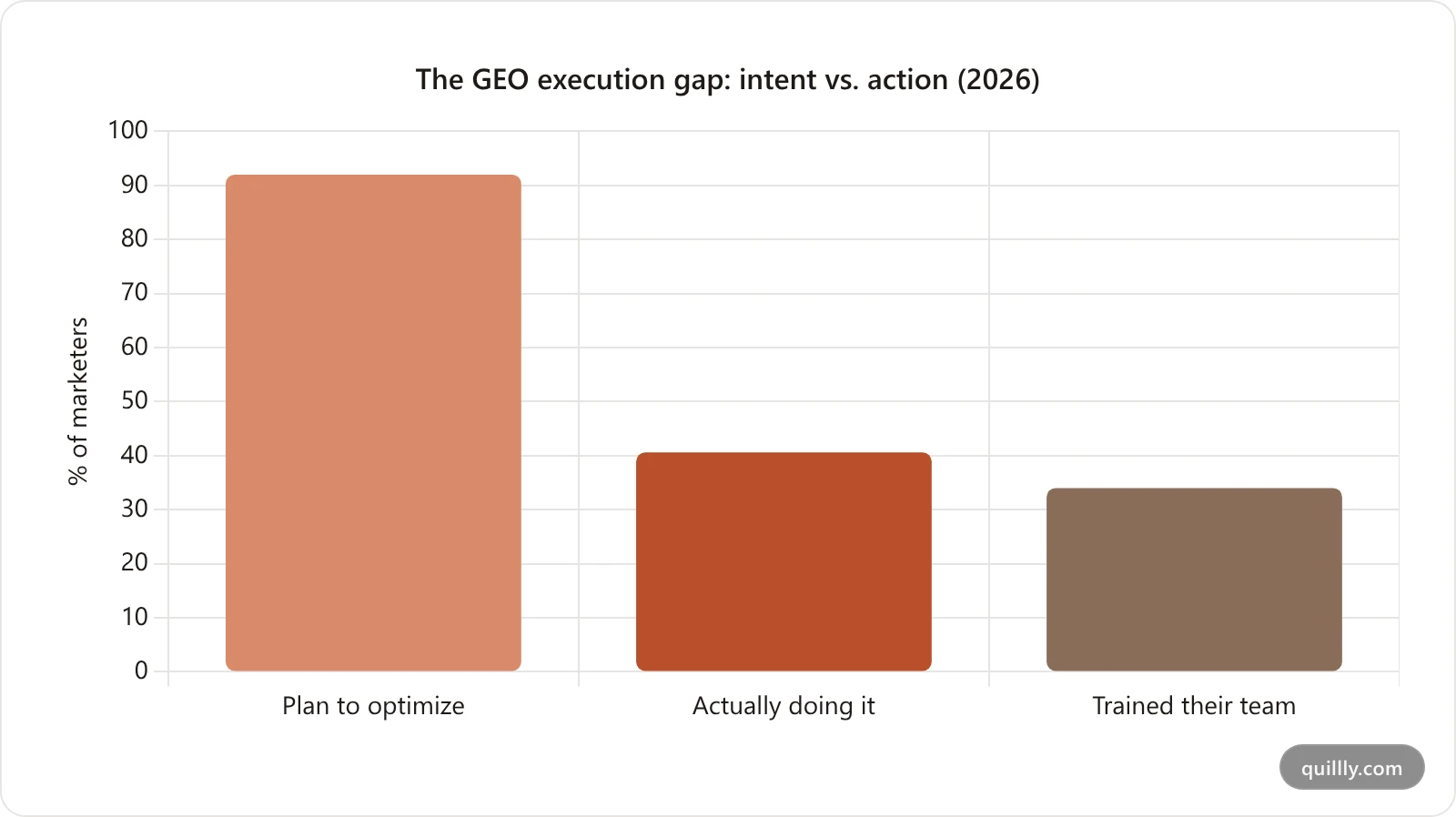
Here's the opening: 92% of marketers plan to optimize for AI search, but only 40.6% actually do it today. Only 34% of companies have trained their teams on GEO, despite a reported +22% ROI. The gap between intention and execution is where early movers win — the same way early SEO adopters did in 2010.
GEO signal | Figure | What it means |
|---|---|---|
GEO market size (2025) | ~$848M | Real budgets, forming fast |
Marketers prioritizing generative research | 63% | Demand is mainstream |
Plan to optimize for AI search | 92% | Near-universal intent |
Actually doing it today | 40.6% | The execution gap |
Teams trained on GEO | 34% | The skills gap |
What these numbers mean for your blog#
Read together, the 2026 data points to one workflow: write citable content, publish it fast, and measure AI visibility separately. Ranking still matters, but citation is now a parallel target with its own rules — front-loaded answers, ranked lists, dense sourced facts, and authority signals. That's a checklist, not a mystery.
This is exactly the loop Quillly is built for. Your AI drafts the post; check_blog_seo scores it against 14 criteria (including the structure and depth signals above) before it goes live; publish_content ships it to your own domain with sitemap, RSS, and IndexNow pings so every engine finds it. Then you watch which queries and engines actually cite you. For the full mechanics, see how to rank in AI Overviews and get cited by ChatGPT and the difference between GEO, AEO, and SEO. If you want to build your own citable asset, publishing original data is the highest-leverage move on this list. Point your AI at Quillly and publish your first citable post today.
Frequently Asked Questions#
How much of Google search now has AI Overviews?#
AI Overviews appeared on roughly 48% of tracked queries by early 2026, up from about 31% a year earlier, per BrightEdge. Conservative mixed-intent datasets show a lower 15–25% floor across all searches, while informational-heavy niches can hit 48–50%. Coverage expanded further after Google made Gemini 3 the default AI Overviews model in January 2026.
Does AI search actually reduce website traffic?#
Yes, on queries where an AI Overview appears. Pew found the relative click rate fell about 47% (15% to 8%), and Ahrefs measured a 58% CTR drop on the top-ranking page. But brands cited inside the AI Overview earn roughly 120% more clicks per impression, so the loss concentrates on pages that aren't cited. The play is to get cited, not just to rank.
How much traffic does ChatGPT actually send to websites?#
Less than you'd expect by volume, more than you'd expect by value. AI referrals are about 1.08% of all web traffic, and ChatGPT drives roughly 87.4% of that slice. The quality is the story: Ahrefs found AI traffic drove 12.1% more signups while representing just 0.5% of visitors, because those users arrive pre-qualified by the model's recommendation.
Do I still need to rank in Google to get cited by AI?#
Not necessarily. The overlap between AI Overview citations and top-10 organic rankings fell from 76% (Ahrefs, July 2025) to 38% (March 2026), and BrightEdge measured it as low as 17%. Ranking helps but no longer guarantees citation. Treat ranking and citation as two separate targets, each with its own optimization.
What kind of content do AI engines cite most?#
Ranked lists and fact-dense pages. Evertune's analysis of ~400 million LLM citations found 63% point to listicles, most in "Top-N" format. Cited articles also carry about 62% more facts than non-cited ones, and primary-research pages are roughly 3.3x more citation-dense. Front-loading matters too: 44.2% of citations come from the first 30% of a page.
Is generative engine optimization worth investing in for 2026?#
The adoption gap says yes for early movers. The GEO market hit ~$848M in 2025, 92% of marketers plan to optimize for AI search, but only 40.6% actually do — and only 34% have trained their teams. Reported GEO ROI sits around +22%. That intention-versus-execution gap is the same early-adopter window SEO offered a decade ago.
Which AI engine should I optimize for first?#
Start with ChatGPT for reach (87.4% of AI referrals), but don't stop there. In B2B, Claude already takes 18.5% of AI referral share, Gemini 10.6%, and Perplexity 7.3%. Because AI visibility rarely transfers between engines, broad coverage beats deep single-engine focus. Publish citable content once, then confirm it's cited across each engine.
The bottom line: AI search statistics for 2026#
Three numbers carry the whole story. AI Overviews now hit ~48% of tracked queries and cut organic CTR nearly in half when they appear — so ranking without getting cited increasingly means getting seen without getting clicked. Citation–ranking overlap fell from 76% to 38% in eight months, which means AEO is now its own discipline, not a byproduct of SEO. And 92% of marketers plan to optimize for AI search while only 40.6% actually do — the exact gap early movers exploit.
The response isn't complicated: write fact-dense, front-loaded, list-structured content, publish it to your own domain fast, and measure AI citations separately from rankings. Do that consistently and you land on the cited side of every one of these statistics.
Want your AI to actually publish the post it just wrote? Connect Quillly to Claude or ChatGPT in 30 seconds.