Perplexity answered more than 780 million queries in May 2025 and was growing over 20% month over month, its CEO said on X. By mid-2026 it had roughly 45 million monthly users and $450 million in annual recurring revenue. Your buyers are asking it questions right now. The only thing that matters is whether it quotes you or a competitor in the answer.
Most "Perplexity SEO" advice gets one thing wrong from the start. It treats Perplexity like Google, where you chase a ranking position. Perplexity has no positions. It reads a handful of sources it already trusts, then writes an answer and cites them. Your job is to become one of those sources.
Perplexity SEO is the practice of structuring your content so PerplexityBot can crawl it, so Perplexity can extract a clean answer from it, and so the model trusts it enough to cite. There are no rankings to climb. You either make the citation list for a query or you don't.
This guide is the builder's version. You'll get the real crawler behavior, the 2026 citation data, a named framework called the CITE method, a copyable robots.txt block, and a way to check your own logs. Updated July 2026, with fresh numbers throughout.
What is Perplexity SEO?#
Perplexity SEO refers to optimizing your content and site so Perplexity AI cites it as a source in its answers. It's a branch of answer engine optimization, focused on one engine that behaves differently from the rest. New to the acronyms? Start with GEO vs AEO vs SEO.
Here's why the distinction matters. Google shows a list of ten blue links and, increasingly, an AI Overview. Perplexity skips the list. It returns a synthesized answer with numbered citations, and it packs in more sources than any rival. Perplexity cites 8.2 sources per answer on average, the highest citation density of any mainstream AI engine, per Ahrefs.
That density is good news. More citation slots per answer means more chances to be included. But the bar to fill one is specific. Perplexity favors pages with a direct answer up top, concrete data, clean structure, and recent updates. Miss those and you're invisible, no matter how well you rank on Google.
How Perplexity actually picks its sources#
Perplexity builds an answer in stages, and each stage is a filter. Understanding the pipeline tells you exactly where your page can fall out.
When someone asks a question, Perplexity expands it into several related searches, pulls candidate pages from its index and live web results, ranks those candidates for relevance and trust, then writes an answer that quotes the survivors. This is closer to a retrieval system than a traditional search engine.
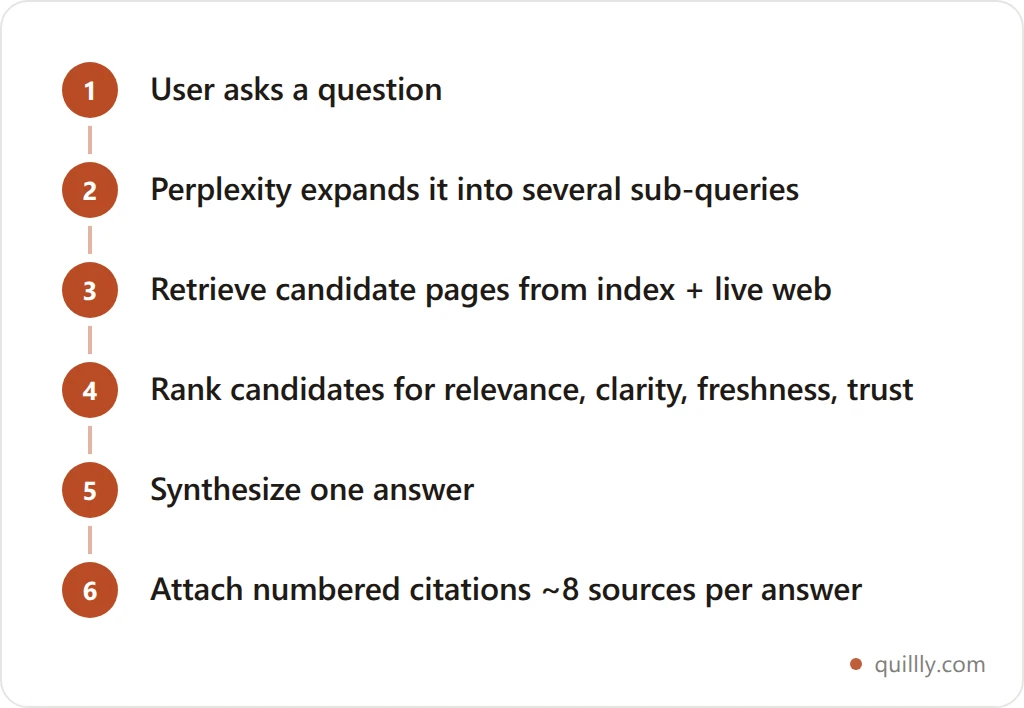
Two facts fall out of this design. First, because Perplexity expands your question into variations, more than 80% of its citations come from pages that don't rank for the exact query a user typed, Ahrefs found. It rewards depth on a topic, not exact-match keywords. Second, the ranking step leans on signals you already know from SEO: clarity, structure, freshness, and authority. Perplexity isn't magic. It's retrieval plus a trust filter.
The uncomfortable truth: you can't "rank" on Perplexity#
Here's the contrarian part. Stop trying to rank on Perplexity. There is no rank. There's a citation list that gets rebuilt for every single query, and it changes with phrasing, freshness, and context.
That reframe changes your whole strategy. You're not optimizing one page for one keyword. You're trying to be the most quotable, most trustworthy source across a whole topic, so you show up no matter how the question is phrased.
And here's the twist that trips people up: the fastest path to Perplexity citations runs straight through classic SEO. Perplexity is the AI engine most aligned with Google. Nearly 1 in 3 of its cited URLs, 28.6%, also rank in Google's top 10, versus roughly 8% for ChatGPT and Gemini, according to Ahrefs.

So the conventional wisdom that "AI search killed SEO" is backwards for Perplexity. Solid organic SEO is the strongest lever you have. Aleyda Solís calls this dual-surface optimization: the same page earns Google rankings and AI citations when it's built right. You don't need a separate Perplexity playbook. You need a better page.
Where Perplexity gets its citations in 2026#
Perplexity leans hard on user-generated content. Ahrefs tracked every domain it cited across 3.1 million US queries and found the citation pool is dominated by a few giants.

YouTube captures 32.4% of citations and Reddit takes 16.6%, Ahrefs reports. Together, those two user-generated platforms account for nearly half of everything Perplexity quotes. Wikipedia sits third at 8.2%.
Read that the right way. It does not mean your blog can't win. It means two things. First, a presence on YouTube and Reddit feeds the same engine that cites your site, so they're worth cultivating. Second, that remaining 37.7% is a long tail of independent sites, and niche blogs win citations there every day by being the clearest, freshest answer on a specific question. The giants own broad queries. You can own the specific ones.
Query type | Who Perplexity tends to cite | Your opening |
|---|---|---|
Broad "what is X" | Wikipedia, big publishers | Hard to crack, low intent anyway |
"Best X for Y" | Reddit threads, review sites | Original data, first-hand testing |
Niche how-to / technical | Independent blogs, docs | Your sweet spot |
Product comparisons | Retailers, forums | Structured comparison tables |
The CITE method: how to get cited by Perplexity#
Most advice throws thirty tips at you. Here's a model you can actually remember. To earn a Perplexity citation, a page needs four things. Call it the CITE method: Crawlable, Instant answer, Trusted, and Evidence-dense.
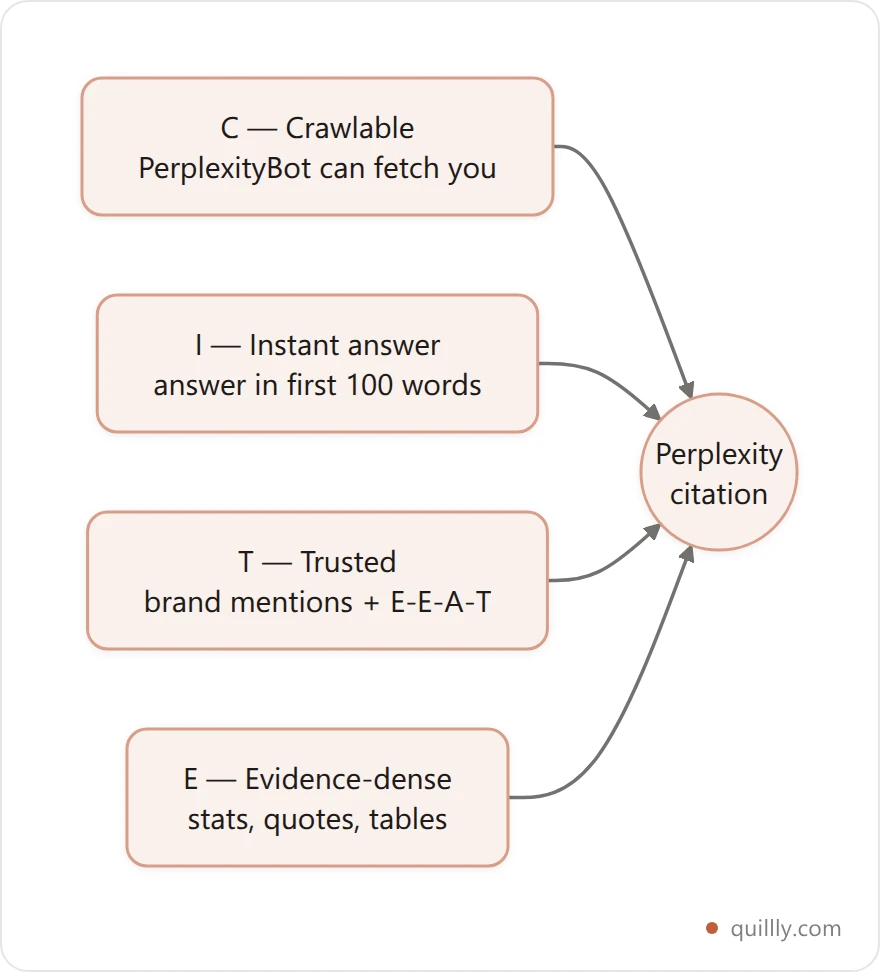
Miss any one and the citation doesn't happen. A page can be brilliant and go unquoted because a robots.txt rule blocks the crawler. It can be perfectly crawlable and get skipped because it buries the answer under 300 words of throat-clearing. The next four sections take each letter in turn.
C — Crawlable#
If PerplexityBot can't fetch your page, nothing else counts. This is step one of the pipeline, and it's where most sites quietly lose.
PerplexityBot is a pure retrieval crawler. It fetches pages to answer live queries and does not train foundation models on your content, per Perplexity's docs. It respects robots.txt. So a single stray Disallow can erase your whole domain from the citation pool. It discovers pages through links, sitemaps, and plain mentions of your domain, then recrawls on a schedule that tracks how often you update and how much authority you carry.
Two rules follow. Let PerplexityBot in explicitly, and make sure your content renders without JavaScript, because a retrieval crawler that can't parse your HTML sees an empty page.
I — Instant answer#
Perplexity scans your intro first. Give it fluff and it tags the page low-density. Give it a direct answer and it lifts that sentence into the response.
The data is blunt: 90% of top-cited sources answered the user's core question within the first 100 words, per a 2026 citation analysis. Kevin Indig's study of 1.2 million AI responses found 44.2% of all citations come from the first 30% of a page, a pattern his team calls the "ski ramp."
Write every section like an inverted pyramid. Lead with the one-sentence answer. Then add the nuance, the data, and the example. Do this under every H2, not just the intro, because Perplexity extracts at the section level.
T — Trusted#
Perplexity won't quote a page it doesn't trust, and its trust signals look a lot like Google's E-E-A-T. The single strongest correlate isn't what most people expect.
Ahrefs studied 75,000 brands and found brand mentions correlate with AI visibility at 0.664, versus just 0.218 for backlinks. Being talked about across the web matters more than raw links. Reviews on G2, Trustpilot, and your Google Business Profile feed the same trust model, especially for commercial queries. Named authors, an About page, and real citations to primary sources all push the same lever.
E — Evidence-dense#
Perplexity quotes facts, not vibes. A page that says "email marketing has strong ROI" gets skipped. A page that says "email marketing returns $36 for every $1 spent, per Litmus" gets cited.
The Princeton GEO study (KDD 2024) found that adding statistics, quotes, and citations lifted AI visibility 30 to 40%. Pages with five or more stats get cited far more often, and comparison pages with three or more tables earn around 26% more citations. Every claim you make should carry a number, a source, or a concrete example. That's what fills Perplexity's 8-source answer.
Let PerplexityBot in: the 5-minute technical setup#
Start with the crawler, because it's the one thing that can zero out everything else. Here's a robots.txt block that welcomes the AI crawlers you want and points them at your sitemap. Copy it, adjust for your site, and ship it.
# Allow the AI answer engines that cite (not just train)
User-agent: PerplexityBot
Allow: /

User-agent: OAI-SearchBot
Allow: /

User-agent: ClaudeBot
Allow: /

# Point every crawler at your sitemap
Sitemap: https://yourdomain.com/sitemap.xml
A few notes. PerplexityBot is the retrieval crawler that powers citations; if a page is blocked, Perplexity may still show your domain and headline but can't quote the body, per its help center. OAI-SearchBot is OpenAI's search crawler, worth allowing for the same reason. Keep learning the wider crawler map in our guide to AI crawler optimization.
Then handle discovery and freshness, because Perplexity recrawls based on how often you update:
Keep a current XML sitemap. It's how PerplexityBot finds new pages fast.
Ping IndexNow on every publish. It tells Bing and its partners about new URLs the moment they go live. See how IndexNow speeds indexing.
Add schema markup. FAQPage, Article with an author, and HowTo map cleanly to the question-and-answer shape AI engines prefer.
This is exactly the plumbing an AI publishing setup should handle for you. When your AI ships a post with Quillly's publish_content, it regenerates your sitemap and RSS feed and pings the IndexNow engines automatically, so fresh content is discoverable within minutes instead of days.
Freshness is a ranking factor on Perplexity#
Recency carries real weight here, more than on classic search. Around half of Perplexity's citations come from 2025 content, and pages updated recently get cited noticeably more than stale ones. One analysis found content updated "two hours ago" was cited 38% more often than content last touched a month ago, per ZipTie.
The takeaway is simple. Publishing once and forgetting is a losing move on Perplexity. Refresh your best posts on a schedule: update the stats, add a "last updated" date, and republish so the crawler sees a change. This is the same discipline that beats content decay on Google, doing double duty for AI citations.
A before-and-after worked example#
Here's how the CITE method plays out on a real page, using the patterns from the studies above. Say you publish a 900-word post titled "How we cut churn." It opens with three paragraphs of story, mentions no numbers until halfway down, has no headings, and hasn't been touched in eight months.
Perplexity's verdict: low-density intro, no extractable answer, stale. It goes uncited.
Now rebuild it with CITE:
Element | Before | After |
|---|---|---|
First 100 words | Backstory | Direct answer: "We cut churn 34% in 90 days by doing X" |
Data points | 1, buried | 7, with sources |
Structure | No headings | 6 H2s, 2 comparison tables |
Freshness | 8 months old | Updated this month |
Author | None | Named founder + bio |
Same core story, restructured for extraction. The rewrite now answers a cluster of related questions ("how to reduce churn," "churn benchmarks," "churn reduction tactics") in a form Perplexity can lift. That's the whole game: not a longer post, a more quotable one.
How to track whether Perplexity is citing you#
You don't have to guess. Two data sources tell you almost everything: your server logs and your referral analytics.
In your logs, filter by user agent. You're looking for PerplexityBot and Perplexity-User (the second fires when a person's live query fetches your page). Confirm they're actually reaching your key posts. If you never see them, revisit your robots.txt and sitemap first.
Then watch referral traffic for sessions from perplexity.ai. Those are humans who clicked a citation inside a Perplexity answer, and that number maps to revenue better than any vanity metric. Our guide to tracking AI search traffic walks through the full setup.
Run this quick audit once a month:
Filter server logs for
PerplexityBotandPerplexity-User.Confirm they're fetching your top posts and sitemap.
Ask Perplexity 10 questions your content should answer, and note who it cites.
Track referral sessions from
perplexity.aiin analytics.Refresh the posts that already earn citations, and rebuild the ones that don't with CITE.
Perplexity SEO myths vs reality#
A lot of advice floating around is wrong or half-right. Here's the quick corrective.
Myth | Reality |
|---|---|
"You rank #1 on Perplexity" | There are no ranks. There's a per-query citation list. |
"AI search killed SEO" | For Perplexity, strong Google SEO is the biggest lever (28.6% citation overlap). |
"An llms.txt file gets you cited" | No major crawler fetches it. Your real pages do the work. |
"Longer content wins" | Denser, answer-first content wins. Length alone does nothing. |
"Set it and forget it" | Freshness is a live signal. Stale pages fade from citations. |
"Keywords are everything" | 80%+ of citations come from pages that don't match the exact query. |
Frequently asked questions about Perplexity SEO#
How do I get my website cited by Perplexity?#
Make your page crawlable, answer-first, trusted, and evidence-dense (the CITE method). Let PerplexityBot through your robots.txt, lead each section with a direct answer in the first 100 words, back claims with stats and sources, and earn brand mentions and reviews. Because Perplexity aligns closely with Google, ranking well organically is the single strongest path to getting cited.
Does Perplexity respect robots.txt?#
Yes. PerplexityBot honors robots.txt directives. If you disallow it, Perplexity won't index your page's body text, though it may still show your domain name, headline, and a short factual summary. A stray Disallow rule is one of the most common reasons a site never gets cited, so audit your robots.txt before anything else.
How is Perplexity SEO different from Google SEO?#
Google returns a ranked list of links; Perplexity returns one synthesized answer with about eight citations, rebuilt for every query. There's no position to hold. You optimize to be a quotable, trustworthy source across a topic rather than to rank a single page for a single keyword. The upside: the two overlap heavily, so good SEO feeds both.
How long does it take to get cited by Perplexity?#
Faster than classic SEO. Because Perplexity crawls and refreshes on a rolling schedule and weights freshness heavily, well-optimized pages can appear in citations within hours to a few weeks. Most sites that restructure content for extraction see measurable citation lift within about 30 days, far quicker than the months traditional ranking often takes.
Do I need an llms.txt file to rank on Perplexity?#
No. No major AI crawler, including PerplexityBot, has confirmed it fetches llms.txt files. Perplexity crawls your real HTML pages and your sitemap. An llms.txt file is cheap insurance at best and won't earn citations on its own. Spend your effort on crawlable, answer-first pages instead of a file crawlers skip.
Why does Perplexity cite Reddit and YouTube so much?#
Perplexity leans on user-generated content: YouTube accounts for 32.4% of its citations and Reddit 16.6%, together nearly half of everything it quotes. Those platforms carry fresh, first-hand, conversational answers the model trusts. For your own site, that means the remaining long tail of niche, specific queries is where independent blogs realistically win citations.
Can Perplexity SEO help a brand-new blog?#
Yes, if you play to freshness and specificity. New content can get cited within days because Perplexity weights recency, and niche how-to or comparison queries favor clear, dense answers over domain age. Publish to your own domain, structure for extraction, keep posts current, and build brand mentions early to feed the trust signal.
The bottom line#
Perplexity SEO isn't a new discipline. It's classic SEO with the volume turned up on three signals. First, structure: lead with the answer, because 44.2% of AI citations come from the first third of a page. Second, freshness: recently updated content gets cited up to 38% more, so refresh on a schedule. Third, evidence: five-plus stats, tables, and named sources are what fill Perplexity's 8-citation answers.
Remember the frame. You're not chasing a rank. You're becoming one of the few sources Perplexity trusts enough to quote, on your own domain, across a whole topic. Run the CITE method on your best posts, let PerplexityBot in, and check your logs monthly.
Want your AI to write the post and handle the sitemap, schema, and IndexNow pings that get it crawled and cited? Connect Quillly to Claude, ChatGPT, or Cursor in 30 seconds.