

Ask Claude a question today and it doesn't guess. It searches the live web and hands back an answer with cited sources, links and all. Claude passed 245 million monthly active users in 2026 and is the fastest-growing assistant on the market. So here's the uncomfortable question for anyone running a SaaS or a blog: when one of those users asks Claude about your category, does your site show up in the answer, or does a competitor?
Claude SEO is the practice of getting your pages cited inside Claude's answers. It is not the same game as ranking on Google, and the difference is bigger than most people realize.
Get cited by Claude by publishing content its web search can find and trust: rank in Brave Search (Claude's retrieval backend), answer questions directly in liftable passages, back every claim with data and quotes, drop the promotional tone, and allow Claude's fetch bots in your robots.txt.
This guide turns that into a repeatable method, the BRAVE framework, with the exact robots.txt, the numbers behind each move, and a monthly test you can run to see if any of it is working.
How Claude decides what to cite#
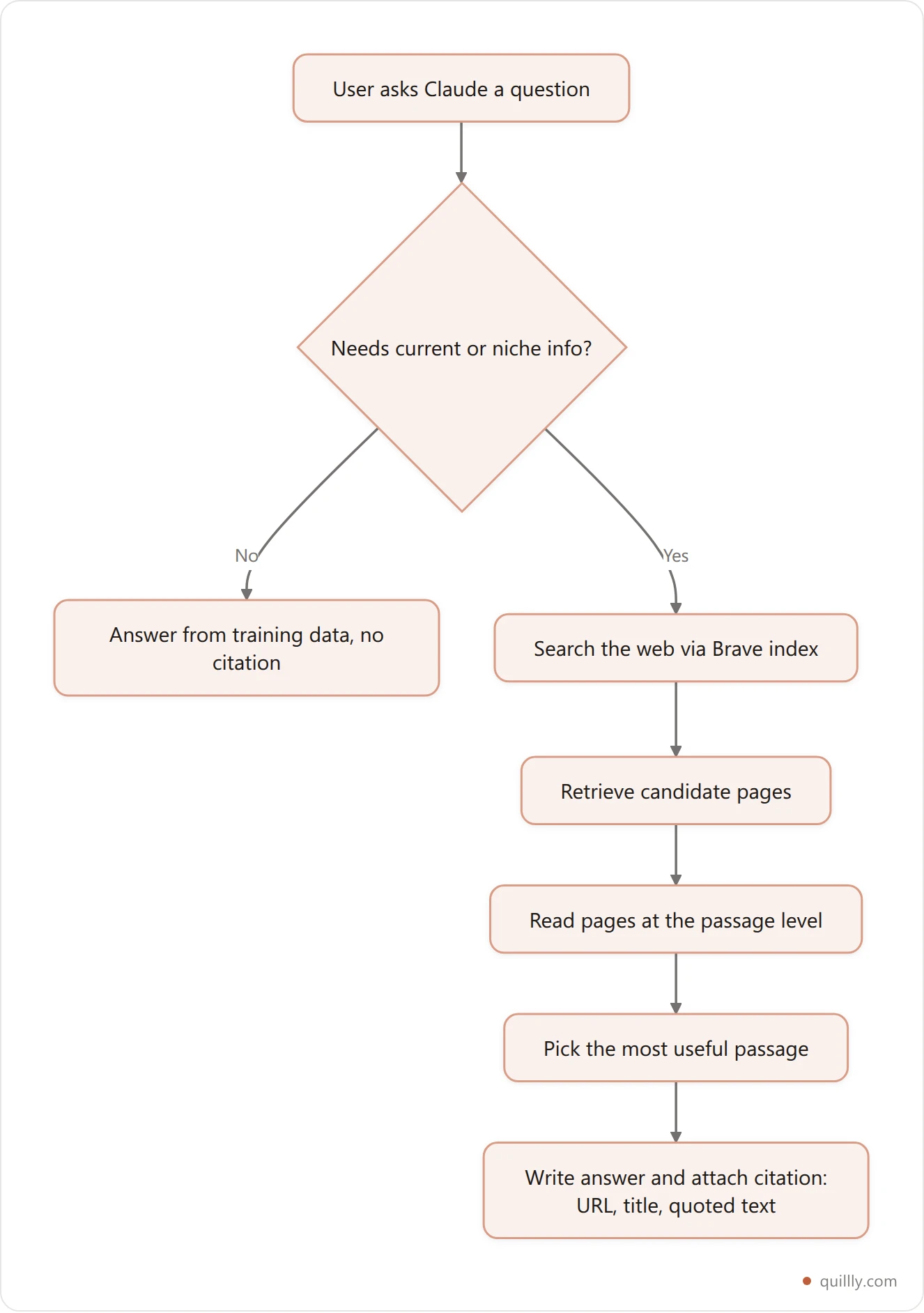
Claude's citations are built into how its web search works, not bolted on afterward. Per Anthropic's web search documentation, "the response includes citations for sources drawn from search results," and those citations are always on. The loop looks like this:
You ask Claude something.
Claude decides whether it needs to search. It searches when the answer depends on current, changing, or niche information: recent events, prices, stats, or "specific organizations, people, or products that might have changed." It answers from memory for stable facts.
The search runs and results flow into Claude's context. This can repeat in a single turn. Simple questions use one to three searches; comparative research can trigger ten or more, much like the query fan-out pattern in Google's AI Mode.
Claude writes its answer and attaches a citation (URL, title, and up to 150 characters of quoted text) to each claim it pulled from a page.
That last step is the prize. To be the URL Claude attaches, your page has to clear two filters: it has to be retrieved, then it has to be the passage Claude chooses to quote.
Claude runs on Brave Search, not Google#
Most AI SEO advice assumes every AI engine reads Google. Claude doesn't. Independent citation analyses put the overlap between the sources Claude cites and Brave Search's organic results at roughly 86.7%. Claude's web search leans on Brave's independent index, not Google and not Bing.
That single fact rewrites your priorities. You can rank third on Google and stay invisible to Claude if Brave doesn't have you indexed. Different engines pull from different back ends:
AI assistant | Primary retrieval backend | What that means for you |
|---|---|---|
Claude | Brave Search | Get crawled and ranked in Brave's index |
Bing | Bing visibility plus IndexNow pings | |
Own index and partners | Broad crawlability and fresh content | |
Classic Google ranking still applies |
The good news: Brave crawls the open web and rewards the same fundamentals everyone else does. Clean HTML, crawlable pages, real content. The action item is simply to stop assuming Google coverage equals Claude coverage. Search your money queries in Brave Search directly. If you're not there, that's the first thing to fix, because every other tactic in this guide depends on it.
The BRAVE framework, in one view#
Optimizing for Claude comes down to five moves. They spell BRAVE, which is fitting, because Brave Search is where this whole thing starts.
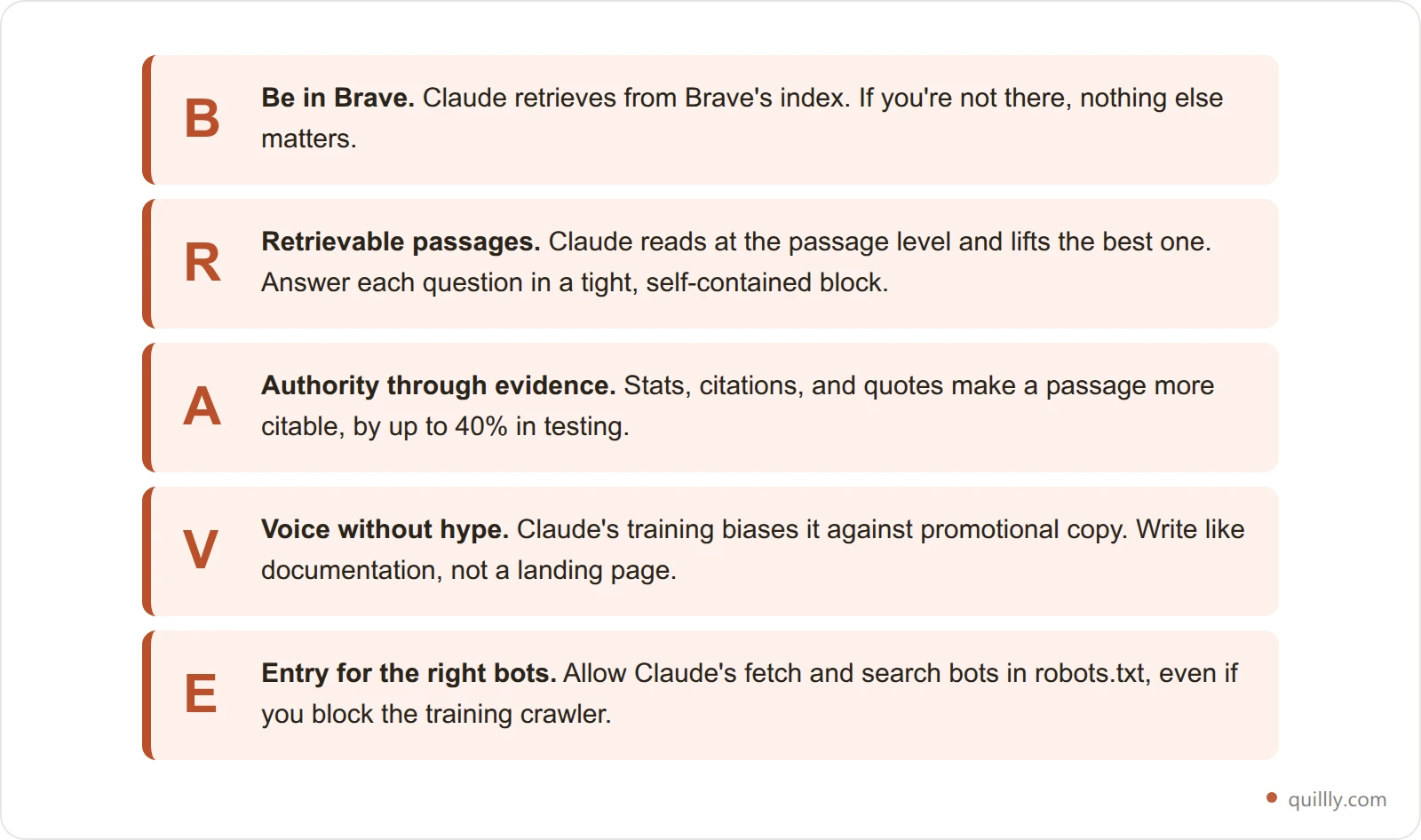
We covered B above. The rest of this guide takes R, A, V, and E in turn.
R: structure content Claude can actually lift#
Claude reads at the passage level, not the page level. It scans your page for the single block that best answers the question, then quotes up to 150 characters of it. So the unit of optimization is the passage, not the post.
The fix is boring and it works: put a direct, self-contained answer in the first one or two sentences under every heading. Write headings as the questions people actually ask. Keep the answer paragraph 40 to 60 words so it stands on its own without the surrounding context. This is the same structure that wins Google's AI Overviews, so you're not doing double work.
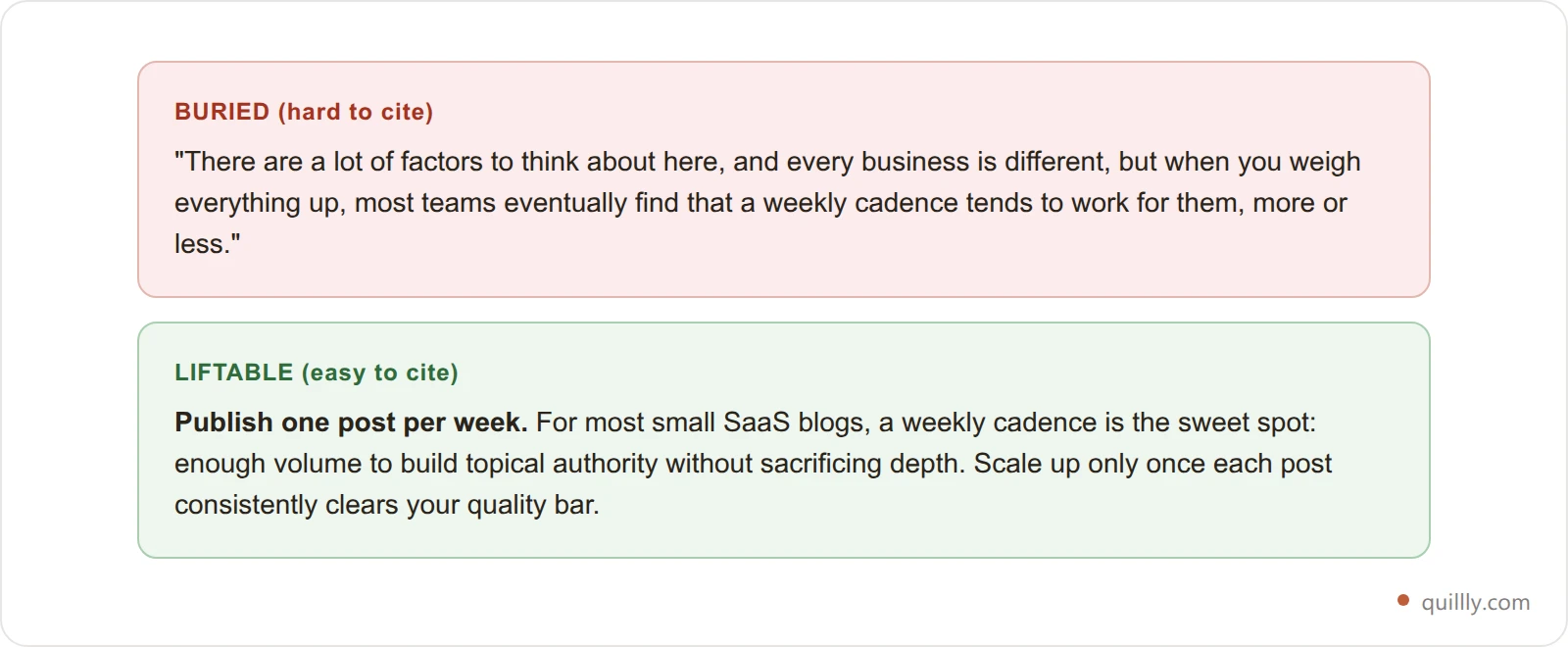
Bullets for lists, numbered steps for sequences, and a table for any real comparison. Structured blocks give Claude clean, self-contained chunks to pull, and they survive the trip into an answer far better than a wall of prose.
A: evidence is the citation multiplier#
Evidence is the single biggest lever you control. The Princeton Generative Engine Optimization study found that adding citations, quotations, and statistics to a page can lift its visibility in generative-engine answers by up to 40%. Claude leans on the same signals: a claim with a number and a source behind it reads as more trustworthy than an assertion floating on its own.
Kevin Indig, who writes the Growth Memo research newsletter, points to a second reason evidence wins. When a model is unsure, it runs a web search to fact-check itself, and the pages fetched during that verification step are disproportionately represented in citations. Well-sourced, checkable content is exactly what gets pulled during that recheck.
"Commodity prompting produces commodity output. If ten writers prompt ChatGPT with the same brief, LLMs will cite none of them."
The takeaway: give Claude something only you have. Original data, a benchmark you ran, a survey of your users, a teardown with real numbers. Then wrap every claim in a stat and a source.

V: why salesy pages lose with Claude#
Here's the counterintuitive part. Claude is trained with Constitutional AI, which gives it a measurable bias against promotional language. Content written in a salesy, brand-forward voice gets cited less often, even when it's factually correct. The landing-page playbook that works for conversions actively hurts you here.
The data backs the vibe. In one analysis of Claude citations, 63% pointed to niche SaaS blogs, documentation, and practitioner articles, while only 7% went to mainstream news domains. Claude favors clear, well-sourced, docs-style writing with low hype. Aleyda Solis, who runs LearningSEO.io, makes the broader point that this isn't a new game:
"Most GEO tactics are verbatim recommendations that SEO teams have been making for years. The E-E-A-T signals that matter to Google show up disproportionately in the URLs LLMs cite."

This is where content type matters more than most teams realize. Documentation and changelogs are exactly the low-hype, high-detail format Claude reaches for, yet most companies bury them on a subdomain or a third-party tool where they never get crawled well. Publishing docs and changelogs on your own domain, the way Quillly's create_content handles blog, docs, and changelog side by side, turns your product knowledge into citable surface area. Write the reference page you'd want an AI to quote, and quote-worthy is what it becomes. See how docs and changelogs work as SEO surfaces.
E: the ClaudeBot robots.txt trap#
This is the mistake that quietly makes brands uncitable. Anthropic runs several distinct crawlers, and blocking the wrong one, or all of them, can wipe you out of Claude's answers without you ever noticing. Per Anthropic's crawler documentation, each bot has a different job and each respects robots.txt independently:
Bot | What it does | Block it and... |
|---|---|---|
ClaudeBot | Crawls public content to train Anthropic's models | You stay out of training data. Citations unaffected. |
Claude-User | Fetches live pages in real time when a user's question needs them | You become invisible to answers that cite you. |
Claude-SearchBot | Indexes the web to improve Claude's search quality | Your pages drop out of Claude's search results. |
See the trap? A lot of site owners read "block the AI crawler" advice, add a blanket Disallow for every Claude bot, and accidentally kill the two bots that actually put them in answers. If you want Claude to cite you, you must allow Claude-User and Claude-SearchBot, even if you choose to block ClaudeBot from training.
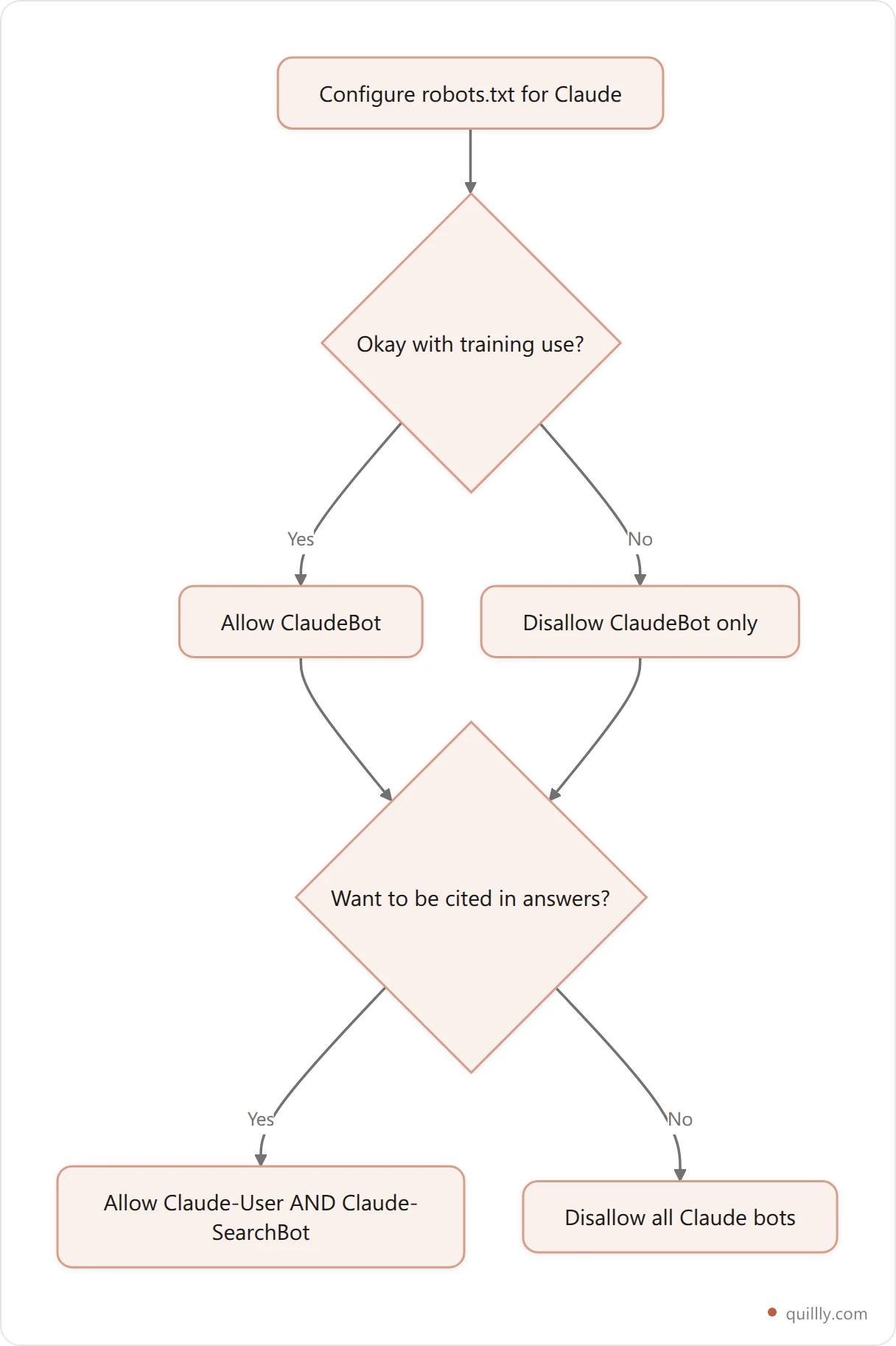
Here's the copy-paste config that keeps you citable while opting out of training:
# Opt out of Claude training, stay eligible for citations
User-agent: ClaudeBot
Disallow: /

User-agent: Claude-User
Allow: /

User-agent: Claude-SearchBot
Allow: /
Prefer to be in everything, training included? Just don't disallow any of them. The one setup to avoid is a blanket block on all three, which is what happens by accident more than any other configuration.
How to measure your Claude citations#
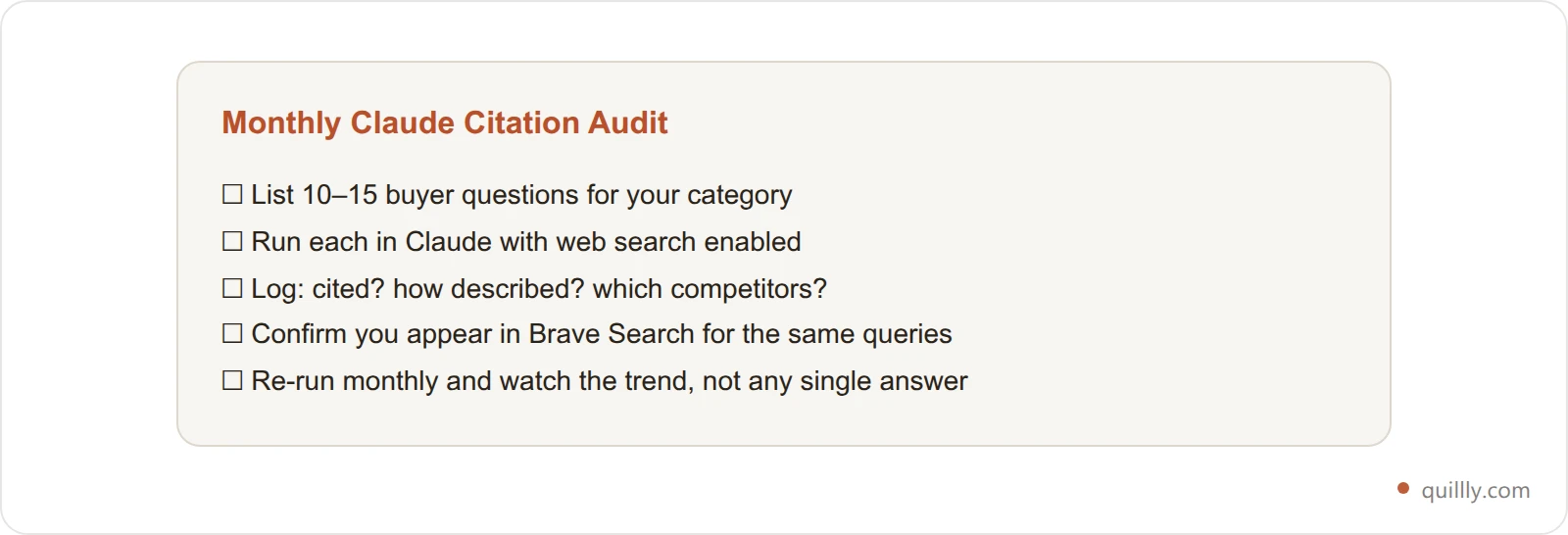
You can't improve what you don't track, and Claude gives you no dashboard. So build your own baseline with a simple monthly test. Pick 10 to 15 questions a real buyer would ask Claude in your category, run each one with web search on, and record three things: whether Claude cites you, how it describes you, and which competitors show up instead.
Run the same list every month. When your fixes land, you'll see your name start appearing and the competitor mentions thin out. That trend line is the only Claude SEO metric that matters.
Pair it with your search-side data. If you already watch Bing and IndexNow for ChatGPT citations, add Brave to the same routine. And run a fresh SEO pass on every page you want cited, because the structure that wins Claude, direct answers and clean passages, is the same structure a scorer like Quillly's check_blog_seo rewards. Run a free SEO check before you publish.
Frequently Asked Questions#
Does Claude cite its sources?#
Yes. Citations are always enabled in Claude's web search. When Claude pulls a fact from a page, it attaches the source URL, the page title, and up to 150 characters of the quoted text. If your content is what it quotes, your link rides along into the answer the user sees.
What search engine does Claude use?#
Claude's web search relies on Brave Search's index, not Google or Bing. Independent analyses find roughly 86.7% overlap between Claude's citations and Brave's organic results. That's why a page can rank well on Google yet never appear in Claude: if Brave hasn't indexed it, Claude usually can't cite it.
How do I stop Claude training on my content but still get cited?#
Block ClaudeBot, the training crawler, in robots.txt, and explicitly allow Claude-User and Claude-SearchBot. Those two bots handle real-time fetches and search indexing, which is what puts you in answers. A blanket block on all Claude bots keeps you out of training and out of citations both.
Why isn't Claude citing my site even though it ranks on Google?#
Three usual suspects: you're not visible in Brave Search, your answers are buried instead of sitting in liftable passages, or your copy reads as promotional. Claude uses a different backend than Google, reads at the passage level, and is trained to avoid salesy sources. Fix all three.
Is Claude SEO different from ChatGPT or Perplexity SEO?#
The fundamentals of GEO vs AEO vs SEO overlap, but the plumbing differs. ChatGPT leans on Bing, Perplexity runs its own index, and Claude reads Brave. The winning content structure, direct answers, evidence, and clean markup, travels across all of them, so optimizing well for one lifts the others.
Does content freshness affect Claude citations?#
Yes. Recent, dated content is cited more often, and AI tools cite pages that are about 25.7% fresher than those in traditional search, per Ahrefs. Show a visible publish or updated date, and refresh important pages so Claude reads them as current rather than stale.
The bottom line#
Getting cited by Claude isn't luck, it's positioning. Three numbers to remember: Claude's citations align about 86.7% with Brave Search, so being in Brave comes first. Evidence can lift your visibility in AI answers by up to 40%, so wrap every claim in a stat and a source. And 63% of Claude's citations go to practitioner and docs-style content, so drop the hype and write like a reference. Run the BRAVE framework, fix the robots.txt trap so Claude-User and Claude-SearchBot can reach you, and track a monthly query list to prove it's working.
Want your AI to actually publish the post it just wrote? Connect Quillly to Claude or ChatGPT in 30 seconds.


