Your best page can rank #1 on Google and still lose the reader. In ChatGPT Atlas, OpenAI's new browser, someone types your target query and gets a written answer with two or three cited sources before a single blue link loads. If you're not one of those citations, you don't exist for that user. That's the shift ChatGPT Atlas SEO solves, and most SEO advice from 2024 has no answer for it.
The stakes are not small. ChatGPT crossed 800 million weekly active users in October 2025 and passed a billion monthly users by mid-2026. Atlas puts that model inside a Chromium browser that reads the open web, summarizes it, and cites a handful of pages. Meanwhile Ahrefs found that on queries triggering AI answers, click-through at position one fell from 0.073 to 0.016 between 2023 and 2025, a 58% drop. Ranking still matters, but being cited is the new front line.
Direct answer: ChatGPT Atlas SEO is the practice of structuring your content and technical setup so OpenAI's Atlas browser can crawl, extract, and cite your pages in its AI answers. It rests on four moves: allow the OAI-SearchBot crawler, lead every section with a standalone answer, prove real expertise, and format for machine extraction.
What ChatGPT Atlas actually is (and why SEOs suddenly care)#
ChatGPT Atlas is OpenAI's own web browser, launched on macOS in October 2025 with Windows following. Takeaway: it's not a plugin bolted onto Chrome, it's a full browser with ChatGPT living in a sidebar that can read the page you're on, run searches, and complete tasks in an "agent mode."
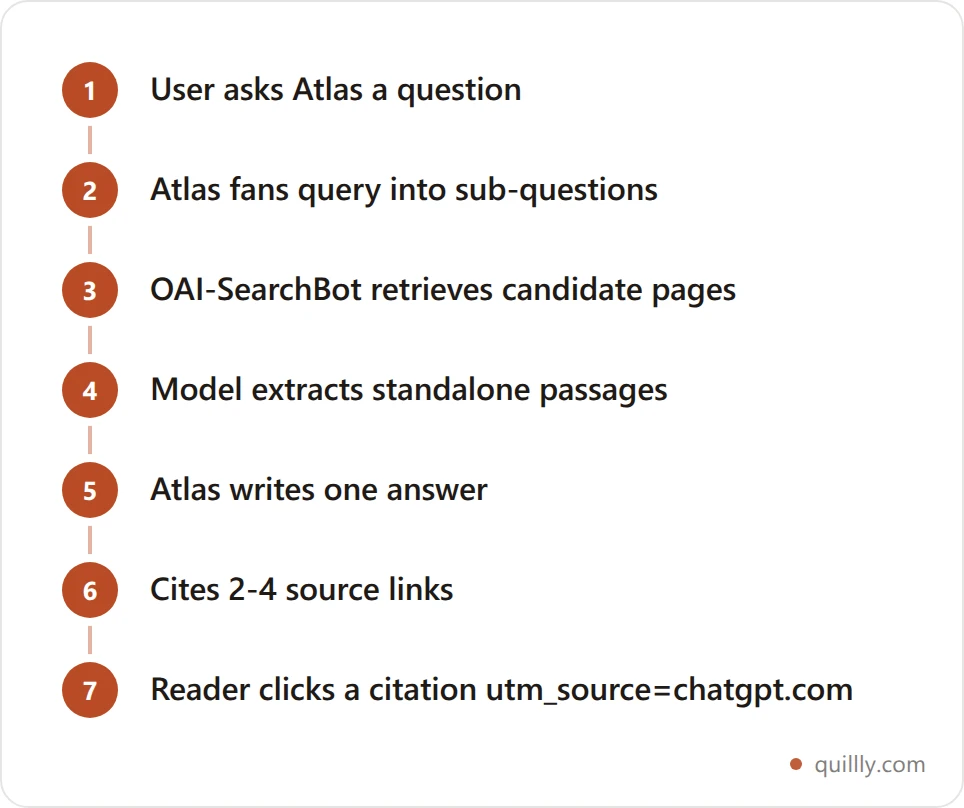
The part that changes your job is the answer surface. When a user asks Atlas a question, it doesn't just return ten links. It fans the query out, fetches passages from several pages, and writes a synthesized answer that names and links its sources. As of July 2026, that citation slot, not the classic first result, is the thing worth competing for. Atlas also appends utm_source=chatgpt.com to outbound links, so for the first time you can actually measure the traffic these citations send.
This is why generative engine optimization stopped being a side project. Atlas is one of several AI browsers, alongside Perplexity's Comet, and the AI browser market is projected to grow from $4.5B in 2024 to $76.8B by 2034. The reading audience is moving into a window your old rank-tracking never watched.
ChatGPT Atlas vs. Google Search vs. AI Overviews#
Here's the fast version: the three surfaces reward overlapping but different things, and pages that win Atlas citations tend to be the cleanest, most extractable versions of the pages that already rank. Treat them as one funnel, not three projects.
Dimension | Google Search | Google AI Overviews | ChatGPT Atlas |
|---|---|---|---|
Primary unit | 10 blue links | One AI summary + links | One AI answer + 2-4 citations |
Underlying index | Googlebot | Googlebot | OAI-SearchBot (Bing-adjacent web data) |
What wins | Rankings + backlinks | Extractable passages in top results | Standalone, factual, well-sourced passages |
Crawler to allow | Googlebot | Googlebot | OAI-SearchBot |
How you track it | GSC clicks/position | GSC (bundled) |
|
Reader's next step | Clicks a link | Reads, sometimes clicks | Reads answer, clicks a citation |
The strategic overlap is the good news. If you already structure content to earn Google AI Overviews and featured snippets, you're most of the way to Atlas. Our guide to Google AI Mode SEO covers the Google half of this table in depth. The gap is the crawler and the extraction discipline, which the rest of this post fixes. If you'd rather your AI handle that discipline automatically, see how Quillly scores and publishes to your own domain.
The CITE framework for getting cited in Atlas#
Everything that earns an Atlas citation fits a four-part checklist we call CITE: Crawl access, Instant answers, Trust signals, Extractable structure. Takeaway: skip any one letter and you drop out of the answer, because Atlas has to reach the page, understand it in seconds, believe it, and lift a clean passage from it.
flowchart TB
    subgraph CITE[The CITE Framework]
    direction TB
    C["C — Crawl access<br/>Atlas can fetch the page"]
    I["I — Instant answers<br/>Lead with a standalone claim"]
    T["T — Trust signals<br/>Author, sources, original data"]
    E["E — Extractable structure<br/>Headings, tables, schema, FAQ"]
    end
    C --> I --> T --> E --> Cited[Cited in the Atlas answer]
The CITE framework: four layers that decide whether ChatGPT Atlas can cite your page.
Run every important page through the four sections below. Each one is a concrete, testable move, not a vibe.
C — Crawl access: don't block OAI-SearchBot#
The single fastest way to disappear from Atlas is to block the wrong bot, or block the right one by accident. Takeaway: Atlas discovery runs on OAI-SearchBot, and if your robots.txt disallows it, you forfeit generative inclusion, no matter how good the page is.
OpenAI runs three separate crawlers, and people conflate them constantly:
Crawler | Job | Should you allow it? |
|---|---|---|
OAI-SearchBot | Discovers pages for ChatGPT search + Atlas citations | Yes — this is the one that gets you cited |
ChatGPT-User | Fetches a page live when a user's prompt needs it | Yes — enables real-time answers about your page |
GPTBot | Collects data for model training | Optional — block if you don't want training use |
The common mistake: a founder reads "block GPTBot to keep AI off my content," adds a blanket disallow, and quietly kills their Atlas visibility because they also blocked OAI-SearchBot. Blocking GPTBot has zero effect on whether Atlas can cite you, a distinction we unpack in our guide to AI crawler optimization. Here's the copy-paste rule that keeps you citable while opting out of training:
# Allow ChatGPT search + Atlas citations
User-agent: OAI-SearchBot
Allow: /

User-agent: ChatGPT-User
Allow: /

# Opt out of model training (optional)
User-agent: GPTBot
Disallow: /
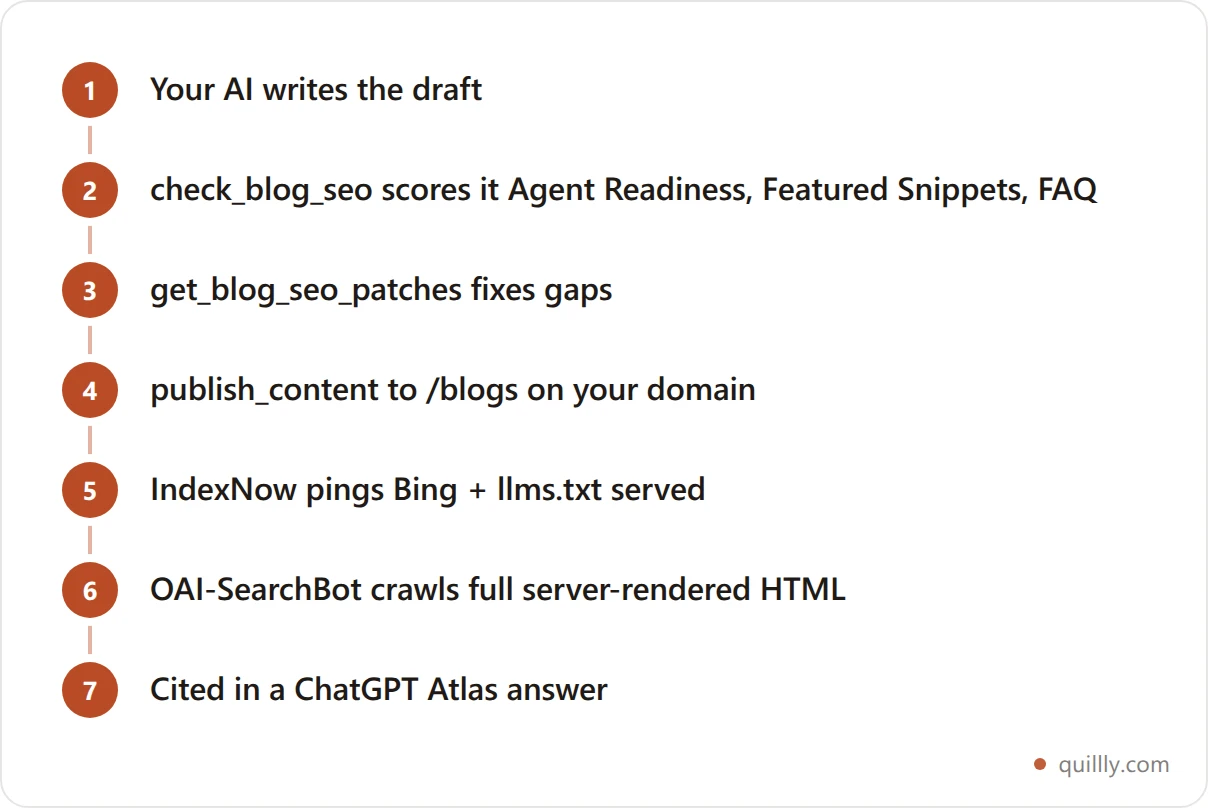
Crawl access has a second half: the bot has to actually see your content. Atlas is Chromium-based and can render JavaScript, but it leans on the initial HTML and structured signals, so client-side-only content is a gamble. Prefer server-side rendering, ship real text and headings in the first HTML response, and test by loading your page with JavaScript disabled. If the article body vanishes, so does your citation. This is where pages published through Quillly land ahead by default: served pages are server-rendered to full HTML, so OAI-SearchBot gets the complete article, JSON-LD, and byline instead of an empty shell.
Speed of discovery matters too. New posts get in front of ChatGPT faster when they're pushed to the Bing-side index, which historically feeds ChatGPT search. Our IndexNow guide explains the mechanism, and Bing SEO: the back door to ChatGPT covers why the Bing index is the shortest path to being cited.
I — Instant answers: lead with the takeaway#
Atlas doesn't read your page top to bottom and admire your intro. Takeaway: it scans for a self-contained sentence that answers the question, and if the first line of your section buries the answer under throat-clearing, a competitor's cleaner passage gets lifted instead.
The rule is simple: every H2 should be answerable in one standalone sentence placed as the first line of that section. Write the direct answer first, then explain, expand, and prove it. A 40-to-60-word answer paragraph under a question-style heading is the exact shape AI answer engines extract. Compare these two openings for a section titled "How much does Atlas cost?":
Buries it: "There's been a lot of discussion lately about pricing models for AI browsers, and it's worth understanding the history before we..."
Leads with it: "ChatGPT Atlas is free to use with any ChatGPT account, including the free tier, with agentic features expanded for Plus and Pro plans."
The second one can be quoted verbatim in an answer with your name on it. The first can't. This is also the highest-leverage edit for Google, because the same passage feeds featured snippets and AI Overviews. When you run a draft through Quillly's check_blog_seo, the Featured Snippets and Agent Readiness checks flag sections that don't lead with a liftable answer, which is exactly the pattern Atlas rewards. Score a draft against these checks in seconds.
T — Trust signals: why Atlas cites you and not the other page#
When two pages say the same thing, Atlas cites the one it trusts more. Takeaway: trust is built from visible authorship, real sourcing, and original information the model can't get anywhere else, which is the practical meaning of E-E-A-T in an answer-engine world.
Kevin Indig, who coined the "Great Decoupling" to describe rising impressions and falling clicks, argues the scoreboard itself has changed: teams should shift "from traffic reporting to influence reporting" and track how often AI systems cite them, not just sessions. To earn those citations, load pages with signals a model reads as credibility:
A named author with a real bio and, ideally, Person schema tying the byline to a track record.
Primary sourcing: link the actual study, doc, or dataset, not a listicle that links to it.
Original data or a first-hand result — a benchmark you ran, a number from your own product, a screenshot. This is the one thing a competitor literally cannot copy, and it's citation gold.
Freshness: an accurate, current publish or update date. Answer engines lean toward recent sources for anything time-sensitive.
The contrarian point worth internalizing: in an Atlas world, a thin page ranking #1 is worth less than a deep, sourced page ranking #6, because the deep page is the one that gets pulled into the answer. Chasing rank alone is optimizing the wrong number.

E — Extractable structure: format for the machine#
A brilliant paragraph the model can't parse cleanly won't get cited. Takeaway: Atlas favors "well-structured, lightweight, and accessible pages," so the layout of your content is a ranking factor in itself, not just decoration.
Make every page easy to disassemble into facts:
Question-shaped headings. Turn H2s into the actual questions people ask ("How do I track Atlas traffic?"), one clear question per section.
Tables for any comparison. Three or more options, prices, or feature rows belong in a table. Pages with comparison tables get pulled into answers more often because the data is pre-structured.
Lists for steps and enumerations. Ordered lists for sequences, bullets for sets. Never hide steps inside a wall of prose.
Schema markup that matches the visible page. BlogPosting for articles, FAQPage for Q&A, HowTo for tutorials, with fields (author, datePublished, headline) that mirror what a human sees. Mismatched schema hurts more than none.
A real FAQ section. Standalone Q&A blocks are the most extractable format on the web, and they map perfectly to how Atlas fans a query into sub-questions.
This is where a scoring pass earns its keep. Quillly's SEO score includes an Agent Readiness check built for exactly this: it flags vague link anchors, bare URLs, and malformed tables, then get_blog_seo_patches hands back the specific fixes. It also emits a live llms.txt and a plain-markdown version of every post, so answer engines can read a clean copy without fighting your CSS.
How to track ChatGPT Atlas traffic#
You can measure Atlas today, no special setup required. Takeaway: Atlas appends utm_source=chatgpt.com to every outbound link, so citation-driven visits show up as a named referral source in whatever analytics you already run.
To isolate it, filter your analytics for the source chatgpt.com. In GA4, build an exploration or a segment where Session source contains chatgpt.com; in Plausible, Matomo, or a server-log tool, filter referrers the same way. Watch three things: the volume trend, the pages that receive the visits (those are your cited pages), and the on-site behavior. It's worth the attention: ChatGPT referral traffic converts at 7.1%, second only to paid search, because the reader already got a recommendation before they clicked. For the bigger picture on measuring AI visibility, see our take on tracking every page you own.
Frequently Asked Questions#
What is ChatGPT Atlas SEO?#
ChatGPT Atlas SEO is the practice of optimizing your content and technical setup so OpenAI's Atlas browser can crawl, understand, and cite your pages in its AI-generated answers. It combines classic SEO clarity with machine-extractable structure, allowing the OAI-SearchBot crawler, leading sections with standalone answers, and adding schema so Atlas can lift facts accurately.
Does ChatGPT Atlas use Google's index?#
No. Atlas relies on OpenAI's own crawler, OAI-SearchBot, and web data historically associated with the Bing index rather than Googlebot. That's why getting content into Bing quickly, through IndexNow pings, is one of the shortest paths to appearing in ChatGPT search and Atlas citations, even when your Google rankings lag.
Which crawler do I need to allow for ChatGPT Atlas?#
Allow OAI-SearchBot in your robots.txt, since it discovers pages for ChatGPT search and Atlas citations. Also allow ChatGPT-User, which fetches pages live when a user's prompt needs them. GPTBot is separate and used for model training, so blocking it does not affect whether Atlas can cite you.
Will blocking GPTBot stop Atlas from citing my content?#
No, and this trips up a lot of teams. GPTBot only handles training data. The crawler that powers ChatGPT search and Atlas citations is OAI-SearchBot, a different agent entirely. You can block GPTBot to opt out of model training while keeping OAI-SearchBot and ChatGPT-User allowed, so Atlas can still surface and cite your pages.
How do I track traffic from ChatGPT Atlas?#
Atlas automatically appends utm_source=chatgpt.com to outbound links, so citation traffic appears as a referral from chatgpt.com in GA4, Plausible, Matomo, or your server logs. Filter or segment by that source to see volume, which pages get cited, and how those visitors behave. No tags or extra configuration are required.
Is optimizing for ChatGPT Atlas different from SEO for Google?#
The foundations overlap: crawlable pages, clear structure, real expertise, and fast indexing help on both. The differences are the crawler you allow (OAI-SearchBot, not Googlebot), the emphasis on standalone extractable passages over ranking position, and a new tracking source. Most Atlas gains come from tightening content you already publish, not starting over.
How long until content shows up in ChatGPT Atlas?#
There's no fixed timeline, but discovery is faster when OAI-SearchBot can reach the page and the URL is pushed to the Bing index promptly. Publishing to a server-rendered page and pinging IndexNow on publish can shorten the gap from days to hours. Fresh, well-structured pages with clear answers tend to be picked up and cited sooner.
The takeaway#
ChatGPT Atlas moved the finish line from ranking to being cited, and the numbers back it up: 800M+ weekly ChatGPT users, referral traffic up 206% year over year, and a 58% collapse in click-through on AI-answer queries. Three moves capture most of the upside. First, allow OAI-SearchBot and ship server-rendered HTML so Atlas can read you at all. Second, lead every section with a 40-to-60-word standalone answer it can quote. Third, prove trust with named authors, real sources, and original data no competitor can copy. Run each page through the CITE framework, then track the payoff as utm_source=chatgpt.com referrals. The teams winning Atlas aren't writing more, they're formatting smarter.
Want your AI to actually publish the post it just wrote, structured to get cited? Connect Quillly to Claude or ChatGPT in 30 seconds.