You wrote the best page on your topic. It ranks. And ChatGPT still cites a Reddit thread instead of you. That gap confuses most people because they assume AI search works like Google's blue links — rank high, get picked. It doesn't. Understanding how AI search chooses citations is now a separate skill from ranking, and the two overlap less every month. Ahrefs analyzed 863,000 keywords and found only 38% of Google AI Overview citations come from pages in the top 10 for that query — down from 76% a year earlier. Roughly five of every six AI citations come from content that isn't even on page one. So the real question isn't "how do I rank?" It's "how does a language model decide which passage to quote and link?" This guide breaks down the actual mechanism, then turns it into a repeatable way to get cited.
The short version: AI search doesn't cite pages — it cites passages. A model retrieves small chunks of text that answer a query, grounds its answer in the ones that agree, and links the sources it leaned on. To get cited, your page has to be indexed, retrievable, and written so a single passage can stand alone as the answer.
How AI Search Chooses Citations: The 30-Second Answer#
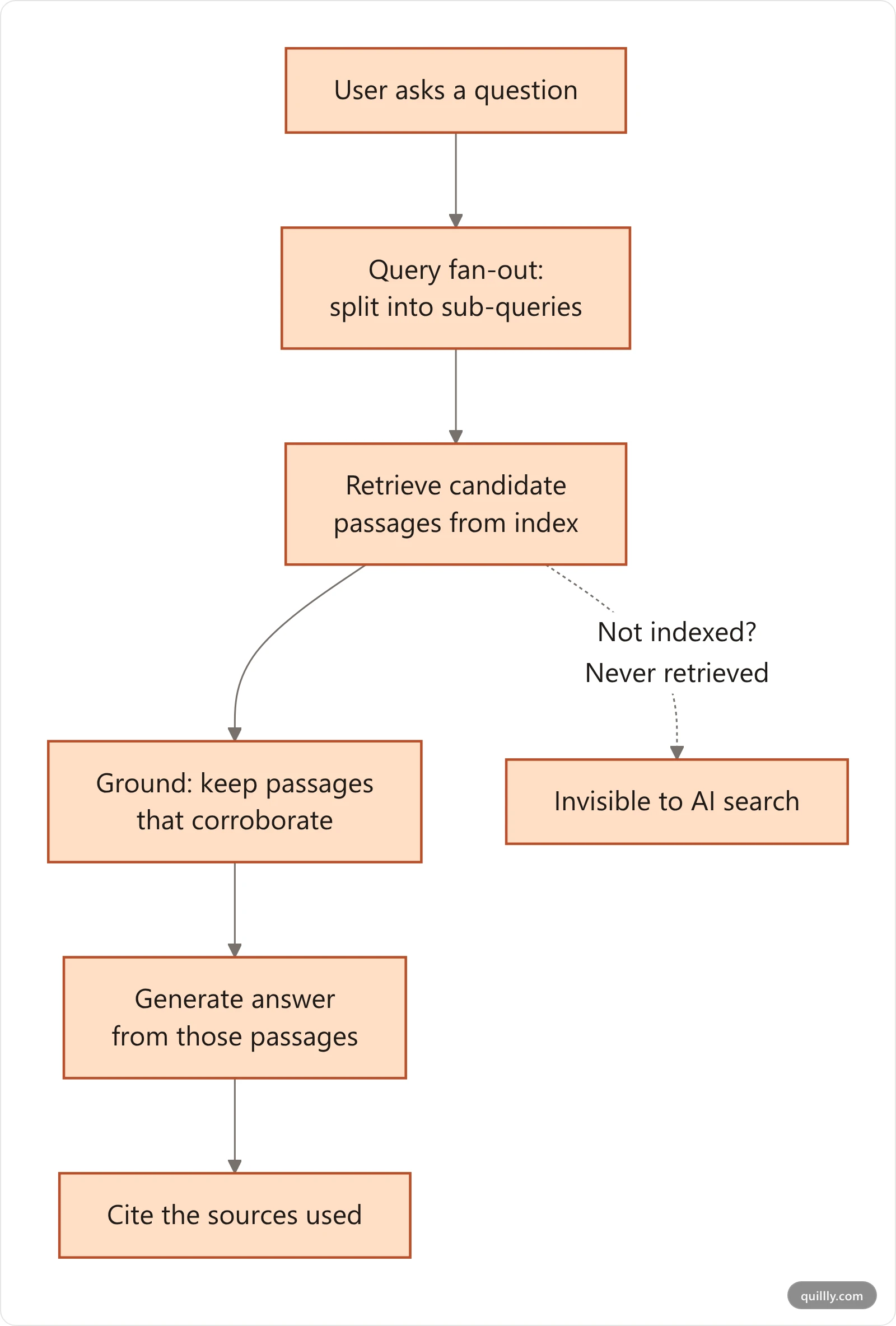
Every AI answer engine runs the same four-step loop:
Retrieve candidate passages from an index.
Ground the answer in the passages that corroborate each other.
Generate the answer from those grounded passages.
Cite the sources it actually leaned on.
Ranking matters only at the retrieval step, and even there it's one signal among many. In short, how AI search chooses citations is decided passage by passage, not page by page.
This is why a page can rank #3 and never get cited, while a page ranked #40 gets quoted in the AI Overview. The model isn't rewarding position — it's rewarding the passage that most cleanly answers a narrow sub-question. As Ahrefs puts it in its explainer on retrieval-augmented generation, "a passage that isn't retrieved cannot be cited, summarized, or reasoned over, no matter how good the generator is."
Get comfortable with that sentence. It reframes the whole game: your job is to be the most retrievable, most quotable passage for a specific question, not the highest-ranked URL for a broad keyword.
Step 1: Retrieval — you can't be cited if you're not retrieved#
Retrieval is the gate, and most content dies here. AI answer engines are built on retrieval-augmented generation (RAG): before the model writes anything, a retriever searches an index for passages relevant to the query and hands the best ones to the generator. If your page isn't in that index, it is invisible — full stop.
Which index depends on the engine. ChatGPT Search leans heavily on Bing's index, Google's AI Overviews and AI Mode use Google's index, and Perplexity blends its own crawl with third-party sources. If those crawlers can't reach you, start with AI crawler optimization for GPTBot, ClaudeBot, and PerplexityBot. The practical takeaway: getting indexed by Google and Bing is table stakes for AI visibility, not an afterthought. A page stuck in "Discovered — currently not indexed" can't be retrieved by anything, so our guide on how to get indexed on Google fast is where AI visibility actually starts.
Retrieval is also semantic, not just keyword-based. The retriever converts the query and your passages into vectors and matches on meaning, so a passage that clearly states the concept beats one that merely repeats the keyword. Clarity is a retrieval feature.
Step 2: Query fan-out — one question becomes dozens#
The biggest difference between AI search and classic search is fan-out. Instead of matching your one query against the index, engines like Google's AI Mode expand it into a fan of related sub-queries, run them in parallel, and merge the retrieved passages. iPullRank describes this as the mechanism that lets AI search "gather a richer set of relevant passages from different documents" for a single answer.
So a question like "best way to get cited by AI" silently becomes a dozen searches: "how AI citations work," "passage optimization," "AI Overview data," "does ranking affect citations," and more. Each sub-query retrieves its own passages, and your page competes at the sub-query level. That's how a niche page ranked #40 wins a citation — it owned one specific sub-question the fan-out generated.
This changes content strategy. A page that answers one narrow question deeply will win more fan-out sub-queries than a shallow page that skims ten. Depth per question beats breadth. Our builder's playbook on query fan-out for AI Mode goes deeper on how to map and target those sub-queries.
Step 3: Grounding — the model keeps passages that agree#
Grounding is where AI search decides which retrieved passages to trust. After fan-out pulls dozens of candidate chunks, the model looks for consensus: facts that show up across multiple independent sources get treated as reliable, and the passages carrying them become citation candidates. Grounding exists to reduce hallucination by anchoring the answer to verifiable, real-world text.
This has a blunt consequence. If your page states a fact the way three other trusted sources state it, you reinforce the consensus and become a citable witness to it. If your page contradicts the consensus with no evidence, the model routes around you. And if your page is the original source of a stat everyone else quotes, you become the anchor citation — the highest-value position in AI search.
That's why original data and first-hand experience punch above their weight. Consensus rewards agreement, but it rewards being the reason for the consensus even more.
Step 4: Generation and attribution — how the link gets chosen#
In the final step, the model writes the answer from its grounded passages and attaches citations to the specific claims it used. Attribution isn't decorative — engines increasingly tie each sentence to the passage that supported it. A source gets linked when its passage was actually used in generation, not merely retrieved.
So two things have to be true to earn the link: your passage survives retrieval and grounding, and it's the cleanest expression of the claim the model chose to state. If a competing passage says the same thing more directly, it wins the citation even if yours ranked higher. This is why phrasing matters as much as authority: the model quotes what's quotable.
Passages, not pages: the real unit of citation#
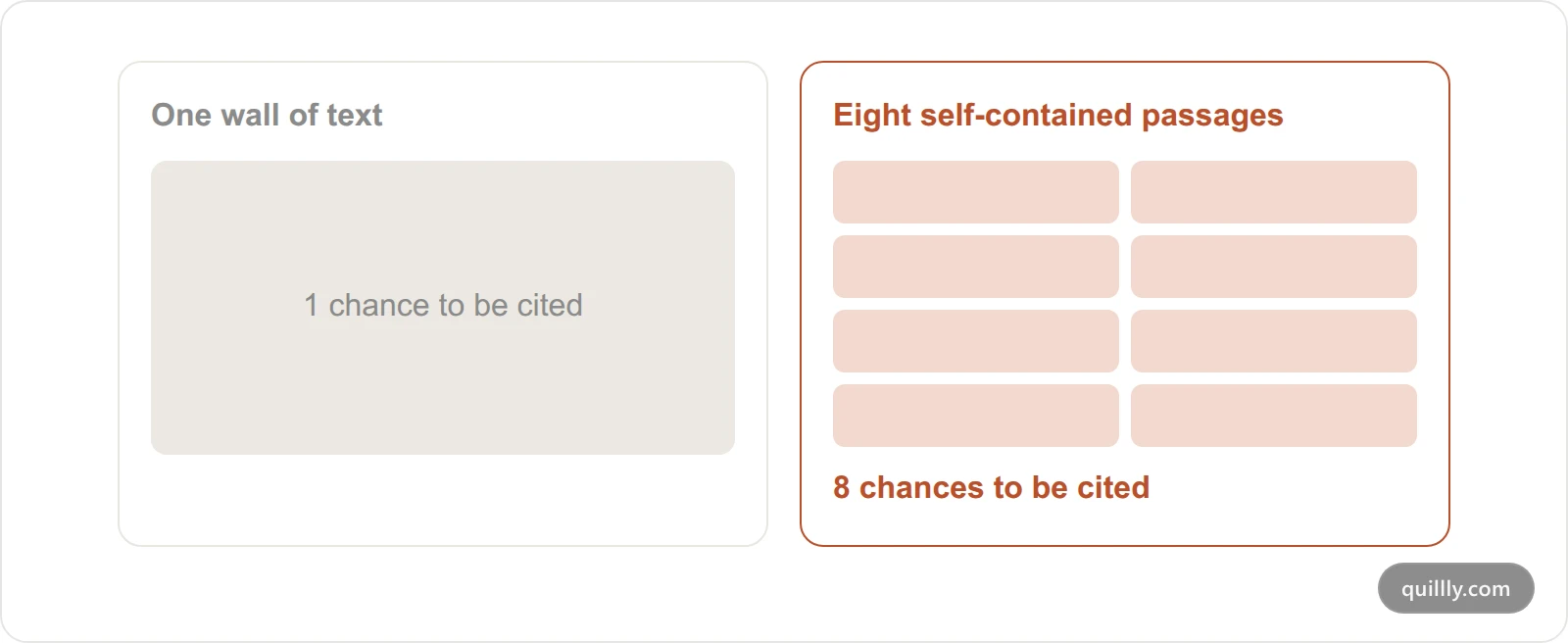
Here's the mental model shift that changes everything: AI search retrieves passages, not pages. The RAG system doesn't hand the model your whole article — it hands over the specific chunk that best answers a sub-query. Your 3,000-word guide isn't one entry in the contest; each of its self-contained passages is a separate contestant.
Content strategist practice has converged on a tidy rule: a well-formed passage runs 40 to 120 words, opens with its answer, names its subject, and contains at least one concrete fact. As one chunk-optimization analysis put it, "a page with eight well-formed passages has eight chances to be cited instead of one." Structure your page as a series of stand-alone answers and you multiply your surface area for citation.
What actually makes a passage cite-worthy#
Seven factors decide whether a passage gets retrieved, grounded, and quoted. Miss the early ones and the later ones never get a chance to matter.
Factor | What it means | Why it matters |
|---|---|---|
Indexed | Google and Bing have the page in their index | Not indexed = never retrieved |
Relevance | Passage semantically matches a sub-query | Retrieval is meaning-based, not keyword-based |
Answer-first | Opens with the answer, not a wind-up | Models quote the sentence that states the claim |
Self-contained | Makes sense without the paragraph above it | Chunks are read in isolation |
Concrete | Contains a fact, number, or named entity | Grounding favors verifiable specifics |
Corroborated | Agrees with what trusted sources say | Consensus builds trust; original data anchors it |
Authoritative | Backed by real experience and E-E-A-T | Trust signals break ties between similar passages |
Notice the order. Indexing and relevance are retrieval gates — fail them and nothing else counts. Answer-first, self-contained, and concrete are extractability levers you fully control. Corroboration and authority are the tiebreakers when several passages say the same thing.
Turn your AI drafts into passage-first content that gets scored before it ships.
The data: where AI citations actually come from#
The numbers make the "ranking ≠ citation" point impossible to ignore. AI engines pull from far deeper and wider than page one, and the trend is accelerating.
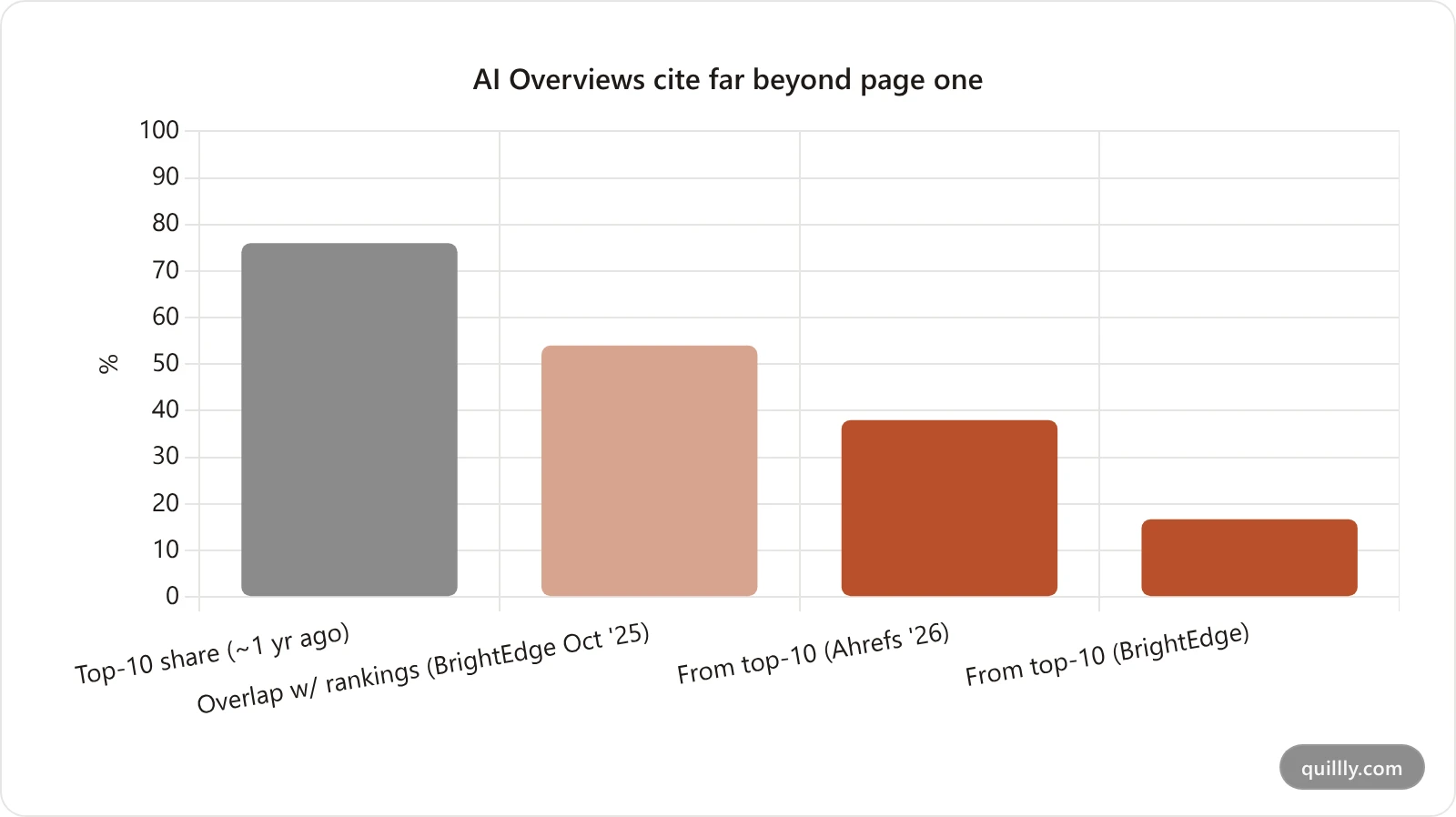
The reason is fan-out and passage retrieval working together. When one question becomes dozens of sub-queries and each retrieves passages independently, the model naturally samples a wide, deep set of pages — most of which never ranked top 10 for the original query. Ranking gets you into the candidate pool for the head query; it does nothing for the long tail of sub-queries where most citations are actually won. For the full stat pack, see our roundup of AI search statistics that matter in 2026.
Why each engine cites differently#
There is no single "AI search" to optimize for. An analysis of 680 million citations found that only 11% of domains cited by ChatGPT are also cited by Perplexity — the platforms disagree on sources far more than they agree. Each engine has a source personality baked into its retrieval and grounding.
Engine | Retrieval index | Cites heavily | Freshness behavior |
|---|---|---|---|
ChatGPT Search | Bing-based | Wikipedia (47.9% of top-10 sources) | Favors stable, authoritative pages |
Perplexity | Own crawl + third-party | Reddit (46.7% of top citations) | 2–3 month content decay window |
Google AI Overviews | Google index | Traditionally strong E-E-A-T pages | Broad, deep sampling via fan-out |
Grok | X + web | Brand and community sources | Real-time, recency-weighted |
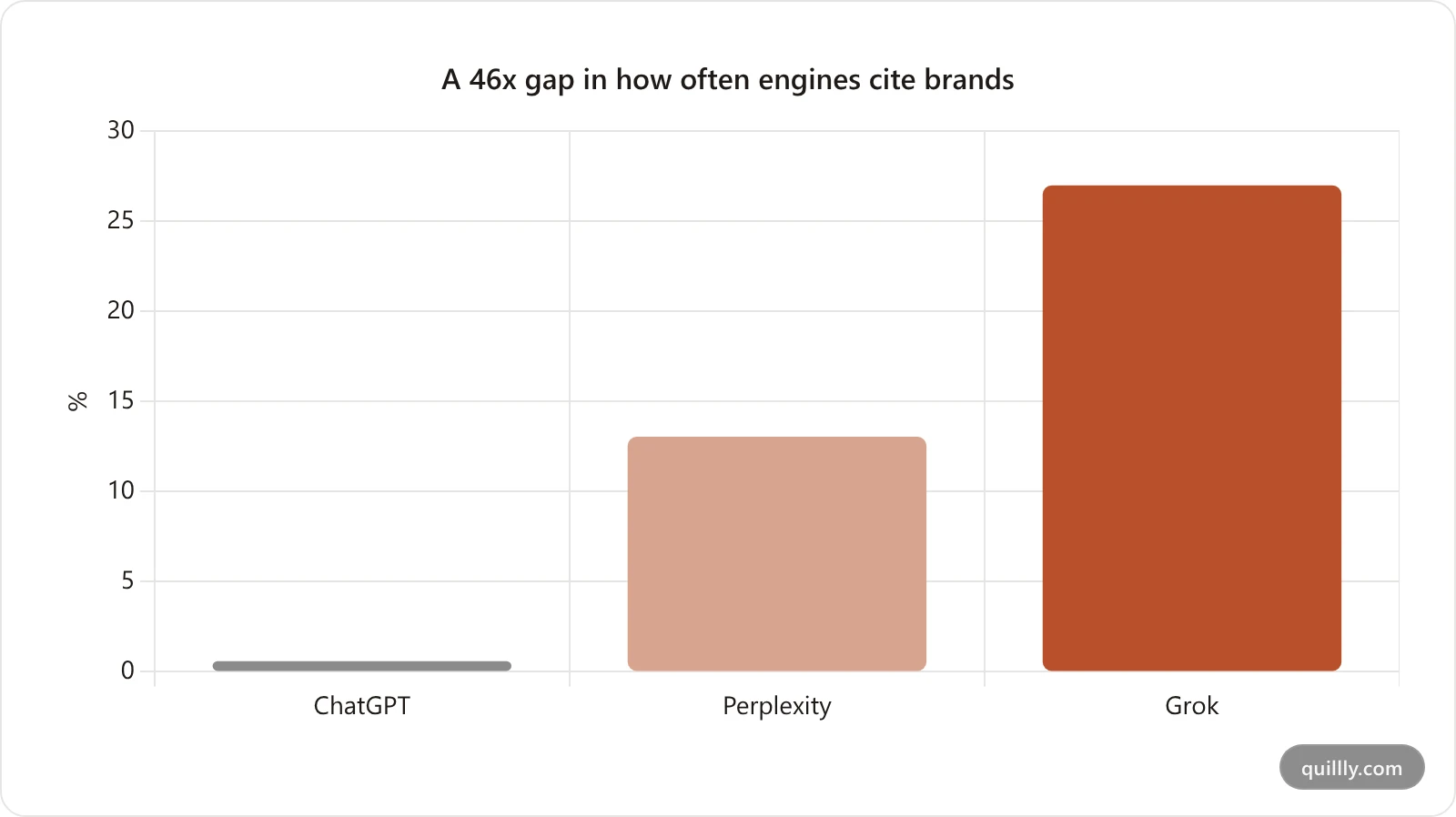
The gap in how often engines cite anyone is just as wide. A 2026 study of 34,234 AI responses found a 46-times difference in brand citation rates between platforms: ChatGPT cited brands 0.59% of the time, Perplexity 13.05%, and Grok 27%. Optimizing "for AI" without naming the engine is a category error.
The practical move: pick the engines your audience actually uses and study their source patterns. If your buyers live in ChatGPT, wiki-clear declarative writing and Wikipedia-grade neutrality matter. If they live in Perplexity, community presence and freshness win. Our engine-specific guides cover the tactics for Perplexity, Google AI Mode, Gemini, Grok, and Claude.
Where on the page citations come from#
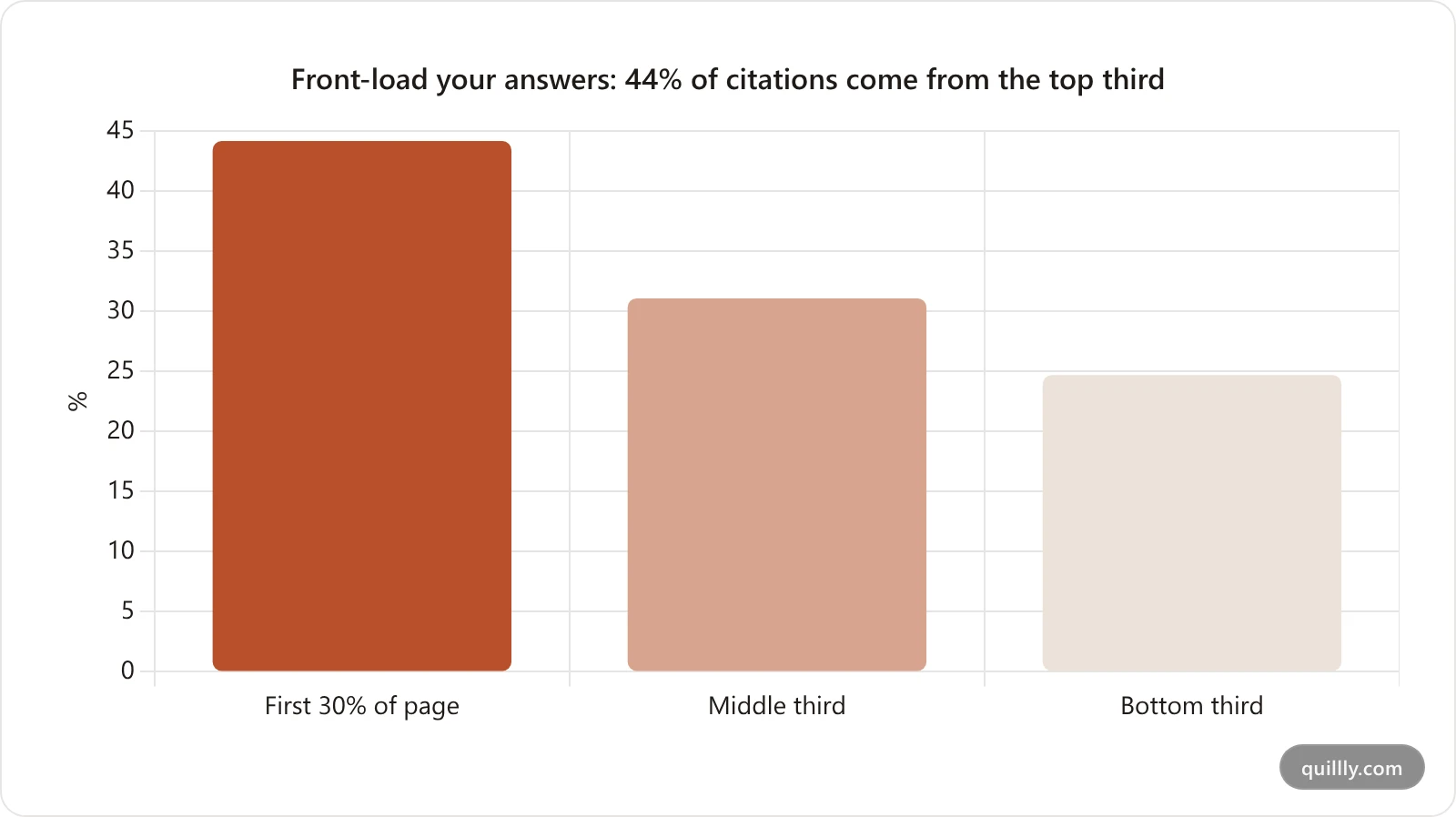
Position inside your page matters almost as much as which page. Kevin Indig's research on citation patterns found the first 30% of a page generates 44.2% of all citations, the middle third 31.1%, and the bottom third just 24.7%. Retrievers and readers both front-load attention, so your best answer should never be buried in the conclusion.
Structure amplifies this. Indig's data also shows content formatted as question → immediate answer gets cited nearly twice as often as content that doesn't (18% vs. 8.9%). That single formatting choice — pose the question in a heading, answer it in the first sentence below — is one of the highest-ROI moves in AI search.
Publish answer-first content on your own domain with Quillly.
The R.E.A.C.H. framework: engineer content to get cited#
The mechanism gives you a checklist. To move from "understand how AI search chooses citations" to actually earning them, run every page through R.E.A.C.H. — five gates mapped directly to retrieve, ground, and generate. This is the copyable asset.
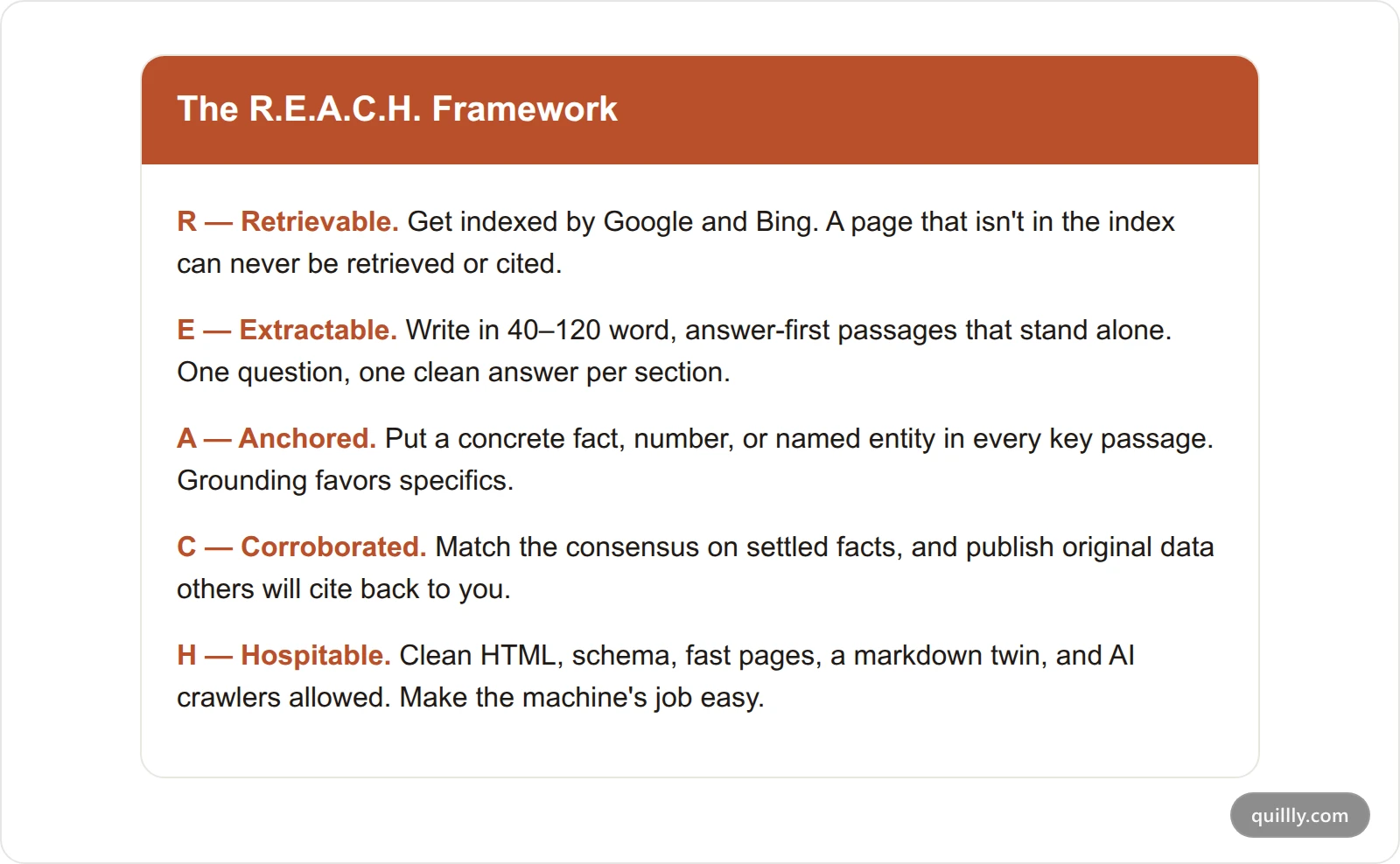
The letter people underinvest in is H. A brilliant passage inside a slow, script-heavy page that blocks GPTBot never gets read. Serving a clean markdown twin for AI crawlers and keeping pages fast removes that friction at the source.
Score and publish citation-ready content in one workflow.
How to track and improve your AI citations#
You can't optimize what you can't see, so close the loop with measurement. Start by confirming the retrieval gate: is every page actually indexed on Google and Bing? Then watch which passages get pulled into AI answers and iterate on the ones that don't.
This is where the publishing layer earns its keep. With Quillly, your AI drafts the passage-first content, then check_blog_seo scores it against 14+ criteria — including whether sections lead with answers and carry concrete facts — before anything ships. After you publish_content, indexing status is tracked automatically across Google and Bing, so a page stuck in "Discovered — currently not indexed" surfaces immediately instead of silently failing the retrieval gate for months. Because everything publishes to your own domain, you build the authority and corroboration signals on an asset you own, not a rented platform.
The workflow that compounds is simple: write in passages, verify retrieval, ship, watch citations, and feed what wins back into the next draft. Do that consistently and you stop guessing how AI search chooses citations and start engineering the outcome.
Frequently Asked Questions#
How does AI search choose which sources to cite?#
AI search runs a retrieve-ground-generate-cite loop. It expands your query into sub-queries (fan-out), retrieves matching passages from an index, keeps the ones that corroborate each other (grounding), writes an answer from them, and links the passages it actually used. Ranking only influences the retrieval step — the citation goes to the clearest, best-supported passage, not the highest-ranked page.
Does ranking #1 on Google get me cited by AI?#
Not reliably. Ahrefs found only 38% of Google AI Overview citations come from top-10 pages, down from 76% a year earlier, and roughly five of six citations come from beyond page one. Ranking helps you enter the retrieval pool for the head query, but most citations are won at the sub-query level, where deep, passage-first pages outside the top 10 frequently get picked.
What is query fan-out in AI search?#
Query fan-out is when an engine expands a single question into many related sub-queries, runs them in parallel, and merges the retrieved passages into one answer. It's the core mechanism behind Google's AI Mode. Because each sub-query retrieves independently, a page that deeply answers one narrow question can win a citation even if it doesn't rank for the original broad query.
Why does AI cite passages instead of whole pages?#
AI search is built on retrieval-augmented generation, which fetches the specific chunk of text that best answers a query rather than your entire page. That means each self-contained passage on your page is a separate citation candidate. A page with eight well-formed 40–120 word passages has eight chances to be cited instead of one.
Why do ChatGPT and Perplexity cite different sources?#
Each engine uses a different index and grounding logic. Across 680 million citations, only 11% of domains cited by ChatGPT were also cited by Perplexity. ChatGPT leans on Wikipedia (47.9% of top sources), while Perplexity favors Reddit (46.7%) and applies a 2–3 month freshness window. You can't optimize for both with identical content — target the engines your audience uses.
How do I structure content to get cited by AI?#
Lead each section with a question and answer it in the first sentence. Keep passages self-contained at 40–120 words, include a concrete fact or number, and put your strongest answers in the top third of the page, where 44% of citations originate. Then make sure the page is indexed and crawlable so retrieval can find it in the first place.
How can I tell if my content is being cited by AI engines?#
Track it deliberately: confirm each page is indexed on Google and Bing, then monitor AI-answer inclusion with an AI SERP or citation-tracking tool and watch referral traffic from AI engines in analytics. A publishing tool that tracks indexing status automatically closes the biggest blind spot — pages that never got retrieved because they never got indexed.
The bottom line#
AI search cites passages, not pages, and it does so through a loop you can now engineer: retrieve, ground, generate, cite. Three facts should reset your strategy:
only 38% of AI Overview citations come from top-10 pages, so ranking alone won't earn them,
engines disagree on sources by design — just 11% domain overlap between ChatGPT and Perplexity — so pick your targets, and
44% of citations come from the first third of a page, so front-load answer-first passages. Run every page through R.E.A.C.H., publish passage-first content on a domain you own, and verify the retrieval gate by tracking indexing. Do that and getting cited stops being luck.
Want your AI to write passage-first content, score it, and publish it to your own domain — indexed and citation-ready? Connect Quillly to Claude or ChatGPT in 30 seconds.