

Ask Grok "what's the best MCP tool for SEO right now" and it does something no other AI assistant does: it reads live X posts from the last few hours alongside the open web, then names a handful of sources. You're one of those names, or you're invisible. There's no page two. That's why Grok SEO is its own discipline, not a footnote to your Google playbook.
Grok crossed roughly 64 million monthly active users by early 2026 and about 17.8% of the US chatbot market, making it the third most-used AI assistant in the country. That's a citation surface most brands ignore because they optimized for Google and stopped paying attention.
This guide breaks down how Grok actually retrieves and cites sources, why its live X grounding changes the strategy, and the SPARK framework for earning those citations, with hard data, a comparison table, and a copy-paste checklist you can run today.
Short answer: To get cited by Grok, publish answer-first content backed by fresh statistics and named sources, then reinforce it with an active, credible presence on X. Grok pulls citations from both the live X post graph and the open web, so brands active on both channels win disproportionately.
What Grok SEO actually means#
Grok SEO is the practice of structuring content so Grok names your page, or your X posts, as a source inside its synthesized answers. It's a slice of generative engine optimization, and it is not blue-link ranking. Grok folds X and the web into a single written answer with inline citations. As FixAEO founder Nitish Kumar Yadav puts it, "there is no second page to be on. You're named, or you're not."
Three things make Grok SEO different from classic search work. First, citation, not position, is the unit of visibility. Second, Grok reads a live social stream, so recency and your presence on X matter more than domain age. Third, one prompt triggers many searches, so broad topic coverage beats single-keyword targeting. If you've already worked on getting cited by Claude or earning Perplexity citations, the muscle is familiar. The sources Grok trusts are not.
How Grok search actually works#
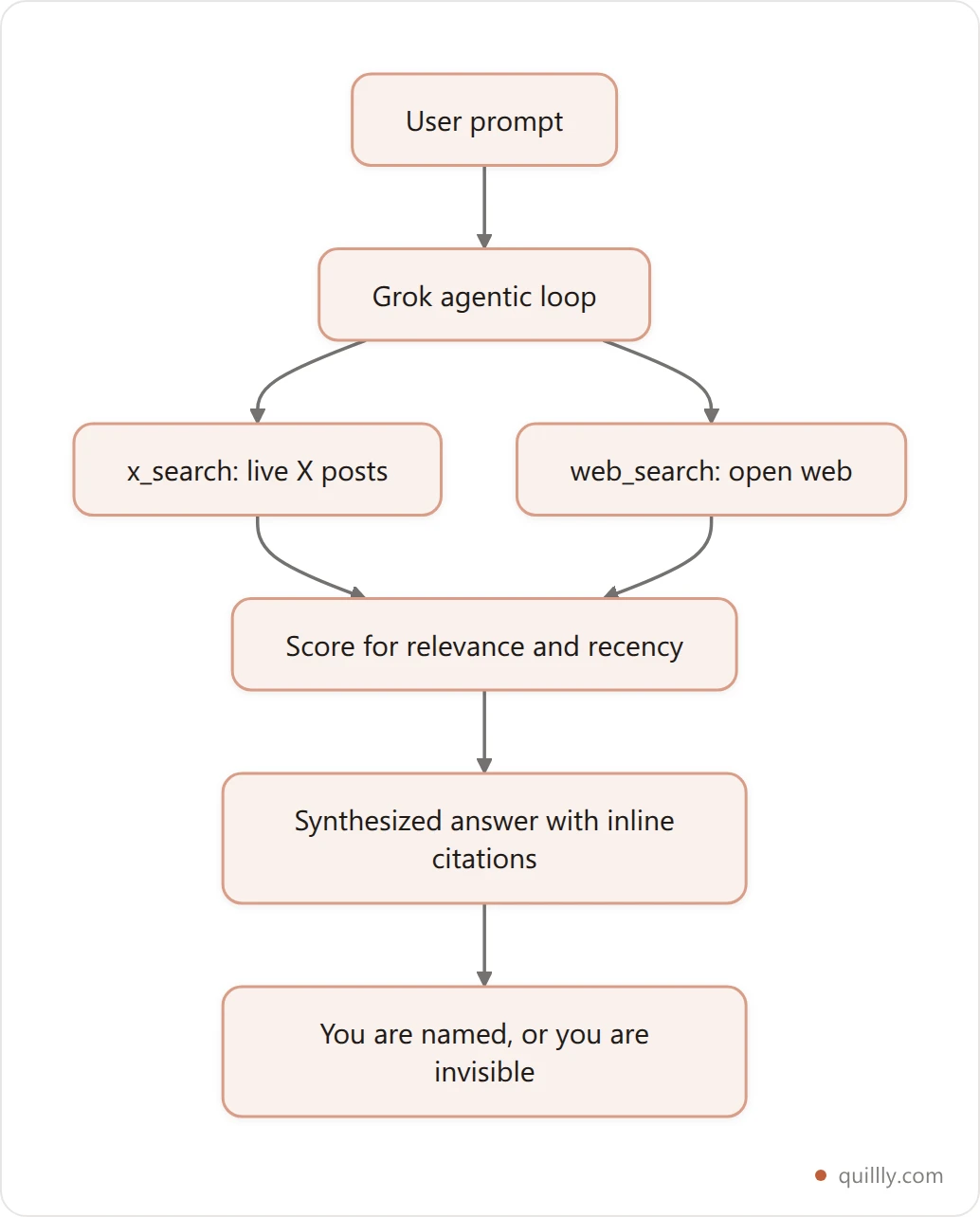
Grok runs an agentic loop, not a fixed "look it up, then answer" step. The model decides when to search and writes its own queries. It can fire two tools at once: web_search for the open internet and x_search for real-time X posts, searchable by keyword, handle, or thread. That dual-tool retrieval is the core of how Grok grounds its answers.
The old DeepSearch button folded into a mode selector around mid-2025. Today users pick Fast (auto-routed quick answers), Expert (multi-step research across web and X), and Heavy (a multi-agent "team of experts" on the top SuperGrok tier). Expert and Heavy formulate sub-queries, retrieve, evaluate, and iterate before answering, the same query fan-out pattern that powers Google AI Mode, applied to a social-plus-web index. The takeaway: cover the cluster of questions around your topic, because Grok is searching for all of them, not just your headline keyword.
Why live X posts change the citation game#
Grok is the only major assistant reading a live social stream, and that single fact reshapes the strategy. When Grok answers a fast-moving question, it can weight X posts from the last few hours as direct grounding sources alongside web pages. A flurry of on-topic posts from credible accounts can move what Grok says about you this week, for better or worse.
Here's the contrarian part. Citation overlap between ChatGPT and Perplexity sits around 11%, and Grok is more distinct still because of its social grounding. So a page that gets cited everywhere else can be completely absent from Grok if you have no social corpus behind it. For Grok, an active X account that links to your authoritative pages isn't a "nice to have." It's a ranking input, and it's one you can't fake with backlinks or replicate on any other engine.
The SPARK framework for getting cited by Grok#
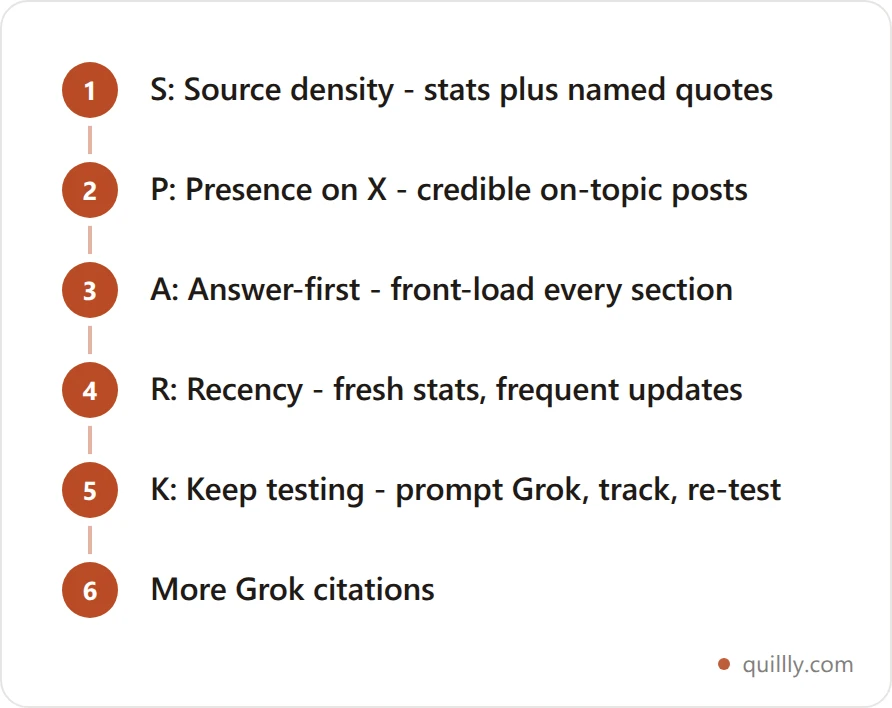
Most "get cited by AI" advice is a pile of tips with no order. SPARK gives you five levers, ranked by how much they move Grok specifically. Work them top to bottom.
S — Source density. Pair every key claim with a statistic, a named source, or an expert quote. Cited passages use definitive language 36.2% of the time versus 20.3% for uncited ones, and adding statistics lifts AI visibility by about 22% while quotations lift it by roughly 37% (Contently, 2026).
P — Presence on X. Post substantive, on-topic takes that link to your authoritative pages. Consistency beats volume. Grok reads these as direct sources, so your X account is part of your content, not a side channel.
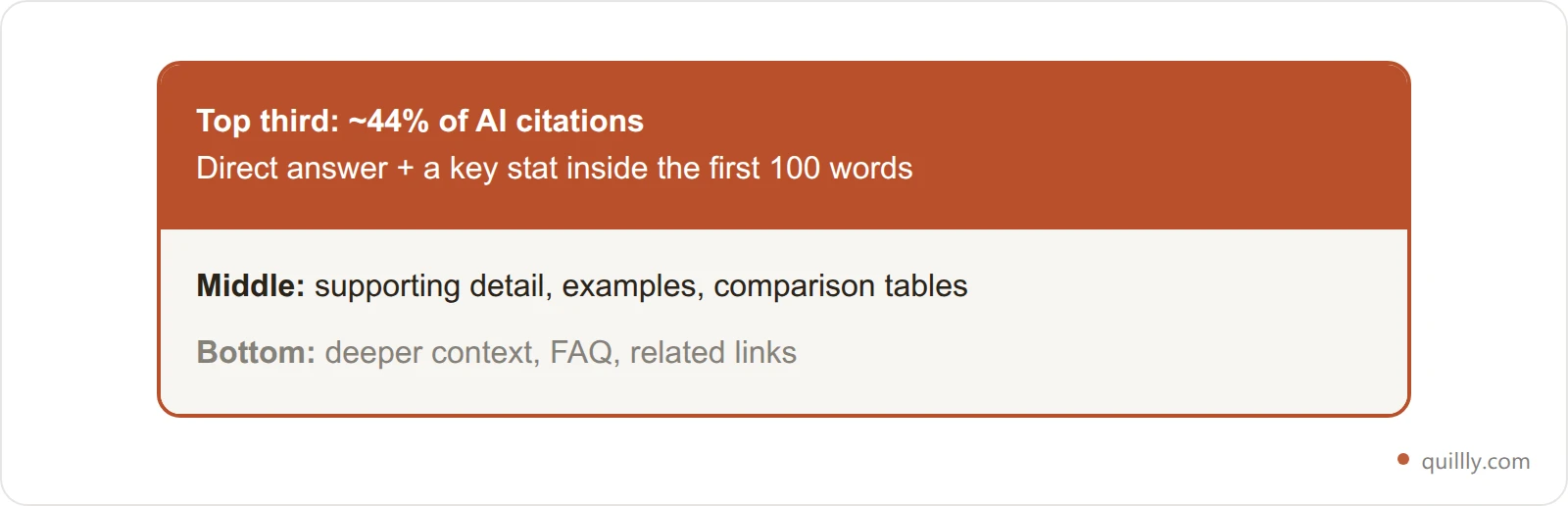
A — Answer-first structure. Lead every section with a direct, factual sentence. Around 44% of AI citations come from the top third of the page, and structured formats earn more.
R — Recency. Add fresh stats and keep a visible update cadence. Roughly 65% of AI bot hits target content published in the past year, and Grok's real-time architecture can surface your changes within days.
K — Keep testing. Prompt Grok with your priority questions, record which sources it names, fix the gaps, and re-test in days, not months.
Structure your content so Grok can lift it#
Front-load the answer, then support it. Grok's synthesizer looks for a clean, quotable claim it can attribute, and the top third of your page is where most citations are pulled from. Bury the answer under a 200-word windup and you hand the citation to a competitor who led with theirs.
Three structural moves do most of the work. Lead each H2 with a one-sentence takeaway. Use bullet lists and comparison tables, which measured a 43% citation lift in 2026 GEO testing. And write in definitive language ("Grok weights X posts as direct sources") rather than hedged phrasing ("Grok may sometimes consider social signals"). The confident, sourced sentence is the one that gets quoted.

This is also where a scoring pass earns its keep. Running check_blog_seo before you publish flags thin sections, missing visuals, and weak structure, the same signals Grok rewards, so you fix them before the model ever sees the page.
Stop copy-pasting AI drafts into a CMS. Publish straight from your AI to your own domain with Quillly.
Build the X presence Grok reads#
Grok's edge is your opportunity: it treats credible X accounts as first-class sources, so an active profile compounds your web content. Post accurate, on-topic takes that link back to your authoritative pages. Reply to real conversations in your niche. Thread your best articles into ongoing discussions where verified accounts are already talking.
The bar is credibility, not follower count. A brand that publishes substantive content on X and earns replies from trusted accounts builds a social corpus signal Grok weighs alongside the web. Topics that appear in both your published content and current X discussion get a stronger trust read than either channel alone. If you write a data-backed post, ship the article and the X thread the same day, so Grok sees the claim confirmed in two places at once.
Grok vs Claude, ChatGPT, and Google AI Mode#
Grok shares the citation-first logic of every AI engine, but its sources are unusual. The table below shows where each assistant looks and what that means for your work. Optimize for the engine's index, not a generic AEO checklist.
Engine | Primary sources | Recency weighting | Your biggest lever |
|---|---|---|---|
Grok | Live X posts + open web | Very high | Active X presence + fresh pages |
ChatGPT | Bing index + web | Medium | Structured, quotable pages |
Claude | Brave Search index | Medium | Clean, evidence-led content |
Google AI Mode | Google index + fan-out | Medium-high | Full topic coverage |
Perplexity | Multi-engine web | High | Sourced, up-to-date answers |
The pattern: the fundamentals travel, but the winning move changes per engine. Grok rewards a social corpus no one else reads. ChatGPT rewards the Bing-fed structure you already build for search. And Google AI Mode rewards coverage breadth. Publish once to your own domain, then tune the edges for each.
Want your AI to handle that publishing step end to end? Connect Quillly to Claude or ChatGPT in 30 seconds.
Measure your Grok citations with a fast loop#
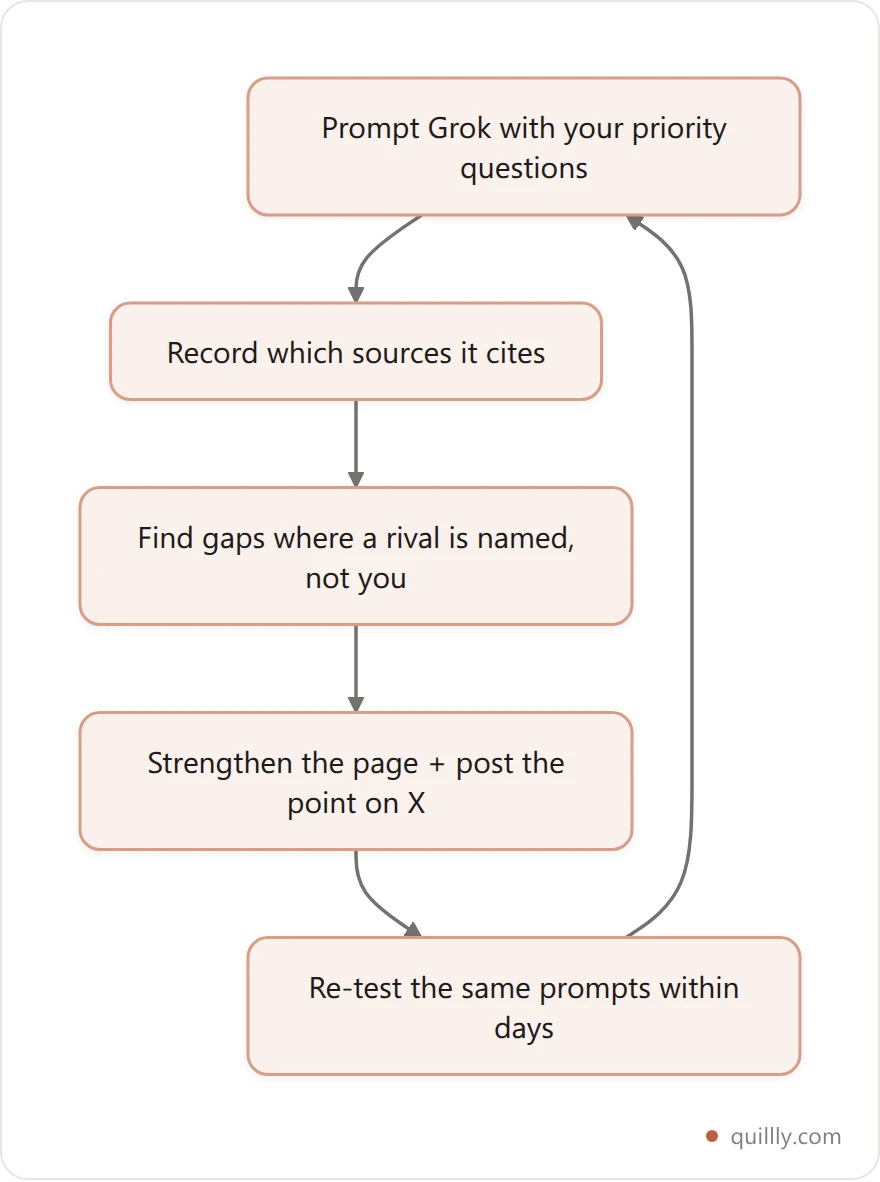
You can't optimize what you don't watch, and Grok moves faster than any crawl-based engine. Build a weekly loop instead of a quarterly audit. Prompt Grok with the 10 to 20 questions your buyers actually ask, note which sources it names, and find the gaps where a rival is cited and you aren't.
Then close each gap two ways: strengthen the matching page with a sharper answer and a fresh stat, and post the same point on X from a credible account. Because Grok reads live posts, changes can surface within days, so re-test the same prompts a week later. Track citation frequency over time, not a single snapshot, and verify that Grok's claims actually match your page, since a large share of LLM citations don't fully support the sentence they're attached to.
Mistakes that keep you out of Grok's answers#
The fastest way to improve is to stop doing the things that guarantee invisibility. Four show up constantly.
Trying to block GrokBot in robots.txt. xAI publishes no official crawler docs, and Grok's retrieval traffic often doesn't identify itself, so a
robots.txtblock usually does nothing except give you false comfort. This is the same robots.txt trap that trips up AI crawler control across engines.Hedged language. "May," "might," and "in some cases" read as low-confidence and get skipped. Definitive, sourced sentences get quoted.
Stale statistics. When Grok can pick a 2023 source or a 2026 source on the same topic, the fresh one wins. An outdated stat is a silent citation killer.
Zero X footprint. If your brand never appears in the live post graph, you've opted out of half of Grok's index. No other engine punishes silence on social this directly.
Fix these four and you clear the floor most competitors never do. A quick on-page SEO audit catches the structural half; your X calendar handles the rest.
Score your post against 14 SEO criteria before you hit publish.
Frequently Asked Questions#
Does Grok actually search the web in real time?#
Yes. Grok runs an agentic loop that decides when to search and fires two tools: web_search for the open internet and x_search for live X posts. It retrieves fresh results at query time rather than answering purely from training data, which is why it handles breaking topics better than static models.
How is getting cited by Grok different from ranking on Google?#
Google ranks pages in a list; Grok names sources inside one synthesized answer. There's no page two, so you're either cited or invisible. Grok also weighs live X posts as direct sources, which means your social presence influences citations in a way it never did for classic Google rankings.
Do I need an active X account to get cited by Grok?#
It's the single biggest Grok-specific lever. Grok treats credible X accounts as first-class sources alongside web pages, so a brand active on both channels wins disproportionately. You can still be cited from the web alone, but skipping X means opting out of half of Grok's index.
What is Grok DeepSearch?#
DeepSearch was Grok's agentic, multi-step research mode. Around mid-2025 it folded into a mode selector, so you now choose Fast, Expert, or Heavy. Expert and Heavy still run the same deep behavior: the model formulates sub-queries, retrieves, evaluates, and iterates across the web and X before writing a cited answer.
How often should I check my Grok citations?#
Weekly. Grok reads live posts and fresh pages, so it can change what it says about you within days of an update, far faster than crawl-based engines. Prompt it with your priority questions, track which sources it cites over time, and re-test after each content or X change.
Does query fan-out apply to Grok too?#
Yes. Grok's Expert and Heavy modes expand one prompt into several sub-queries before answering, the same fan-out logic behind Google AI Mode. Practically, that means covering the full cluster of questions around a topic beats optimizing a single keyword, because Grok is searching for all of them at once.
Can I optimize for Grok and other AI engines at once?#
Mostly. The fundamentals travel: answer-first structure, sourced claims, and fresh content help everywhere. The edges differ, since Grok reads X, ChatGPT leans on Bing, and Claude uses Brave Search. Publish once to your own domain, then tune the per-engine levers rather than maintaining separate content.
The takeaway#
Grok is a citation surface hiding in plain sight: roughly 64 million monthly users, the third-most-used assistant in the US, and the only one reading a live social stream. Three moves win it. Lead every section with a sourced, definitive answer, because about 44% of citations come from the top third of the page. Back your claims with data and named quotes, which lift AI visibility by 22% to 37%. And build a credible X presence, since it's the one Grok-specific lever no backlink can replace.
Run the SPARK framework, watch your citations weekly, and treat X as content, not a side channel. The brands that show up in Grok's answers in 2026 are the ones building for how it actually retrieves, not the ones still optimizing for 2023.
Want your AI to actually publish the post it just wrote? Connect Quillly to Claude or ChatGPT in 30 seconds.


