Ask eight tools that call themselves an AI content agent to run your blog, and seven of them hand you a draft. That's the trick. The draft was never the hard part — a general-purpose model does that free. The hard part is everything after it, and that's exactly where most "agents" quietly hand the work back to you. Every content automation pitch sounds identical at the demo stage, because every demo ends at the draft. This comparison starts there instead.
An AI content agent is software that runs a content job end to end — research, draft, publish, verify — without a human carrying files between the steps. Most products sold as agents only do the middle two. The gap that decides whether you actually have an agent is what happens after the draft: getting the page live on your domain, and confirming a search engine took it.
We scored eight of them on those four jobs. Three finish the run.
The Eight Agents at a Glance#
Tool | Research | Draft | Publish | Verify | Starting price |
|---|---|---|---|---|---|
Quillly | ✓ | ✓ | ✓ | ✓ | $19/mo |
Outrank | ✓ | ✓ | ✓ | — | $99/mo |
Autoblogging.ai | ✓ | ✓ | ✓ | — | $12/mo |
Byword | ✓ | ✓ | ✓ | — | $99/mo |
Jasper | ✓ | ✓ | — | — | $69/mo per seat |
Writer | ✓ | ✓ | — | — | Sales-led |
MindStudio | — | ✓ | — | — | Free / $20/mo |
DIY (Zapier + an LLM API) | — | ✓ | ✓ | — | API cost + your time |
Scored from each tool's own public pricing and feature pages, checked 7 September 2026. A dash means the capability isn't documented there — not that it's impossible to bolt on.
Read the table this way:
All eight can draft. Drafting is a commodity capability now, and nobody wins on it.
Four can publish a live URL to your site without a human opening a CMS.
One verifies that a search engine actually indexed the page afterwards.
Price tracks coverage loosely at best — the $12 tool publishes and the $69 one doesn't.
If that fourth column is the one you care about, you can watch it run on your own domain in about ten minutes.
What Actually Makes Something an Agent#
An agent is judged by what it does when nobody is watching. A generator waits for your next instruction and stops until you give one. An agent holds a goal, takes the next step itself, notices when that step failed, and retries. Everything else is packaging around a model call.
The word "agent" got attached to anything with a text box in front of a model, which is why the label itself stopped carrying information. Behaviour still does.
That distinction has a ladder to it — we mapped the full version in the five rungs of AI SEO agent autonomy, which is the framework this scorecard applies. The short version: each rung removes one human handoff. Most content tools sit on rung two and are marketed as rung five.
The Four Jobs, Defined#
Content work is a pipeline, and a pipeline is only as autonomous as its weakest joint. Here are the four joints, and what "done" means at each.
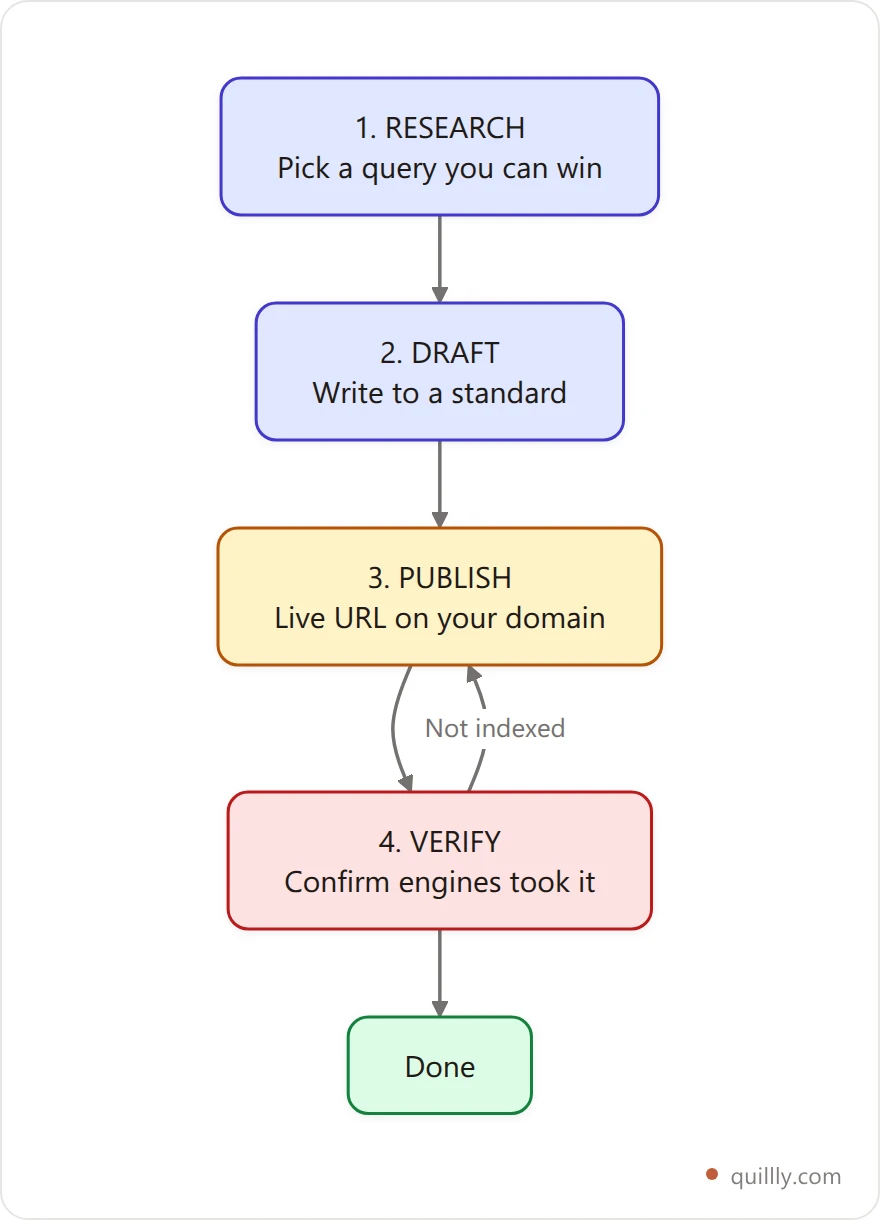
Research means choosing the query, not describing it. A tool that accepts your keyword has not done research. A tool that reads the live results, weighs the competition against your site's authority, and tells you to skip the query has.
Draft means writing to a standard rather than to a word count. The check is whether the tool can fail its own output and rewrite it.
Publish means a real URL on your own domain, created without a human touching a CMS. This is the joint that breaks.
Verify means going back a week later and asking the engine whether the page exists in its index — then doing something when the answer is no.
The Eight Agents, Scored#
1. Quillly — all four jobs, $19/mo#
Full disclosure: this is our product, so score the claims against the documentation rather than our adjectives.
Quillly is built on the Model Context Protocol, which means the agent isn't a chatbot we wrote — it's Claude, ChatGPT, Cursor, Windsurf or Gemini, holding real publishing tools. Your assistant researches the keyword, scores the draft against 14 SEO checks, publishes to your own domain, submits to eight engines, and reads back per-URL indexing status from Google, Bing and Yandex.
The fourth job is the one that's unusual: when a page doesn't get indexed, the indexing report names the reason and the fix, and revalidation re-checks it daily for up to two weeks. Pro is $19/month; hands-off Autopilot plans start at $39/month. There's a 14-day trial with no card.
2. Outrank — publishes everywhere, stops at live#
Outrank is the most complete of the pure auto-pilot tools: $99/month for 30 articles researched, written and published automatically, with integrations for WordPress, Webflow, Shopify, Wix, Framer, Notion, Ghost and custom webhooks. Annual billing is $999.
Its publishing coverage is genuinely broader than ours, and for pure automated blog publishing into a mainstream CMS it's the strongest option on this list. What its public pages don't describe is any per-URL index verification — the run ends when the post is live. We went deeper on the trade-offs in our Outrank review.
3. Autoblogging.ai — cheapest way to publish at volume#
Autoblogging.ai is credit-based, from $12/month for 40 credits up to $649/month for 5,000, with most article modes costing one or two credits. One-click WordPress publishing and CSV bulk generation of up to 500 articles per batch make it the volume play.
Volume is also the risk: 500 articles a batch is precisely the pattern Google's spam policies were rewritten to catch. If you go this route, read our notes on scaled content abuse and the alternatives worth weighing first.
4. Byword — publish-capable, opaque pricing#
Byword advertises plans starting at $99/month. Its public pricing page is thin enough that we couldn't confirm tier limits or the full integration list without a sales conversation, which is itself a data point when you're comparing on cost per published post.
5. Jasper — strong drafts, no native publish#
Jasper is $69/month per seat, or $59 annually, and does ship agents — "agents for core marketing workflows" on Pro, with a no-code custom agent builder on Business. It's a capable writing platform with real brand-voice controls.
But its pricing page documents no native publishing to your own site. CMS delivery runs through API access, Zapier or Make on the Business tier, which means you're building and maintaining the last mile yourself.
6. Writer — enterprise agents, sales-led#
Writer markets agents around a "content supply chain" and sits firmly in the enterprise segment: pricing is not public. If you have a procurement process and a compliance team, it belongs on your list. If you're one person with a blog, the evaluation cost alone exceeds a year of every other tool here.
7. MindStudio — an agent builder, not a content agent#
MindStudio is genuinely useful and genuinely a different category. Free for one agent and 1,000 runs a month, $20/month for unlimited agents, with access to a large model router. You can embed agents on your own site.
What it doesn't do is publish content to your CMS or verify indexing — you'd build that yourself. It's a workshop, not a finished machine.
8. DIY: Zapier or Make plus an LLM API#
The build-it-yourself route can reach three of four jobs and costs only API credits. It's the right answer if your workflow is genuinely unusual.
The honest cost is maintenance. Every model deprecation, CMS API change and auth rotation is now yours. We compared this path in detail against managed options in our n8n comparison.
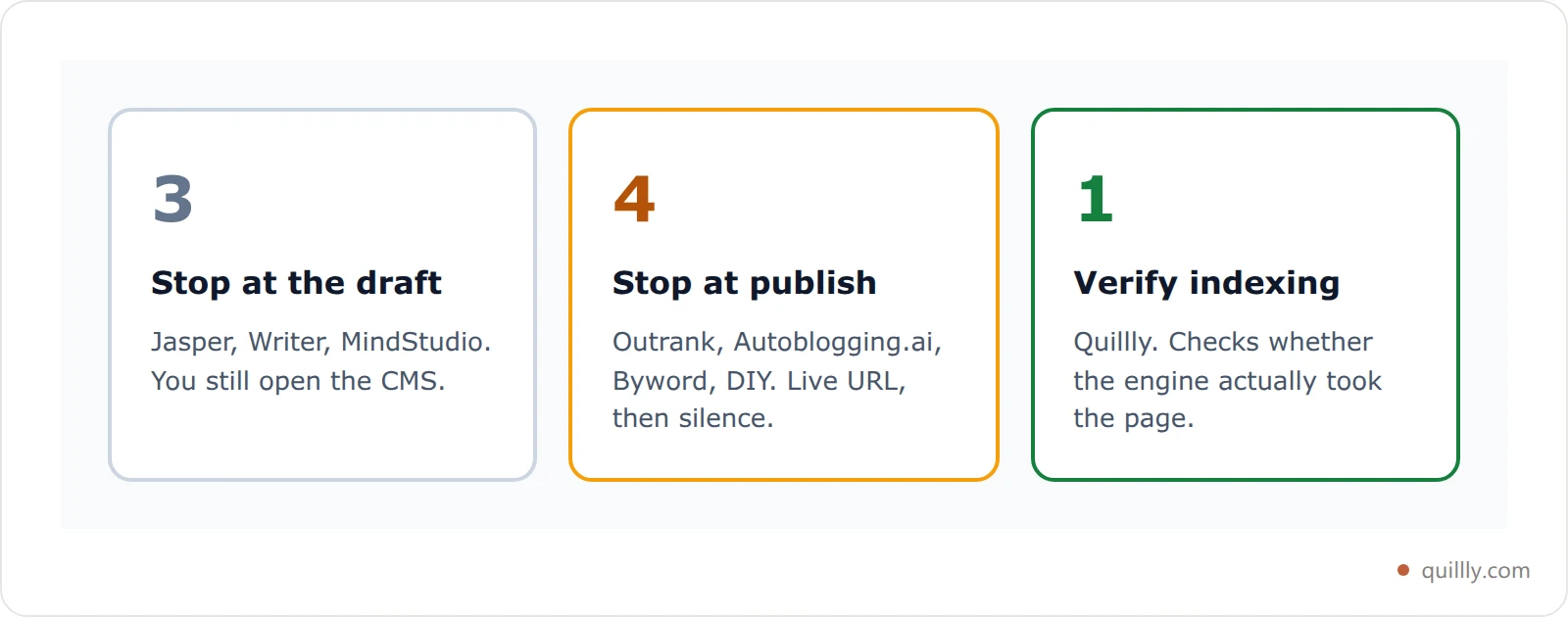
The Publish Wall: Where Six of Eight Stop#
Look at the scorecard column by column and the pattern is stark. All eight can draft. Four can publish. One verifies.
That middle drop-off is the publish wall, and it exists for a boring reason: publishing requires credentials for a system the vendor doesn't control. Drafting is a model call. Publishing is an OAuth token, a CMS schema, a slug collision, an image upload, and a rollback plan for when any of those fail.
We hit this wall ourselves before building past it: for months the last mile here was a person pasting markdown into a CMS at midnight, and the posts that got skipped were always the ones written last. The cost of the wall is easy to underestimate because it's paid in minutes, not dollars. Say the last mile takes twelve minutes per post — paste, format, fix headings, upload the image, set the meta description, publish. At four posts a week that's about 40 hours a year of work you bought an agent to avoid. The subscription that removes it pays for itself long before the drafts do — you can test the last mile on a real post before committing to any of it. If you want the full mechanics of closing that gap, we wrote them up in the end-to-end AI publishing workflow.
The Job Nobody Scores: Did It Get Indexed?#
Publishing a page does not put it in an index. This site has 142 published pages, all pushed through one pipeline to every engine. Google has indexed 76 of them. Bing has 29. Yandex has 129. Same pages, same day, three very different answers — and only one of those numbers is the one most people quote.

Published is not indexed. On this site, 91% of pages made it into Yandex, 54% into Google, and 20% into Bing — from one identical publishing pipeline, submitting every URL to every engine. Any tool whose run ends at "published" would have reported 142 successes and a 100% success rate. The real number, on the engine most people care about, is 54%.
That gap is the entire reason verify is a job and not a nice-to-have. A page Google crawled and declined sits in a bucket with a specific name and a specific set of fixes; we took 284 URLs through that diagnosis and found the verdict is usually about the site, not the page. And because engines disagree this violently, tracking more than Google changes which pages look like failures.
Google's own documentation on how Search works is blunt about this: crawling and indexing are separate stages, and there is no guarantee the second follows the first. IndexNow gets your URL in front of the participating engines faster, but it's a notification, not a promise. Something has to check.
How to Pick One for Your Stack#
Skip the feature grids and answer three questions: where your content lives, who fixes a post that doesn't rank, and how many posts you genuinely publish each month. Those three answers eliminate most of this list before price enters the conversation at all.
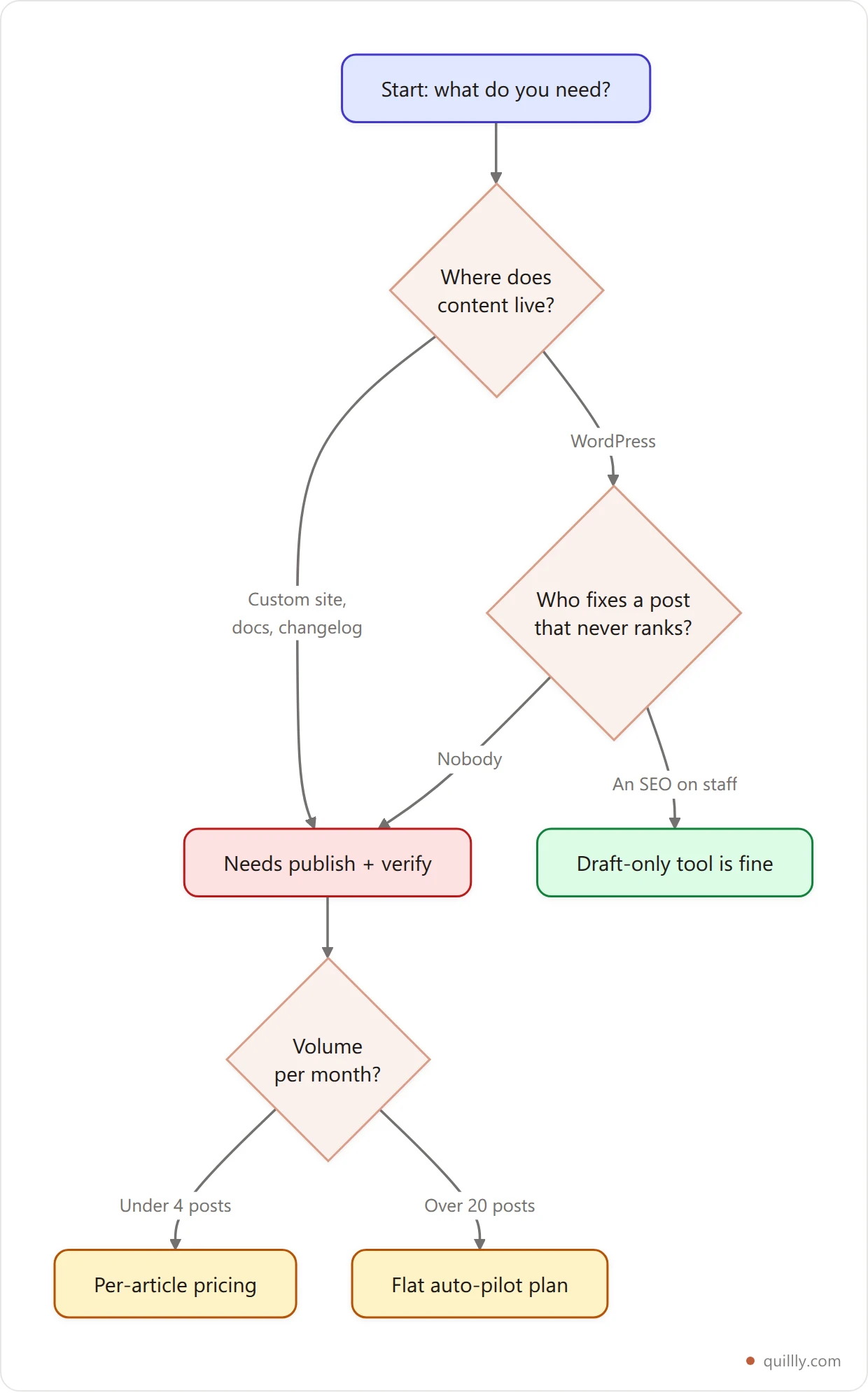
Where does your content live? If it's WordPress, the field is wide and Autoblogging.ai is the cheapest way in. If it's a custom site, a framework build, or you want docs and changelogs from the same pipeline, most of this list can't reach you at all.
Who fixes it when a post doesn't rank? If the answer is "nobody, we just publish more," you want the verify column and you should stop reading the price row. If you have an SEO on staff, a draft-only tool plus their judgement may genuinely beat an agent.
What's your actual volume? Under four posts a month, per-article pricing wins. Above twenty, the flat plans win and the deciding factor becomes whether you trust the output enough not to read it.
One warning worth repeating: every tool here can produce more pages than your domain has earned the right to publish. At low authority, the constraint is rarely drafting capacity — our own indexed share says so plainly.
See all four jobs run on your own domain
Connect Claude, ChatGPT, Cursor, Windsurf or Gemini to Quillly and watch one post go from keyword to live URL to a confirmed indexing status. 14-day trial, no card.
Start the free trialKey Takeaways#
Drafting is commodity. All eight tools do it, and none of them win on it.
The publish wall is the real divider. Four of eight put a live page on your domain with no human in a CMS.
Verification is the missing job. One tool checks whether an engine took the page — and on our own site, 54% of published pages are in Google.
Buy for the joint you're missing, not the longest feature list. A draft-only tool is fine when you already have someone to publish and check.
Volume is a risk setting, not a growth setting while your domain authority is low.
If you want that fourth column without building it yourself, connect your assistant and publish one post end to end.
Frequently Asked Questions#
What is an AI content agent?#
It's software that runs a content job from end to end — choosing the query, writing the piece, publishing it to your domain, and confirming search engines indexed it — without a person moving work between those steps. Tools that only return a draft are content generators wearing the word "agent."
Is an AI content agent different from an AI writing tool?#
Yes, and the test is simple. A writing tool waits for your next instruction; an agent takes the next step itself and notices when a step failed. Jasper writes beautifully and still needs you to publish. That's a tool, not an agent.
Can an AI content agent publish directly to my website?#
Four of the eight here can: Quillly, Outrank, Autoblogging.ai and Byword. Coverage varies enormously — Outrank supports the most third-party CMS platforms, while Quillly serves pages on your own domain through a reverse proxy or subdomain. Jasper, Writer and MindStudio require you to build that last step.
Do AI content agents get penalised by Google?#
Not for being AI-written. Google's guidance targets content produced at scale primarily to manipulate rankings, regardless of how it was made. The risk sits in the volume settings, not the model — bulk-generating hundreds of near-identical pages is the pattern that gets caught.
How much should an AI content agent cost?#
Entry pricing runs from $12/month for credit-based drafting to $99/month for managed auto-pilot, with per-seat writing platforms around $69. Work out your cost per published, indexed post rather than per generated draft — the two numbers are further apart than any pricing page admits.
What happens if a published post never gets indexed?#
Nothing, unless something checks. The page sits live, earns no impressions, and quietly counts as a success in any dashboard that stops at "published." That's why verification belongs in the pipeline: it's the only step that catches a run that technically succeeded and actually failed.