

Most "Quillly vs n8n" comparisons are really asking a simpler question: should you buy a tool that already does publishing, or wire one together yourself? These two products barely belong in the same category, and pretending otherwise is how people end up with the wrong one.
Quillly is a purpose-built AI publishing platform: your AI assistant writes, the post is scored against 14+ SEO criteria, and it goes live on your domain and out to eight search engines. n8n is a general-purpose workflow automation engine that can be assembled into a publishing pipeline if you're willing to build and maintain it. Pick Quillly to skip the plumbing; pick n8n when you need control over every step.
Here's the honest framing before the details: n8n is not a blogging tool, and Quillly is not a workflow engine. Every useful blog automation comparison has to start there, because this is a build-versus-buy decision wearing a product-comparison costume.
Quillly vs n8n at a glance#
Quillly | n8n | |
|---|---|---|
What it actually is | AI publishing platform for blogs, docs and changelogs | General workflow automation engine |
How you use it | Connect your AI over MCP, then ask it to write and publish | Build a pipeline from nodes, then maintain it |
Publishing | Built in — your domain or an included quillly.com subdomain | You build it, per CMS |
SEO scoring | Built in, 14+ criteria, enforced before publish | Not included; add your own logic |
Search engine submission | Built in, eight engines | You build it |
Setup effort | Minutes | Hours to days, then ongoing upkeep |
Pricing | From $19/month after a 14-day trial | Open-source core, self-host, or paid cloud tiers |
Best fit | Founders and small teams who want posts live | Technical teams with unusual requirements |
The rows that matter are the middle four. Everything Quillly bundles for automated blog writing is something you'd otherwise build in n8n and own forever.
What Quillly actually does#
Quillly is built around the Model Context Protocol, so instead of copy-pasting drafts out of a chat window, your AI assistant gets real publishing tools. You connect Claude, ChatGPT, or Cursor once, then ask for a post in plain language.
What's included:
Scoring before publish. Every item is graded against 14+ SEO criteria, and publishing is refused below the score floor your site sets. See how the score is calculated.
Publishing to your own domain through a reverse proxy, or to an included quillly.com subdomain.
Submission to eight engines — Google via sitemap and RSS through Search Console, and Bing, Yahoo, Yandex, Naver, Seznam, Yep and Amazon through IndexNow.
Tracking after publish — positions, impressions, clicks, and per-engine indexing coverage.
Docs and changelogs from the same pipeline, not just blog posts.
Pricing starts with a 14-day trial and no card, then $19/month (or $190/year) on the Pro plan for unlimited content you write across up to five websites. Higher Autopilot tiers add agent-written posts, more sites and research credits. Prices move, so check quillly.com for the current list rather than trusting a number in a blog post.
What n8n actually does#
n8n is a workflow automation platform — closer in spirit to Zapier or Make than to a CMS. You connect nodes into a pipeline: trigger, call an API, transform data, call another API. It's open-source, self-hostable, and genuinely excellent at what it does.
n8n blog automation is therefore something you construct rather than switch on. To publish a blog with it, you'd assemble something like: a trigger, a research step, an LLM call for the draft, a formatting step, an image step, a CMS API call, and a sitemap ping. Every one of those is a node you choose, configure, and maintain. Current plans and self-hosting options are on the n8n pricing page, and the n8n docs cover how workflows are built.
The strength is that nothing is hidden. Want a different model, a custom scoring rule, or a step that pulls from your internal database? You can build it. The cost is that you own it — including the morning a CMS API changes and your pipeline silently stops publishing.

Setup: minutes versus an afternoon#
Quillly's setup is three steps — create the account, point your domain (or take the subdomain), and paste one MCP config line into your AI client. From there, "write a post about X and publish it" is the interface. The full path is covered in publishing a blog with AI.
n8n's setup depends on how much you're building. Cloning an existing community workflow and swapping in your API keys is a short job. Building a publishing pipeline that handles images, internal links, metadata, and error states is not — and it's the second one you'll actually need.
Neither number is a criticism. A workflow engine is supposed to be assembled; that's the product.
Cost: the part that's usually stated wrong#
Compare total cost, not sticker price.
Quillly's Pro plan is $19/month or $190/year, and the content you write is unlimited across up to five websites. The Autopilot tiers cost more and add agent-written posts, additional sites and research credits.
n8n's platform cost can be zero if you self-host the open-source core — but that's not the whole bill. You still pay for LLM API calls, the server you run it on, any paid nodes, and the engineering hours to build and maintain the pipeline. For a solo founder, those hours usually dominate everything else on the list. For a team that already runs n8n for six other workflows, the marginal cost of one more is small.
That's the real dividing line: n8n gets cheaper the more you already use it, and Quillly is cheaper the less infrastructure you want to own. See what the scored-publish loop costs on your own site.
Where each one genuinely loses#
An honest comparison names its own weaknesses.
Quillly's limits. It's opinionated. You publish through its pipeline, on its scoring rules, to the engines it supports. If you need a bespoke step — a legal review queue, a translation hop, a proprietary data source — that's not what it's for. The plan also caps at five websites, so an agency running forty client sites will outgrow it.
n8n's limits. There is no SEO scoring, no indexing submission, and no publishing target until you build them. A workflow that produces fluent text but never checks whether the keyword made it into the title will happily publish weak pages at scale. And the pipeline is a permanent maintenance surface.
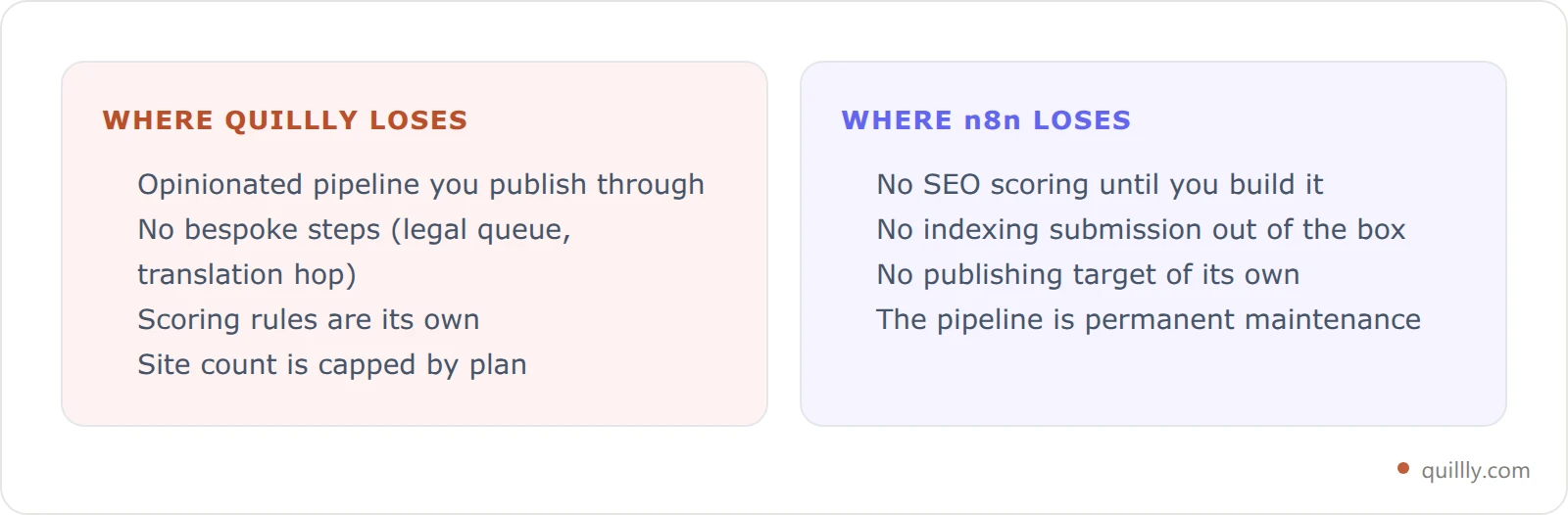
Neither of these is a flaw — they're the shape of the trade-off. Google's guidance on helpful content applies to whatever you build, and it doesn't care which tool produced the page.
Want to see the scored-before-publish loop for yourself? Connect your AI assistant and publish a post in a few minutes.
Can you use both?#
Yes, and for some teams it's the right answer. n8n is good at the things around publishing: watching a source, transforming a feed, notifying a channel, syncing a spreadsheet. Quillly is good at turning a request into a scored, published, submitted page.
A sensible split for AI content automation is to let n8n handle triggers and internal plumbing, and let Quillly own the write-score-publish-submit stretch. You get the custom logic where you need it without rebuilding a CMS and an SEO analyzer to get it.
If your goal is publishing many similar pages from structured data, that's a different job again — worth reading what programmatic SEO tools actually automate before you pick either.
How to decide in five minutes#
Answer these honestly:
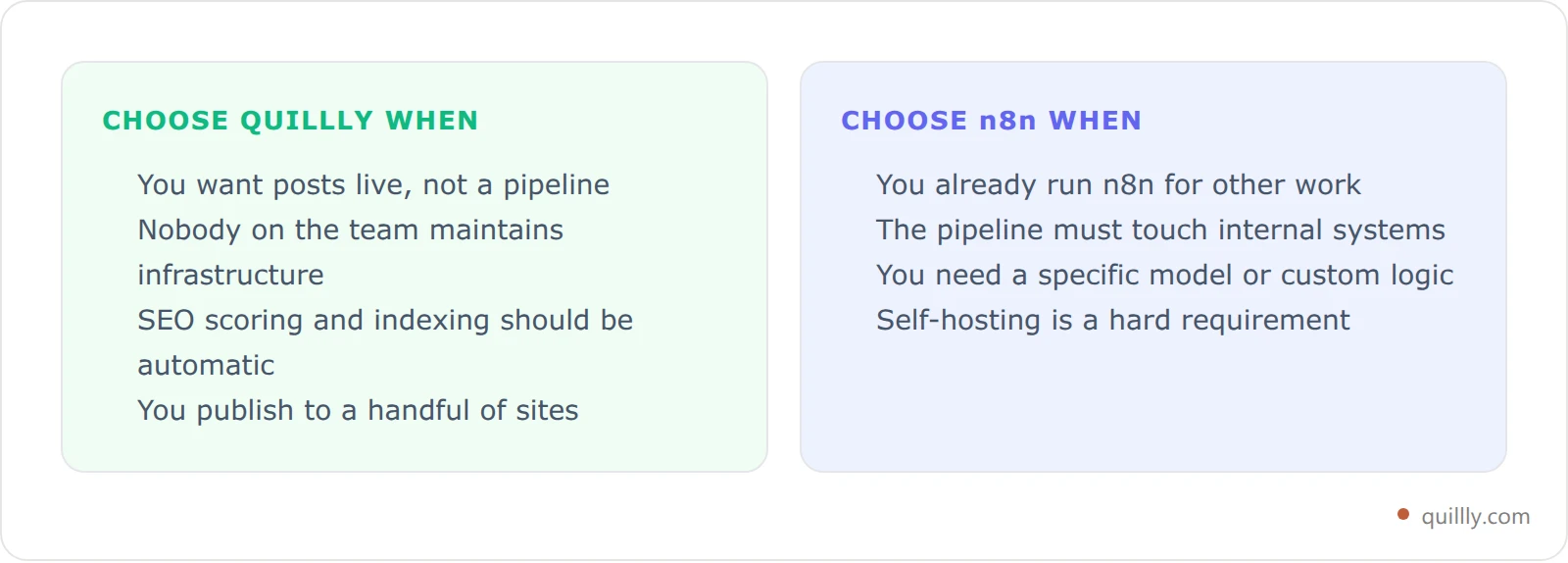
Does anyone on your team maintain infrastructure today? If no, a workflow engine will become someone's unpaid second job.
Do you need a step neither tool offers out of the box? If yes, n8n is the only one that can host it.
How many sites? Over five, Quillly's plan doesn't fit.
What breaks if publishing stops for a week? The more it matters, the less you want to own the pipeline.
Most solo founders and small marketing teams land on the bought tool, because the pipeline was never the interesting part of the job. Teams with existing automation practice and unusual requirements land on n8n. Both are defensible; drifting into one by accident is not.
Once you've picked, the format of what you publish matters as much as the tooling — seven examples of a blog post shows which shapes actually earn impressions, with real numbers attached. The wider method is in the complete guide to AI-powered blog SEO.
Frequently Asked Questions#
Is n8n free for blog automation?#
The open-source core is free to self-host, but that's the platform only. You still pay for LLM API calls, hosting, and the engineering time to build and maintain the pipeline. Paid cloud tiers are listed on n8n's own pricing page. "Free" describes the license, not the total cost.
How much does Quillly cost?#
A 14-day free trial with no card, then $19 per month (or $190 per year) on the Pro plan. That covers unlimited content you write across up to five websites, including SEO scoring, publishing to your own domain, submission to eight search engines, and analytics. Autopilot tiers cost more and add agent-written posts, more sites and research credits.
Can n8n do SEO scoring like Quillly?#
Not on its own. n8n has no built-in SEO analysis, so you'd add nodes calling a third-party API or write scoring logic yourself. Quillly's scoring runs on every save and blocks publishing below your site's floor, which is a different guarantee than a step you can forget to add.
Do I need to be technical to use either one?#
Quillly needs no engineering — connect an AI client and ask for a post. n8n expects you to understand APIs, data transformation, and error handling well enough to build and debug a pipeline. That gap is the main practical difference between them.
Which one publishes to my own domain?#
Quillly does, through a reverse proxy, or to an included quillly.com subdomain. n8n publishes wherever you build a connector for — your CMS, your static site repo, your API — but you write that step yourself.
Can I use Quillly and n8n together?#
Yes. A common split is n8n for triggers and internal plumbing, with Quillly handling the write, score, publish and submit stretch. You keep custom logic where it's needed without rebuilding a publishing platform to get it.
Key takeaways#
This is a build-versus-buy decision, not a feature race. n8n is a workflow engine; Quillly is a publishing platform.
Quillly bundles scoring, publishing, and eight-engine submission from $19/month across up to five sites. In n8n, each of those is something you build and maintain.
n8n wins on control, self-hosting, and marginal cost if you already run it. It has no SEO scoring or publishing target until you write one.
Using both is legitimate: n8n for the plumbing, Quillly for the publishing stretch.