

Search for examples of a blog post and you get a dozen roundups of beautiful pages, none of which tell you whether any of them worked. You get a screenshot, a compliment, and no numbers. So we did the opposite. Every one of the blog examples below is a real post on this site, and each comes with its actual search data — impressions, best position, and the uncomfortable parts.
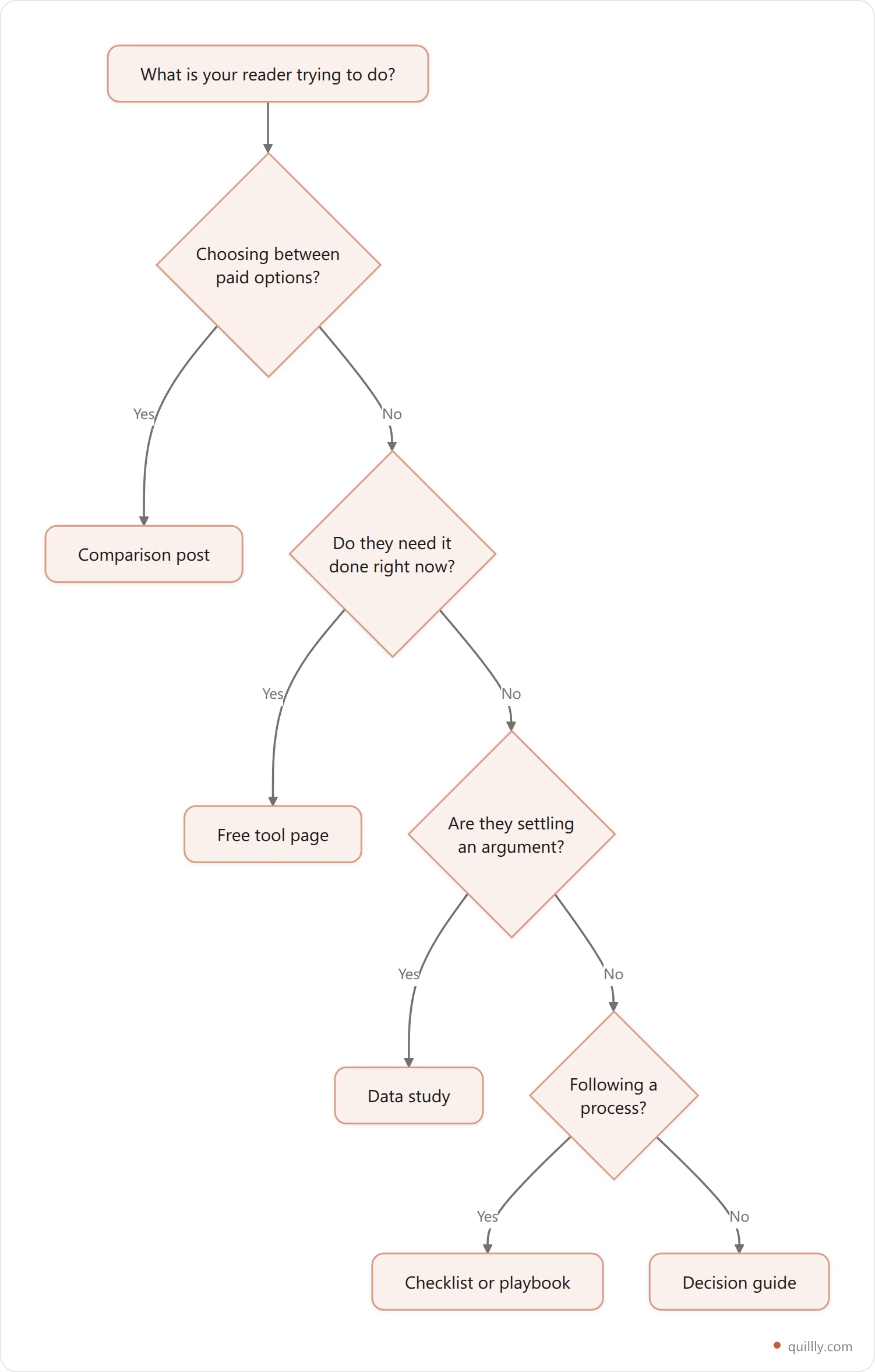
The most useful examples of a blog post are real published pages whose structure you can copy. The seven formats that actually earn search impressions are the comparison post, the data study, the checklist, the tool page, the product review, the step-by-step playbook, and the decision guide. Pick by what your reader is trying to do, not by word count.
Here's the honest headline before we start: across 90 days, this site drew 9,347 impressions and 17 clicks at an average position of 39.9. That is what a young site looks like. The formats below are ranked by what they did against that baseline, not by what a marketing blog says they should do.
7 examples of a blog post, at a glance#
Format | Reader's job | Our example | Best result |
|---|---|---|---|
Comparison / alternatives | Choose between tools | Jasper Alternatives | 421 impressions, position 2 |
Free tool page | Do the thing right now | SEO Checker | 751 impressions, position 23 |
Original data study | Settle an argument | How Long Should a Blog Post Be? | 2,226 words, SEO 93 |
Checklist | Not miss a step | Small Business SEO Checklist | 2,798 words, SEO 97 |
Product review | Decide before paying | Outrank Review 2026 | 2,863 words, SEO 97 |
Step-by-step playbook | Ship a process | Publish Blog With AI | 3,953 words, SEO 95 |
Decision guide | Answer yes or no | Should You Block AI Crawlers? | 3,422 words, SEO 93 |
Two things jump out of that table. The shortest format won the best position, and the longest posts are not the top performers. Length is an output of the format, never the goal.
1. The comparison post: our best-ranking example#
A comparison post lines up several options against one buying question and answers it. Ours is "Jasper Alternatives: 7 AI Blog Tools Ranked for 2026," and it is the single best-performing blog post on this site: 421 impressions and a best position of 2 for the query "jasper alternative."
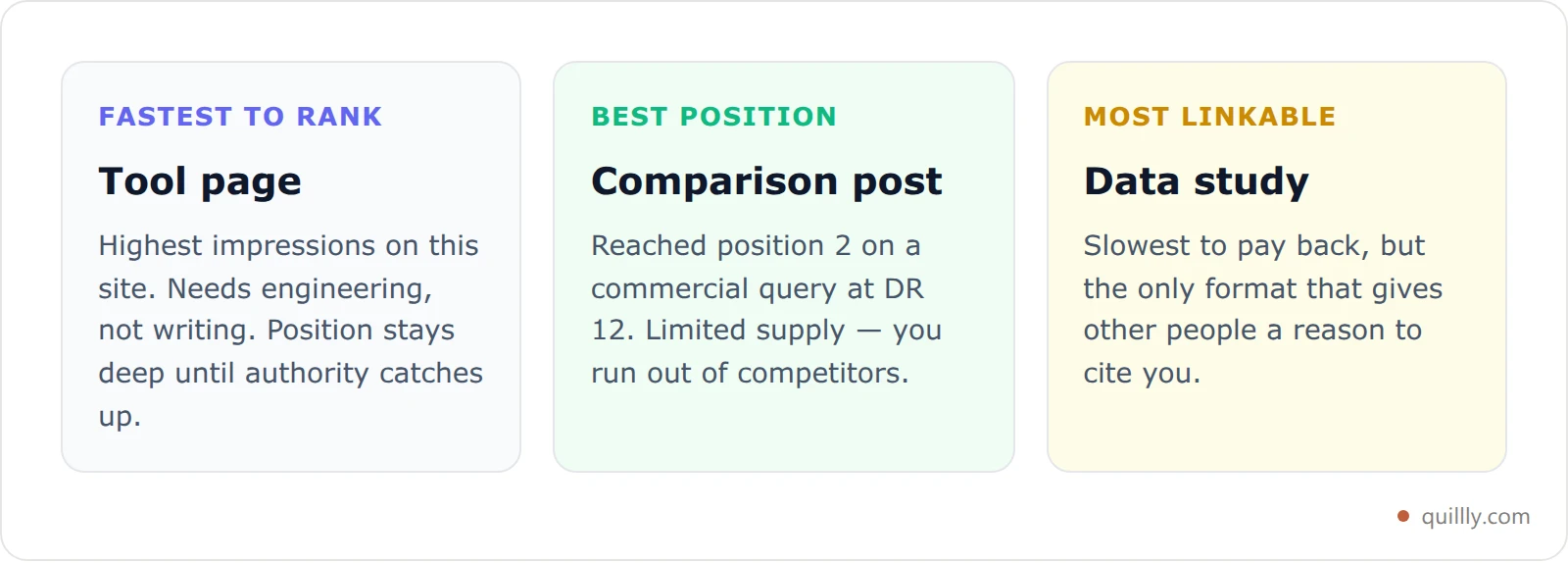
Position 2 on a commercial query, from a site with a Domain Rating of 12, is the closest thing to a cheat code in this list. It works because comparison queries are underserved by big brands — nobody wants to write honestly about their competitors, so the SERP fills with thin affiliate pages you can beat with real detail.
What makes the format work:
Lead with the table. Readers comparing tools want the grid, not your introduction. Put it above the first heading.
Publish the prices. Most comparison posts hide pricing behind "contact us." Naming real numbers is the differentiator.
Include yourself honestly, or not at all. If you're on the list, say so plainly and give a competitor the win where they deserve it.
Answer the buying question in the title. "7 Tools With Public Pricing" tells the reader what they get.
The catch: this format has a floor. There are only so many competitors to compare, and a library made entirely of alternatives posts ranks for exactly one kind of query. We learned that the expensive way — see how the alternatives page format actually earns citations for where the vein runs out.

2. The original data study#
A data study answers a question everyone asks with numbers nobody else has. You do not need a research budget — you need your own logs.
Our example is How Long Should a Blog Post Be? A 66-Post Test, which paired word count against Google index status across 66 of our own posts. The finding was deliberately unflattering: indexed posts averaged 3,158 words and unindexed ones 2,881 — a gap of under 10%, and confounded by age. The longest post on the site was not indexed. Several 500-word docs pages were.
The rule for this format: publish the result that argues against you. A study that concludes "and that's why our product is great" reads as marketing. One that says "we expected a strong effect and found almost nothing" is the reason people link to you.
Sources of data you already own:
Your Search Console export (queries, positions, impressions)
Your own publishing history — dates, lengths, formats
Anything you measured while building the product
Google's guidance on creating helpful content is explicit that first-hand expertise is what separates useful pages from summaries. Original data is the cheapest proof of it.
3. The checklist post#
The checklist is the most-copied format on the internet because it matches how people actually work: they want to not miss something. Our small business SEO checklist runs 2,798 words across 12 steps and scored 97 on our own SEO analyzer.
The format only works if each item is genuinely actionable. "Optimize your titles" is not a checklist item; "rewrite any title over 60 characters so the keyword sits in the first five words" is. Write each line so a reader can tell whether they've done it.
4. The free tool page: the format that beat every blog post#
This is the finding that surprised us most, and it is why the table above is not all prose. The three highest-impression pages on this entire site are not blog posts at all — they're small utility pages: an SEO checker (751 impressions), a word counter (584 impressions, position 9), and a color picker (507 impressions).
The word counter alone out-earns every article we've written except one, and it ranks on page one.
But read the second number carefully. The SEO checker's 751 impressions converted to zero clicks, because its best position was 23 — page three. Impressions without position are just proof that Google knows you exist. That is the honest limit of this format at low authority: tool pages get you seen far earlier than articles do, and seen is not the same as visited.
If you build one, keep it genuinely free and genuinely instant. A tool that demands an email before it counts words will not earn the query.
5. The review, the playbook, and the decision guide#
Three formats worth having in rotation, each matched to a different question:
The product review answers "should I pay for this?" Our Outrank review is 2,863 words and scored 97, and its angle was a number the vendor doesn't publish: cost per indexed article rather than per published article. Reviews earn trust when they compute something the pricing page won't.
The step-by-step playbook answers "how do I actually ship this?" Publish Blog With AI is the longest at 3,953 words, because a real workflow has real steps. Playbooks are allowed to be long; padding is not the same as completeness.
The decision guide answers a yes-or-no question honestly. Should You Block AI Crawlers? is 3,422 words and, crucially, does not force an answer — it gives the reader the conditions under which each choice is right.

The green bar is the best-performing post on this site. Three longer formats sit to the right of it, which is the whole argument against writing to a word count.
Ready to publish one of these on your own domain? Connect your AI assistant to Quillly and your next draft is scored before it ships.
How to pick the format for your next post#
Work backwards from the query, not from a content calendar:
Read the SERP first. If the top ten are listicles, a 4,000-word essay will not break in. Match the format Google is already rewarding.
Check who holds the weakest seat. A page-one result from a small site means the query is winnable. A top ten of household names means it is not, whatever the difficulty score says.
Pick the format you can make evidence for. A data study with no data is just an opinion post with charts.
Only then decide length. Our best-performing post is 2,226 words; our longest is 4,114. Length followed the format both times.
That order matters more than any template, and it is why the examples of a blog post that work for us would not all work for you — the SERP decides the shape, not your preferences. How often you publish should be capped by how fast your pages actually get indexed — and picking a format the SERP doesn't reward is the fastest way to add a page that never gets crawled twice.
What none of these examples fixed#
Here is the part the other roundups leave out. Format selection is real, but it is not the constraint at low authority — indexing is.
Of 134 published pages on this site, Google has indexed 76 (57%), Bing 28 (21%), and Yandex 109 (81%). More than four in ten pages are invisible on Google no matter how well the format was chosen. Across the same 90 days, Bing sent this site an average position of 4.2 while Google's average was 39.7 — the same posts, the same formats, a tenfold difference in where they land.
So the ranking above is genuine but conditional. A great comparison post on an unindexed URL earns nothing. If your pages aren't showing up at all, format is the wrong problem to solve first — start with getting indexed, then come back and pick a shape.
Every post on this site is scored against 14+ SEO criteria before it goes live, and published to eight search engines. See how the scoring works if you want the rubric behind the numbers in this post.
Key takeaways#
If you remember four things from these blog examples, make it these:
The SERP picks the format. Read the top ten before you outline anything.
Tool pages get seen first; comparison posts rank best. Impressions and position are different problems.
Original data is the only thing a competitor cannot copy. Use your own logs.
Indexing beats format. With 57% of our pages in Google's index, the best-shaped post on an uncrawled URL still earns nothing.
Frequently Asked Questions#
What are the best examples of a blog post?#
The best examples of a blog post are real published articles whose structure you can reuse, shown with evidence — a comparison post that reached position 2, or a data study that changed someone's mind. Whether you search for a blog entry example or a full template, screenshots of pretty layouts teach you design, not what earns search traffic.
How long should a blog post example be?#
Long enough to fully answer the query and no longer. On this site the best-performing post is 2,226 words while the longest is 4,114, and length tracked the format rather than the result. Most formats land between 1,500 and 2,500 words.
Which blog post format ranks fastest?#
Small free tool pages earned the most impressions here — 751, 584 and 507 across three utilities — but sat at positions 9 to 30. Comparison posts reached the best position (2) on commercial queries. Fastest visibility and best position are not the same format.
Do I need original data to write a good blog post?#
No, but it is the strongest differentiator available to a small site. You already own publishable data: your Search Console queries, your publishing history, and anything you measured building your product. A study using your own numbers is something no competitor can copy.
How many blog post formats should I use?#
Rotate at least three or four. A library built entirely from one shape ranks for one kind of query, and we published nine near-identical alternatives posts before noticing most of them never got indexed. Variety is an indexing strategy, not a style preference.
Where should I publish my blog post examples?#
On your own domain, so the authority accrues to you. Quillly publishes to your domain through a reverse proxy or an included quillly.com subdomain, on a plan covering up to five websites with unlimited content at $9/month after a 14-day trial. Start your free trial and publish your first post today.


