Most small business SEO checklists are written by agencies whose own domain has been collecting links since 2009. They tell you to "earn authoritative backlinks" and "publish consistently," then move on. That advice assumes an asset you don't have yet, and it's why month three arrives with nothing to show.
Here's the short version: at zero authority, the steps that pay back first are the ones that make you findable and specific — indexing, one clear page per service, and long-tail queries the big sites ignore. Link building and volume publishing pay back last. Order the checklist by payback, not by category, and you'll see movement in weeks instead of quarters.
We run this site at Ahrefs DR 18, and every number below comes from its live search data over the 90 days ending 11 September 2026. Some of it is unflattering. All of it is real.
What's on this page
The Small Business SEO Checklist at a Glance#
Work top to bottom. Each block only makes sense once the one above it is done.
# | Step | When | Payback |
|---|---|---|---|
1 | Claim your Google Business Profile | Day 1 | Fast |
2 | Verify in Google Search Console and Bing Webmaster Tools | Day 1 | Fast |
3 | Submit a real sitemap | Day 1 | Fast |
4 | Fix titles and meta descriptions on money pages | Week 1 | Fast |
5 | Give every service its own page | Week 2 | Fast |
6 | Add LocalBusiness structured data | Week 2 | Medium |
7 | Target long-tail queries with a real buyer behind them | Weeks 2–4 | Fast |
8 | Get listed consistently in the directories that matter | Month 2 | Medium |
9 | Publish only as fast as you get indexed | Month 2+ | Medium |
10 | Interlink every new page from an indexed one | Month 2+ | Fast |
11 | Track indexed share, not just rankings | Month 2+ | — |
12 | Check Bing separately from Google | Month 2+ | Fast |
The order matters more than the list. Nine of these twelve appear on every small business SEO checklist in the search results. The sequencing, and steps 9 through 12, are where most small businesses lose a year.
Why Agency Checklists Don't Work at Zero Authority#
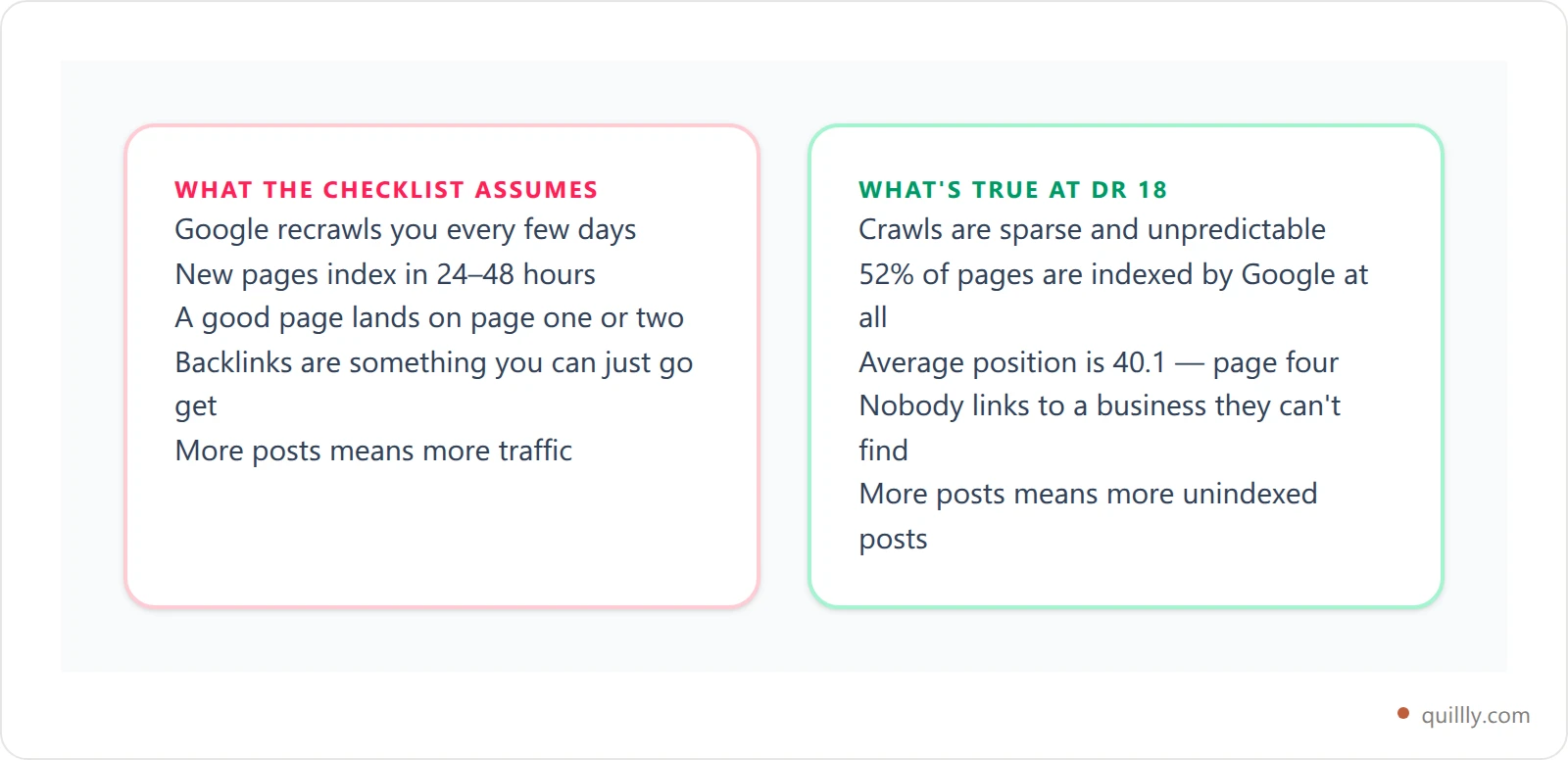
Most small business SEO checklists fail because they were written from a strong domain. They assume Google crawls you often, that a new page indexes within a day or two, and that a decent page lands somewhere findable. None of that holds on a new site, so the advice arrives in the wrong order.
A checklist written from authority takes crawling for granted. Yours can't.
On our own site, 146 published pages have produced 6,353 impressions and 18 clicks over 90 days — a 0.28% click-through rate at an average position of 40.1. Position 40 is page four. Nobody goes to page four.
That's not a content-quality problem. It's an authority problem, and no amount of extra publishing fixes it. What does move is picking queries where page one isn't already owned, and making sure the pages you have actually get into the index.
Steps 1-4: Get Findable Before You Get Fancy#
Day one is plumbing, and it's the highest-payback work you will ever do.
Claim your Google Business Profile. If you do only one thing on this local SEO checklist, do this one. For anything with a service area or a front door, it's the single fastest source of real customers. It ranks in the map pack, which sits above the organic results you're fighting for. Fill in hours, categories, service areas and photos completely — Google's own guidance is worth reading once, properly.
Verify with both engines. Google Search Console and Bing Webmaster Tools are free and take ten minutes each. You cannot fix what you cannot see, and as you'll see below, Bing is not a footnote.
Submit a real sitemap. Not a homepage link — an actual XML sitemap listing every page you want found. Then check back in a week to see how many got indexed.
Fix your titles. Every money page needs a title tag under 60 characters that names what you sell and where. "Home" and "Services" are not titles. This is the cheapest ranking change available, and most small business sites still get it wrong. Our on-page SEO audit walkthrough covers the rest of the on-page pass.
If you're starting from nothing, the broader SEO checklist for new websites covers the launch-day technical setup in more depth than this piece does.
Steps 5-7: Target Queries the Big Sites Skip#
Here's where small businesses hand away their advantage. They write one "Services" page listing eight things, then wonder why they rank for none of them.
One page per service. A page about gutter cleaning can rank for gutter cleaning. A page about eight services ranks for nothing. Split them, and give each one enough substance to answer the question a buyer actually has.
Add LocalBusiness structured data. The schema.org LocalBusiness markup tells engines your address, hours, and service area in a format they don't have to guess at. It won't rank you on its own, but it makes you eligible for result types that a plain page isn't.
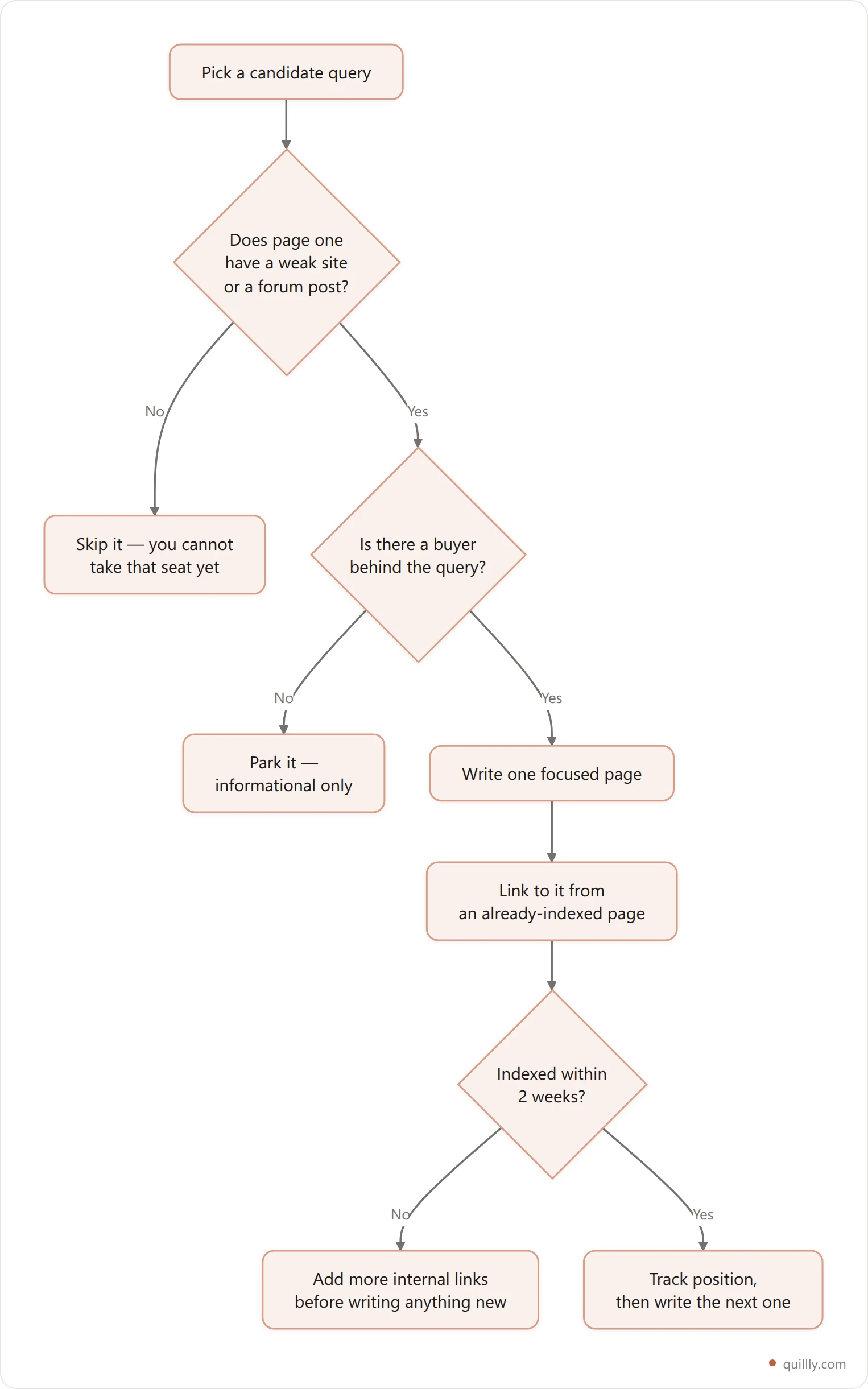
Chase specificity, not volume. "Plumber" is unwinnable. "Emergency water heater repair in [your suburb]" has a buyer behind it, far less competition, and converts better. The rule at low authority: if page one is all national brands, skip it. If page one has a forum post, a Quora thread, or a site you've never heard of on it, that's your opening.
That last signal is the whole game. When Google surfaces user-generated results for a query, it's telling you it doesn't have a definitive answer yet — and a real page can take that seat regardless of who else is ranking.
Start publishing on your own domain — Quillly scores every page against 14+ SEO criteria before it goes live, so you find the thin ones before an engine does.
Bing Ranks a New Site 9x Higher Than Google#
This is the step no other small business checklist will give you, and it's the one that surprised us most.
Over the same 90 days, on the same 146 pages:
Engine | Impressions | Clicks | CTR | Average position |
|---|---|---|---|---|
5,590 | 13 | 0.23% | 39.9 | |
Bing | 695 | 5 | 0.72% | 4.4 |
Yandex | 68 | 0 | 0% | 7.3 |
Google puts this site at position 39.9. Bing puts the same pages at 4.4 — page one, above the fold. Bing's click-through rate is more than three times Google's.
The reason is straightforward: Google weighs domain authority heavily and is slow to trust a new site. Bing is measurably more willing to rank a relevant page from a domain it doesn't know yet. For a small business in year one, that's not a curiosity — it's your first real search traffic, months before Google comes around.

The practical move: submit to both, and judge your early progress on Bing numbers rather than Google ones. Google is the bigger prize and the slower one. We go deeper on this in multi-engine SEO beyond Google.
Push every new page to all eight engines at once — one publish, no manual submission per engine.
It's worth knowing how submission actually works, because the two engines differ. Google finds new pages through your sitemap and RSS feed via Search Console. Bing, Yahoo, Yandex, Naver, Seznam, Yep and Amazon are reachable through IndexNow, a single push that notifies the whole network at once. Google does not participate in IndexNow — so a tool claiming to "instantly submit to Google" via IndexNow is describing something that doesn't exist.
Steps 8-10: Publish Only as Fast as You Get Indexed#
The most damaging advice in small business SEO is "post consistently." Consistency is worthless if the posts never enter the index.
Our indexed share, live: 146 published pages, 139 indexed on at least one engine. Split by engine, Google has 76 of them (52%), Yandex 136 (93%), and Bing just 32 (22%). Nearly half the library is invisible to Google — and every new page competes with those for the same limited crawl budget.

So cap your publishing rate at your indexing rate. If four of your last five pages made it into the index within two weeks, write the next one. If one of five made it, stop writing and go fix indexing instead — that means internal links, better titles, and cutting the thin pages that dilute the rest.
Interlinking is the lever. A new page with no inbound internal links is a page engines have little reason to crawl. Every time you publish, add two or three links to it from pages that are already indexed — not from your other new pages, which are just as invisible. If you're unsure which of your pages are actually indexed, check the engine's own report rather than assuming.
We wrote up the full method in how often you should blog and the recovery steps in getting indexed on Google fast.
Steps 11-12: Measure the Two Numbers That Matter#
Rankings are a vanity metric in year one, because ranking 41st and ranking 78th feel identical: zero traffic. Track these instead.
Indexed share. What percentage of your pages does each engine actually hold? Below 70%, adding pages makes things worse, not better. This is the number that tells you whether to write or to repair.
Position distribution, not average position. Our average position is a dismal 40.1. But the distribution shows 30 keywords in the top 3 and 27 more in the top 10 — against 1 and 1 in the previous 90-day window. The average is dragged down by a long tail of page-five rankings; the distribution shows real progress underneath it. If you only watched the average, you'd conclude nothing was working.
That's the difference between a number that describes you and a number that tells you what to do next.
What to Skip in Your First Year#
Skip five things in year one: buying backlinks, blogging off-topic, chasing head terms, tool sprawl, and rewriting pages that were never indexed. Every hour spent on them is an hour not spent on steps 1-12, and none of them move a site engines can't reliably find yet.
Buying backlinks. At best wasted money, at worst a manual penalty. Links follow from being findable, not the other way around.
Blogging about anything unrelated to what you sell. Traffic that never buys costs you crawl budget and gains you nothing.
Chasing head terms. If page one is Yelp, Angi and three national chains, you're not taking that seat this year.
Tool sprawl. A rank tracker you check daily changes nothing. Search Console and Bing Webmaster Tools are free and sufficient.
Rewriting pages that were never indexed. You're polishing something no engine has read. Fix indexing first.
Authority does eventually matter — how to increase domain rating covers that when you're ready. It's a year-two project, not a year-one one.
Stop guessing which pages are invisible
Quillly publishes to your own domain, scores every page against 14+ SEO criteria before it goes live, and tracks indexing and rankings per engine — so you can see your indexed share before you write the next post. 14-day free trial, no card. Then $19/month for unlimited content across up to 5 websites.
Start free for 14 daysFrequently Asked Questions#
How long does small business SEO take to work?#
Expect three to six months before Google sends meaningful traffic, and often sooner on Bing. Getting indexed comes first and takes days to weeks on a new domain; ranking follows after that. Local map-pack visibility from a Google Business Profile can arrive within days of claiming it.
Do I need to hire an SEO agency?#
Not for steps 1 through 7. Those are a weekend of focused work and they're where most of the early payback is. Consider help once you have pages indexed and ranking, and the constraint becomes authority rather than setup.
Is Bing SEO actually worth the effort for a small business?#
Yes, and it costs almost nothing extra. Our pages average position 4.4 on Bing versus 39.9 on Google. Bing also feeds Yahoo, so one verification covers both. For a new domain, it's usually your first real search traffic.
How many pages does a small business website need?#
One per service you actually sell, plus a location page if you serve a defined area, plus an about and contact page. Depth beats breadth — five pages that fully answer a buyer's question outperform twenty thin ones, and thin pages actively hurt your indexed share.
What's the most common small business SEO mistake?#
Publishing more content while existing pages sit unindexed. It feels productive and it makes the underlying problem worse. Check your indexed share before you write anything new. Our complete guide to blog SEO walks through the diagnosis.
Does structured data help small businesses rank?#
Not directly. LocalBusiness markup doesn't boost position, but it makes you eligible for richer result formats and removes ambiguity about your hours, location and service area — which matters more for local queries than for general ones.
Key Takeaways#
Order the checklist by payback: get findable first, get specific second, chase authority last.
One page per service beats one page listing every service.
Bing ranks a new domain far higher than Google — check it separately, from day one.
Cap your publishing rate at your indexing rate. Below 70% indexed, repair before you write.
Track indexed share and position distribution, not average position.
SEO for small business owners at zero authority isn't the same discipline agencies write about. Getting findable beats getting clever. One specific page beats five general ones. Bing pays out before Google does. And publishing faster than you get indexed is the most common way to spend a year going backwards.
Work the twelve steps in order. Check your indexed share before you write. And measure distribution, not averages — because the average will tell you you're failing right up until the moment you aren't.