


Automated requests now make up 57.5% of all HTML web traffic, and Cloudflare's Matthew Prince reported that number in June 2026 with a warning: most of it is AI crawlers taking content and sending almost nothing back. So the instinct to block AI crawlers makes sense. Then a founder blocks "OpenAI" in one line, and three weeks later their brand stops showing up in ChatGPT answers entirely. They didn't mean to do that. They fired one shotgun blast at a fleet of very different bots.
That's the trap. "AI crawler" isn't one thing. Under that label sit training bots that feed future models, search bots that decide whether you show up in AI answers, and user-triggered fetchers that are literally a reader clicking a citation. Block the wrong bucket and you don't protect your content, you just delete yourself from the fastest-growing referral channel on the web.
Should you block AI crawlers? Block training crawlers if you want to keep your content out of model training, but never block the search and user-triggered bots, because those are the ones that put you in ChatGPT, Perplexity, and Google AI answers and send real readers back. The decision is per-bucket, not all-or-nothing.
This guide gives you the framework, the exact bot names, the trade-offs with real 2026 numbers, and a copy-paste robots.txt you can ship today.
Why "block AI crawlers" is the wrong question#
The takeaway: there's no single "AI crawler" switch, so a yes/no answer is always wrong. Every major AI company runs a fleet of bots, each with a different job and a different consequence when you block it.
Ask "should I block AI crawlers?" and you've already lost, because the honest answer is "which ones, and what are you trying to protect?" Blocking OpenAI's training bot (GPTBot) keeps your words out of the next model. Blocking OpenAI's search bot (OAI-SearchBot) removes you from ChatGPT's live search results. Blocking OpenAI's user fetcher (ChatGPT-User) kills the visit that happens when a real person asks ChatGPT about you. Same company, three switches, three completely different outcomes.
So reframe it. The right question is: can this specific bot send me a reader or a citation? If yes, allowing it is free visibility. If no, blocking it is a defensible content-protection choice with near-zero traffic cost. That one question sorts every bot on the internet into a keep pile and a your-call pile.
The Four-Bucket Robots Policy#
The takeaway: sort every bot into one of four buckets by what it does with your page, then apply one rule per bucket. This is the whole framework, and it maps to how AI-visibility tools already label your traffic.
Here are the four buckets and the single question that assigns each bot: does it send a reader or a citation back to you?
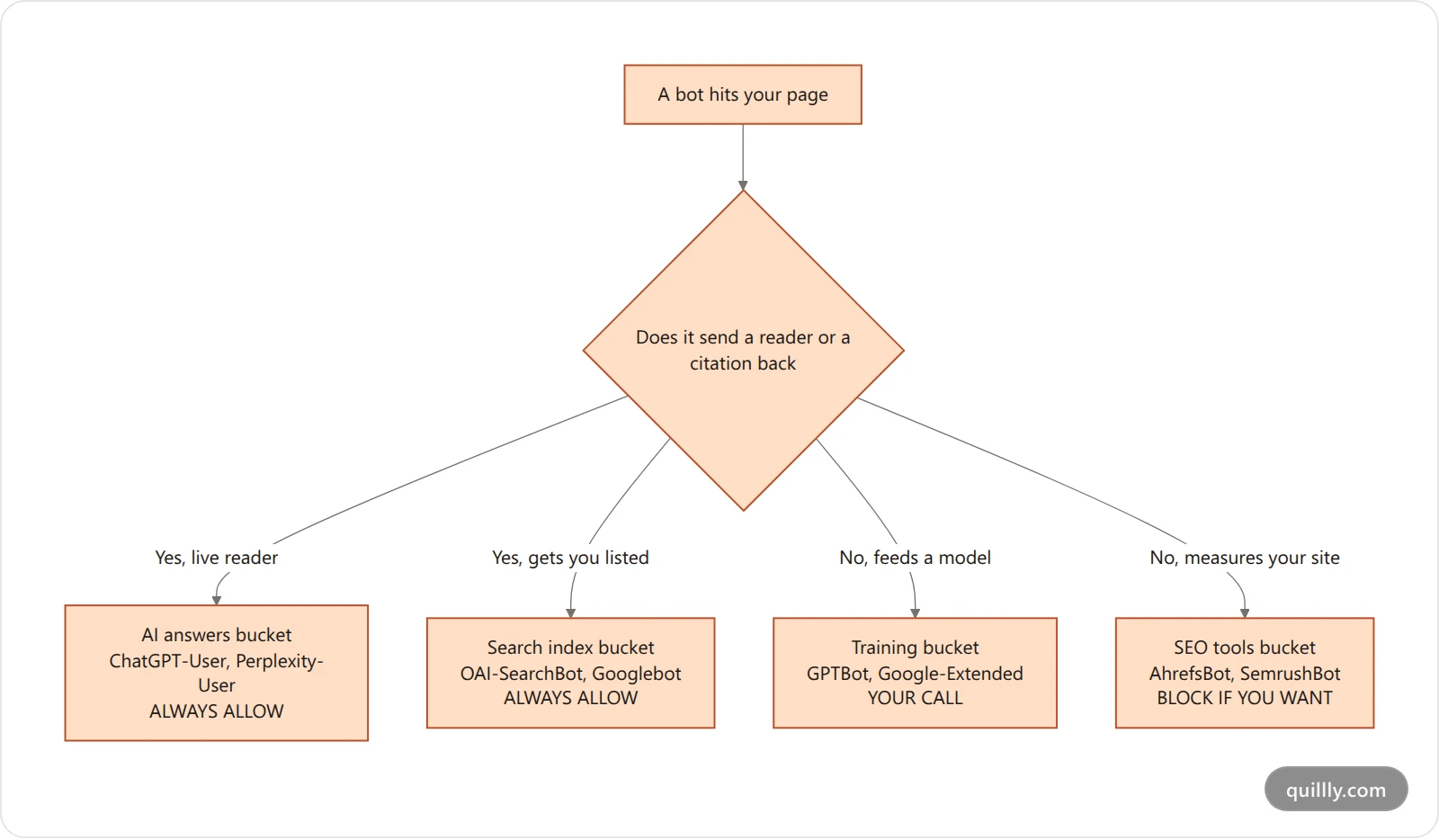
Two buckets are non-negotiable allows because they are your visibility. Two buckets are genuinely your choice because they send you nothing either way. Here's the same logic as a table you can keep next to your robots.txt:
Bucket | Example bots | Sends you traffic or citations? | Verdict |
|---|---|---|---|
AI answers (user-triggered) | ChatGPT-User, Claude-User, Perplexity-User | Yes — a real person clicked | Always allow |
Search indexes | OAI-SearchBot, PerplexityBot, Googlebot, Bingbot | Yes — makes you eligible to surface | Always allow |
Training crawlers | GPTBot, Google-Extended, ClaudeBot, CCBot | No — feeds future models | Your call |
SEO tools | AhrefsBot, SemrushBot, MJ12bot | No — someone is auditing the site | Block to save load |
The reason this framework holds up: it's not a hot take, it's how crawler-analytics tools already bucket real traffic. Quillly's bot-traffic dashboard labels every AI hit as AI answers, Search indexes, Training, or SEO tools using the same logic — because you can't make a good blocking decision until you can see, per bucket, who is actually hitting your site.
Bucket 1 and 2: never block your own visibility#
The takeaway: the search and user-triggered bots are the entire mechanism by which AI puts you in front of people. Blocking them is self-sabotage, and it's the single most common accidental mistake in 2026.
When someone asks ChatGPT "what's the best MCP tool for publishing blogs," two things can put you in that answer. First, OAI-SearchBot has to have indexed your page so the model can retrieve it. Second, ChatGPT-User fetches your page live to quote it and drops in a citation link. Both are your friends. OpenAI's own bot documentation confirms that opting out of OAI-SearchBot means your site "will not be shown in ChatGPT search" at all.
Perplexity works the same way: PerplexityBot builds the index, Perplexity-User fetches on demand for a cited answer. Anthropic splits Claude-SearchBot (index) and Claude-User (live fetch), both documented in Anthropic's crawler support article. Block any of these and you don't "protect" anything worth protecting — you erase yourself from that engine's answers while your competitor stays quotable.
This is exactly where teams shoot themselves. SEO consultant Aleyda Solís put it plainly on the Humans of Martech podcast in January 2026: "You need to allow AI crawlers to access your content. The rules you set might need to be different depending on your context." Her recurring warning is that CDN rules, WAF settings, and inherited robots.txt files quietly block newer user agents while letting Googlebot through — so the block is invisible until your AI referrals flatline. If you want the offensive side of this, our guides on getting cited by Claude, getting cited in Google AI Mode, and the full AI crawler optimization playbook all assume these bots can reach you in the first place.
Bucket 3: training crawlers are the only real decision#
The takeaway: training bots (GPTBot, Google-Extended, CCBot, ClaudeBot) are the only bucket where blocking is a legitimate strategic choice, because they send zero traffic whether you allow them or not.
A training crawler collects your content to improve a future model. It will never send you a reader and never leave a citation. So the trade-off is pure: allow it and your content helps shape what models "know" about your topic (and, some argue, your brand); block it and you keep your words out of the training set. Google confirms Google-Extended is training-only and has no effect on Google Search rankings or indexing — a critical point, because founders panic that blocking AI bots will tank their SEO. It won't. Googlebot and Google-Extended are different bots with different jobs.
The catch is that "influence" is soft and hard to measure, while the downside of blocking is close to zero. That's why most site owners who think it through allow training bots by default and only block when they have a specific reason: a paywall, licensed content, proprietary research, or a legal/brand-safety posture. Here's the decision by what you're actually optimizing for:
Your priority | Training crawlers | Search + user bots |
|---|---|---|
Maximum AI visibility | Allow | Allow |
Protect premium/licensed content | Block | Allow (still get cited) |
Pure content control | Block | Your call |
"Don't tank my Google rankings" | Doesn't matter — no ranking impact | Allow |
Notice the middle row: you can block GPTBot from training on your content and still be fully citable in ChatGPT, because search and user bots are separate. You don't have to choose between "protect my content" and "be visible in AI." That's the whole point of bucketing.
Seeing your own numbers turns this from a theory into a five-minute call. Check which crawlers are actually hitting your site, bucketed automatically.
The economics: why blocking feels tempting#
The takeaway: the crawl-to-refer ratio explains the frustration. Training bots crawl thousands of times per referral they send, and in 2026 that imbalance got extreme enough that Cloudflare changed the default for 20% of the web.
Cloudflare popularized the "crawl-to-refer ratio" — how many times a company's bots hit your site for every visitor they send back. The numbers are lopsided and they keep getting worse.
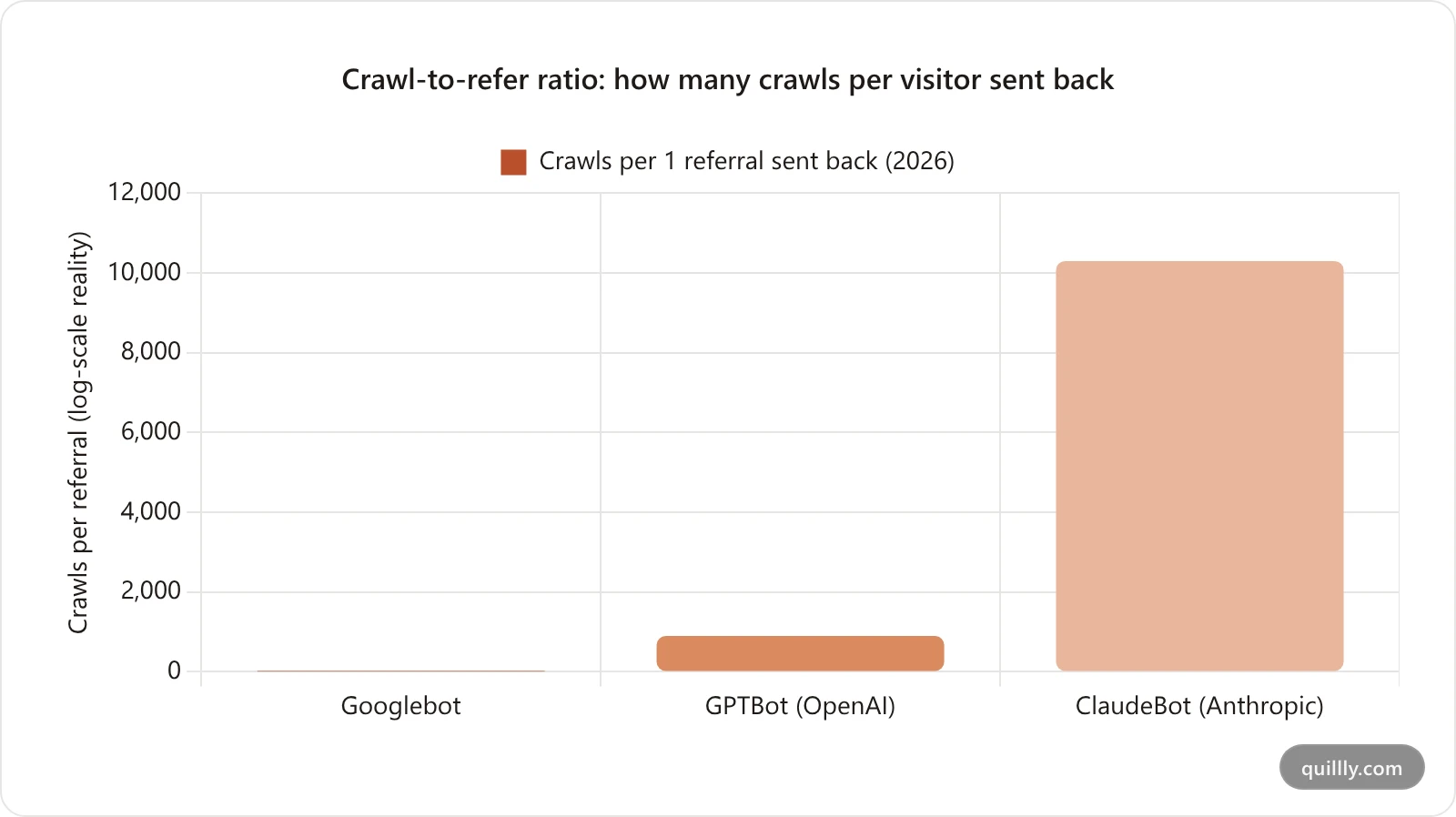
Those training-bot ratios are why blocking feels justified — you're paying bandwidth to feed a model that returns nothing. In July 2025 Cloudflare began blocking AI crawlers by default for new sites and launched pay-per-crawl, a mechanism that lets you charge bots for access instead of just refusing them. Cloudflare's own managed robots.txt and pay-per-crawl documentation frames it as consent and compensation, not a blanket ban.
But read the ratio table again next to the buckets. The brutal ratios belong to training bots. The search and user bots — the ones that actually send referrals — are the good side of the ledger. Pay-per-crawl and default blocking are aimed at bucket 3, and they're only a win if your monetization setup doesn't also wall off buckets 1 and 2. Which, by default, they sometimes do.
The costly mistake: blocking a vendor instead of a bucket#
The takeaway: the number-one AI-crawler error in 2026 is blocking a company's whole fleet with a broad rule, killing the citation bots along with the training bot you actually wanted to stop.
Picture the fleet. OpenAI alone runs at least three bots with three jobs. Block "OpenAI" the lazy way — a firewall rule on the org, or User-agent: GPTBot copied from a blog post that also happened to match a wildcard — and you can take out all three.
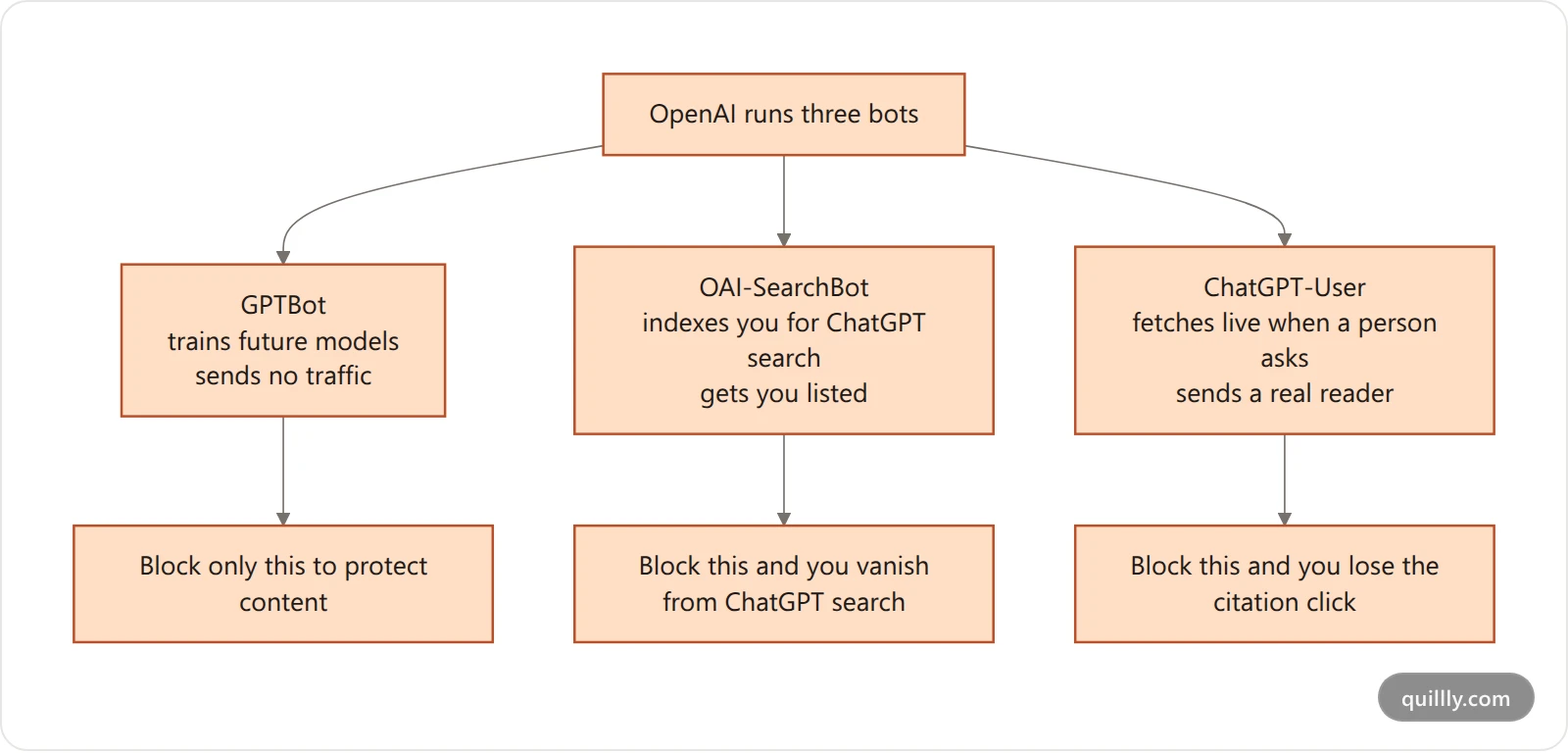
Every major vendor splits its fleet the same way. Keep this reference next to your robots.txt so you never block a citation bot by accident:
Vendor | Training bot (your call) | Search/index bot (allow) | User fetcher (allow) |
|---|---|---|---|
OpenAI | GPTBot | OAI-SearchBot | ChatGPT-User |
Anthropic | ClaudeBot | Claude-SearchBot | Claude-User |
Perplexity | — | PerplexityBot | Perplexity-User |
Google-Extended | Googlebot | Google-NotebookLM | |
Common Crawl | CCBot | — | — |
The fix is surgical robots.txt: name the training bot you want to stop, and leave the search and user bots explicitly allowed. This is also why serving AI crawlers a clean Markdown version of every page matters — once you've allowed the right bots, you want them to read the cleanest possible copy, not a JavaScript-heavy render they'll parse badly.
Want to know if you've already made this mistake? The tell is impressions holding steady in Google Search Console while your AI referral traffic sits at zero. Check which bots are actually reaching your pages before you touch a single rule. See your live crawler breakdown by bucket in Quillly.
How much is everyone actually blocking?#
The takeaway: blocking is real but far from universal, and it's concentrated on training bots — which tells you the market has quietly settled on roughly the bucket logic in this guide.
Across large-scale robots.txt analysis of Cloudflare's network, GPTBot is the most-blocked AI crawler, but even it appears in only a mid-single-digit share of disallow rules.
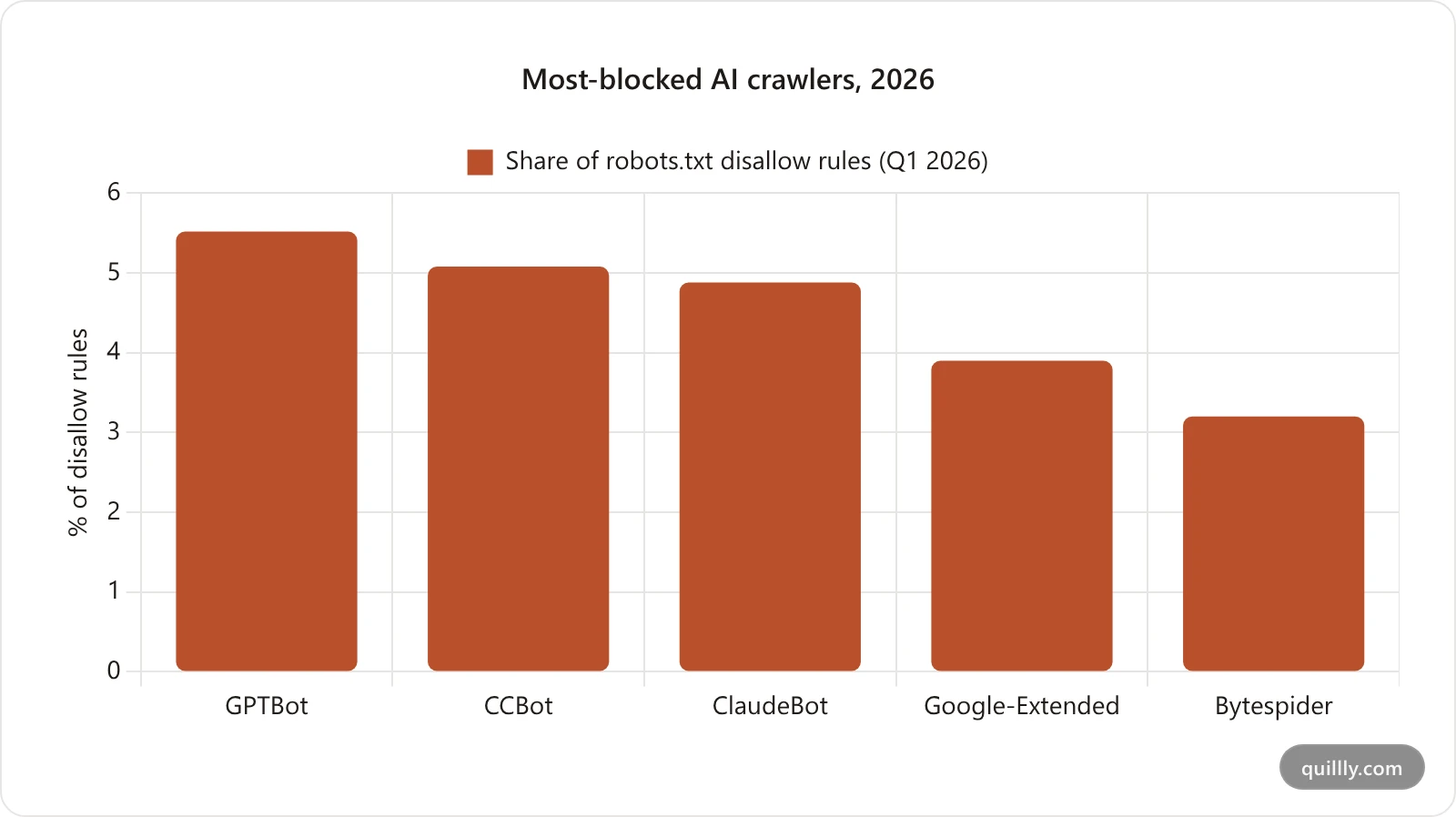
A few numbers worth keeping in your head, all from 2026 crawler-traffic data:
AI crawlers now account for ~20.3% of verified bot traffic, with AI-search bots adding another ~6.5%, per 2026 AI crawler statistics.
Over 2.5 million sites had fully disallowed AI training as of August 2025 — a real movement, but a fraction of the web.
GPTBot, CCBot, and ClaudeBot lead the blocklists; almost no one blocks OAI-SearchBot or the user fetchers, because doing so is self-harm.
The pattern is the story: the web is blocking training and keeping citation bots. The market ran the same cost-benefit you're running now and landed on the buckets.
Your copy-paste robots.txt (citation-safe)#
The takeaway: this template blocks the training bucket, keeps every search and user bot, and won't touch your Google rankings. Paste it, edit the training list to taste, ship it.
Here's a starting point that protects your content from model training while staying fully visible in AI search and answers. Delete lines from the training block if you'd rather allow those too.
# ---- Search + AI answer bots: ALWAYS allow (this is your visibility) ----
User-agent: Googlebot
User-agent: Bingbot
User-agent: OAI-SearchBot
User-agent: ChatGPT-User
User-agent: PerplexityBot
User-agent: Perplexity-User
User-agent: Claude-SearchBot
User-agent: Claude-User
Allow: /

# ---- Training crawlers: block to keep content out of model training ----
User-agent: GPTBot
User-agent: Google-Extended
User-agent: ClaudeBot
User-agent: CCBot
User-agent: Bytespider
User-agent: Amazonbot
Disallow: /

# ---- SEO auditing tools: optional block to save server load ----
User-agent: AhrefsBot
User-agent: SemrushBot
User-agent: MJ12bot
Disallow: /

Sitemap: https://yourdomain.com/sitemap.xml
Two rules for using it safely. First, verify the block actually does what you think — robots.txt only works for bots that honor it, and a misconfigured CDN can block far more than these lines say. Second, watch your AI referral traffic for two weeks after any change. A drop in ChatGPT or Perplexity clicks means you've caught a citation bot in a rule meant for a training bot. If you publish through a platform that serves your robots.txt and llms.txt for you, keep this logic there rather than fighting your host's defaults — the same place that handles your fast indexing on Google should own crawler access too.
Publish to your own domain with robots.txt, llms.txt, and crawler analytics handled for you.
Measure before — and after — you block#
The takeaway: a blocking decision without measurement is a guess. See who's crawling, block by bucket, then confirm your citation traffic held.
The whole framework collapses if you can't see your own crawler traffic, because you'll never know whether that firewall rule from 2024 is quietly costing you ChatGPT citations. The loop is simple and you should run it every time you touch access rules.
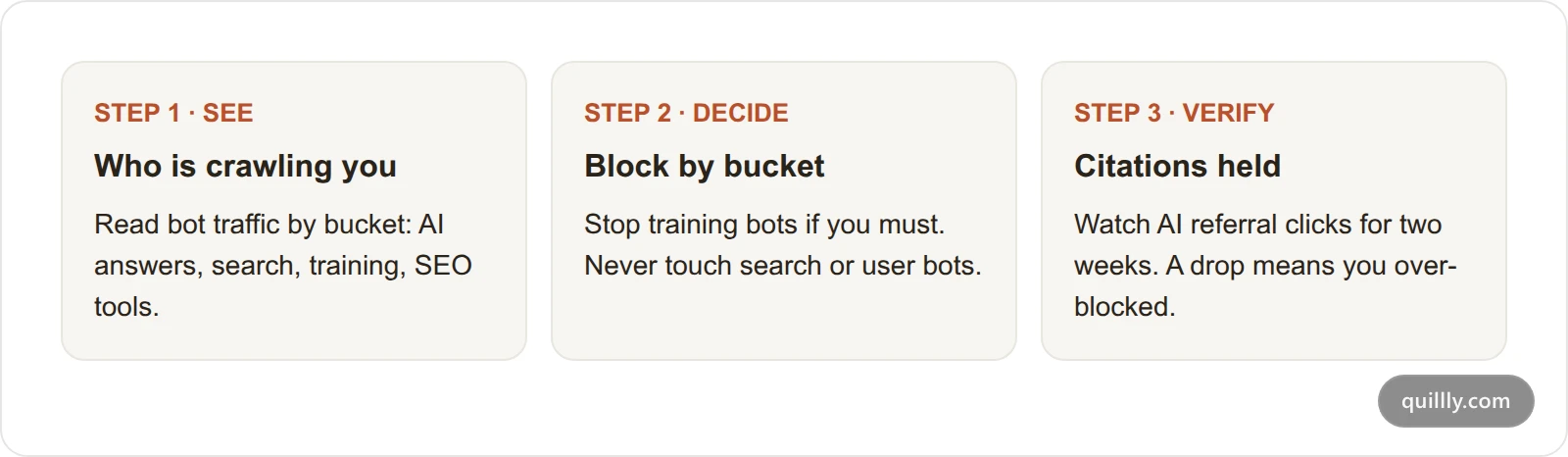
This is where owning your publishing stack pays off. When your AI writes a post, Quillly's check_blog_seo scores it and publish_content ships it to your own domain — and the same dashboard shows the bot-traffic rail, so the decision to allow or block a crawler sits right next to the data that tells you whether it's working. You decide policy once, with numbers, instead of copying a robots.txt snippet and hoping.
Frequently Asked Questions#
Should I block GPTBot?#
Only if you specifically want to keep your content out of OpenAI's model training. GPTBot is training-only — blocking it has no effect on your Google rankings and doesn't remove you from ChatGPT's live answers. If your goal is content protection, block it. If your goal is AI visibility, allowing it costs you nothing and may help models represent your brand accurately.
Does blocking AI crawlers hurt my SEO?#
Blocking training crawlers like GPTBot or Google-Extended has zero impact on Google Search rankings, because they're separate bots from Googlebot. The real SEO-style damage comes from accidentally blocking search and user bots (OAI-SearchBot, ChatGPT-User, PerplexityBot), which removes you from AI answers. Traditional SEO is safe; AI visibility is what's at risk.
Will blocking AI bots remove me from ChatGPT and Perplexity?#
It depends which bots. Blocking GPTBot (training) leaves you fully visible in ChatGPT. Blocking OAI-SearchBot removes you from ChatGPT search results, and blocking ChatGPT-User kills the live citation fetch. For Perplexity, blocking PerplexityBot or Perplexity-User does the same. Keep every search and user bot allowed to stay quotable.
What's the difference between GPTBot and OAI-SearchBot?#
GPTBot collects content to train future OpenAI models and sends you no traffic. OAI-SearchBot indexes your pages so ChatGPT can retrieve and cite them in search answers. They're different bots with opposite consequences: blocking GPTBot protects content harmlessly, while blocking OAI-SearchBot deletes you from ChatGPT search. Never treat "OpenAI" as one switch.
Do AI crawlers actually respect robots.txt?#
The major ones from OpenAI, Anthropic, Google, Perplexity, and Bing document that they honor robots.txt, and most comply. But some scrapers ignore it, and enforcement varies. For content you truly need to protect, robots.txt is a request, not a lock — pair it with server-side or CDN-level controls like Cloudflare's managed blocking rather than relying on robots.txt alone.
Should I use robots.txt or Cloudflare to block AI bots?#
Use robots.txt for polite, well-behaved bots and clear intent; use Cloudflare (or your CDN/WAF) when you need actual enforcement against bots that ignore robots.txt. Cloudflare added default AI-bot blocking and pay-per-crawl in 2025. Whichever you use, apply it by bucket — the risk with CDN rules is over-blocking and silently catching citation bots.
Is Cloudflare blocking AI crawlers by default a good thing?#
For content protection, yes — it stops training bots from crawling for free. The risk is that a blanket default can also wall off the search and user bots that send you AI referrals. If you're on Cloudflare, review the managed rules and explicitly allow OAI-SearchBot, ChatGPT-User, PerplexityBot, and the other citation bots so default protection doesn't cost you visibility.
The bottom line#
Stop asking whether to block AI crawlers and start asking what each bot does. Three numbers make the call for you. Training bots like Anthropic's crawled roughly 10,300 times per single referral in 2026 — block those freely if content protection matters, with zero ranking cost. But ~20% of bot traffic is now AI, and the search and user bots inside that share are your fastest-growing referral channel — block them and you erase yourself from ChatGPT, Perplexity, and Google AI answers.
The Four-Bucket Robots Policy is the whole playbook: always allow AI-answer and search bots, decide on training bots by your content-protection needs, and block SEO tools only to save load. Then measure, because a blocking rule you can't see the effect of is just superstition.
Want your AI to write, score, and publish the post it just drafted — on your own domain, with crawler analytics built in? Connect Quillly to Claude or ChatGPT in 30 seconds.
Related Reading#
Crawler access decisions are easiest to get right before launch, not after. Our SEO checklist for new websites covers robots.txt and the rest of the pre-launch technical setup in one place.


