

Search "cheap SEO" and page one hands you two kinds of result: agencies selling $199-a-month packages, and roundups of cheap SEO tools under $99. Neither kind tells you the thing you actually need to know, which is what changes on your own site after the money leaves your account — and how many months you'll wait before you can tell whether it worked.
The short answer: cheap SEO is real, but it buys tooling and labor — never authority. Under $30 a month gets you publishing, scoring and multi-engine submission. Between $300 and $1,000 a month usually buys volume you could produce yourself. The one thing no tier buys is the six to twelve months engines take to trust a new domain.
We run this site on close to the cheapest tier there is — $19 a month of tooling, no agency, no link budget — and publish daily. Every number below comes from its live search data on 11 September 2026. Some of it argues against spending more. Some of it argues against spending at all.
What's on this page
Cheap SEO at a Glance: Five Price Tiers#
Tier | Typical price | What you're actually buying | Best for |
|---|---|---|---|
DIY free | $0 | Your own hours plus free engine tools | Everyone, always — this is step one |
Self-serve tooling | $10–$30/mo | Publishing, scoring, multi-engine submission | Founders who write their own posts |
Auto-pilot content | $40–$200/mo | Drafts written and published for you | Teams with nobody to write |
Budget agency | $300–$1,000/mo | A junior's hours and templated reporting | Local firms with no in-house time |
Real retainer | $2,000+/mo | Strategy, links, developer time | Not cheap — the reference point |
Read that table as a ladder of labor, not results. Each step up buys back hours. None of them buys rankings directly, which is why the cheapest tiers so often outperform the middle ones.
What $0 Buys You, and Why It's Still the Best Deal#
The free tier does the highest-payback work in all of SEO, and most people skip it to go shopping.
Verify your site in Google Search Console and Bing Webmaster Tools. Submit a real XML sitemap. Write a title tag under 60 characters for every page that sells something. If you have a service area or a front door, claim your Google Business Profile and fill it in completely.
That's a weekend of work, it costs nothing, and no paid tier substitutes for it. An agency charging you $500 a month will do these five things in week one and bill you for twelve months.
The honest limit of free: it doesn't scale past a handful of pages, and it gives you no early warning. You'll find out a post was thin, or never got indexed, months after you published it.
Under $30 a Month: Tooling That Publishes and Submits#
This is the tier where cheap SEO stops being a compromise. For roughly the price of two coffees a week you get the three things free tools don't give you: a place to publish, a quality check before you ship, and automatic submission to every engine at once.
The submission part matters more than it sounds. Google finds new pages through your sitemap and RSS feed via Search Console. Bing, Yahoo, Yandex, Naver, Seznam, Yep and Amazon are reachable through IndexNow, a single push that notifies the whole network. Google does not participate in IndexNow — so any tool promising to "instantly submit to Google" that way is describing something that doesn't exist.
What you should expect at this price: your own domain, a score before you publish rather than a report after, and per-engine indexing you can actually see. What you should not expect: anyone writing for you, and anyone building links.
For comparison, tools priced per article — the Frase and Clearscope class — start higher and stop at the draft. They optimize words. They don't publish or submit them.
Start publishing on your own domain — Quillly scores every page against 14 SEO checks before it goes live, then pushes it to eight engines in one step.
$40 to $200 a Month: Auto-Pilot Content#
Here you're buying drafts. A tool picks keywords, writes posts on a schedule, and publishes them without you.
It's a real category and it genuinely saves time, but the economics only work if two things are true: the posts are good enough that you'd have published them anyway, and your site can get them indexed. The second condition is the one that quietly fails. Publishing eight posts a month into a domain that indexes two of them isn't automation, it's a treadmill.
We broke down what one of these services actually costs and delivers in our Outrank review. The short version: judge auto-pilot tools on indexed pages per month, not posts per month. They are very different numbers.
$300 to $1,000 a Month: The "Affordable Package" Trap#
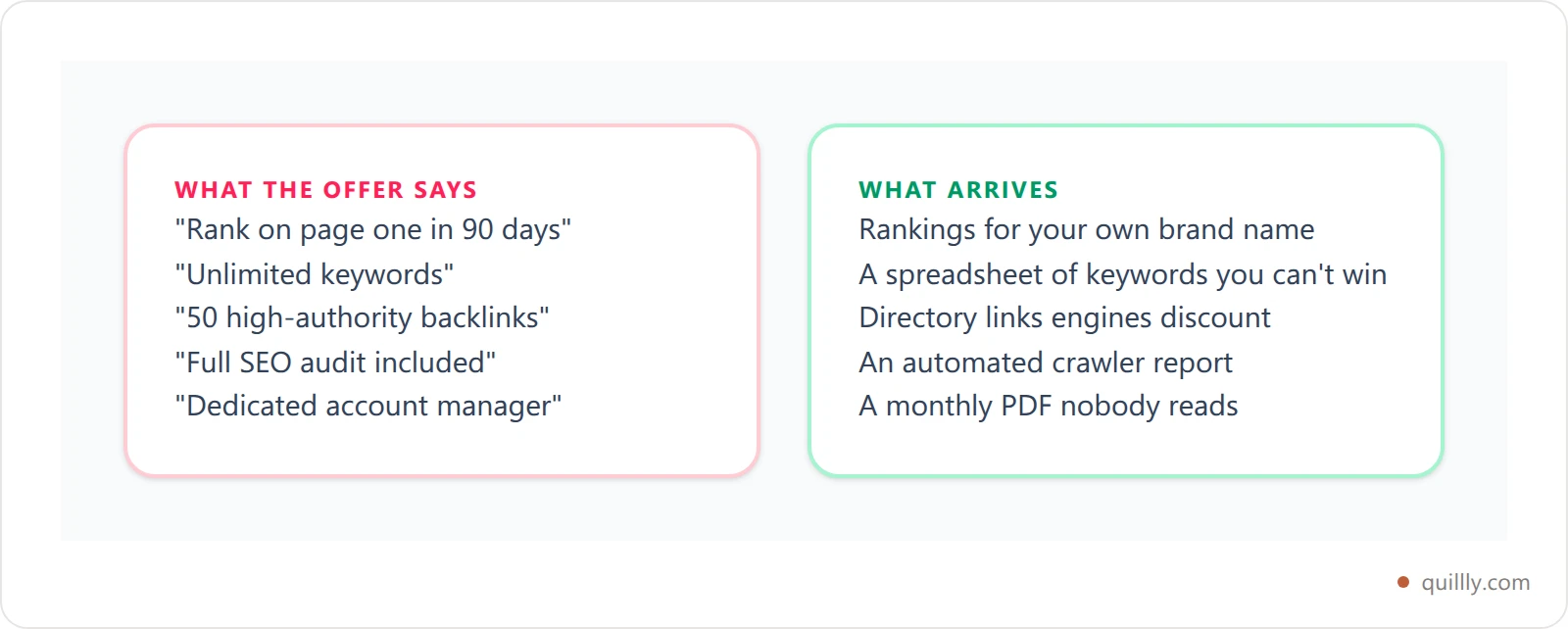
This is the tier most "cheap SEO" and "affordable SEO" ads are selling, and it's the worst value on the ladder. Treat both phrases as marketing rather than a price band: affordable SEO and cheap SEO services get sold at wildly different prices for near-identical scopes.
At $500 a month you're buying perhaps four to six hours of a junior marketer's time, spread thin across setup you could do yourself and reporting that exists to justify the invoice. The work that would actually move you — original content, genuine outreach, developer fixes — takes more hours than that budget contains.
Watch for the specific tells below. Two or more of them and you're funding reporting, not ranking.
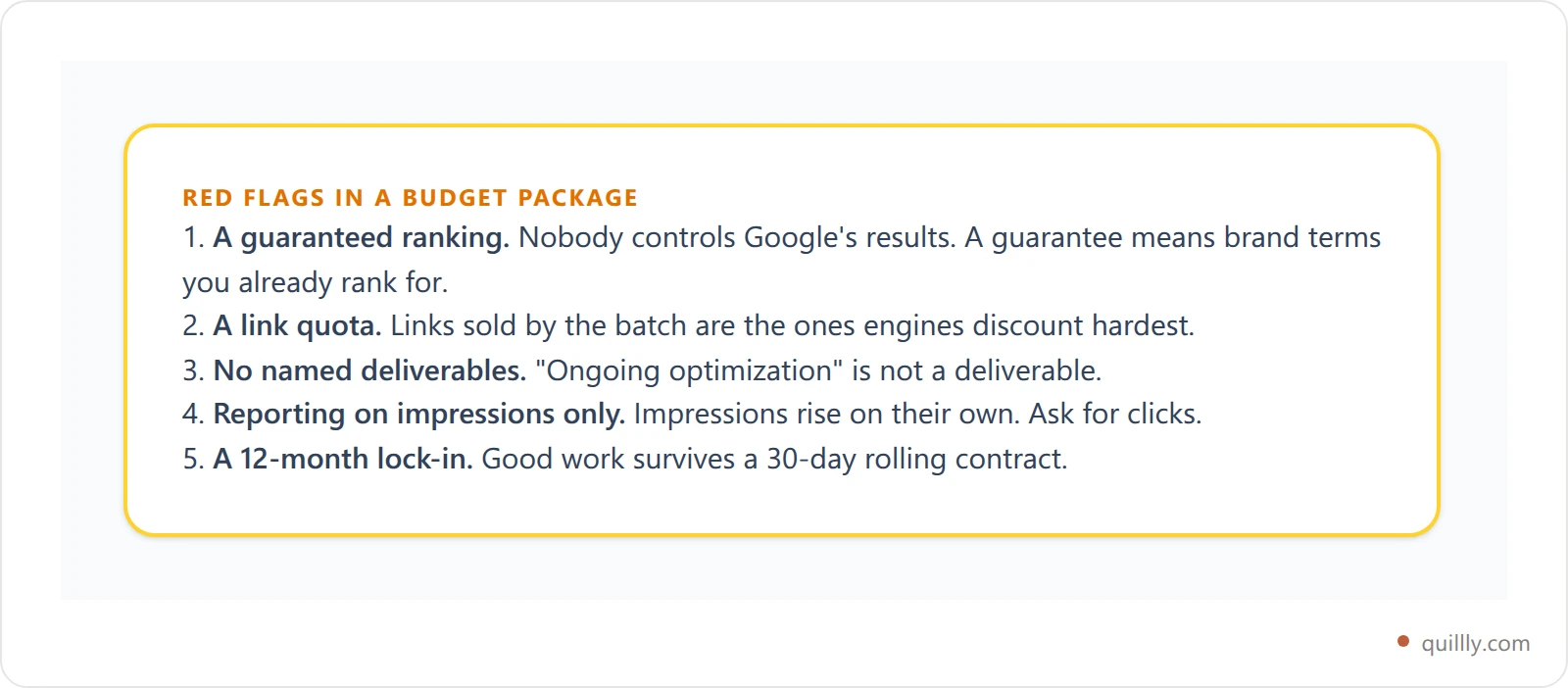
Buying links deserves its own warning. Google's spam policies treat link schemes as a violation, and the cheap end of the link market is exactly where schemes live. The upside is capped and the downside is a manual action.
What No Amount of Cheap SEO Can Buy#
Authority, and the time it takes to earn. Here's what that looks like in practice on our own domain.
This site sits at Ahrefs DR 18. It has 146 published pages. Google holds 76 of them. Bing holds 32. Yandex holds 136. Same pages, same sitemap, same single push to all eight engines.

No tool and no agency changes that spread quickly. It's a trust curve, and it moves on its own schedule. The levers that do eventually move it — real backlinks, brand mentions, being cited — are slow and mostly free. We've written up the ones that work with no budget in our link building playbook for startups, the listings still worth claiming in directory submission sites, and the longer arc in how to increase domain rating.
That's the real reason cheap SEO can work: the expensive part of SEO isn't purchasable at any tier you'd call affordable, so paying more mostly buys you hours, not outcomes.
See your indexed share per engine — Quillly tracks Google, Bing and Yandex separately, so you find out which engine is holding your pages back before you spend another month on volume.
The Honest Math on Our Own $19 Stack#
Our best-performing page is a free tool. It earned 751 impressions in the last window, for the query "seo blog checker," at an average position of 23. Clicks from those impressions: zero.

Position 23 is page three. Page three gets seen and not clicked, which is exactly what zero clicks against 751 impressions means.
We're not showing you that to be gloomy. We're showing you because it's the number a $500-a-month package would have put in a green box on slide four and called growth. Impressions climb long before clicks do, and at low authority they can climb for months while the money number stays flat. If you only ever ask a cheap SEO provider one question, ask what your clicks did — we walk through the rest of the diagnosis in how to get blog traffic.
How to Pick a Tier Without Getting Burned#
Work down this decision, not up from your budget.
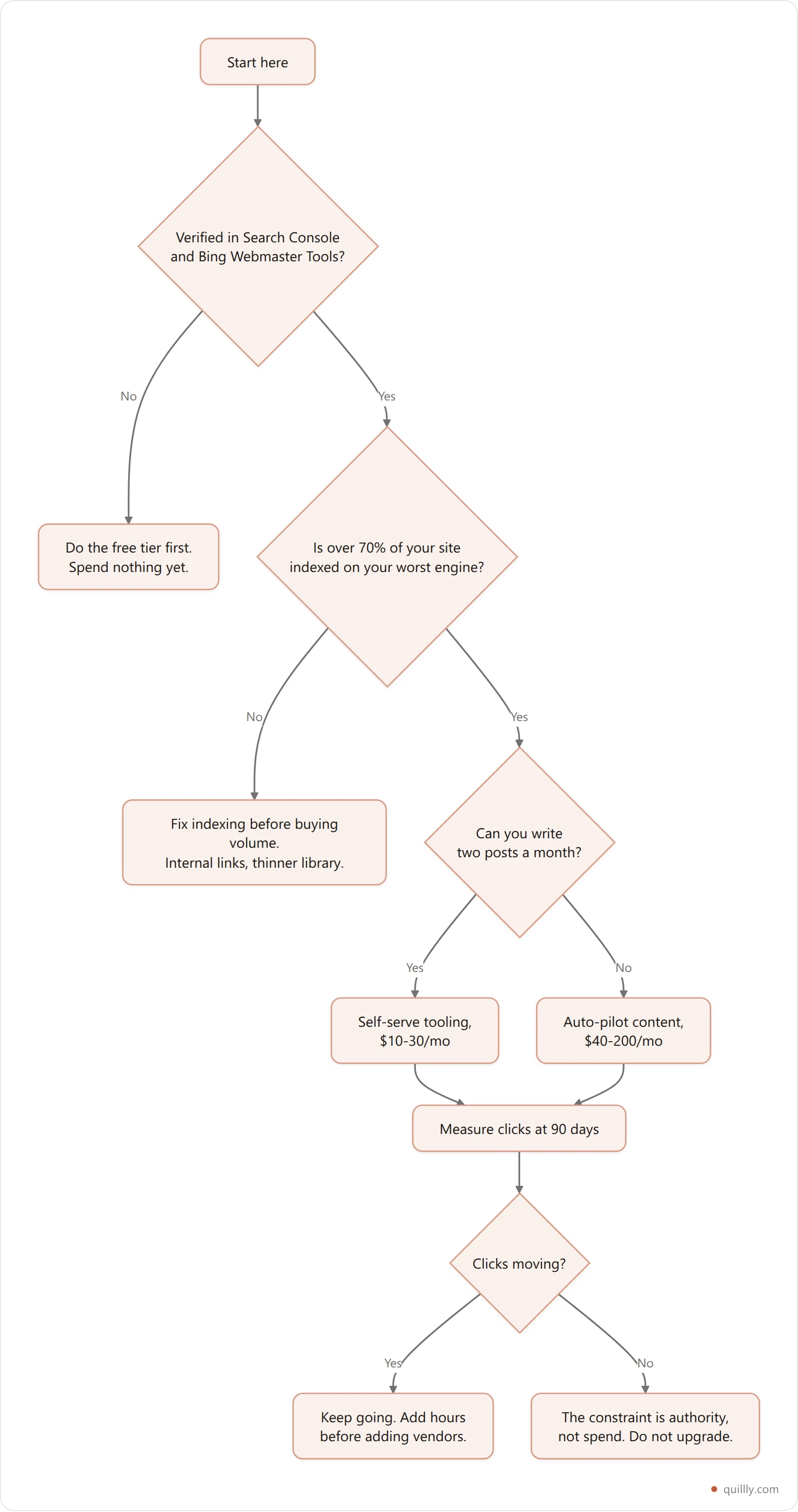
Three rules make the difference between cheap and wasted:
Never buy volume while indexing is broken. Below 70% indexed on your weakest engine, every new page competes with your own backlog for crawl attention.
Buy hours, not promises. A tier that saves you six hours a month at $19 is a clear win. A tier that promises rankings at $500 is a bet you can't verify.
Keep the contract short. Thirty days rolling. If the work is good, you'll renew it.
For the full sequencing at zero authority, our small business SEO checklist orders the same work by payback rather than category.
Cheap doesn't have to mean guesswork
Quillly publishes to your own domain, scores every post against 14 SEO checks before it goes live, and submits it to eight search engines in one step — then tracks indexing and rankings per engine so you can see what's working. 14-day free trial, no card required. Then $19/month for up to 5 websites.
Start free for 14 daysFrequently Asked Questions#
Is cheap SEO worth it?#
Yes, at the right tier. Under $30 a month for tooling is one of the best-value purchases in marketing, because it buys back hours you'd otherwise spend on mechanics. Budget agency packages between $300 and $1,000 are where value collapses, since that money buys only a few hours of junior time.
What is the cheapest SEO that actually works?#
The free tier: Search Console, Bing Webmaster Tools, a real sitemap, and honest title tags on every page that sells something. It costs nothing but your weekend and it outperforms most paid packages in the first three months. Add tooling once you're publishing regularly.
How much should a small business spend on SEO per month?#
If you can write, $10 to $30 a month on tooling plus your own hours. If you can't write, $40 to $200 a month for content help. Spending above that before you're consistently indexed usually buys reporting rather than rankings.
Why is cheap SEO sometimes a scam?#
Because results are slow and hard to verify, which leaves room to sell activity instead of outcomes. The common patterns are guaranteed rankings, bulk link quotas, impression-only reporting, and long lock-ins. None of those are illegal — they're just uncorrelated with traffic.
Can I do SEO myself instead of paying?#
Yes, and for the first few months you probably should. The highest-payback steps — verification, sitemaps, titles, one page per thing you sell — are all manual and all free. Pay for tools once the bottleneck is your time rather than your knowledge.
Does cheap SEO hurt your rankings?#
Cheap tooling doesn't. Cheap link building can. Bulk paid links fall under Google's link spam policies, and the downside is a manual action that costs far more to undo than the links cost to buy.
Key Takeaways#
Cheap SEO buys tooling and labor. It never buys authority, which is the actual constraint at a new domain.
The free tier does the highest-payback work. Do it before you spend anything.
Under $30 a month is the best value on the ladder; $300 to $1,000 a month is the worst.
Judge any paid tier on indexed pages and clicks, never on posts published or impressions earned.
Below 70% indexed on your weakest engine, fix indexing before you buy more volume.
Cheap SEO gets a bad name from one tier of it. The tooling end is genuinely cheap and genuinely useful. The package end is expensive for what it is, and the free end is better than either — right up until your own hours become the thing you can't spare.
Start at the bottom of the ladder. Move up only when the step you're on runs out of hours, not when a page-one ad tells you it's time.


