

We publish a new post on this blog almost every day. Over the last 28 days that ran us 7 clicks. In the same window, the number of our own keywords ranking in the top 10 went from 5 to 31 — a six-fold jump — while clicks barely moved. If you've been told that figuring out how to get blog traffic just means writing more and ranking higher, our own numbers say that's only half the story: you can win rankings and still lose the click.
This post is what we changed once we saw that gap, in the order it actually mattered — indexing first, engine mix second, keyword selection third, and content quality last (not because it matters least, but because it's the one every other guide already covers).
Why "Publish More" Doesn't Get You Traffic at Low Domain Authority#
Blog traffic has three gates, and volume only helps with the first one:
Crawled — a search engine's bot has to find the URL.
Indexed — the engine has to decide the page is worth storing in its index at all.
Clicked — once it's indexed and ranking, someone has to prefer your snippet over nine others.
A new site with a low Domain Rating clears gate one easily (submit a sitemap, ping IndexNow). It struggles at gate two. Google in particular will crawl a page, read it, and still leave it in "Crawled – currently not indexed" for weeks. Publishing ten more posts doesn't fix that. It just adds ten more pages competing for the same limited crawl budget and quality bar. Google's own guide to Helpful, Reliable, People-First Content is explicit that a page has to demonstrate first-hand value to get indexed at all, not just to rank well once it is.
Check your own gate-two number before you write anything else: how many of your published URLs are actually indexed, on every engine you care about — not just Google.

Get Indexed Before You Optimize for Clicks#
If a page isn't indexed, nothing else in this post applies to it — no keyword, no internal link, no CTA will produce a single visit. This is the step most "get more blog traffic" advice skips, because it assumes indexing already happened.
Three checks worth running before you touch content strategy:
Pull the real indexing report, not just "published count." Google Search Console's Page Indexing report groups every URL into "Indexed," "Crawled – not indexed," "Discovered – not indexed," and a handful of exclusion reasons. Each bucket has a different fix.
Treat "Crawled – not indexed" as a quality signal, not a technical bug. In our own case, condensing a post's length didn't move a single stuck page. What has worked is adding inbound internal links to a stuck page specifically from pages that are already indexed — a link from another unindexed page barely registers.
Don't assume Google is your only audience. We cover that next, because it's the fastest lever most sites never pull.
For the mechanics of chasing down each indexing bucket, we wrote up the full checklist in how to get indexed on Google fast.
Connect your AI assistant to Quillly and it publishes straight to your own domain, scored against 14+ SEO checks before it goes live — no separate CMS step, no copy-paste.
Play to the Search Engine That Actually Ranks You#
Here's the number that changed how we think about "SEO traffic": our average position on Google right now is 42. On Bing it's 4.2. On Yandex it's 7.7. Same content, same 28-day window, wildly different outcomes — because Google's quality bar for a low-authority site is simply higher than Bing's or Yandex's right now.
Most blog-traffic advice is written for sites that already clear Google's bar. If yours doesn't yet, chasing Google exclusively means ignoring the audience you can already win. Submitting to the IndexNow network gets a new post in front of Bing, Yandex, Naver, and Seznam within hours instead of the days-to-weeks Google can take to even crawl it — and on a young site, that's often where your first real clicks come from.
We go deeper on splitting effort across engines in multi-engine SEO: rank beyond Google.
Target Keywords You Can Actually Win#
Volume is the number every keyword tool leads with, and it's the least useful one for a new or low-authority blog. A 5,000-search keyword with ten DR-500+ brands on page one isn't a traffic keyword for you — it's a keyword you'll rank position 40 for, forever, which is exactly where our own average sits today.
What matters more:
SERP signal | What it means | What to do |
|---|---|---|
Weakest domain authority in the top 10 is under ~150 | A real page can outrank at least one competitor | Write it |
A forum or Q&A result (Reddit, Quora) ranks in the top 10 | Google hasn't found a definitive answer yet | Strong candidate, even at higher difficulty |
Every top-10 result is DR 300+ | You're competing with brand budgets, not content quality | Skip it, or find a narrower angle |
An AI Overview sits above the results | Position 1 gets less click share than it used to | Still worth ranking for, but don't count on it alone |
Check the live SERP for a keyword before you write it, not after — it's the difference between a post that ranks position 8 in six weeks and one that sits at position 40 next to nine sites with ten times your authority. We keep a running log of this in striking distance keywords: the quick-win playbook.
Make Internal Links Do the Compounding Work#
A new post has zero authority of its own. The fastest way to give it some is a link from a page that already has some — specifically, a page that's already indexed and already ranking.
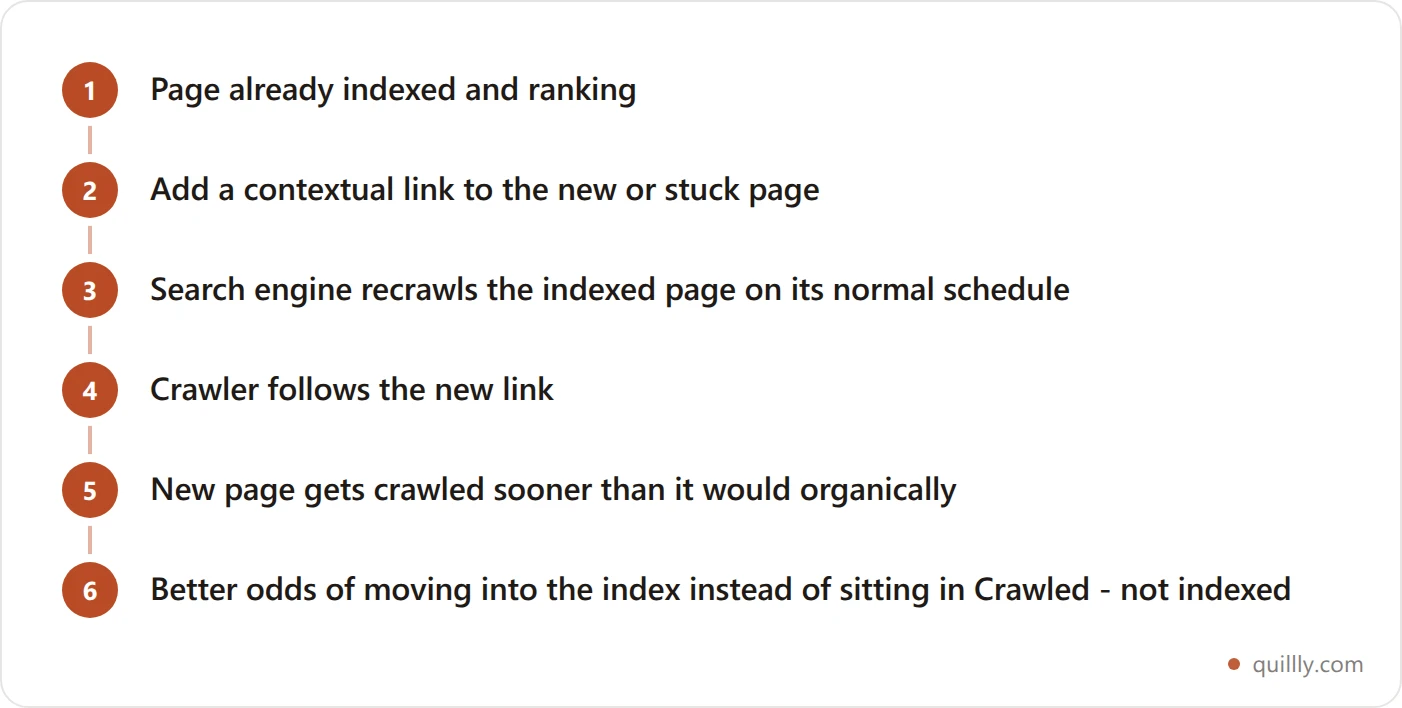
We treat this as a required step for every new post, not an optional polish pass: 2-3 links in, from pages we've confirmed are indexed, before we consider the post done. Our playbook for doing this at scale — including why a link from an unindexed page does almost nothing — is in AI internal linking: the playbook for topical authority.
Distribute Outside Search While You Wait for Google#
Search traffic on a new domain has a lag built in — ours took roughly 9-10 days median from submit to index even on posts that do get indexed. That's dead time if search is your only channel.
The channels that produced real, attributable clicks for us while posts were still working through the index:
Directory and community submissions for a new post's first links and first non-search traffic.
Answer-engine citations — being the source an AI assistant quotes doesn't require ranking #1 in Google; it requires being crawlable, well-structured, and specific.
Your own changelog or newsletter, linking back to the post the day it ships, so it has at least one click and one referral signal before search sends anything.
Our full distribution stack — including which channels actually moved the needle versus which just felt productive — is in content distribution automation for AI blogs.
See how Quillly submits every new post to Google and the IndexNow network automatically on publish
A 90-Day Checklist for How to Get Blog Traffic#
If you're starting from zero — or from our own numbers above — this is the order we'd run it in.
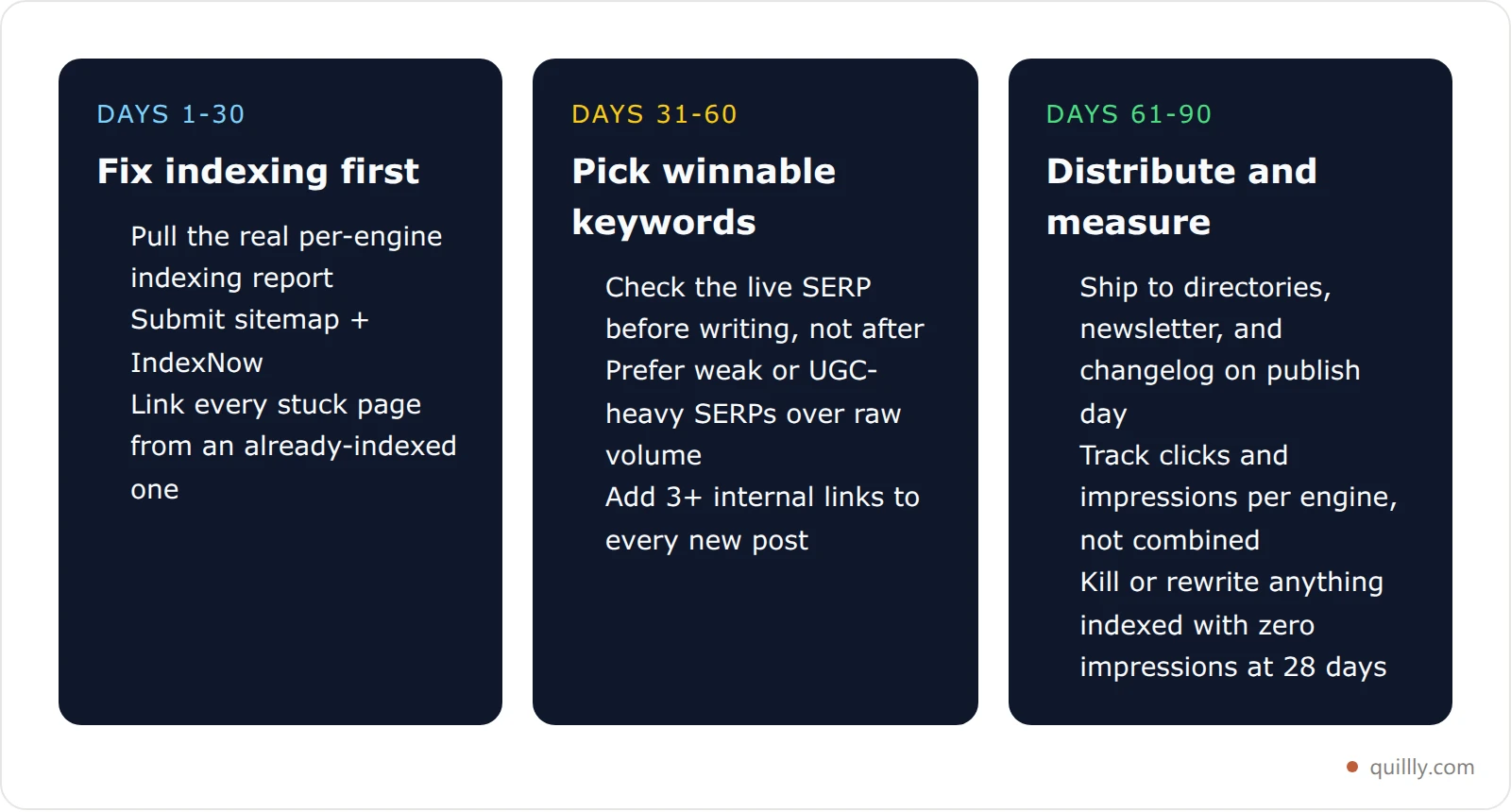

That last chart is the whole argument of this post in one picture. Rankings and clicks are not the same problem, and most blog-traffic advice only solves the first one.
Key Takeaways#
If you came here searching for a shortcut to grow blog traffic overnight, this isn't it. Every tactic above is slow and compounding, not a trick:
Indexing is the real gate. No keyword or link strategy helps a page that isn't indexed.
Blog SEO traffic isn't one number. Check position per search engine, not combined — ours ranges from position 4 on Bing to position 42 on Google.
Winnable beats big. A keyword with a weak SERP beats a high-volume one you'll never crack.
Links compound. A stuck page needs a link from a page that's already indexed, not just any link.
Distribution buys time. Use it to get more blog readers while search catches up.
Taken together, that's the whole playbook we used to increase blog traffic 2026 numbers on a site that started at DR 12 — not a single tactic, but the order you run them in.
Frequently Asked Questions#
How long does it take to get blog traffic from Google?#
On a new or low-authority domain, expect a lag before Google even indexes a post — commonly a week or more — and another stretch before it ranks well enough to get clicks. Bing and Yandex typically index and rank new content faster, which is why we treat them as the earlier traffic source.
Do backlinks matter more than content for blog traffic?#
They solve different gates. Content quality affects whether a page gets indexed and how it ranks once found; backlinks (internal and external) affect how quickly it gets found and how much authority it starts with. A great post with zero links in still sits and waits.
Why is my blog ranking but not getting clicks?#
Usually one of three things: the title and meta description don't match what the searcher actually wants, an AI Overview or featured snippet is answering the query above your listing, or you're ranking on page two where click-through rates are a fraction of page one's, per Backlinko's CTR study.
Should I focus on Google or other search engines first?#
Focus on whichever engine's SERP you can actually win right now. Check your average position per engine, not combined — a site with weak Google authority often ranks far better on Bing or Yandex immediately, which is worth real traffic while Google catches up.
How many keywords should a new blog post target?#
One primary keyword the post is built around, plus 2-4 closely related secondary terms it naturally covers. Targeting more than that usually means the post is too broad to rank well for any single query.
Does posting daily actually increase blog traffic?#
Only if each post clears the indexing bar. Publishing volume without checking indexing status just produces more unindexed pages competing for the same limited crawl budget — which is exactly the trap this post opened with.
Stop guessing whether a post will rank
Quillly scores every post against 14+ SEO checks before it publishes, submits it to Google and the IndexNow network automatically, and tracks indexing and rankings per engine — so you catch a stuck page in days, not months.
Start your free trial

