

Open MarketMuse's pricing page right now and you'll find four tiers — Free, Optimize, Research, Strategy — with query caps, brief counts and tracked-topic limits for each. What you won't find is a single dollar figure. That's the real reason most people go looking for MarketMuse alternatives: not a missing feature, but a number they can't see without booking a sales call. This comparison prices seven of them, job by job, straight from each vendor's own public pricing page — no quotes, no estimates, no affiliate math.
Short answer: choose a MarketMuse alternative by the job you're replacing, not by feature count. For site-wide content inventory, Ahrefs starts at $29/month. For SERP-driven briefs, Frase starts at $39/month. For on-page grading at volume, Surfer starts at $49/month. For getting scored content actually published and indexed, Quillly is $9/month.
Every price below was pulled from the vendor's own public pricing page while writing this. Where a vendor doesn't publish one, this post says so instead of guessing.
What's in this comparison:
A price table covering all seven MarketMuse competitors, cheapest entry tier first
Why MarketMuse's own price is missing from its pricing page
The four jobs MarketMuse bundles, and which of them you actually need
Tool-by-tool picks for each job, from content brief tools to content optimization tools
A five-minute decision tree, key takeaways, and six common questions answered
7 MarketMuse Alternatives, Priced#
Tool | Entry price | What that buys | The job it replaces |
|---|---|---|---|
MarketMuse | Not published | Free tier: 1 user, 10 queries/mo. Optimize: 1 site inventory, 100 tracked topics, 5 briefs/mo | All four, bundled |
Ahrefs | $29/mo (Starter) | Competitor data; Lite at $129/mo adds 5 projects, 750 tracked keywords, 100K crawl credits | Content inventory + audit |
Frase | $39/mo billed yearly ($49 monthly) | 10 articles and 50 audit pages/month, 1 seat, 1 site | SERP research → brief |
Surfer SEO | $49/mo billed yearly | 120 documents to create or optimize, track 10 pages | On-page optimization |
Content Harmony | $50/mo | 5 Content Workflows (keyword report + brief + grader), unlimited users | Agency brief production |
Dashword | $99/mo | 30 content reports, 5 user seats | Briefs + AI writer for small teams |
Clearscope | $129/mo (Essentials) | 50 pages, 20 topic explorations, 20 drafts, unlimited users | Editorial grading |
Quillly | $9/mo (Pro, early adopter) | Unlimited content on up to 5 sites, 14+ criteria SEO score, auto-submit to 8 engines | Publishing + indexing |
Two things jump out of that table. The spread between the cheapest and most expensive entry tier is more than 14×, and almost none of these tools overlap as completely as the roundups suggest. Ahrefs won't write your brief. Frase won't publish your post. MarketMuse won't tell you what it costs. Compare that against $9 a month before you book a demo.
Why MarketMuse's Price Is Hard to Find#
MarketMuse publishes tier names and feature limits but no dollar amounts, so pricing comes only through a sales conversation. That's normal for enterprise SEO software and awkward for anyone budgeting a content program, because you can't calculate cost per published page from a quote you don't have yet.
Here's the pricing page as it renders today — feature comparison intact, price row absent.
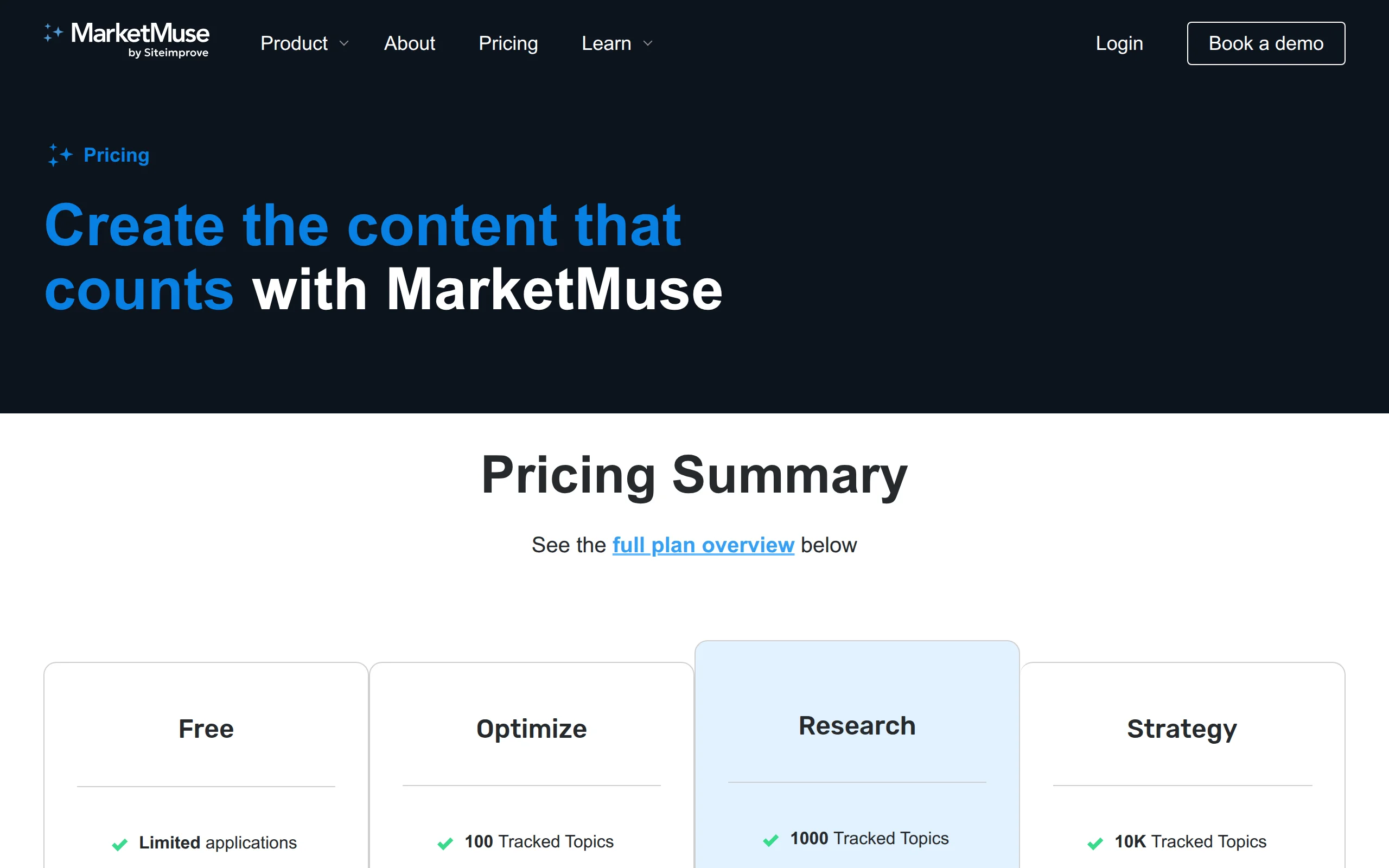
The tier structure is still informative even without numbers. Free gives you 1 user and 10 queries a month, with no site inventory, no tracked topics and no Content Briefs — enough to look around, not enough to work. Optimize adds 1 site inventory, 100 tracked topics, 5 Content Briefs a month (Article type only) and 100 queries. Research raises that to 3 users, 1,000 tracked topics, 10 briefs and unlimited queries. Strategy tops out at 5 users, 10K tracked topics and 20 briefs across all nine brief types.
Read those limits as a shopping signal. Five briefs a month is a solo content marketer's pace. If you publish weekly, you're on the second tier before you've written anything, and you're finding out the cost of that tier from a salesperson rather than a web page. Meanwhile every alternative in the table above publishes a number you can budget against today.
That gap matters more than it sounds. When you can't see a price, you can't calculate cost per published page — and cost per published page is the only content metric that survives contact with a real budget.
The Four Jobs MarketMuse Bundles#
MarketMuse is not one product. It's four jobs sold together, which is exactly why "alternatives" lists feel unsatisfying: they compare tools that each do one of the four.
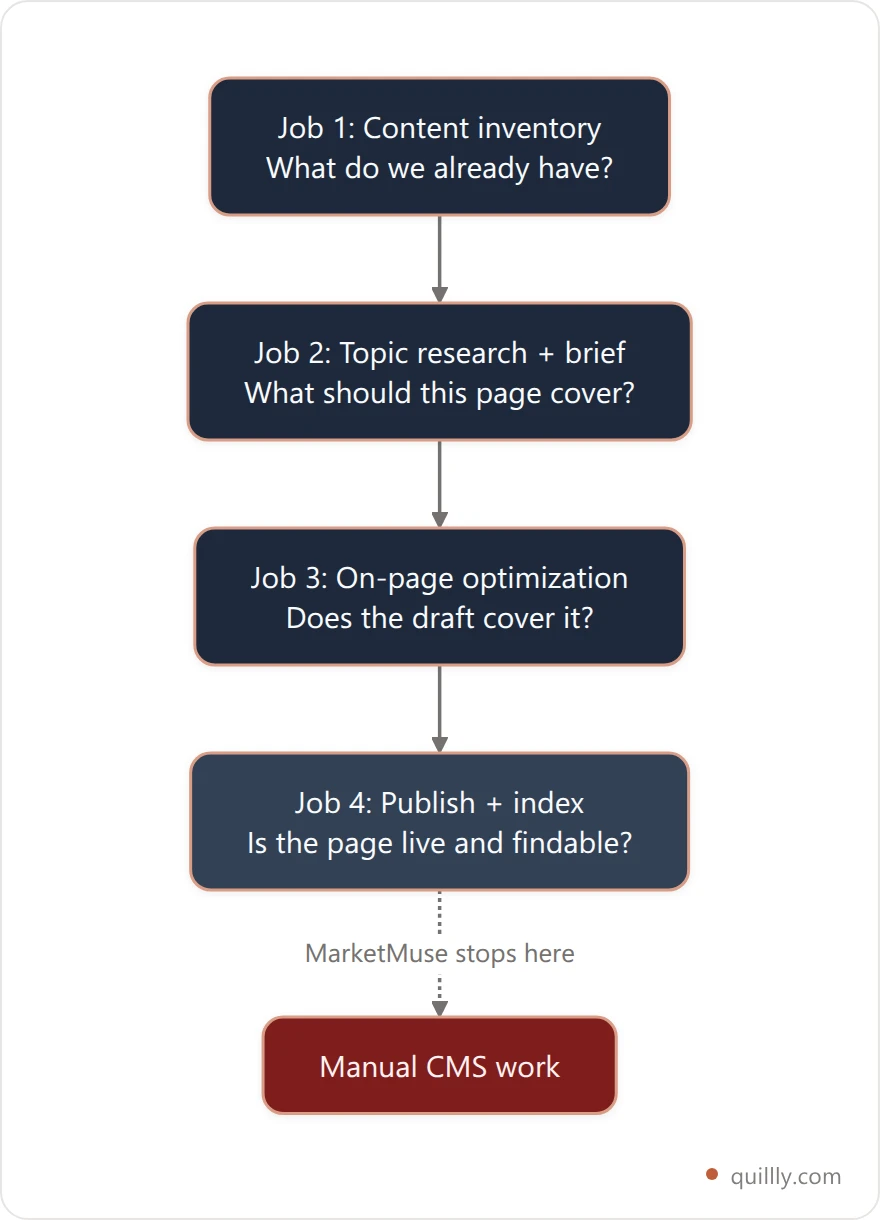
Notice where the chain breaks. MarketMuse covers jobs 1 through 3 well and stops entirely at job 4 — the part where a graded draft becomes a live URL that a search engine has actually crawled. That last step is where most content programs quietly leak, and no amount of topic modelling fixes it.
So before you compare tools, decide which jobs you're actually paying for. If you already run a brief template you trust, you're shopping for jobs 3 and 4 only, and your budget just dropped by a factor of five.
Job 1: Content Inventory and Site-Wide Audit#
This is MarketMuse's genuine differentiator. A site inventory crawls everything you've published, scores it against the topics you care about, and tells you what to update rather than what to write. Few tools do this well.
Ahrefs is the closest practical replacement at the low end. Its Starter plan runs $29/month for competitor data, and the Lite plan at $129/month covers 5 projects, 750 tracked keywords and 100,000 crawl credits. Ahrefs Site Audit finds the technical and on-page problems; you supply the topical judgment MarketMuse would have automated.
Screaming Frog plus a spreadsheet remains the answer for a lot of teams under 200 pages, and costs nothing but an afternoon. Inventory is a once-a-quarter job for most sites, not a monthly subscription.
The honest version: if content inventory is the only job you need, a $129/month Ahrefs plan plus an afternoon beats an unpriced enterprise tier. It is also the one job where every MarketMuse alternative falls short of the original, so be clear-eyed about it. Start a 14-day trial only after you know which of the four jobs you're actually buying.
Job 2: Topic Research and Content Briefs#
This is the crowded lane. Content brief tools are where most MarketMuse competitors actually compete with each other, and price-per-brief is the number to compare.
Frase — $39/month billed yearly ($49 monthly) buys 10 articles and 50 audit pages, 1 seat, 1 site. That's roughly $3.90 per brief at the entry tier. The Professional tier at $103/month yearly covers 40 articles, 250 audit pages and 3 seats, with overage articles at $5 each. There's a 7-day free trial, no card. We covered the wider field in our Frase alternatives breakdown.
Content Harmony — $50/month for 5 Content Workflows, where one workflow bundles a keyword report, a content brief and a content grader for a single page. That's $10 per brief, but each brief is deeper than Frase's, and users and projects are unlimited. Their trial is unusual and generous: $10 for your first 10 workflows, no auto-billing and no time limit.
Dashword — $99/month for 30 content reports and 5 user seats, or roughly $3.30 per report, with annual billing knocking off 20%. Briefs, an AI writer, API access and an MCP server are included on both tiers.

Price per brief is the wrong number if you only publish four posts a month. At that volume every tool here costs between $10 and $30 per published page, and the difference is noise. Pick on workflow fit instead.
Job 3: On-Page Optimization While You Write#
Content optimization tools grade a draft against what already ranks for the query. Two of them own this job, and they split it cleanly.
Surfer SEO is the volume play. Discovery at $49/month billed yearly covers 120 documents to create or optimize plus 10 tracked pages. Standard at $99/month raises that to 360 documents and adds WordPress and Google Docs integrations. Pro at $182/month adds internal linking and cannibalization reports across 5 brand workspaces. At 120 documents for $49, that's 41 cents per document — the cheapest per-unit optimization on this list by a wide margin. Our Surfer SEO alternatives post compares the field it sits in.
Clearscope is the editorial-quality play. Essentials is $129/month for 50 pages, 20 topic explorations and 20 drafts, with unlimited users and projects — a real advantage for a team where five people touch a draft. Business at $399/month covers 300 pages. Additional pages are $25/month on Essentials, $15 on Business. If your bottleneck is editors disagreeing about whether a draft is done, Clearscope's grade settles it; see our Clearscope alternatives comparison for the cheaper seats.
The split is clean: Surfer if you optimize a lot of pages, Clearscope if a lot of people optimize each page.
Job 4: Publishing and Getting Indexed#
Here's the job no MarketMuse alternative on the usual lists covers — and the one with the worst success rate.
A graded draft is not a ranking page. It has to be published, submitted, crawled and indexed, and each of those steps has a real failure rate. Our own site is a fair example, because the numbers are unflattering and we publish them anyway: of 132 published pages on quillly.com, Google has indexed 76, Bing 27 and Yandex 105.

Twenty percent on Bing means four out of five pages we paid to write earn nothing there. No content-optimization score would have caught that, because the drafts were fine. The pipeline after the draft was the problem — which is exactly why ranking beyond Google is worth treating as its own job.
Quillly is built for that fourth job at $9/month on the Pro (early adopter) tier, or $96/year. That covers unlimited content across up to 5 websites, unlimited traffic, a 14+ criteria SEO score that runs before publish, auto-submission to 8 search engines (Google, Bing, Yahoo, Yandex, Naver, Seznam, Yep and Amazon), 90-day analytics and 100 research credits a month. There's a 14-day trial with no card, and no permanent free tier. Autopilot plans run $29, $79 and $199/month if you want the whole loop scheduled rather than driven from chat. For a like-for-like look at a competitor selling that same scheduled loop, see our Outrank review.
The honest limitation: Quillly won't build you a MarketMuse-style topic model or a site inventory. It's the other end of the chain — which is why plenty of teams run it alongside one of the other MarketMuse alternatives rather than instead of one. See what a scored, published post costs.
How to Pick in Under Five Minutes#
Pick by bottleneck, not by feature list. If you don't know what you've already published, buy inventory. If writers start from nothing, buy briefs. If drafts keep missing the topic, buy optimization. If finished drafts never go live, buy publishing. The tree below walks each branch.
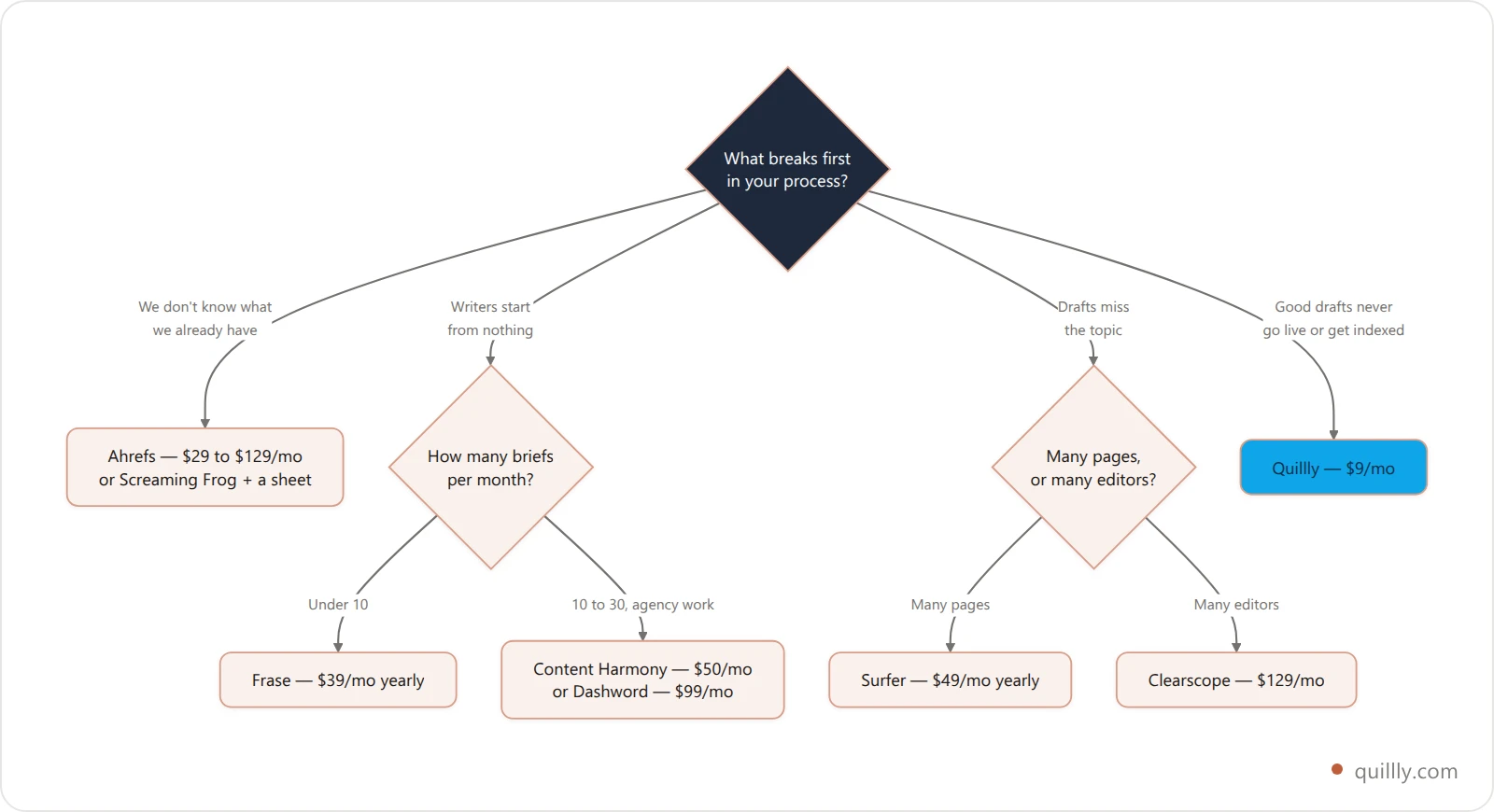
Most teams answer that question wrong on the first try. The tell is simple: if you have a backlog of finished drafts, your bottleneck is job 4, and buying a better brief tool will make the backlog bigger.
What You Actually Give Up Leaving MarketMuse#
You give up three things no cheap alternative fully replaces: the automated site inventory that scores every existing page, nine distinct brief types instead of one, and the Content Strategy Document that maps clusters to pages. Everything else on this list has a public-priced substitute, usually for less money.
Be fair to the product you're leaving. Three things genuinely don't have cheap replacements.
The site inventory. Automatically scoring every existing page against your topic set is real work that Ahrefs approximates rather than replaces.
Nine brief types. MarketMuse's Strategy tier generates briefs for nine content shapes, not just "article." Most alternatives ship one template.
Content Strategy Documents. The planning artifact that maps clusters to pages has no direct equivalent at $50/month.
What the MarketMuse alternatives hand back is a number you can see, a bill you can predict, and the freedom to buy only the jobs you're bad at. For most sites under a few hundred pages, that trade is worth making — and the money left over is better spent on the internal linking and indexing work that actually moves pages onto page one.
Stop losing finished drafts to the publish step
Quillly scores every post against 14+ SEO criteria, publishes it to your own domain, and submits it to 8 search engines automatically. $9/month, 14-day trial, no card.
Try Quillly freeKey Takeaways#
MarketMuse publishes no price at all. Every alternative here does, and their entry tiers span $9 to $129 a month.
MarketMuse bundles four jobs — inventory, briefs, optimization, publishing. Buy only the ones you're bad at.
Cheapest per job: Ahrefs at $29/mo for data, Frase at $39/mo for briefs, Surfer at $49/mo for optimization, Quillly at $9/mo for publishing.
Content Harmony ($50/mo, 5 workflows) and Dashword ($99/mo, 30 reports) sit between briefs and grading, and suit agency work.
Nothing cheap replaces the site inventory or the nine brief types — budget an Ahrefs plan and an afternoon instead.
Splitting the stack across three MarketMuse alternatives runs about $177/month, entirely on public pricing.
Frequently Asked Questions#
How much does MarketMuse actually cost?#
MarketMuse does not publish prices on its pricing page. The page lists four tiers — Free, Optimize, Research and Strategy — with feature limits like 100, 1,000 and 10K tracked topics, but no dollar figures. You have to contact them for a quote, which is the single most common reason people start comparing alternatives.
What is the cheapest MarketMuse alternative?#
Quillly at $9/month is the cheapest tool on this list, but it covers publishing and indexing rather than topic modelling. If you need briefs specifically, Frase at $39/month billed yearly is the cheapest genuine brief tool. Ahrefs Starter at $29/month is the cheapest route to competitor and keyword data.
Is Surfer or Clearscope closer to MarketMuse?#
Neither replaces the site inventory, but Clearscope is closer in philosophy — editorial grading against a topic model, with unlimited users at $129/month. Surfer is closer in economics, at $49/month for 120 documents. Pick Clearscope for quality control, Surfer for throughput.
Can I replace MarketMuse with more than one tool?#
Yes, and it's usually cheaper. Ahrefs Lite for inventory ($129/month) plus Frase for briefs ($39/month) plus Quillly for publishing ($9/month) comes to $177/month with public, predictable pricing and no sales call. Whether that beats a single MarketMuse tier depends on a quote you can't see in advance.
Does any alternative handle publishing and indexing?#
Almost none of them do. Frase offers CMS hosting as a paid add-on, and Surfer integrates with WordPress. Quillly is the only tool here built around the publish-and-index step, submitting to 8 engines and tracking indexing status per page. That gap is why so many teams have a folder of graded drafts that never went live.
How many briefs a month do I actually need?#
Fewer than you think. Publishing one strong post a week is 4 briefs a month, which fits inside Frase's entry tier and MarketMuse's Optimize tier alike. Buy for the volume you sustain, not the volume you plan — and check our take on how alternatives pages get cited if you're writing one of these yourself.


