

Clearscope's cheapest plan is $129 a month. That buys you a content grade and a brief — not a published page. If you're a solo writer or a two-person team, you're paying an editorial-department price for a tool built around the assumption that you have an editorial department.
Quick answer: For Clearscope's scoring without the enterprise price tag, Page Optimizer Pro ($40/mo) or NeuronWriter ($23/mo) are the closest self-serve swaps. Dashword ($99/mo) adds AI drafting and its own MCP server. And if the actual problem is that none of these tools publish your finished post, Quillly ($9/mo) replaces the step instead of competing in it.
Clearscope Alternatives at a Glance#
Every price below is pulled from the vendor's own pricing page, checked in August 2026. "Entry price" means the cheapest tier that does real work — not a free trial.
Tool | Entry price/mo | What it gets you | Publishes to your domain | Best for |
|---|---|---|---|---|
Clearscope (baseline) | $129 | 50 pages, 50 tracked prompts, 20 drafts, unlimited seats | No | Editorial teams standardizing many writers |
Quillly | $9 | 5 websites, unlimited content, full MCP | Yes, your own domain | Solo writers and small teams who want to ship, not just grade |
NeuronWriter | $23 | 2 projects, 25 content analyses | No | Cheapest true scoring swap |
Page Optimizer Pro | $40 | 20 POP credits, 10 Watchdog pages | No | Sharpest on-page signal, no drafting |
Surfer SEO | $49 | 120 documents, 10 tracked pages, 1 seat | No | The default move if you want Clearscope's polish |
Dashword | $99 | 30 content reports, 5 seats, AI writer, MCP server | No | Teams who want drafting and API access bundled |
MarketMuse | Ask sales | 100 tracked topics, 5 briefs/mo (Optimize tier) | No | Large teams who don't mind a demo call |
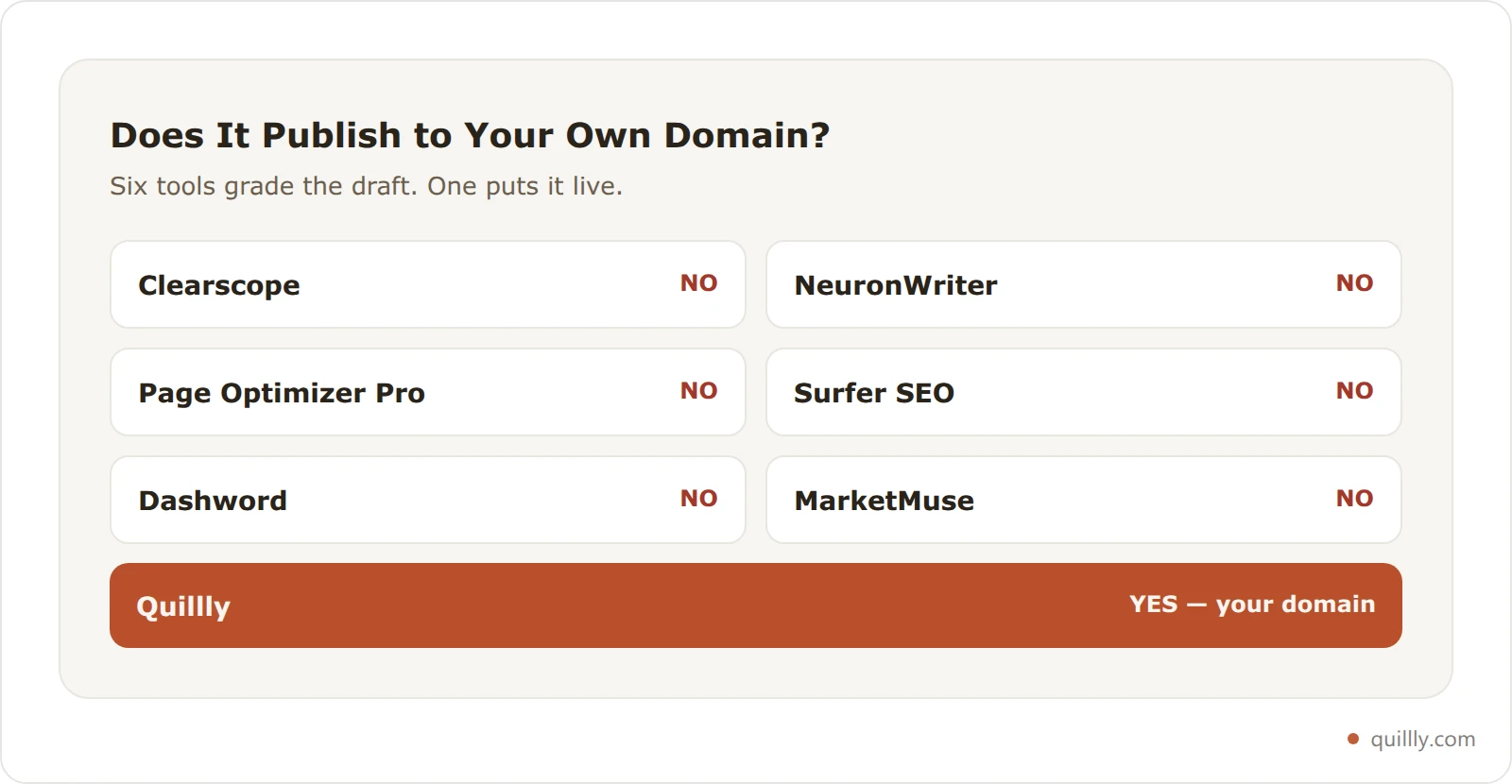
Two things stand out. Only one of these seven puts a finished post on a domain you own. And the "unlimited seats" pitch that makes Clearscope's $129 look reasonable only pays off once several people are actually using those seats. Six of these seven are content optimization tools in the same category Clearscope pioneered: score the draft, hand it back, and let you publish it somewhere else.
What Clearscope Actually Costs in 2026#
Here's Clearscope's live pricing page, so you can check our numbers against the source instead of trusting a table. Clearscope pricing changes often enough that any roundup older than a few months is worth double-checking against this page directly.
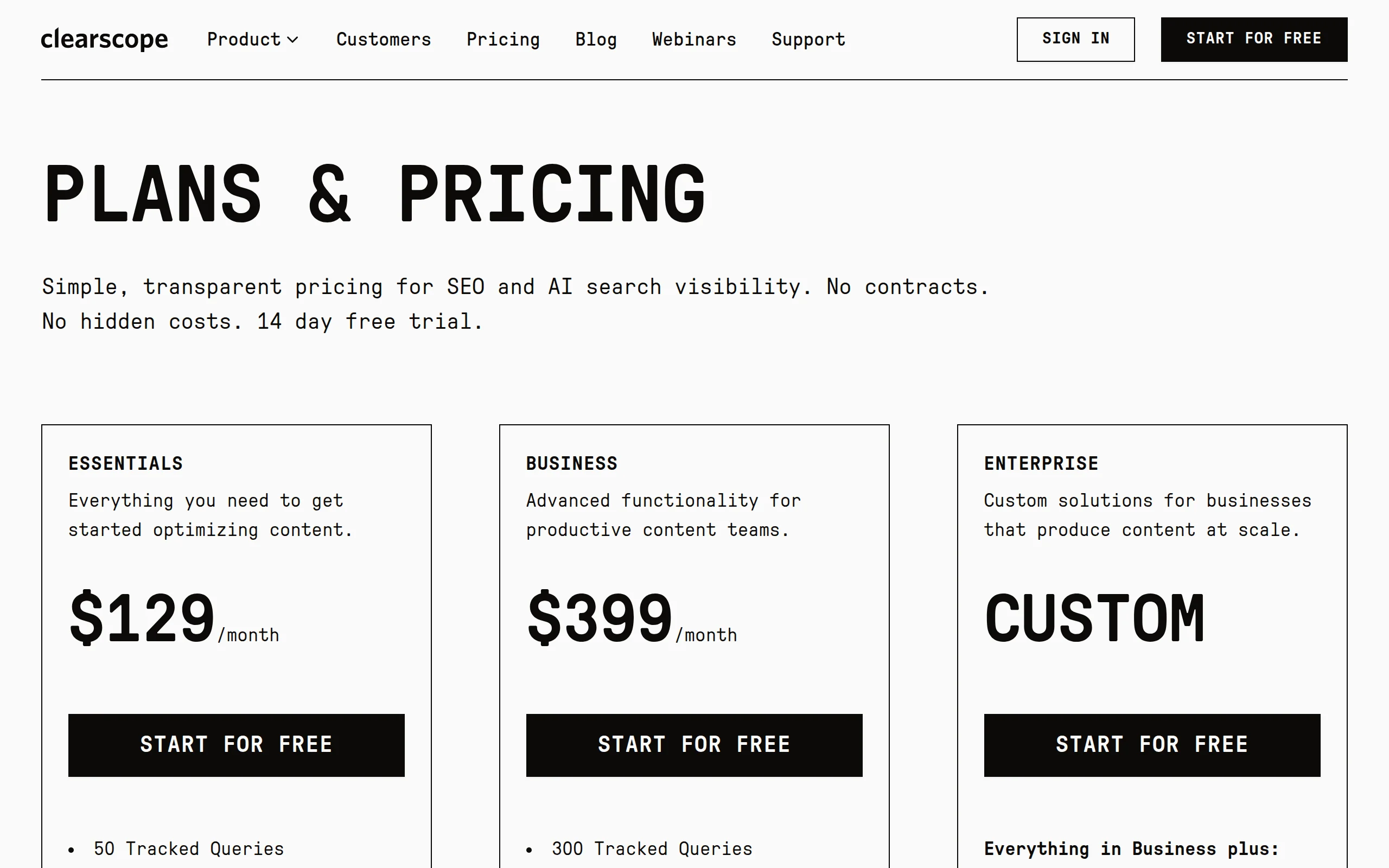
The ladder runs Essentials at $129/month (50 pages, 50 tracked prompts, 20 monthly drafts), Business at $399/month (300 pages, 300 tracked prompts, a dedicated account manager), and Enterprise at custom pricing with SSO and crawler whitelisting. Both public tiers include unlimited users and projects — no per-seat charge, no contract, and a 14-day free trial with no card required.
Clearscope has also moved into tracking brand mentions across ChatGPT and Gemini, alongside classic search visibility. That's a real and growing need — see how AI search actually chooses what to cite if that's the piece you're evaluating Clearscope for — but it's layered onto the same $129-$399 ladder, not a separate cheaper tier.
Two numbers matter more than the sticker price. Twenty drafts a month on Essentials caps out fast if more than one person is writing. And 50 tracked pages sounds like a lot until you remember it's the whole site, not just this month's posts — a blog with 200 back-posts can't all stay monitored on the entry plan.
Do You Actually Need Unlimited Seats?#
Unlimited users is the entire pitch behind Clearscope's price. A six-person content team splitting $129 pays about $21 a seat, which is genuinely competitive. A solo writer or a two-person team pays the full $129 for capacity nobody else is using.

Run the math on your actual team size before the unlimited-seats pitch talks you into a bigger plan than you need. One writer publishing eight posts a month doesn't need 50 tracked pages or a dedicated account manager — they need a brief, a grade, and somewhere for the finished post to go.
See what a workflow that grades and publishes in one step looks like.
The Grade Is Not the Post#
Clearscope's own materials focus on briefs, grading, and — on paid tiers — a metered number of AI drafts. What happens after your draft scores well is left to you: export it, then paste it into whatever CMS you actually publish on.
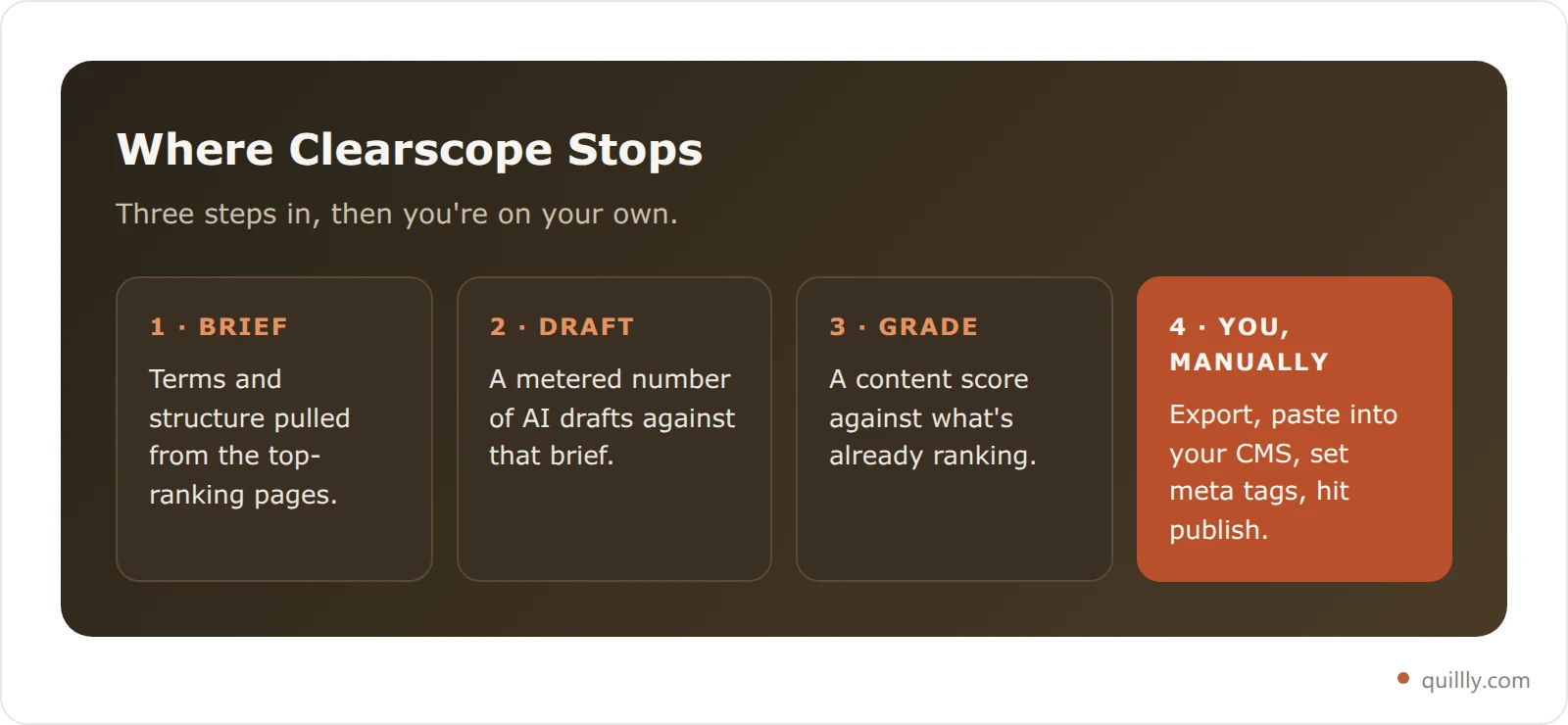
None of the six tools in this comparison do step four for you. Quillly is the only one that skips straight from a scored draft to a live URL on your own domain, which is a different job than the one the other six are competing to do better.
1. NeuronWriter — Cheapest Self-Serve Scoring#
NeuronWriter analyzes the SERP, builds a term list, and scores your draft against it — the same core loop as Clearscope, at a fraction of the price. Bronze runs $23/month ($19 billed yearly) for 2 projects and 25 content analyses; Silver is $45 for 5 projects; Gold is $69 for 10.
Best for: solo writers who want the scoring loop without the seat count.
What Clearscope does better: the interface is more polished and built for handing work between writers and editors. NeuronWriter's dashboard is denser and takes longer to get comfortable in.
2. Page Optimizer Pro — Sharpest On-Page Signal#
POP doesn't draft for you — it tells you exactly which terms and structural changes move a page, then watches your published pages for competitor changes. Basic is $40/month for 20 credits and 10 Watchdog pages; Unlimited is $72 with 50 credits and 200 Watchdog pages; Teams is $143.
Best for: anyone who already has a writer and wants the most precise scoring signal available, not a brief-writing assistant.
What Clearscope does better: onboarding and the AI drafting option. POP assumes you already know what you're doing.
3. Surfer SEO — The Default Move#
Surfer is the name most people already know, and it's a reasonable Clearscope swap if you want a similar level of polish. Discovery is $49/month for 120 documents and 10 tracked pages; Standard is $99; Pro is $182. See our full Surfer SEO alternatives comparison for the complete pricing ladder — including where Surfer itself lands next to Clearscope.
Best for: teams who want the most widely-used tool in the category and don't mind Clearscope-adjacent pricing once you're past the entry tier.
What Clearscope does better: unlimited seats. Surfer's plans cap at a fixed number of seats even on its higher tiers; Clearscope's flat per-team pricing wins for larger writing pools.
4. Dashword — Drafting Plus an MCP Server#
Dashword pairs content scoring with an AI writer and, notably, its own MCP server and API access on every plan. Startup is $99/month for 30 content reports, 5 seats, and 100k AI-generated words; Business starts at $349 for 100 reports and SSO.
Best for: teams who want drafting, scoring, and programmatic access in one subscription without Clearscope's price floor.
What Clearscope does better: it still doesn't publish anywhere, so this comparison is really about which scoring-and-drafting tool you prefer, not about who closes the publishing gap. Neither does.
5. MarketMuse — Enterprise Depth, Demo Required#
MarketMuse goes deeper than Clearscope on content inventory and topic modeling, with tiers named Free, Optimize, Research, and Strategy. None of them list a price — you book a demo to find out, even for the entry-level Optimize tier (100 tracked topics, 5 briefs a month).
Best for: larger teams planning a full content inventory who don't mind a sales conversation before they see a number.
What Clearscope does better: you know the price before you sign up. Clearscope's Essentials and Business tiers are both listed in plain dollars with no call required.
6. Quillly — Skip the Grade, Ship the Post#
The other five tools answer "how good is this draft?" Quillly answers a different question: why does a finished, scored draft still need a separate step to go live? Boiled down, Clearscope vs Quillly is a choice between grading and shipping — most teams need both, just not from the same $129 tool.
Quillly is SEO infrastructure with an MCP server, not a scoring dashboard. You bring your own AI — Claude, ChatGPT, Cursor, Gemini, or Windsurf — and it runs the whole pipeline in one conversation: create_content saves the draft, check_blog_seo grades it against a 14-point check, get_blog_seo_patches returns the specific fixes, and publish_content puts it live on your own domain. Pro is $9/month or $96/year for up to 5 sites, unlimited content, and a 14-day trial that needs no card. Every publish is auto-submitted across 8 search engines, including Google and Bing.
Best for: solo writers and small teams whose real bottleneck is the gap between "draft scores well" and "post is live," not the scoring itself.
What Clearscope does better: raw brief depth for teams with dedicated writers who need a shared editorial standard. If your team already has an established review process and just needs everyone grading against the same brief, Clearscope's unlimited seats are built for exactly that. See how Quillly's own scoring works if you want to compare the two side by side.
Try the score-and-publish workflow free for 14 days.
7. Keep Clearscope (When It's Right)#
Being fair matters here too. Stay on Clearscope if you run a content team of four or more where the unlimited-seats math already works in your favor, if your editorial process depends on the brief format your writers are trained on, or if AI-visibility tracking across ChatGPT and Gemini is now part of your job. At $129 for a team, that's not overpriced for what it replaces.
Switch if you're a solo writer or a two-person team paying full price for seats nobody else uses, if 20 drafts a month is more ceiling than you need, or if the real friction in your week is the manual step between a finished draft and a live URL.
How to Migrate Off Clearscope#
If you're moving to a bring-your-own-AI setup, the shape of the work changes more than the tool does.
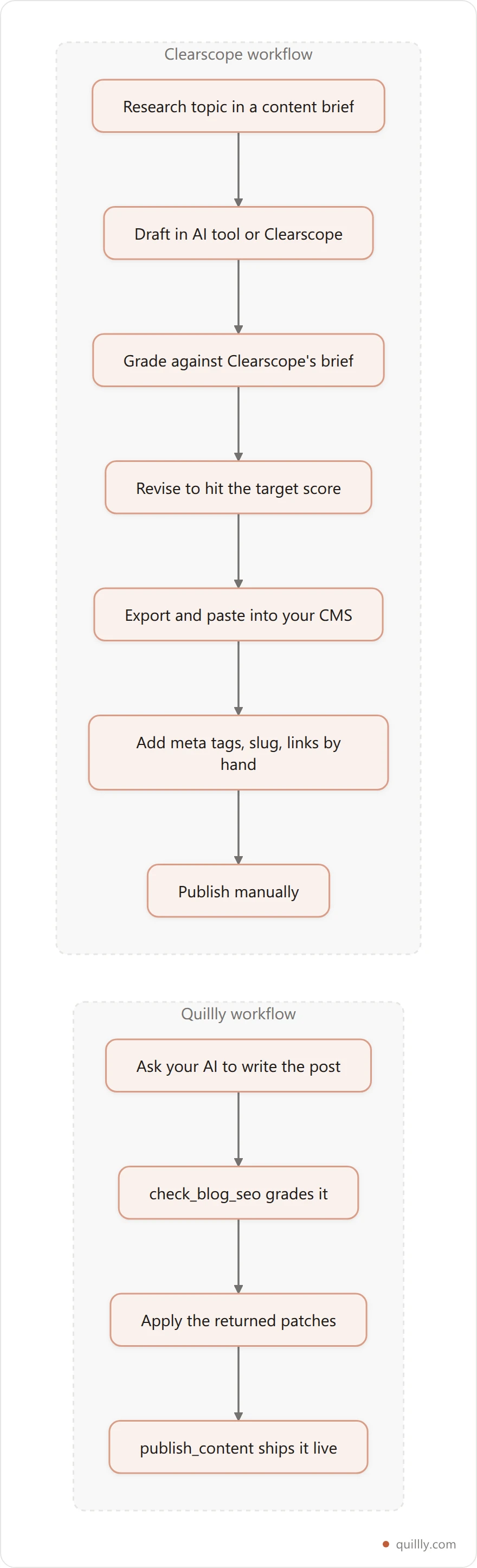
The time you get back isn't the subscription difference. It's the export-paste-format-publish sequence after the grade turns green — the part that eats 20 minutes per post and is the first thing to get skipped on a busy week, usually along with the meta tags that determine whether the post earns any impressions at all.
If you're deciding between writing tools rather than optimization tools, our ranked comparison of AI blog writers covers that side of the market instead.
How to Choose in Under Five Minutes#
If you... | Pick | Why |
|---|---|---|
Want Clearscope's scoring for less | NeuronWriter | Same core loop at $23/mo |
Need the sharpest on-page signal | Page Optimizer Pro | Specialist scoring plus live monitoring |
Want the most widely-known tool | Surfer SEO | Familiar, well-documented, similar price band |
Want drafting plus API/MCP access | Dashword | Bundles a writer and programmatic access |
Run a large team, don't mind a demo | MarketMuse | Deepest inventory and topic modeling |
Are a solo writer or small team | Quillly | Score and publish in one $9/mo conversation |
Run 4+ writers sharing one brief format | Stay on Clearscope | Unlimited seats already pay for themselves |
Before you commit, check three things: what this actually costs per writer on your team size, whether it hands you a document or a published page, and what you can still export if you cancel.
Stop grading drafts nobody publishes
Connect the AI you already use to your own domain. Draft, run a 14-point SEO check, and publish — in one conversation, 14-day trial, no card.
Start the free trialFrequently Asked Questions#
What is the closest free or cheap alternative to Clearscope?#
There's no serious free tier for ongoing work. NeuronWriter at $23/month is the closest low-cost swap with the same SERP-scoring loop. MarketMuse has a free tier, but it's capped at 10 queries a month with no tracked topics — usable for one-off checks, not a publishing cadence.
Does any Clearscope alternative publish content for me?#
Of the six alternatives compared here, only Quillly does. NeuronWriter, Page Optimizer Pro, Surfer SEO, Dashword, and MarketMuse all hand you a scored document or brief that you still move into a CMS yourself.
Is Clearscope worth it for a solo blogger?#
Usually not at full price. Clearscope's value case is unlimited seats spread across several writers; a solo blogger pays the same $129 as a six-person team for capacity they're not using. A single-user tool like NeuronWriter or Page Optimizer Pro is meaningfully cheaper than Clearscope and gets similar scoring for a quarter of the cost.
Why doesn't MarketMuse list its prices?#
MarketMuse sells through a demo-and-quote process rather than self-serve checkout, even for its entry Optimize tier. That's common in the enterprise content-ops segment, but it means you can't compare it on price without booking a call first — unlike Clearscope, Surfer, or Quillly, which all publish their pricing.
Does a higher content score actually improve rankings?#
Not by itself. A content score measures term coverage against pages that already rank, which correlates with topical relevance but ignores domain authority, backlinks, and search intent. Treat any score — Clearscope's or Quillly's — as a floor to clear, not a target to maximize. A perfectly-scored page on a new domain can still lose to an average one on an established site.
The Bottom Line#
The Clearscope alternatives worth considering split into two groups: tools that grade for less, and one tool that skips the hand-off to a CMS entirely. Clearscope's $129 floor makes sense the moment several writers share it — that's the entire product. It stops making sense the moment you're the only one logging in. If you're evaluating alternatives because the price feels wrong for your team size, NeuronWriter or Page Optimizer Pro solve that directly. If the actual complaint is that a good grade still leaves you pasting into a CMS by hand, that's a different problem, and it's the one Quillly was built to remove rather than compete on.
Run the math on your own team size before you renew anything: divide the monthly price by the writers actually using it, then ask what happens after the draft scores well. That second question is usually the one that decides it.
Connect Quillly to Claude, ChatGPT, or Cursor and publish your next post in one conversation.
What to Read Next#
SEObot alternatives: 8 AI autoblog tools ranked — for readers comparing autopilot writing tools instead of optimization tools.
Alternatives page SEO: rank and get cited in 2026 — the method behind how comparisons like this one get built.
AI keyword research: the 2026 playbook — what to do before you run anything through a scoring tool.


