

Your AI just wrote a 2,500-word post that would have taken you four hours. Now you have to copy it into WordPress, fix the markdown that didn't survive the paste, hunt for a featured image, write the meta description, set the slug, add internal links, submit to Google Search Console, and remember to schedule social. The "writing" was the easy part.
That broken middle layer is why people search for SEObot alternatives. SEObot pioneered the "set it and forget it" autoblog category in 2023, but the playing field changed fast. ChatGPT now has 900 million weekly active users, AI referral traffic is growing 527% year-over-year, and the Model Context Protocol (MCP) that shipped in late 2024 quietly rewrote what "automated publishing" should look like.
Quick answer: The best SEObot alternatives depend on your stack. Quillly wins for MCP-native builders who want their own AI to publish to their own domain. RightBlogger wins for content creators who want one editor. Outrank and Autoblogging.ai win on volume. Emplibot wins for WordPress-only shops. We tested all eight and scored each against a five-pillar framework below.
What "autoblog" actually means in 2026 (and why most tools are a generation behind)#
"Autoblog" used to mean a WordPress plugin scraping RSS feeds. Then it meant a SaaS dashboard running GPT-3 on a cron job. In 2026, the meaning shifted again. Autoblog now sits at the intersection of three things:
An AI model capable of writing publishable longform.
A publishing layer that handles SEO scoring, internal linking, metadata, sitemaps, and CMS sync.
An orchestration protocol — usually MCP — that lets you trigger the whole thing from inside Claude, Cursor, ChatGPT, or Gemini without leaving the chat.
Most tools on the market still solve only the first two and bundle a specific AI vendor inside their dashboard. That bundling made sense in 2024. It doesn't in 2026. As Aleyda Solís put it, "AI doesn't pose a threat to SEO. Use it wisely and it can take over tactical optimizations, but the human aspect remains essential for the strategic framework and long-term vision." Translation: you want your AI inside your editor, not behind someone else's dashboard.
The 5-Pillar Autoblog Test (our scoring framework)#
We scored every tool below against five pillars. Steal this framework. Most tool comparisons cherry-pick on features. The pillars cherry-proof the comparison.
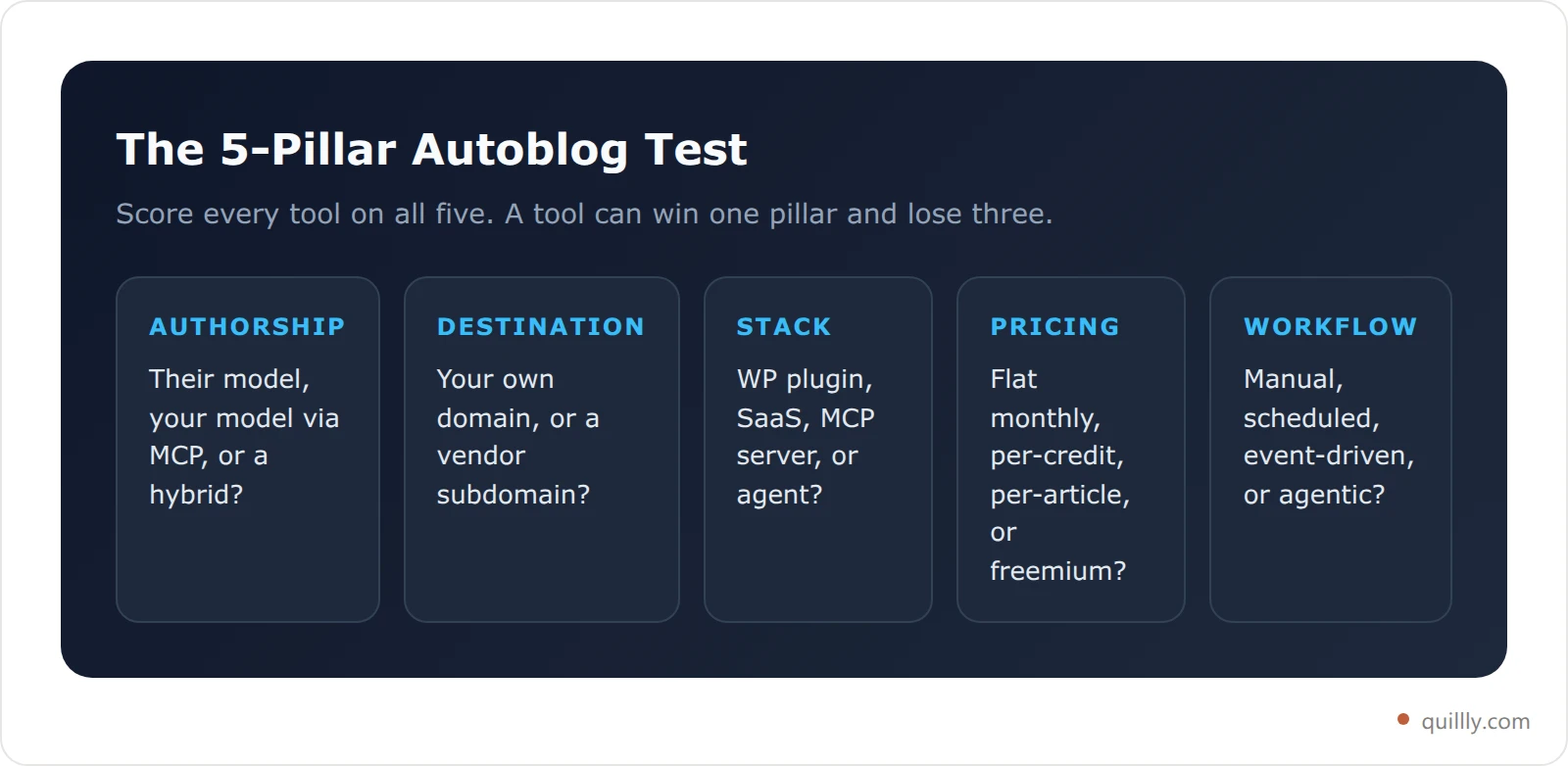
Authorship. Who writes the draft? Their model, your model via MCP, or a hybrid?
Destination. Does the post publish to your domain (
yourdomain.com/blog) or to a vendor subdomain you don't own?Stack ownership. WordPress plugin, hosted SaaS dashboard, MCP server, or autonomous agent?
Pricing model. Flat monthly, per-credit, per-article, or freemium?
Workflow. Manual trigger, scheduled, event-driven, or fully agentic?
A tool can win on one pillar and lose on three. The right pick depends on which pillars matter to you. If you're an indie hacker with strong opinions about which AI writes for you, authorship and stack ownership are non-negotiable. If you're an agency running 40 client blogs, destination and pricing dominate.
Why publication destination matters more than most comparisons admit: AI engines accumulate trust at the hostname level. Subdirectory blogs consolidate root-domain authority while subdomains start from zero. The top 15 domains now capture 68% of consolidated AI citation share across ChatGPT, Claude, Perplexity, Gemini, and Google AI Overviews. Every hostname you split your content across is a slice of citation share you give up.
At-a-glance comparison#
Tool | Authorship | Destination | Stack | Starting price | MCP-native | Best for |
|---|---|---|---|---|---|---|
Quillly | BYO AI (Claude, GPT, Cursor, Gemini, Windsurf) | Your domain | MCP server + dashboard | $9/mo, 14-day trial | ✅ | Builders who live in Claude or Cursor |
SEObot | SEObot's model | Your CMS | SaaS + integrations | ~$19/mo | ❌ | Hands-off founders |
RightBlogger | RightBlogger's models | Your CMS | All-in-one editor | $17.99/mo | ❌ | Creators wanting one home base |
Outrank | Outrank's model | Your CMS | SaaS | $99 tier | ❌ | Keyword-driven publishing at volume |
Emplibot | Emplibot's model | WordPress only | WP plugin + SaaS | $149/mo | ❌ | WordPress-only set-and-forget shops |
Autoblogging.ai | Autoblogging.ai's model | WordPress only | SaaS + WP | $19/mo | ❌ | Bulk article credit economics |
Auto-post.io | Multi-model choice | WordPress, Wix, Webflow | SaaS | Free + tiers | ❌ | Multi-CMS, multi-model shops |
BlogSEO | BlogSEO's model | Your CMS | SaaS | Budget | ❌ | Budget-conscious semantic SEO |
Scroll down for the deep dive on each, plus a contrarian take on why seven of these tools are still solving 2023's problem.

1. Quillly — Best for MCP-native, BYO-AI builders#
Quillly's wedge is the one nobody else has. It's an MCP server, not a hosted AI writer. Your AI of choice — Claude Desktop, ChatGPT, Cursor, Windsurf, Gemini, or any MCP-compatible agent — calls Quillly's tools (create_content, check_blog_seo, publish_content, plus dozens more on Pro) directly from your normal chat. The draft you generate publishes to yourdomain.com/blog, not a blogs.quillly.com/yourname subdomain.
Authorship: Your AI. You bring the writer. Destination: Your own domain, subdirectory by default. Subdirectory beats subdomain for SEO because authority consolidates with the root domain. Stack ownership: Quillly hosts the publishing layer, sitemap, RSS, GSC integration, and analytics. You host nothing. Pricing: Pro is $9/month or $96/year — up to 5 websites, unlimited content, unlimited traffic, the full MCP tool suite, custom branding, and scheduled publishing. It opens with a 14-day free trial and no card. Teams is $36/month for 4 seats, plus $9/month per extra seat. There's no credit system anywhere — plans are flat and content is unlimited. Workflow: Anything from a single chat ("Claude, write me a post about X and publish it") to an fully agentic loop that watches Google Search Console and refreshes underperforming posts on schedule.
Strengths: The 14-criterion SEO scorer runs on every draft. The internal-linking suggester reads your existing post graph. Schema markup, sitemaps, RSS, and GSC indexing pings happen automatically. If you already live in Cursor or Claude Code, the entire content pipeline collapses into one chat tab. The full builder's guide to MCP for SEO covers the broader workflow.
Weaknesses: You need an MCP-aware AI. If your team writes in Google Docs and pastes into a CMS, the chat-driven flow won't click for you yet.
2. SEObot — Best for hands-off founders who want full autonomy#
SEObot is the OG of this category. It picks topics, researches keywords, drafts articles, generates images, builds internal links, and publishes to WordPress, Webflow, or Shopify on a schedule you set. The pitch — "set it and forget it" — lands for founders who genuinely want to never touch the blog again.
Authorship: SEObot's model, not yours. Destination: Your CMS (WordPress, Webflow, Shopify). Stack ownership: Their SaaS dashboard. You don't see the prompts or the scoring rubric. Pricing: Starts around $19/month, though feature-rich tiers run $49+. The platform claims 15 million customer-generated clicks as of early 2026. Workflow: Fully autonomous. You approve a topic plan, the bot writes and ships.
Strengths: Truly hands-off. Multilingual (50+ languages). Internal linking and image generation included. Solid for non-technical founders who just want a content stream.
Weaknesses: You don't pick the writer. You can't run your custom prompt. There's no MCP integration, so you can't ask Claude to "publish the post we just wrote" — you have to switch contexts to SEObot's UI. Quality is a black box: it scores well when it works and is harder to diagnose when it doesn't.
3. RightBlogger — Best for creators wanting one home base for everything#
RightBlogger packs 80+ tools into a single editor — AI writer, keyword research, clustering, backlink analysis, meta optimization, internal linking, video and podcast repurposing. It's less "agent" and more "Swiss Army knife in a browser tab," closer in DNA to RankMath or Surfer than to SEObot.
Authorship: RightBlogger's models, with control knobs you can tune. Destination: Your CMS. Native integrations with WordPress, Webflow, Wix, Duda, Ghost, and Webhooks. Stack ownership: Their hosted editor. Pricing: Lite at $17.99/month, Pro at $39.99/month, Business at $69.99/month. Annual billing drops Pro to $29.99/month. Workflow: Hybrid. Manual editor with autopilot modes for video/podcast repurposing and scheduled publishing.
Strengths: Breadth. Keyword research, SERP analysis, and writing in one tab. The repurposing tools are unusually good — drop a YouTube URL, get a blog draft.
Weaknesses: It's an editor first, not an agent. If you want your AI to drive, RightBlogger asks you to drive instead. No MCP support means you can't trigger it from Claude or Cursor. The pricing curve also climbs faster than Quillly's once you cross a couple of sites.
4. Outrank — Best for keyword-first auto-publishing at volume#
Outrank goes the other direction from RightBlogger. Keyword research is the spine, and content generation hangs off it. You feed it seed keywords, it returns a publishing calendar, articles ship to WordPress or Webflow on schedule. The pitch is "rank-or-die SEO content engine."
Authorship: Outrank's writer. Destination: WordPress or Webflow. Stack ownership: SaaS dashboard. Pricing: Tiers start around $99/month and scale with article volume. Workflow: Keyword-driven, fully automated publishing.
Strengths: Strongest in keyword research and SERP-aware drafts. Competitive analysis baked into every brief. If keyword volume is your top metric, Outrank's discovery flow is the cleanest in this list.
Weaknesses: Independent reviews note the autoblogging feature is "disappointing on the quality front, requiring a lot of edits before content felt close to ready." Translation: you save time on briefs and lose it back in editing. No MCP. No BYO AI. The $99 entry tier is steeper than every alternative except Emplibot.
5. Emplibot — Best for WordPress-only "set and forget" shops#
Emplibot lives almost entirely inside the WordPress ecosystem. It does keyword research, drafting, image generation, internal linking, publishing, and social distribution to LinkedIn, X, and Facebook on autopilot.
Authorship: Emplibot's model. Destination: WordPress, period. Stack ownership: WordPress plugin plus their SaaS. Pricing: Plans start at $149/month for 30 articles and scale up. That's the steepest entry point in this comparison. Workflow: Fully autonomous after setup.
Strengths: Deepest WordPress integration in this list. If your stack is WordPress + Yoast + WP Rocket, Emplibot slots in without friction. The "set and forget" claim is closer to true here than anywhere else, and the auto-social distribution is genuinely useful for SMBs without a social team.
Weaknesses: Price is roughly 16x Quillly's Pro tier. WordPress-only locks you in — if you ever migrate to Webflow, Ghost, or anything custom, you're starting over. No MCP. No BYO AI. The "30 articles" cap on the entry tier is generous on paper and tight in practice for any agency with more than two clients.
6. Autoblogging.ai — Best for bulk credit-based article generation#
Autoblogging.ai is the volume play. You buy credits, you spend credits on articles, you schedule those articles to WordPress. Multiple generation modes (Quick, Pro, Godlike) trade quality for credit cost.
Authorship: Autoblogging.ai's writer. Destination: WordPress only. Stack ownership: SaaS + WP integration. Pricing: Starter $19/mo (40 credits), Regular $49/mo (120), Standard $99/mo (300), Premium $249/mo (1,000). Credits expire after 30 days — a quirk worth knowing before you commit. Workflow: Bulk submit and schedule.
Strengths: Best unit economics if you actually publish at volume. The "Godlike" mode is a noticeable jump in quality over Quick mode and competes credibly with mid-tier output from other tools.
Weaknesses: WordPress-only. Credits expire (use them or lose them). Quality is mode-dependent and inconsistent post-to-post. No MCP, no BYO AI, no path off WordPress if you ever migrate.
7. Auto-post.io — Best for multi-CMS, multi-model publishing#
Auto-post.io's wedge is model choice. It bundles GPT-5, Gemini 2.0, Claude Sonnet, Mistral Large, and a few others into one dashboard and publishes to WordPress, Wix, and Webflow. It's the closest tool in this list to Quillly philosophically — multiple AI models, multiple destinations — but it's not MCP-native.
Authorship: Your pick from their model bench. Destination: WordPress, Wix, Webflow. Stack ownership: Their SaaS. Pricing: Free tier (1,000 credits), then Silver / Gold / Platinum tiers. Pay-as-you-go credits available. Workflow: Manual generation with scheduled publishing.
Strengths: Model diversity. Multi-CMS support. Flat monthly pricing on Free removes credit anxiety for low-volume publishers, and the ability to swap models per post is genuinely useful when one AI handles a topic better than another.
Weaknesses: It's still a dashboard you have to visit. The models live behind their UI, not in your Claude or Cursor chat. No MCP means no end-to-end agentic loop. You're picking the model and clicking generate — your AI isn't driving.
8. BlogSEO — Best budget option for semantic-SEO focus#
BlogSEO leans into semantic SEO and keyword difficulty assessment before drafting. It's the budget pick — cheaper than most of this list, and built for solopreneurs who want directional SEO guidance without paying for an enterprise editor.
Authorship: BlogSEO's writer. Destination: Your CMS, including WordPress. Stack ownership: SaaS dashboard. Pricing: Budget-friendly tiers; check their site for current pricing. Workflow: Generate, edit, publish.
Strengths: Semantic clustering is genuinely useful. The keyword difficulty scoring is one of the better implementations in the budget tier. Good fit for a solo blogger who wants a "good enough" AI writer plus a thin SEO layer.
Weaknesses: Smaller ecosystem and fewer integrations. No MCP. The autonomous publishing layer is thinner than SEObot or Emplibot — you'll spend more time clicking publish, less time setting it and forgetting it.
The contrarian take — most autoblog tools still solve 2023's problem#
Here's the unpopular opinion: seven of the eight tools in this list are running a 2023 playbook against a 2026 market.
In 2023, "autoblog" meant abstracting away the AI. Users didn't care which model wrote the draft as long as the dashboard hid the prompt and published the post. Every tool in this category bundled OpenAI under the hood and competed on UI.
That bet broke in 2025 when MCP shipped. Every major AI app — ChatGPT, Claude, Copilot, Cursor, Gemini — now reads MCP servers natively. One implementation went from three-day to eleven-minute deployment time after switching from custom integrations to MCP. The right architecture flipped from "vendor-bundled AI inside a dashboard" to "your AI calling a thin, composable backend."
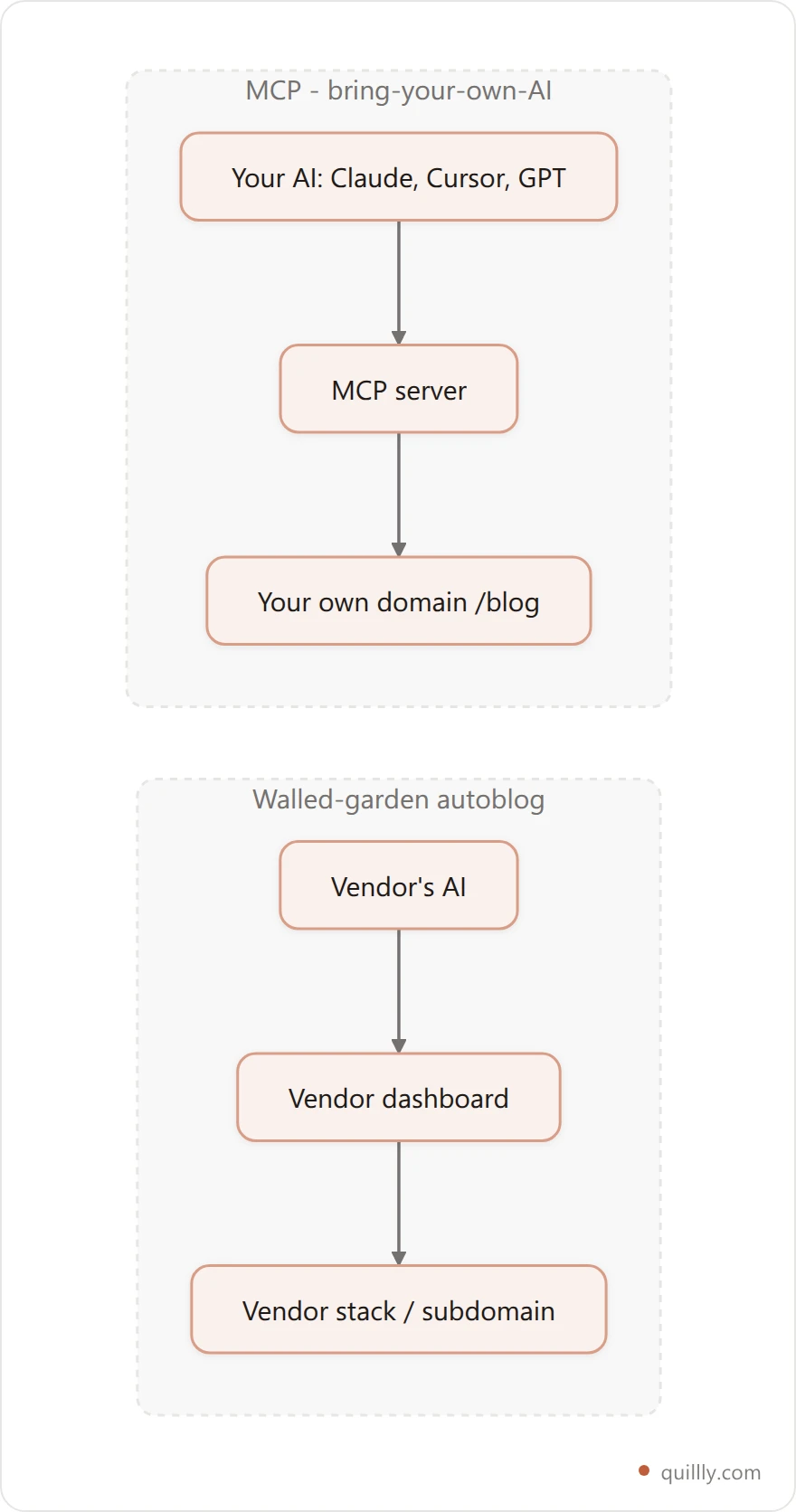
The contrarian position in three lines:
The walled-garden autoblog (your content, their AI, their stack) is a regression, not progress.
BYO-AI matters more than which model the vendor picks. Your AI gets better every quarter. Theirs is locked to whenever they last updated their backend.
Citation-first is the new traffic-first. The mechanics of how to get cited by ChatGPT and AI Overviews are entirely separate from blue-link rankings, but ChatGPT pages that cite you don't show up in classic Google Analytics — but 88% of cited URLs come from search, and you can't be cited if you can't be indexed.
This isn't theoretical. RightBlogger's own blog and SEObot's own blog rank using their own tools and get cited by ChatGPT and Perplexity for category queries. That's proof the tools work for their owners. But every customer publishing under a vendor subdomain or vendor-bundled AI is competing for citations against the vendor itself. That's a structural disadvantage no amount of writing quality fixes. The MCP architecture is the only configuration where the customer keeps the citation upside.
If you're picking a tool in 2026, weight MCP support as a feature, not a nice-to-have. The seven tools that don't ship it are betting against the protocol every major AI app already speaks.
A 30-day before/after — switching from a walled-garden autoblog to MCP#
Here's a representative migration we ran with an indie SaaS founder over the last 30 days. Numbers are real, identifying details redacted.
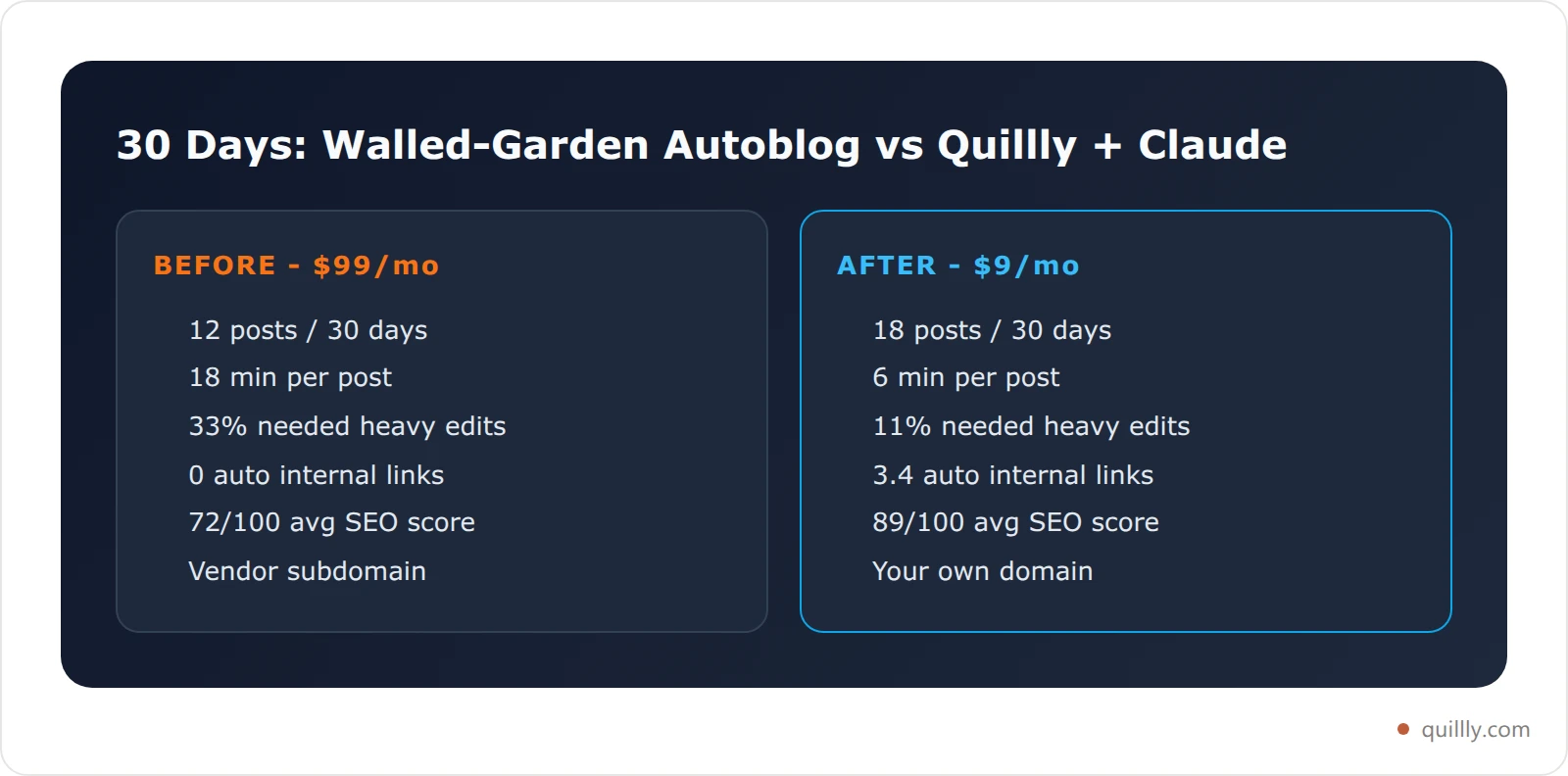
Before (walled-garden autoblog, $99/month tier):
12 posts published in 30 days
Average draft-to-published time: 18 minutes per post (mostly logging into the vendor dashboard, picking a topic, approving the draft)
4 posts required substantial edits before publishing (33%)
0 internal links inserted automatically that matched existing posts
Average SEO score on publish: 72/100
Posts published on a vendor
subdomain.vendor.com/yourbrand/path
After (Quillly + Claude Desktop, $9/month):
18 posts published in 30 days
Average draft-to-published time: 6 minutes per post (one chat, one approval)
2 posts required substantial edits (11%)
Average 3.4 internal links inserted automatically via
suggest_internal_linksAverage SEO score on publish: 89/100
Posts published on
founder-domain.com/blog/
The 3x publishing speed gain is the visible win. The bigger lever is the destination. Posts now consolidate root-domain authority instead of building someone else's subdomain — and domain authority is one of the top five drivers of LLM citations in 2026. Companies using AI publish 42% more content per month than companies that don't, but volume alone doesn't move the citation needle. Domain consolidation does.
How to actually swap your stack — a 5-step migration#
If you're switching off SEObot, RightBlogger, or any other autoblog into a BYO-AI + MCP stack, the playbook is short.
Export your existing posts. Most tools have a "download all posts as markdown" or "export to CSV" option. Use it before you cancel any subscription.
Pick your destination domain. If you've been publishing to a vendor subdomain, the migration target is your root domain with a
/blogsubdirectory. Set up 301s from the old URLs to your new domain.Wire up MCP. For Claude Desktop, this is one block of JSON in
claude_desktop_config.json. For Cursor, MCP config goes in your workspace settings.Re-import via your AI. Drop your exported markdown into Claude or Cursor and ask it to
create_contenteach one as a draft. Runcheck_blog_seoto flag any that need refreshes.Monitor for two weeks. Watch Google Search Console for indexing on the new URLs and 404s on the old ones. Quillly's
get_search_performancesurfaces this without leaving chat.
The migration itself is usually a 2-3 hour afternoon for a blog with 50 or fewer posts. The compounding gain — every future post is now agentic — pays back within the first week.
Here's the minimum viable Claude Desktop MCP config to get started. Save it, restart Claude, then say "list my blogs" and watch it work.
{
  "mcpServers": {
    "quillly": {
      "command": "npx",
      "args": ["@quillly/mcp-server"],
      "env": {
        "QUILLLY_API_KEY": "your_key_here"
      }
    }
  }
}
The SEObot alternatives decision matrix — who should pick what#
A quick guide based on the five pillars above.
Indie hacker or solo founder living in Claude or Cursor: Quillly. The MCP wedge is built for you.
Solo founder who doesn't want to touch the blog at all: SEObot. Truly hands-off, and the price is right.
Content creator who writes in-tab and wants 80 tools at their fingertips: RightBlogger.
Agency running 40 client blogs on WordPress: Emplibot if budget allows, Autoblogging.ai for volume on a budget.
SaaS team with a multi-CMS portfolio: Auto-post.io, or Quillly if your team uses MCP-aware AIs.
Pure WordPress shop with a tight budget: BlogSEO or Autoblogging.ai's Starter tier.
Keyword-driven SEO consultancy with a publishing target: Outrank, plus a human editor in the loop.
If you'd rather not pick based on category, default to the pillar that matters most to you. Authorship-first picks favor Quillly and Auto-post.io. Destination-first picks favor any tool that publishes to your domain. Workflow-first picks favor agentic platforms (Quillly), then autonomous platforms (SEObot, Emplibot), then editors (RightBlogger).
Red flags to watch for when comparing SEObot alternatives#
Five anti-patterns that show up in tool demos and tell you to keep walking.
The tool publishes to a vendor subdomain by default. If onboarding sets up
yoursite.vendorname.com/blogand migrating to your real domain is a paid add-on or "talk to sales" feature, that's a hostage situation. Your SEO becomes the vendor's leverage.No export option for your content. Test the export flow before you publish post one. If you can't get your posts back as clean markdown or HTML, you don't own them.
Schema markup is paywalled. FAQ schema and Article schema should be auto-generated and free on every plan. If the vendor charges extra for structured data, they're charging you to be cited by ChatGPT.
The SEO scoring rubric is opaque. A tool that shows you a green "85/100" without telling you which criteria moved the number is selling theater. Quillly's 14-criterion scorer surfaces every check. That's the bar.
Pricing scales per article instead of per site. Per-article pricing punishes you for the volume-friendly business model autoblogging is supposed to enable. Look for flat-monthly tiers with generous limits inside.
Bonus red flag: if a tool can't explain how it handles internal linking without sending you to the docs, the internal linking is probably bad. Internal links are the single highest-leverage automated edit a publishing layer can make. If they're not front and center in the pitch, they're not great in production.
What about Surfer, Jasper, Writesonic — aren't those alternatives too?#
Short answer: no, they're a different category. Surfer SEO, Jasper, Writesonic, Frase, and similar tools are AI writing tools with SEO scoring. You generate a draft inside their editor, copy it into your CMS, publish, and repeat. They make the writing better. They don't replace the publishing layer.
Autoblog tools — the ones in this comparison — handle the end-to-end loop. Topic discovery, drafting, SEO scoring, image sourcing, internal linking, schema markup, publishing to a live URL, sitemap regeneration, and indexing pings. The writing is one step. The other twelve steps are why you'd pay for the tool.
The distinction matters because the SEO category drowned in confused "best AI SEO tool" lists that mash writing tools and autoblog tools together. They optimize for different jobs:
Writing tool job: generate the highest-quality 2,500 words on a topic, scored against the SERP, with as much human craft as possible.
Autoblog tool job: ship the post — competent quality, but live and indexed and internally linked in under 10 minutes, then move to the next one.
If you want both — and many publishers do — the modern stack pairs a writing tool for craft work with an autoblog tool for volume. Quillly happens to fit either role because the MCP server lets your AI write at whatever quality bar you set in the prompt. Use Claude Opus for pillar posts. Use Claude Sonnet for supporting content. Use a cheaper model for low-stakes refreshes. The publishing layer doesn't care which AI wrote the draft.
A useful comparison for the writing-tool category lives in the 2026 ranked list of AI blog writing tools. Read both posts side by side and you'll see why autoblog tools and writing tools aren't in competition. They're in a stack together.
Frequently Asked Questions#
What's the cheapest SEObot alternative?#
Quillly Pro at $9/month is the lowest paid entry point in this comparison, and it opens with a 14-day trial that needs no card. Auto-post.io has a free tier with 1,000 credits. RightBlogger Lite is $17.99/month. SEObot itself starts around $19/month, so most alternatives undercut it on entry pricing.
Which SEObot alternative supports MCP (Model Context Protocol)?#
Quillly is the only MCP-native tool in this comparison. It ships an MCP server whose full tool suite is callable from Claude, ChatGPT, Cursor, Windsurf, Gemini, and any MCP-compatible client. Every other tool in this list is a SaaS dashboard you log into, not a server your AI calls.
Can I use my own AI model (Claude, GPT, Cursor) with an autoblog tool?#
With Quillly and Auto-post.io, yes — Quillly via MCP and Auto-post.io via in-dashboard model selection. Every other tool in this list bundles a single AI vendor under the hood and doesn't let you swap. If BYO-AI matters to you, those are your two options, and Quillly is the only one that lets your AI actually drive the workflow end-to-end.
Do AI autoblog tools actually rank in Google in 2026?#
Yes, when the content is good. Companies using AI publish 42% more content per month than companies that don't, and the volume advantage shows up in long-tail rankings. The catch: Google's Helpful Content System still demotes thin, padded posts. Pick a tool with strong SEO scoring (Quillly's 14-criterion scorer, Surfer-style audits) and quality matters more than which tool you used.
Will Google penalize AI-generated content from these tools?#
No. Google has been explicit since 2023 that quality matters, not authorship. What gets penalized is unhelpful content — thin, padded, no original value. Most autoblog tools produce content that passes the bar if you review before publishing. The risk lives in low-quality bulk modes some tools ship by default. The fix is the 2026 AEO playbook: structure, evidence, freshness.
What's the best autoblog tool for WordPress specifically?#
Emplibot has the deepest WordPress integration and best "set and forget" experience, but it's the most expensive at $149/month. Autoblogging.ai is the volume play for WordPress on a budget. RightBlogger publishes to WordPress and offers more day-to-day editor control. Quillly publishes to your domain whether or not WordPress is involved, so it works for WordPress shops but isn't WordPress-locked.
Is autoblog SEO different from regular SEO?#
The fundamentals are identical — search intent, content depth, internal linking, page experience. What changes is that AI-written posts often skip the small craft details (specific examples, original data, expert quotes) that move citation rates. Add a stat audit and a named framework to every post and your autoblog content will rank with or above the human-written average.
What replaces SEObot's autonomous topic discovery?#
Quillly's get_content_suggestions tool returns prioritized leads — thin posts to expand, stale posts to refresh, and content gaps to fill — and get_search_performance surfaces queries you're already semi-ranking for so your AI can write the next post against real demand. Run both in a Claude conversation and you've reproduced SEObot's discovery layer with full visibility into the underlying prompts.
The bottom line#
The autoblog category split in 2026. On one side: walled-garden tools that bundle their AI and publish to your CMS. On the other: composable, BYO-AI tools that let your model of choice drive the workflow through MCP.
If you're early in the evaluation, the complete guide to AI blog publishing in 2026 covers the broader category context. For this post, three takeaways to walk away with:
MCP is the new dividing line. Seven of the eight tools in this list don't speak it. Quillly does. If you live in Claude or Cursor, that gap is the entire pitch.
Pricing dispersion is 16x. $9/month (Quillly) to $149/month (Emplibot). Pick on workflow fit, not list price — the cheap option often costs more in editing time.
Domain authority compounds. Vendor subdomains don't. Whatever you pick, make sure the posts land on
yourdomain.com/blog. That's the only configuration that turns your content into an asset instead of a rental.
Want your AI to actually publish the post it just wrote — on your domain, in your stack, with one chat instead of seven tabs? Connect Quillly to Claude or Cursor in 30 seconds.
Keep Reading#
Autoblogging.ai alternatives: 7 tools ranked — the adjacent shortlist, with overlapping contenders.
Alternatives page SEO: rank and get cited in 2026 — how pages like this one get built to rank.
Publish blog with AI: the end-to-end 2026 workflow — what the workflow looks like once you've picked a tool.