

Search "backlink software" and page one hands you an eBay listing, a YouTube video promising unlimited backlinks built by AI, and a forum thread where people argue about which blaster still works. That spread isn't an accident. The category lumps together products that do completely unrelated jobs — and exactly one group of them can get your site penalized.
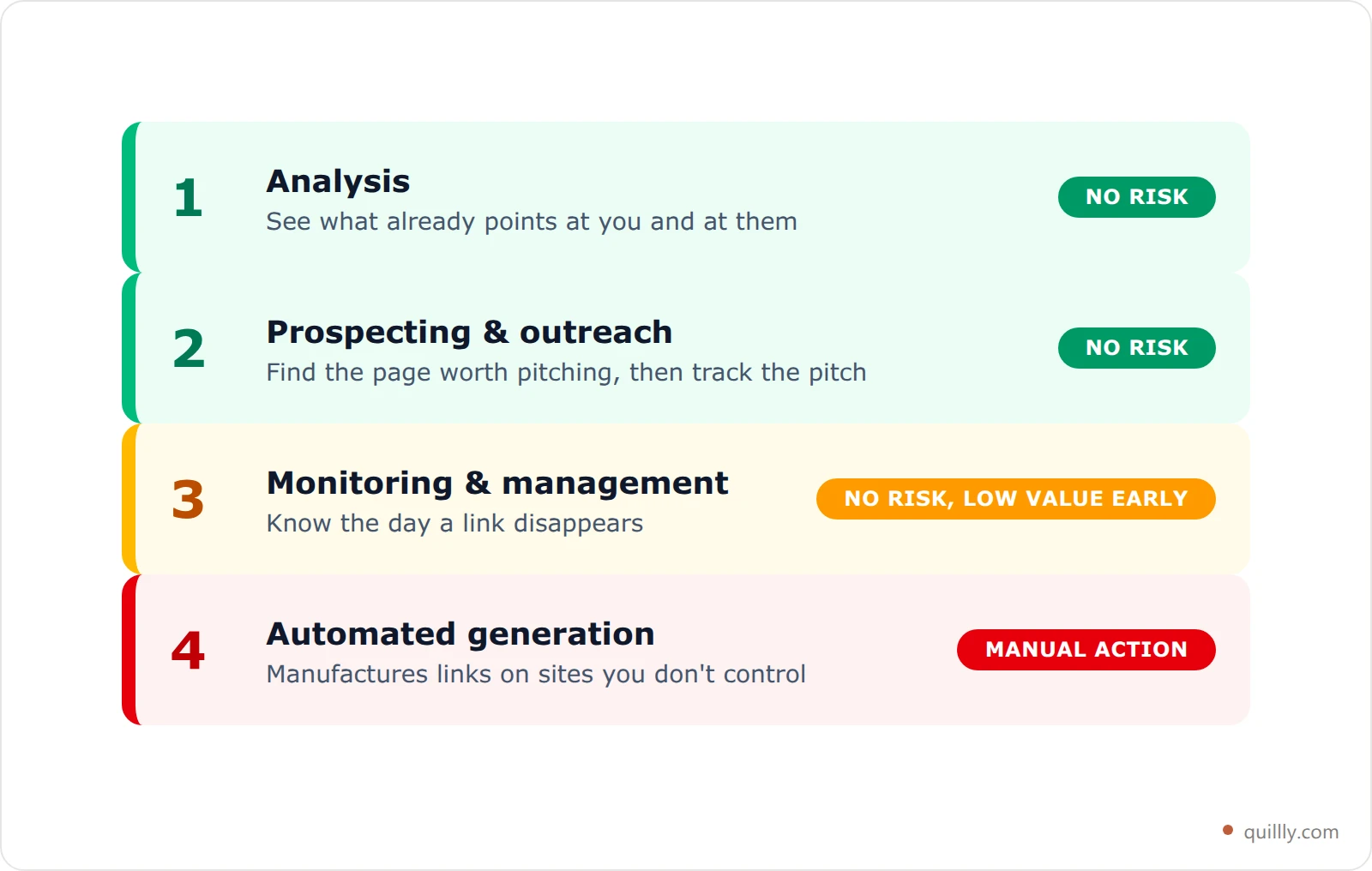
Short answer: backlink software splits into four tiers — analysis, prospecting and outreach, monitoring, and automated generation. The first three are safe, and they do almost all of the real work. The fourth builds the patterns Google's spam policies name directly, and it's the only tier that risks a manual action.
This guide sorts nine tools by what they do and what they cost you in risk — not by which has the nicest dashboard.
Backlink Software at a Glance: Four Tiers#
Tier | What it does | Tools | Penalty risk | Worth it under DR 30? |
|---|---|---|---|---|
1. Analysis | Shows the links you and your competitors already have | Ahrefs, Semrush Backlink Analytics, Moz Link Explorer, Search Console | None | Yes — start here |
2. Prospecting & outreach | Finds pages worth pitching and tracks the pitch | BuzzStream, Respona, Pitchbox, Hunter.io, Quillly | None | Yes — this is the work |
3. Monitoring & management | Alerts you to links won and lost, tracks authority | Ahrefs alerts, backlink CRMs, Quillly | None | Later, once links exist |
4. Automated generation | Mass-creates links on sites you don't control | Blasters, PBN builders, link marketplaces | High | No |
Read the table left to right and the pattern jumps out: risk only appears in the row where the software stops finding links and starts manufacturing them.
Tier 1: Analysis Tools Tell You Where You Stand#
Every useful link decision starts with a number you probably don't have: how many referring domains you've got, and which ones carry weight.
Ahrefs has the deepest index of the three big crawlers, and its Domain Rating is the metric most people mean when they say "authority." It's the default for a reason. Semrush Backlink Analytics covers the same ground inside a broader marketing suite, which matters if you're already paying for the suite. Moz Link Explorer is the cheapest of the three and adds Spam Score, a useful gut-check on a referring domain you're unsure about.
Then there's the one nobody counts as backlink software: Google Search Console. Its Links report is the only view of your backlinks that comes from Google itself rather than a third-party crawl. It's free, it's incomplete, and it's the closest thing to ground truth you'll get.
Here's the part most roundups skip. At low authority, analysis tools tell you something uncomfortable: your competitors' link counts are unreachable in the near term, and chasing their number is the wrong goal. What you're actually looking for is which specific pages link to them — because those pages are your prospect list. We wrote about what Domain Rating does and doesn't predict in DR in SEO, and the short version is that the score follows the links, never the other way around.
Use Tier 1 to get a baseline and a prospect list. Then stop paying for it monthly if money's tight — a one-month snapshot ages slowly when you only add a handful of links a quarter.
Tier 2: Prospecting and Outreach Is the Actual Job#
This is where links come from. Not from software that makes them — from software that finds a human who might add one, and keeps you organised while you ask.
BuzzStream, Respona, and Pitchbox are outreach CRMs. They build prospect lists, find contact details, send sequenced emails, and track who replied. Pitchbox aims at agencies running hundreds of campaigns; BuzzStream and Respona suit smaller teams. Hunter.io does one slice of that well — turning a domain into a verified email address — and pairs with anything.
All four assume you already know which pages to pitch. That's the gap most solo operators get stuck in.
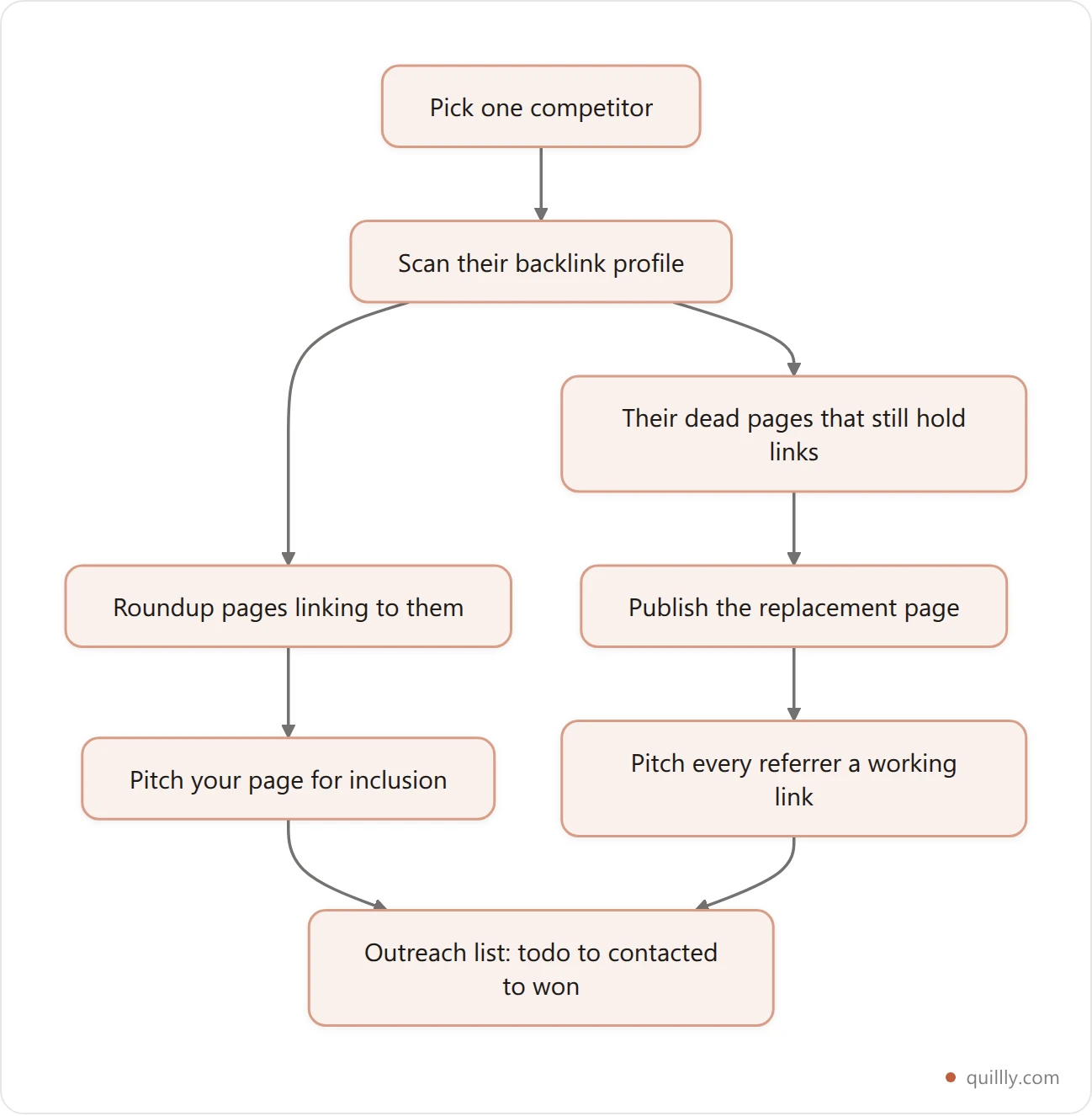
Quillly's find_link_prospects closes it from the other direction: point it at one competitor's domain and it returns two lists built from their backlink profile. The first is every roundup page already linking to them — "best", "top", "tools", "alternatives", "vs" titles, dofollow, one per referring domain, with authority attached. Those pages have proven they'll link to a product like yours. The second is their dead pages that still hold backlinks, grouped by dead URL with sample referrers. You publish the replacement, then pitch every referrer a working link.
Prospects save to a shared outreach list that moves through todo → contacted → won → dismissed, so the next session picks up where the last one left off instead of re-scanning. A scan costs 15 research credits, and the $19/month Pro plan includes 100 a month — roughly six competitor profiles.
If you have no audience yet, the sequencing matters more than the tooling — that's the whole argument of our link building playbook for startups.
See how the directory list is scored →
Tier 3: Monitoring and Management Software#
Links rot. A roundup gets rewritten, a site redesigns, an editor leaves, and the link you earned in March is gone by August with no notification.
Backlink management software watches for that. Ahrefs and Semrush both send alerts on new and lost referring domains. A handful of dedicated backlink CRMs — the category the term "backlink management software" usually means — add per-link status, outreach notes, and exchange tracking on top.
Quillly covers the narrow version of this: it tracks your Ahrefs Domain Rating over time alongside indexing coverage and keyword positions, so you can see whether the links you earned moved the number. It won't replace a dedicated link CRM at scale.
Be honest about timing, though. Monitoring is Tier 3 because it's only worth paying for once there's something to monitor. Twelve referring domains don't need alerting software; you'll notice. Revisit this tier at a hundred.

Tier 4: Automatic Backlink Software Is Where the Risk Lives#
Now the tier the SERP is loudest about. Automatic backlink software — blasters that post to comment fields, forum profiles, wikis and web 2.0 properties, private blog network builders, and marketplaces selling placements by the hundred — works by creating links on sites you don't control, at a volume no human could.
Google's spam policies describe this as link spam in plain terms: links intended to manipulate rankings, including buying or selling links for ranking purposes and large-scale automated link creation. The consequence isn't theoretical. It's a manual action, visible in Search Console, which can suppress individual pages or a whole site until you clean up and file a reconsideration request.
Three things make this a bad trade even setting ethics aside:
The footprint is the product. Mass-generated links share patterns — the same anchor text, the same platforms, the same velocity — and pattern detection is exactly what these systems are good at.
Cleanup costs more than the links. You'll be removing links one by one, then reaching for the disavow tool, which Google treats as an advanced last resort rather than a reset button.
It's the same engine that drives bulk content penalties. The scaled-content pattern we covered in Scaled Content Abuse is the content-side sibling of link spam. Same policy logic, same outcome.
Directory and listing submissions sit in a different place than people assume. A human-curated, genuinely-used directory is a legitimate citation, not a blast — which is why we keep a scored list of them. Quillly tracks 165 directories, 50 of them rated DR 70+, and Directory Submission Sites goes through which categories still pass in 2026 and which are dead weight.
How to Choose Backlink Software for Your Situation#
Match the tier to the constraint that's actually binding, not to the feature list.
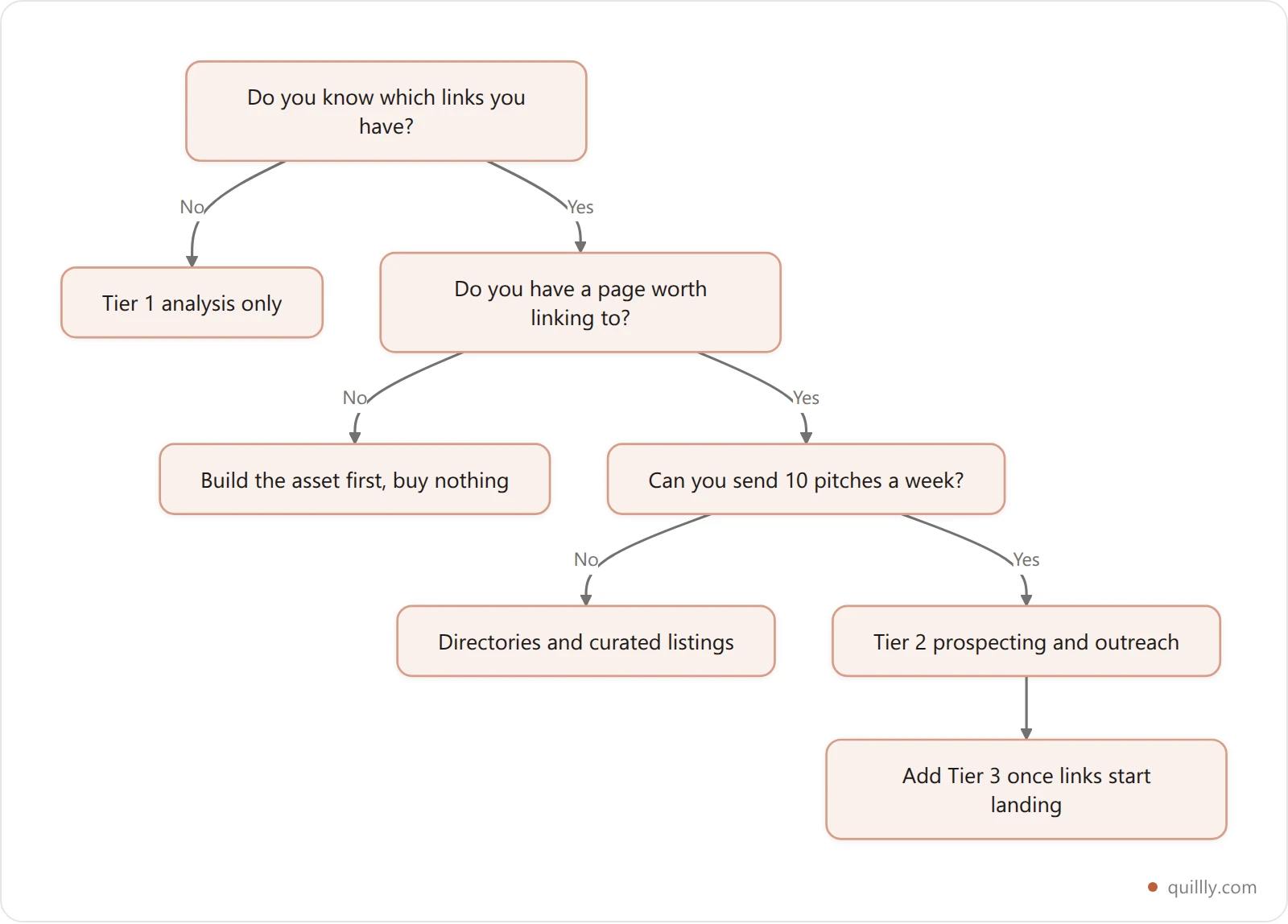
A few rules that hold up:
Under DR 20 with no linkable asset? Buy nothing. No backlink software fixes an empty site — you need one page worth citing first.
One-person team? Pick one Tier 1 tool and one Tier 2 workflow. Three overlapping subscriptions is the most common wasted spend in this category, and our breakdown of what each SEO price tier actually buys shows how fast it compounds.
Agency or multi-site? Pitchbox-class outreach plus a real CRM pays for itself on volume alone.
Tempted by Tier 4 because progress is slow? That's the exact moment it's most expensive. Authority compounds; a manual action resets the compounding.
Find who already links to your competitors
Scan one competitor's backlink profile, get the roundup pages worth pitching and their dead pages worth replacing, then track every pitch in a shared outreach list.
Start on QuilllyWhat Backlink Software Can't Do#
Worth naming the limits, because every tool in this category is sold as if it had none.
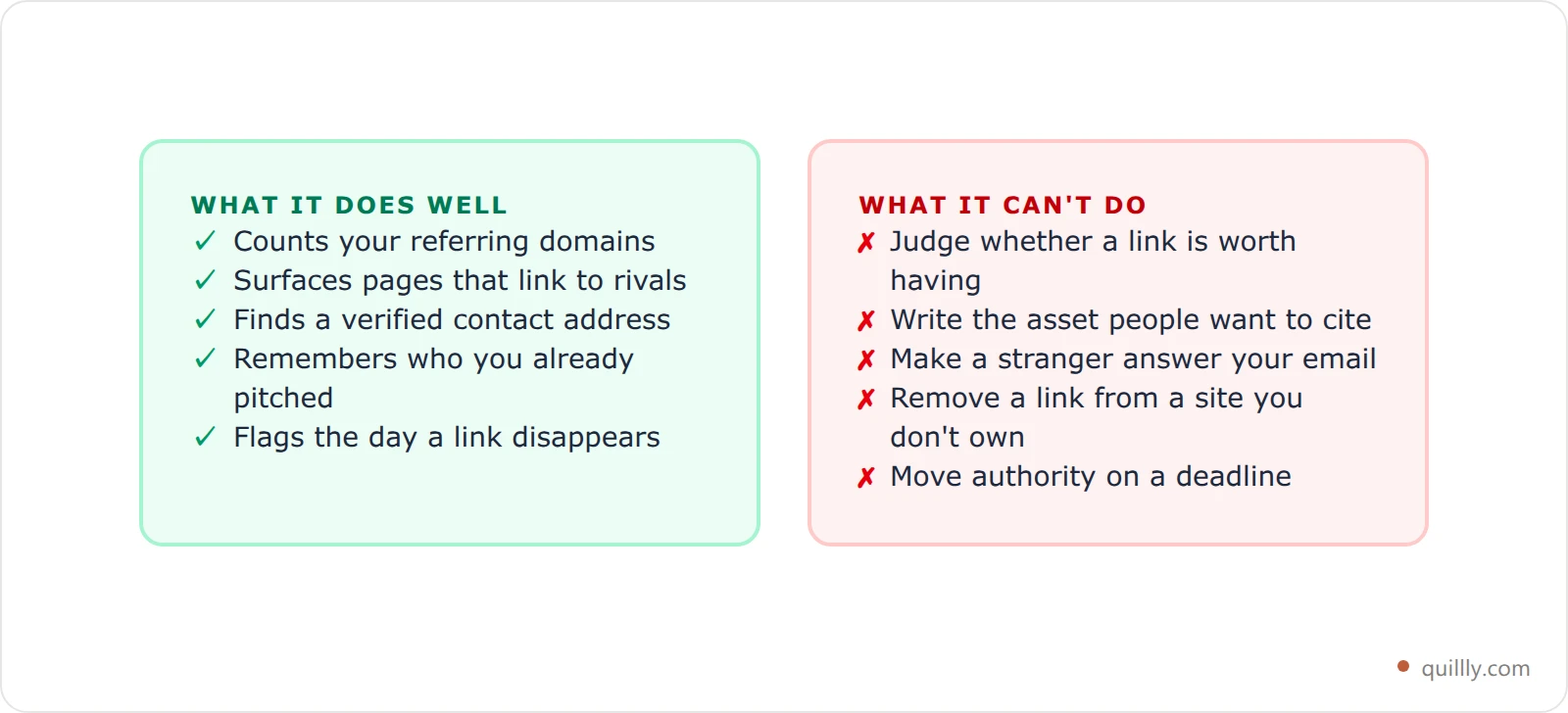
No backlink software decides whether a link is worth having — authority metrics are third-party estimates, not Google's own, and a DR 70 page in an unrelated niche can be worth less than a DR 25 page in yours. None of them writes the thing people want to link to. None of them makes a stranger answer your email; reply rate is a function of your pitch and your page, and better software only lets you send a bad pitch faster.
We test this on our own domain rather than taking it on faith. Quillly's Domain Rating moved from 12 to 19 across the last stretch of daily publishing and curated directory listings — no Tier 4 tool touched it. That pace is unglamorous, and it's also the honest number.
And none of them moves authority quickly. If you want the realistic timeline rather than the sales version, how to increase Domain Rating lays out what a few months of honest link building actually returns.
The useful framing: Tier 1 tells you where you are, Tier 2 does the work, Tier 3 protects what you won, and Tier 4 is a loan against your domain that comes due at the worst moment. You can run a respectable link profile with one tool from Tier 1 and one from Tier 2 — and checking your DR for free costs nothing while you decide.
Key Takeaways for Picking Backlink Tools#
Analysis first. One Tier 1 tool gives you a baseline and, more usefully, a prospect list built from the pages already linking to your competitors.
Outreach is the job. Link building software doesn't create links — it keeps you organised while you ask humans for them. That's the honest description of the whole category.
Monitor later. Alerting earns its subscription at a hundred referring domains, not at twelve.
Skip Tier 4 entirely. Automated generation is a loan against your domain, and it comes due at the worst possible moment.
Two subscriptions beat five. The most common waste in backlink tools is three products quietly doing the same job.
If one line survives this article: backlink tools that find links are an investment, and backlink software that manufactures links is a liability.
Frequently Asked Questions#
Is backlink software safe to use?#
Tiers 1 through 3 are completely safe — they analyse, find and monitor links without creating any. Only Tier 4 automated generation carries penalty risk, because it manufactures links at scale on sites you don't control, which is the behaviour Google's link spam policies target.
What's the best free backlink software?#
Google Search Console's Links report, and it isn't close. It's the only backlink data that comes from Google rather than a third-party crawl. It's incomplete and has no outreach features, but for knowing what actually points at you, nothing free beats it.
Does automatic backlink software still work in 2026?#
Not in any way worth betting a domain on. Mass-generated links leave detectable footprints in anchor text, platform mix and velocity. Any short-term movement comes with manual-action exposure, and cleanup means link-by-link removal plus a disavow file and a reconsideration request.
How many backlinks do I need to move Domain Rating?#
There's no fixed number — DR responds to the authority of referring domains, not their count. A handful of genuinely strong, topically relevant domains moves the score more than a hundred weak ones. Early on, ten good referring domains usually beat anything volume-based.
Can backlink software remove bad links?#
No tool removes a link from a site you don't own. The sequence is manual: ask the site owner, and if that fails, list the URLs in Google's disavow tool. Treat disavow as an advanced last resort, not routine maintenance — a careless file can hurt you.
Do I need backlink software if I'm just starting out?#
Probably not yet. With under a dozen referring domains and no page worth citing, software isn't the constraint — the asset is. Publish something genuinely worth linking to first, then add one analysis tool and one outreach workflow.


