


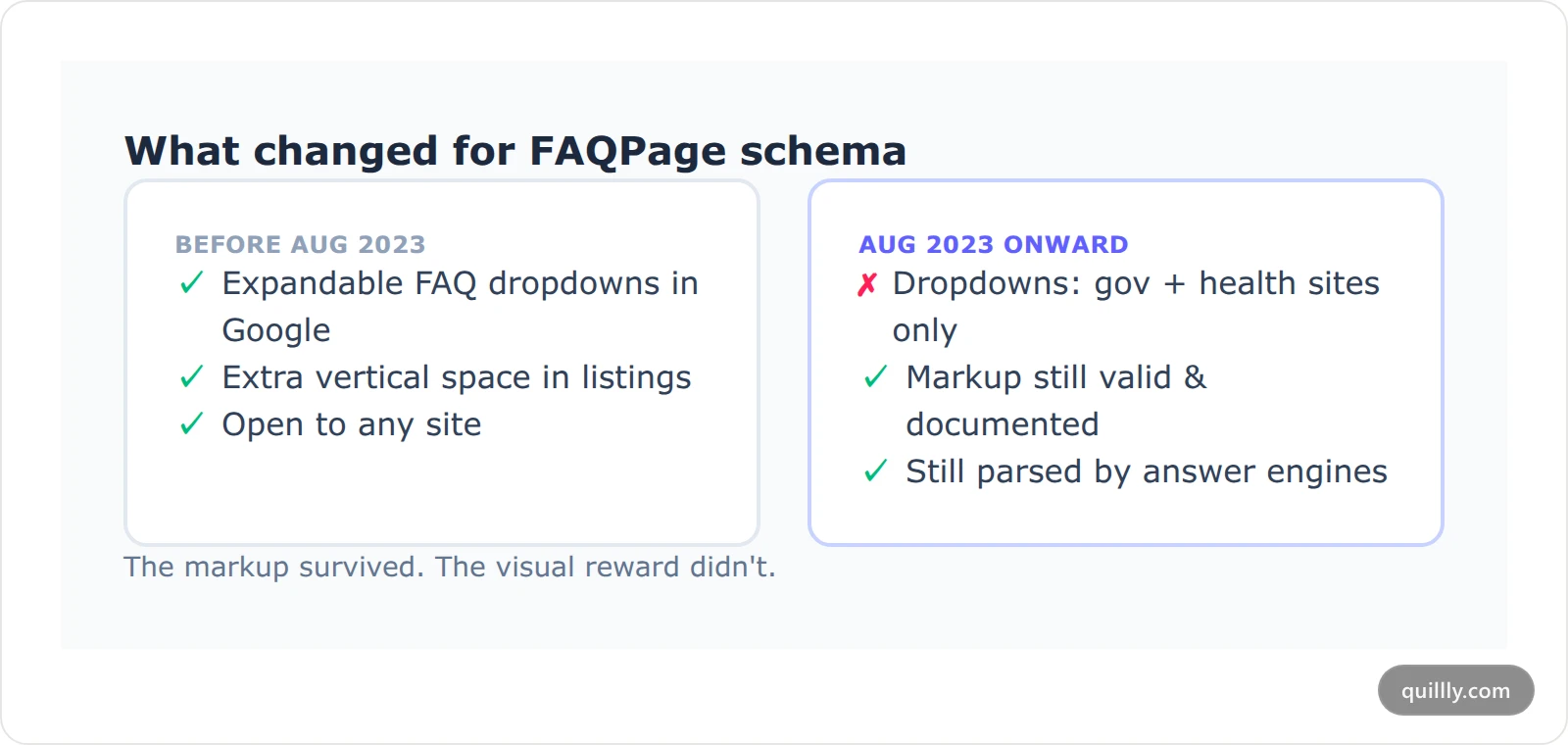
Search "faqpage schema example" and you'll get a dozen tutorials promising expandable FAQ dropdowns under your search listing. Nearly all of them were written before August 2023 — the month Google turned those dropdowns off for almost every site on the internet.
The short version: FAQPage schema is a block of JSON-LD that labels the question-and-answer pairs on a page so machines can read them. Copy the example below, swap in your own Q&As, validate it, ship it. You almost certainly won't get FAQ rich results anymore — but the markup still does real work, just somewhere other than the blue links.
That gap between what the old tutorials promise and what the markup actually does today is the whole reason this page exists.
What FAQPage Schema Actually Does in 2026#
FAQPage schema is a JSON-LD block that wraps a list of questions, each with exactly one accepted answer. It tells any parser that this page holds authoritative answers and marks precisely where each one starts and ends, so the text can be quoted without guesswork.
Three jobs it still does#
All three are verifiable today:
Feeds answer extraction. AI search systems and answer engines parse structured data to lift clean Q&A pairs without guessing where an answer starts and stops.
Disambiguates your page. It states the page's purpose in a machine-readable way, which helps a crawler classify a support page versus a product page versus a blog post.
Forces good structure. Writing valid FAQ schema markup is impossible if your questions and answers are mushed into one paragraph — so the markup audits your HTML for you.
One thing it no longer does for most sites: produce the accordion-style FAQ rich results in Google's organic listings.
Why Almost Every FAQPage Schema Example Online Is Half Wrong#
On 8 August 2023, Google announced a change to HowTo and FAQ rich results. FAQ rich results were restricted to "well-known, authoritative government and health websites." HowTo rich results were dropped entirely.
Google didn't deprecate the markup. FAQPage is still documented in the structured data docs and still a valid schema.org type. What disappeared was the visual payoff — the reason most people added it.
So when a 2019 tutorial tells you FAQ schema will "double your SERP real estate," it isn't lying about the past. It's just describing a feature you no longer qualify for.
The FAQPage Schema Example You Can Copy Right Now#
Here's a complete, valid FAQPage block. The url points at a real live page so you can see the shape in context — swap it for your own before shipping.
{
  "@context": "https://schema.org",
  "@type": "FAQPage",
  "url": "https://quillly.com/tools/schema-generator",
  "mainEntity": [
    {
      "@type": "Question",
      "name": "How long does setup take?",
      "acceptedAnswer": {
        "@type": "Answer",
        "text": "Most sites finish in under ten minutes. You add one DNS record, confirm it resolves, and the connection verifies itself."
      }
    },
    {
      "@type": "Question",
      "name": "Do I need to know how to code?",
      "acceptedAnswer": {
        "@type": "Answer",
        "text": "No. Everything runs through a dashboard. The only technical step is the DNS record, and the setup screen shows the exact values to paste."
      }
    },
    {
      "@type": "Question",
      "name": "Can I cancel at any time?",
      "acceptedAnswer": {
        "@type": "Answer",
        "text": "Yes. Cancellation is immediate from the billing page and your published pages stay live until the period ends."
      }
    }
  ]
}
Drop that inside a <script type="application/ld+json"> tag in your page's <head> or <body>. Both work. Google reads either.
If hand-writing JSON makes you nervous, you can generate it in the browser — it outputs the same structure with FAQPage as one of seven supported types, free and without an account.
Field by Field: What Each Property Does#
Property | Required? | What it holds |
|---|---|---|
| Yes | Always the schema.org vocabulary URL |
| Yes |
|
| Yes | The array of |
| Yes | The question text, as a plain string |
| Yes | Exactly one |
| Yes | The full answer. Basic HTML is allowed |
| Optional | The canonical URL of the page |
Four rules that trip people up in every FAQPage schema example they copy:
One accepted answer per question. Not an array. If a question genuinely has competing answers, that's a
QAPage, not a FAQPage.The answer text must match the visible page. Markup describing content a user can't see is a structured data violation.
nametakes plain text. No nested HTML in the question.The page must actually be an FAQ. Wrapping three random headings in FAQ structured data because you want the tag is exactly what the guidelines prohibit.
Where the Markup Goes — and How It Breaks#
The most common failure isn't invalid JSON — it's markup that validates perfectly while describing a page that doesn't match it. Put the block anywhere in the HTML, but only after confirming every question and answer you're marking up is genuinely visible to a reader who never opens dev tools.
The decision path#
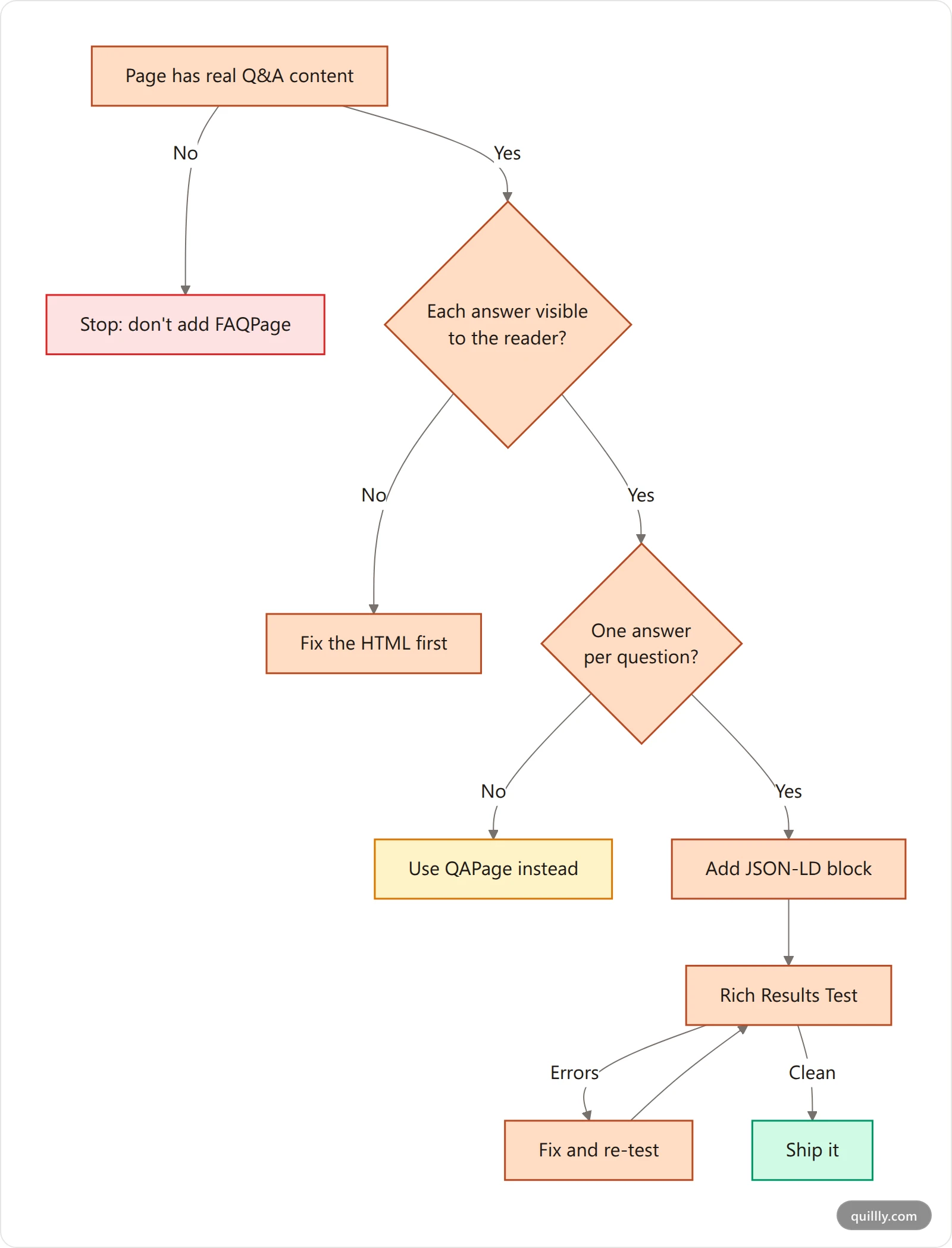
This is where the writing and the markup meet. FAQPage parsing expects a question to stand alone and its answer to follow as a separate block. When an AI drafts your FAQ section, it tends to collapse both into one paragraph — "What is X? X is a…" — which reads fine to a human and parses badly.
Quillly's content score treats this as a first-class defect. It runs a dedicated FAQ-structure check that penalises three specific patterns: a question merged into the same paragraph as its answer, a question heading with nothing underneath it, and several questions crammed into one paragraph. The scoring documentation covers how the categories combine. The fix the checker asks for is always the same shape: each question as its own H3 ending in a question mark, the answer as separate paragraphs below.
Get that right in the HTML and the FAQ schema markup writes itself.
Validating FAQ Structured Data Before You Ship#
Two tools, two different jobs, and people routinely use the wrong one:
Rich Results Test — tells you what Google can parse and which rich result types you're eligible for. Since 2023 it will validate your FAQPage and then tell you no FAQ rich result is available. That's expected, not a failure.
Schema Markup Validator — checks your JSON against schema.org itself, with no opinion about Google's display rules. Use this to confirm the syntax is genuinely correct.
Both are free, as are most of the utilities worth keeping in a blogger's SEO tool stack. Run both. A clean result in the second plus "valid, not eligible" in the first is the correct outcome for a normal site in 2026, and it's the result the average FAQPage schema example never warns you to expect.
For a wider view of which types are worth the effort, Google maintains the full search gallery of supported rich results. Our guide to blog schema markup walks through the ones that still render.
FAQPage vs QAPage: Picking the Right Type#
These two get confused constantly, and using the wrong one is a guidelines problem, not a style choice.
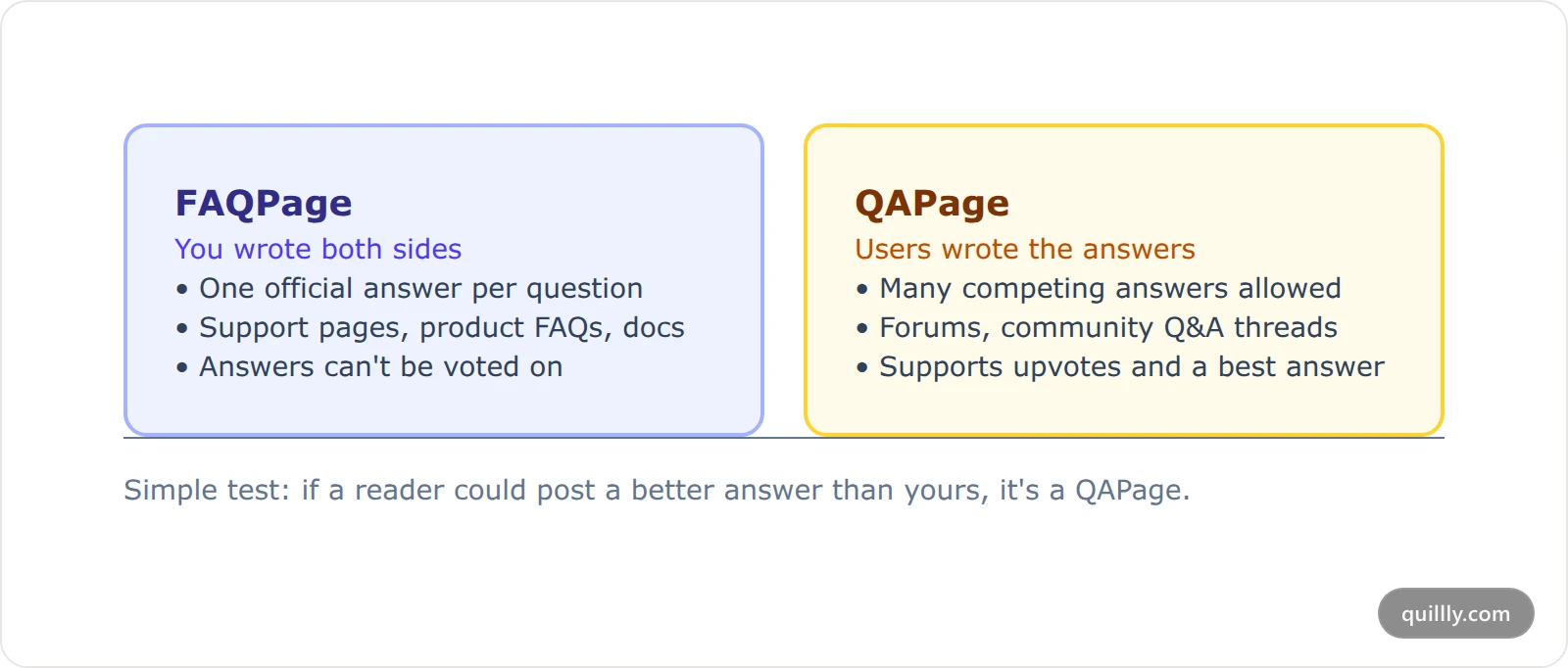
The test is authorship. If your team wrote the single correct answer, it's FAQPage. If your users supply competing answers and can vote, it's QAPage — and unlike FAQ, QAPage rich results are still widely available, which is why forum threads keep showing up in search with answer counts attached.
Need the FAQPage block generated for you? The free schema generator outputs it alongside Article, Product, LocalBusiness, WebSite, HowTo and BreadcrumbList.
How FAQ Schema Markup Feeds AI Search#
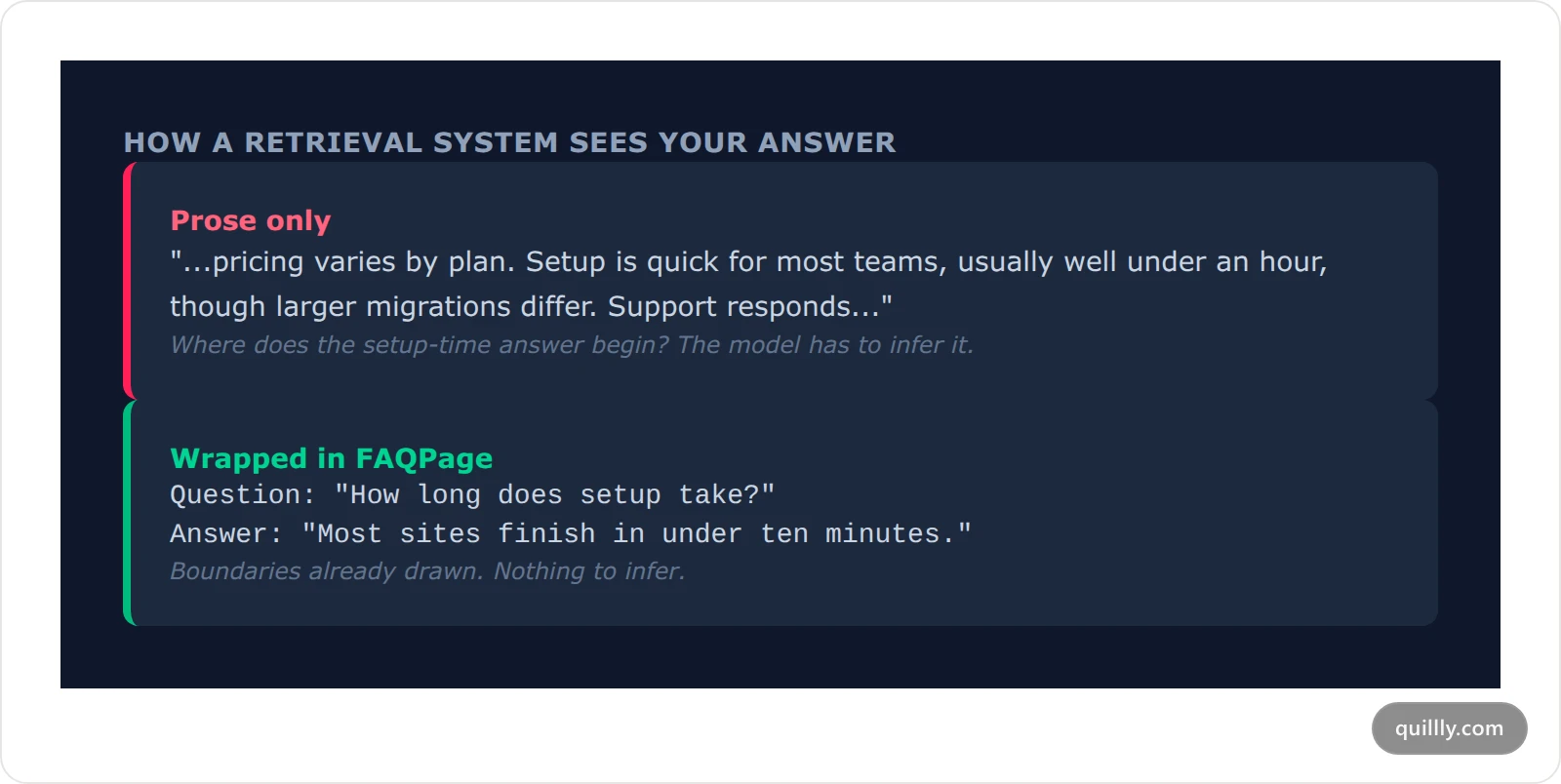
Here's the part worth your time now that the dropdowns are gone. FAQ schema markup gives answer engines pre-drawn boundaries around each answer, which makes your page cheaper to quote accurately than prose where the answer sits buried mid-paragraph. Retrieval comes before ranking, and clean segmentation helps retrieval.
Why segmentation beats prose#
Answer engines have to solve a hard problem on every page they read: where does the answer to this question begin and end? Prose makes them guess. FAQ structured data removes the guess — you've already drawn the boundaries and labelled which text answers which question.
Retrieval comes before ranking#
That matters because citation is a retrieval problem before it's a ranking problem. A page offering pre-segmented, unambiguous Q&A pairs is cheaper to quote accurately than one where the answer is buried mid-paragraph. We've written about how AI search chooses citations and what it takes to get cited in AI Mode in more depth, and our answer engine optimization playbook covers the wider AEO picture — FAQ markup is one of the cheapest structural wins in all three.
It's also the reason the "is schema dead?" argument misses. Schema was never primarily a display feature. It's a machine-readability feature that happened to unlock a display feature for a while. The display went away. The machines multiplied. If you're weighing where structured data fits alongside the rest, our breakdown of GEO, AEO and SEO maps the overlap.
One honest caveat: nobody outside those companies can prove a causal link between FAQ markup and a specific citation. What we can say is that the markup costs you ten minutes, is officially documented, and makes your answers trivially machine-readable. That's a good trade on its own terms — no rich result required.
Stop hand-writing schema for every post
Quillly attaches BlogPosting JSON-LD to every post it serves, layers FAQPage markup on top, and scores your FAQ structure before you publish — so broken question-and-answer formatting gets caught while it's still a draft, not after it ships.
Start your free trialKey Takeaways#
FAQ rich results have been limited to authoritative government and health sites since August 2023. Any FAQPage schema example promising dropdowns is out of date.
The markup itself is still valid, documented and parsed — the payoff moved from display to machine readability.
One accepted answer per question, answer text matching what's visible on the page, plain text in
name.Validate with the Rich Results Test and the schema.org validator; "valid but not eligible" is the correct 2026 result.
Authorship decides the type: your answer means FAQPage, user answers mean QAPage.
Fix the HTML structure first. Clean FAQ on-page structure makes the markup nearly automatic.
Frequently Asked Questions#
Does a faqpage schema example still get rich results in 2026?#
Almost certainly not. Since August 2023 Google has restricted FAQ rich results to well-known authoritative government and health sites. Your markup will still validate and still be parsed — you just won't see the expandable dropdowns beneath your listing.
Where exactly should the FAQPage schema go on my page?#
Either the <head> or the <body>, inside a <script type="application/ld+json"> tag. Google parses both locations equally. Keep one FAQPage block per page rather than splitting questions across several blocks.
Can I reuse one faqpage schema example across every page?#
Reuse the structure, never the content. The answer text in your markup has to match the answers visible on that specific page. Copying identical FAQ structured data onto pages that don't display those answers is a structured data violation.
What happens if my FAQ schema markup doesn't match the visible page?#
Google can ignore the markup for that page or, for repeated mismatches, apply a structured data manual action. The rule is simple: if a reader can't see the question and answer on the page, don't mark it up.
Do I need FAQPage schema if my page already has an FAQ section?#
You don't need it, but it's cheap and it helps. A well-formatted FAQ section already communicates structure to readers; the markup communicates the same structure to parsers that don't render your CSS or infer meaning from heading levels.
Is HowTo schema worth adding too?#
No. Google dropped HowTo rich results entirely in the same August 2023 change. The type still exists in schema.org, but there's no display benefit on any site and considerably less evidence of downstream value than with FAQ markup.


