

Rytr's free plan gives you 10,000 characters a month. That's roughly 1,500 words — one blog post, and you're done until the calendar flips. So you go looking for alternatives, and every roundup hands you tools that start at $49, $69, $79 a month. Rytr pricing is the whole reason most people picked it — and it's the one thing those lists quietly ignore.
Short answer: most Rytr alternatives cost 5-10x what Rytr does, because the popular AI writing tools are built for a different buyer than someone shopping for a cheap AI writer. The right pick depends on which part of Rytr you outgrew — the output quality, the SEO layer, or the fact that it stops at a draft. Match the tool to the reason, not to the review score.
The 7 Rytr alternatives, compared#
Every price below was checked on the vendor's own pricing page in September 2026, using the annual-billing rate where one is offered. "Entry floor" is the cheapest paid plan that actually exists — not a teaser.
Tool | Entry floor | Free plan | What you're paying for | Best if you left Rytr because |
|---|---|---|---|---|
Rytr (staying) | $7.50/mo | Yes — 10K chars/mo | Unlimited short-form generation | — |
Quillly | $9/mo | No (14-day trial, no card) | Drafts that publish and get indexed | It stops at a draft |
ChatGPT / Claude | ~$20/mo | Limited free tier | Raw model quality, no wrapper | Output felt thin |
Copy.ai | $24/mo | No | GTM workflows and agents | You need team workflows |
Frase | $39/mo | No (7-day trial) | SERP-driven briefs, 10 articles/mo | Posts didn't rank |
Surfer SEO | $49/mo | No clear free tier | On-page scoring, 120 documents | Posts didn't rank |
Jasper | $59/mo | No (7-day trial) | Brand voice, 1 seat | You need consistent brand tone |
Writesonic | $79/mo | No | 15 articles/mo + AI visibility tracking | You need rank tracking too |
Two things jump out about these Rytr alternatives. Only one tool on that list costs less than Rytr's Premium plan. And exactly one — Rytr itself — has a real free tier.
The price cliff nobody mentions#
Here's the part the "10 Best Rytr Alternatives" posts skip. Rytr sits at the very bottom of the market. When a roundup tells you to switch, it's quietly asking you to multiply your bill.

The median entry price across those seven alternatives is $39 a month. Against Rytr's $7.50, that's a 5.2x jump before you've written a word. If you're a solo writer publishing four posts a month, that difference is real money, and it buys you nothing unless it solves the specific thing that made you leave.
There's a second cliff waiting one tier up. Entry plans are deliberately thin — Frase gives you 10 articles a month, Writesonic gives you 15 — so the plan you actually need is often the next one.

Copy.ai is the one to watch. Its entry Chat plan is $24 a month, and the next tier up is $1,000 a month. That's a 41x step, and it tells you exactly who the product is for now: go-to-market teams with a budget line, not writers with a side project.
Why people actually leave Rytr#
In almost every case it's one of three reasons, and they point at completely different tools. Work out which one is yours before you look at a single review.
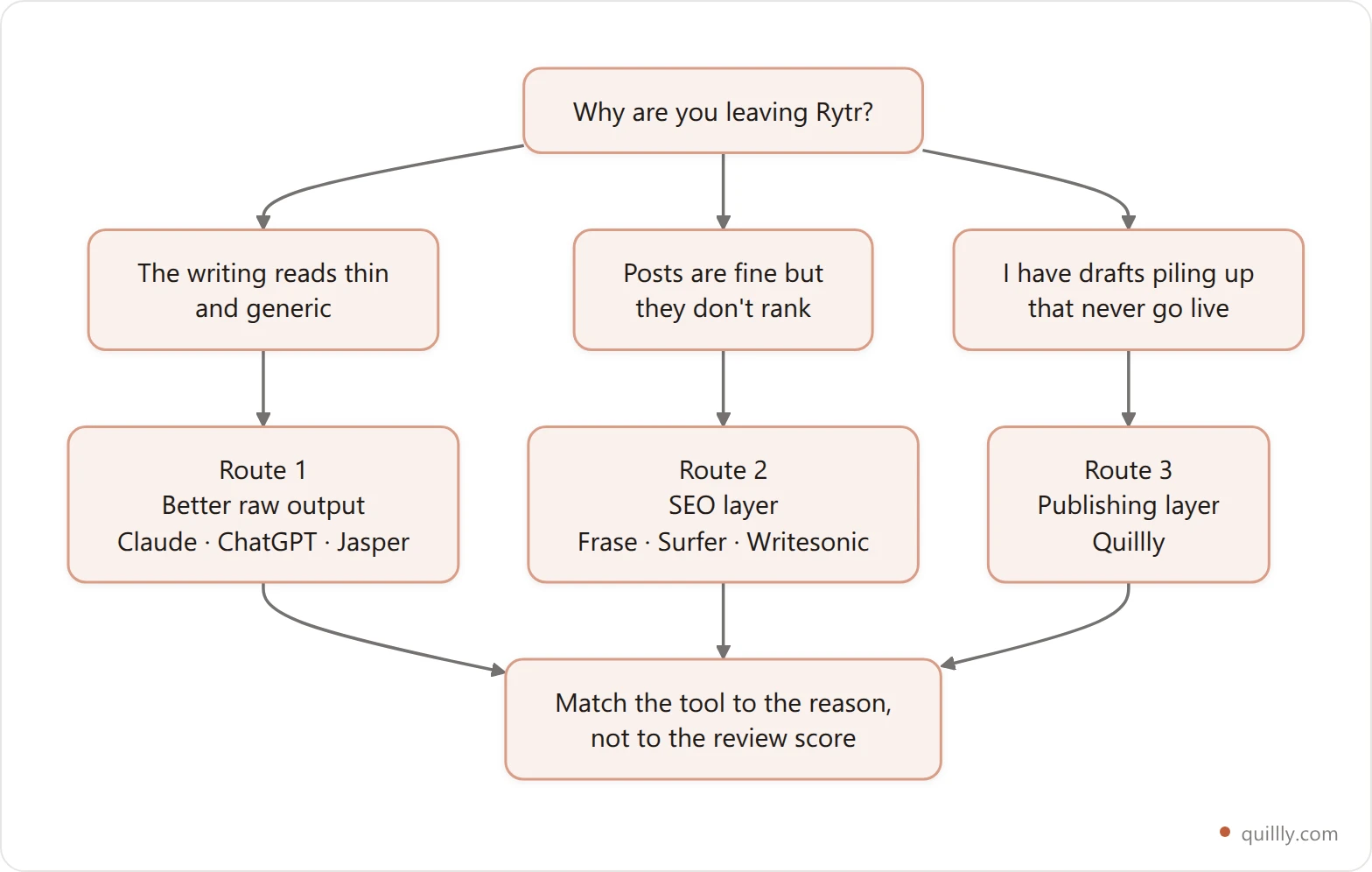
Most roundups treat all seven tools as interchangeable AI writers. They aren't. Three of them barely overlap with Rytr's job at all.
Route 1: the output reads thin#
This is the most common complaint, and it's also the one with the cheapest fix.
Rytr is a wrapper around a model, tuned for short-form marketing copy — taglines, product descriptions, emails. If you're asking it for 1,500-word articles, you're using it against its grain. Before you pay for another wrapper, try the model directly. ChatGPT Plus and Claude Pro both run about $20 a month, and for long-form drafting they'll usually beat any $9 wrapper, because you're not paying a middle layer to constrain the prompt.
Jasper ($69/mo, or $59 on annual billing) is the paid step up here. What you get for the money is brand voice — you train it on your existing writing and it holds tone across a team. That's genuinely useful for an agency with five writers. For one person it's an expensive way to solve a problem a good prompt solves free. We went deeper on this trade-off in our Jasper alternatives breakdown.
Copy.ai ($29/mo, $24 annually) has moved on from the copywriting niche entirely. It now positions itself as "GTM AI" — stitched-together workflows for sales and marketing operations. If you're one writer wanting better blog drafts, this is the wrong shop, and the $1,000 second tier confirms it.
If you can't tell whether your drafts are actually thin or just short, our test on how long a blog post should be is a more useful yardstick than any tool's word counter.
Route 2: the posts don't rank#
Different problem, different aisle. These tools don't write better than Rytr — they tell you what to write about, and score the draft against what's already ranking.
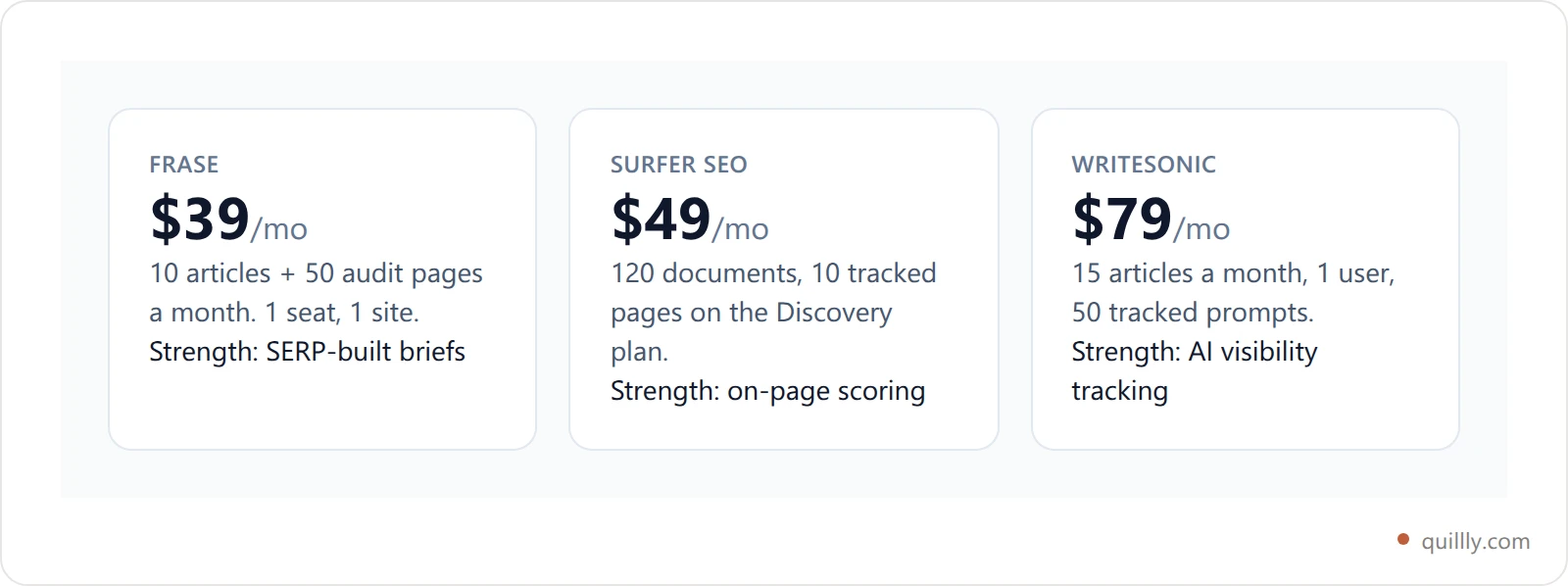
Frase ($49/mo, $39 annually) is the cheapest honest entry into this category. Its briefs pull the actual top-ranking pages and tell you what they cover. The catch is the 10-article cap — publish more than twice a week and you're on the $103 plan. See our Frase alternatives comparison for the per-article math.
Surfer SEO ($49/mo on Discovery, $99 on Standard) is the on-page scorer most agencies land on. 120 documents goes further than Frase's 10 articles, but Surfer scores pages — it doesn't publish them. Our Surfer alternatives post covers where that gap bites.
Writesonic ($79/mo) is the priciest entry on this list and the one that's drifted furthest from writing. The current Starter plan is built around tracking how you show up in ChatGPT, Gemini and AI Overviews. That's a real 2026 problem, but it's not the problem a Rytr user has. More in our Writesonic alternatives roundup.
Worth saying plainly: none of these three will publish anything. You'll still be copy-pasting into a CMS afterwards.
Route 3: the drafts never go live#
This is the reason nobody puts in a roundup, and it's the one that quietly kills most blogs. Rytr generates. Then you copy the text into a CMS, format it, find an image, write the meta description, hit publish, and remember to submit the URL somewhere. That's twenty minutes of unpaid work per post, and it's where drafts go to die.
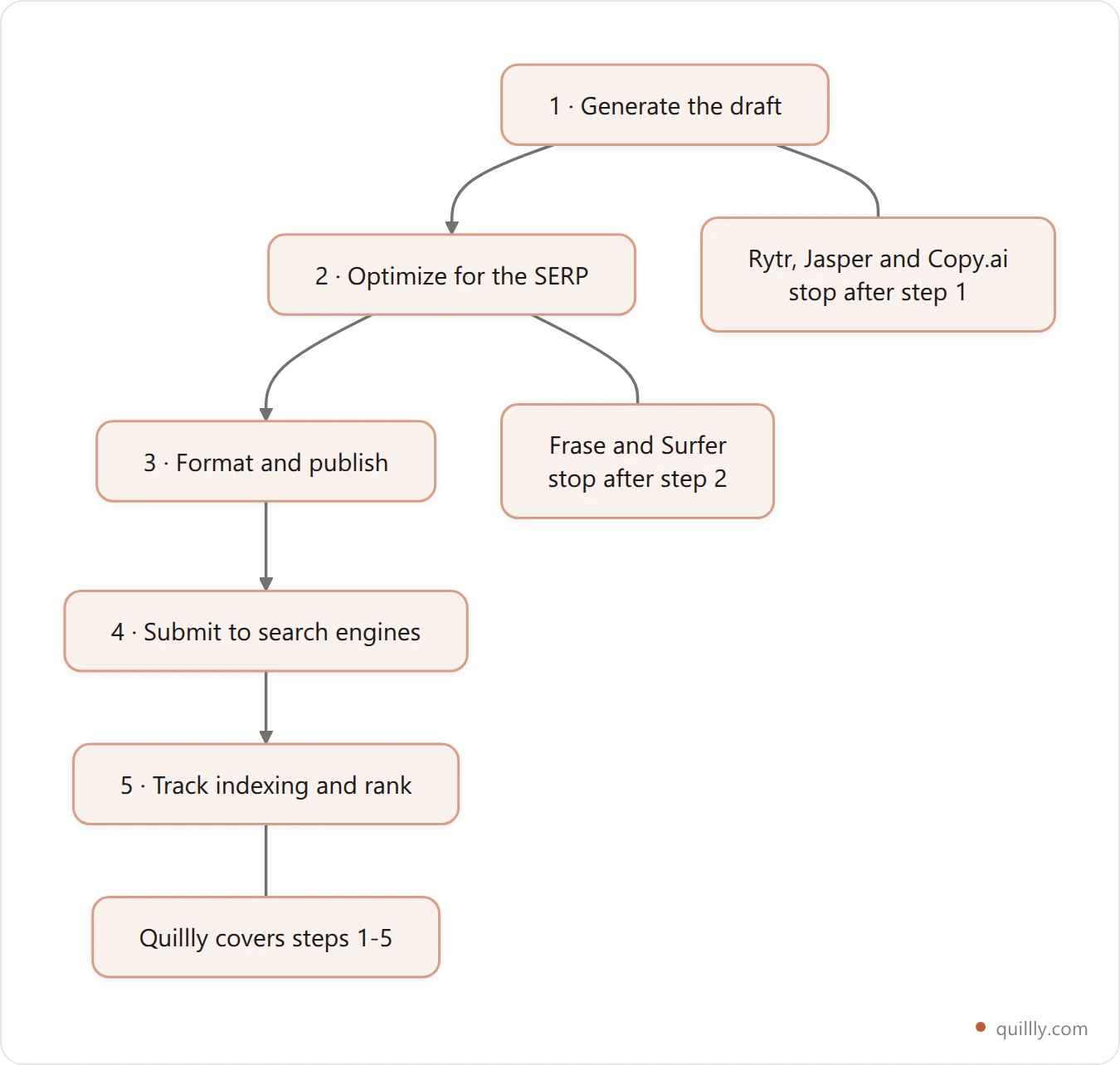
Quillly is built for that gap specifically. You connect your AI assistant — Claude, ChatGPT or Cursor — to Quillly over MCP, and the assistant gets real publishing tools instead of a chat window. It drafts, scores the post against 14+ SEO criteria, publishes to your own domain, and submits the URL to eight search engines: Google, Bing, Yahoo, Yandex, Naver, Seznam, Yep and Amazon. Google gets it via sitemap and RSS through Search Console; the rest go out over IndexNow, which Google doesn't participate in.
Pro is $9 a month, or $96 a year — 5 websites, unlimited content, 100 research credits. There's no free tier, but every account starts on a 14-day trial with no card. Setup is documented in connect your AI, and the full workflow is in our guide to publishing a blog with AI.
The honest caveat: if your complaint about Rytr was purely the writing quality, this won't fix that either. Your model writes the words. Quillly handles everything after.
Stop losing drafts between the chat window and your CMS
Connect Claude, ChatGPT or Cursor once. Your AI writes, scores against 14+ SEO criteria, publishes to your domain and submits to 8 engines — for $9 a month.
Start the 14-day trialWhen staying on Rytr is the right call#
Not every switch is an upgrade. There are three situations where the honest advice is to keep the $7.50 plan:
You mostly write short-form. Product descriptions, ad copy, subject lines, listing blurbs. This is what Rytr was built for, and paying $79 for an article-focused tool to write 40-word blurbs is a downgrade with extra steps.
You publish fewer than two posts a month. Frase's 10-article cap and Writesonic's 15 are irrelevant to you. So is Surfer's document count. You're buying capacity you'll never touch.
Your bottleneck is deciding what to write. No tool on this list fixes an empty topic list. A keyword list and an editorial calendar cost nothing and solve more.
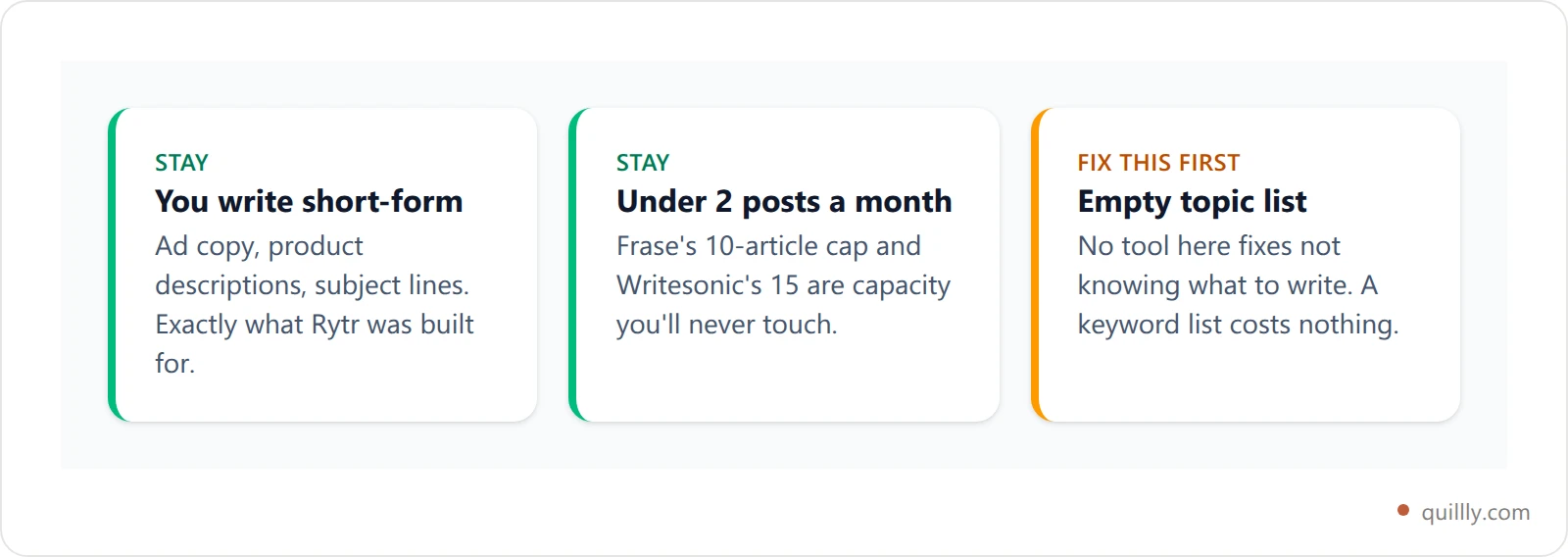
That last one matters more than people admit, and it's the reason half the Rytr alternatives people buy go unused. We ran the numbers on this in our best AI for writing test — the tool almost never turned out to be the constraint.
How to choose in five minutes#
Write down the last three drafts you didn't publish, and note why each one stalled. If the answer is "it read badly," go to Route 1 and try a raw model first at $20. If it's "I published it and nothing happened," that's Route 2, and Frase at $39 is the cheapest honest entry. If the answer is "it's still sitting in a chat window," that's Route 3, and it's a workflow problem no writing tool solves.
Then check the number that actually matters: the second-tier price. Entry plans on these tools are sized to be outgrown, so price the plan you'll be on in six months, not the one on the pricing page's left edge. Try Quillly free for 14 days if the gap you're feeling is the publishing one.
Key takeaways#
If you skim one section, make it this one:
Rytr pricing is the floor. Free at 10,000 characters a month, $7.50 on Unlimited. Only Quillly ($9) comes close among the Rytr alternatives here.
The median alternative costs $39 a month — a 5.2x jump before you write a word.
Price the second tier, not the first. Copy.ai steps from $24 to $1,000. Frase goes $39 to $103. Entry plans are sized to be outgrown.
Sort by your reason for leaving, not by review score: thin output (Route 1), posts that don't rank (Route 2), drafts that never ship (Route 3).
Staying is often right. Short-form work, or fewer than two posts a month, and none of these AI writing tools will pay for themselves.
Frequently Asked Questions#
Is there a free Rytr alternative?#
Not really. Rytr's own free plan — 10,000 characters a month — is the most generous free tier in this comparison. ChatGPT and Claude have limited free tiers useful for drafting, but every dedicated tool here (Jasper, Frase, Surfer, Writesonic, Copy.ai, Quillly) is trial-only, with no permanent free plan.
What is the cheapest Rytr alternative?#
Quillly's Pro plan at $9 a month is the only tool in this comparison priced within a dollar or two of Rytr. After that the next cheapest are ChatGPT or Claude at roughly $20 a month, then Copy.ai at $24 annually. Everything else starts at $39 or higher.
Is Rytr good enough for blog posts?#
For short posts, yes. For 1,500-word SEO articles it's working against its design — Rytr is tuned for short-form marketing copy. You'll get more usable long-form output from a raw model at $20 a month than from a short-form wrapper, before you spend anything on an SEO layer.
Do any of these tools publish the post for me?#
Only Quillly. Frase, Surfer and Writesonic score and optimize drafts but leave the publishing to you. Jasper, Copy.ai and Rytr stop at generated text. If your drafts stall between the chat window and your CMS, that's the distinction to sort on.
Should I pay for an SEO tool or a publishing tool first?#
Publish first. An optimized post that never goes live scores zero. Once you're shipping consistently and still not ranking, a briefing tool like Frase earns its $39. Buying the SEO layer while drafts pile up unpublished solves the wrong half of the problem.

