

If you went looking for a Writesonic alternative because the affordable AI writer you remember is gone, you're not imagining it. Writesonic sells something else now — and most roundups of Writesonic alternatives still compare it as though it were budget blog writing software. It hasn't been that for a while, which is why so many of those lists send you to the wrong tool.
The short answer: Writesonic has repositioned as an AI search visibility platform, and its cheapest plan is $79/month on annual billing. If you wanted a writer, the closest replacements are Koala AI, Frase or Quillly. If you wanted AI visibility tracking, Surfer competes directly. Pick based on which Writesonic you were actually shopping for.
Nearly every list of Writesonic alternatives ranks these tools by price per article. That's the wrong axis, and this post uses a different one: how many manual steps sit between "the AI finished writing" and "the page is live and indexed." That's where the hours in SEO content publishing actually go.
What's in this guide
Writesonic Isn't a Writing Tool Anymore#
This is the part most listicles haven't updated. Writesonic's own pricing page now describes tracking "AI visibility across 10 AI platforms including ChatGPT, Perplexity, and Google AI."
The current tiers, verified on their pricing page:
Plan | Price (annual billing) | Articles/month |
|---|---|---|
Starter | $79/mo | 15–50 depending on tier |
Basic | $199/mo | — |
Growth | $399/mo | — |
Enterprise | Custom | — |
Writing is still in there. It just isn't the product anymore — it's one module inside a visibility suite, alongside site audits, agentic workflows and an Action Center. Named integrations are Google Search Console and WordPress, with GA4 and Looker Studio reserved for Enterprise.
None of that is a criticism. It's a repositioning, and it's a sensible one. But if you arrived wanting a cheap article generator, a $79/month visibility platform is a bad fit, and that mismatch is why "writesonic alternative" gets searched at all.
The Comparison Table#
Every price and integration below came from each vendor's own live pricing page. Nothing here is estimated.
Tool | What it is now | Publishes to your domain? | Submits to search engines? | Entry price |
|---|---|---|---|---|
Writesonic | AI search visibility platform | Not documented on pricing page | GSC + WordPress integrations | $79/mo (annual) |
Quillly | AI-native publishing + SEO platform | Yes — your own domain | Yes — 8 engines, automatic | $9/mo |
Frase | "Content operating system for AI search" | Yes — WordPress, Webflow, Sanity, Wix | Not stated | $39/mo (yearly) |
Koala AI | SEO article generator | Yes — 1-click to WordPress, Shopify, Webflow, Ghost | Not stated | $49/mo |
Surfer SEO | Optimization + AI visibility tracking | No direct publish (WordPress, Docs, Contentful, Zapier) | Not stated | $49/mo (annual) |
Jasper | Marketing AI / brand content | Not stated (Webflow, Docs, Zapier, Make) | Not stated | $59/seat/mo (annual) |
Copy.ai | GTM AI platform | Not stated | Not stated | $29/mo (Chat tier) |
Two things jump out. First, the entry prices span more than 10x. Second, the "publishes to your domain" column splits the field almost perfectly in half — and that column is the one nobody benchmarks.
The Test Every Alternatives List Skips#
Generating a draft is the cheap part now. Every tool on this list writes competent prose. What separates them is the tail end: the unglamorous chain of steps between a finished draft and a URL a search engine has actually stored.
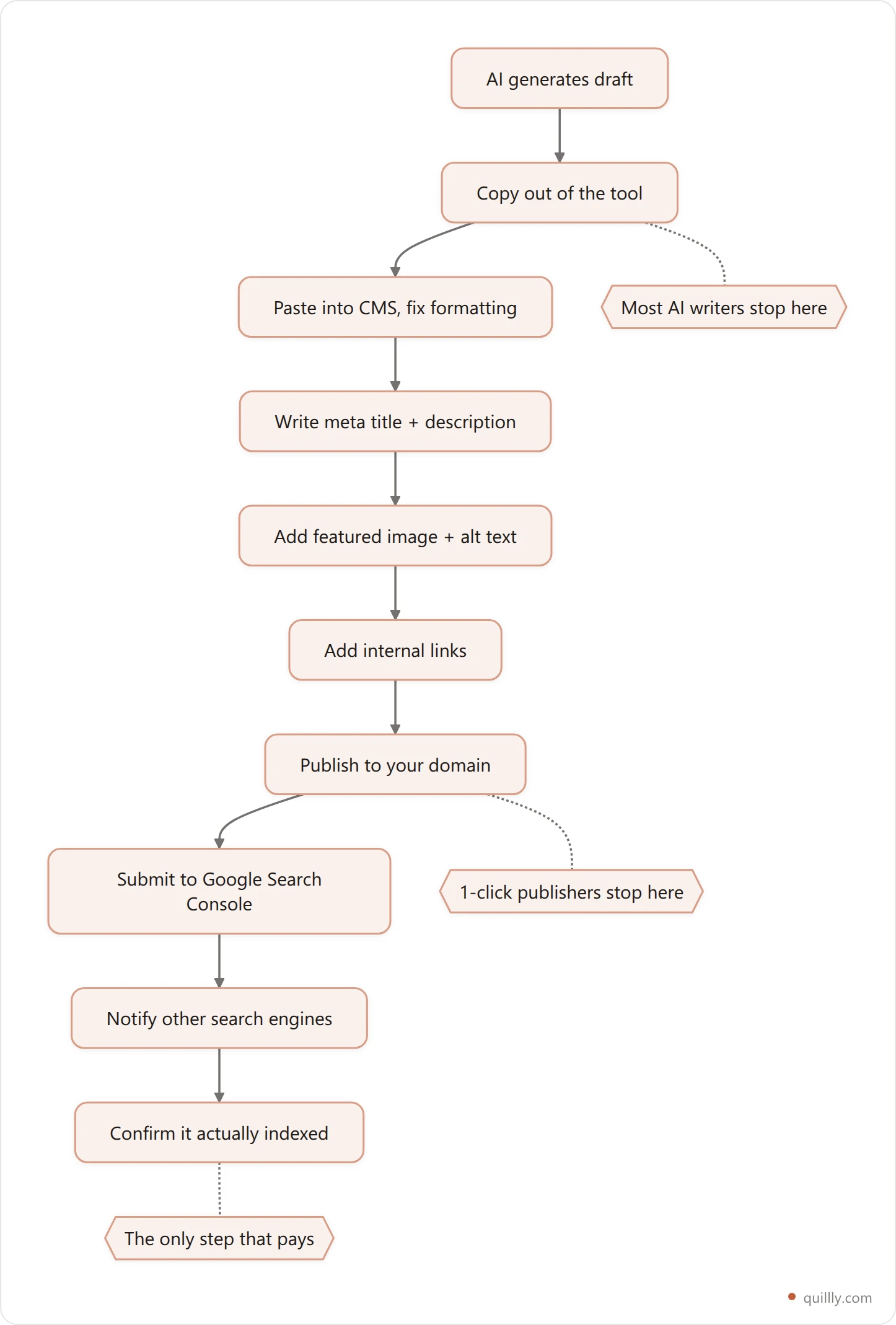
Count them honestly. Jasper, Copy.ai and Surfer hand you a draft and leave steps 2 through 10 on your desk. Koala and Frase carry you through step 7, which is a genuine leap — one-click publishing to WordPress or Webflow removes the most tedious part of the chain.
But steps 8, 9 and 10 stay manual almost everywhere. And those are the steps that decide whether the article earns anything.
Why "Published" Isn't the Finish Line#
Here's the data point that reframed this whole comparison for us. These are quillly.com's own live numbers, pulled today — not a case study, and not flattering.
Of 135 published items on this site, here's how many each engine has actually stored:

Yandex has 81% of our pages. Google has 56%. Bing has 21%.
Same articles. Same domain. Same day. The only variable is which engine was told, and how persistently. A tool that stops at "published" has handed you a page that, on our numbers, has roughly a coin-flip chance of being in Google at all — and worse odds on Bing.
This is why the publishing tail matters more than the price per article. Paying $99/month for articles that sit unindexed is worse value than paying $9 for articles that get submitted everywhere automatically. We wrote up the full engine-by-engine playbook in multi-engine SEO: rank beyond Google.
See how automatic multi-engine submission works
The 7 Alternatives, by the Job You're Hiring Them For#
If you wanted a cheap article generator: Koala AI#
Koala starts at $49/month and offers genuine 1-click publishing to WordPress, Shopify, Webflow and Ghost, plus Zapier, Make.com and Google Sheets. Its plan ladder climbs steeply — [Professional through Scale III runs $49 to $2,000/month](https://koala.sh/pricing) — but as a straightforward AI blog writing tool, the entry tier is a fair swap for what Writesonic's writer used to be.
If you want writing plus optimization: Frase#
Frase now calls itself "the content operating system for AI search" and starts at $39/month on yearly billing. It publishes to WordPress, Webflow, Sanity and Wix, and ships its own hosted FraseCMS as an add-on. Ten articles a month at the Starter tier, 40 at Professional. It's the closest thing on this list to a full pipeline outside of Quillly.
If you want the visibility tracking: Surfer SEO#
Surfer is the most direct competitor to what Writesonic became. Discovery starts at $49/month on annual billing, climbing through Standard, Pro and Peace of Mind, with AI Search Analytics also sold standalone at $158/month. It tracks visibility across ChatGPT, Perplexity, Google and Gemini. What it doesn't do is publish — content leaves via export or Zapier.
If you want brand-consistent marketing copy: Jasper#
Jasper's Pro plan is $69/seat monthly, or $59/seat annually, with a 7-day trial. It's built around brand voice, style guides and marketing agents rather than SEO articles. Integrations include Webflow, Google Docs, Slack, Zapier and Make. Per-seat pricing makes it expensive for solo operators and reasonable for teams. We compared it against the field in Jasper alternatives.
If you're a GTM team, not a blogger: Copy.ai#
Copy.ai has made the same kind of pivot Writesonic did, but further — it's now a GTM AI platform for sales and marketing operations. The Chat tier is $29/month, but the real product starts at $12,000/year for Growth. If you want blog articles, this is no longer the tool.
The one we couldn't fully verify: Byword#
Byword advertises "plans starting at $99/month" and positions itself as an AI article writer for SEO at scale. Its public pricing page doesn't document CMS publishing or name integrations, so we can't place it in the table honestly. Ask them directly before you buy.
If you want the whole chain: Quillly#
Full disclosure — this is our product, so judge the claims against the pricing page.
Quillly connects your AI assistant (Claude, ChatGPT, Cursor or Windsurf) to your own domain over the Model Context Protocol. Your assistant drafts, scores the piece against 14+ SEO criteria, publishes it live, and auto-submits to eight search engines — Google, Bing, Yahoo, Yandex, Naver, Seznam, Yep and Amazon — then tracks indexing and rankings from one dashboard. Google gets sitemap and RSS freshness through Search Console; the rest go via IndexNow in a single push.
Pro is $9/month or $96/year with a 14-day trial, covering up to 5 websites and unlimited content. There are also Autopilot tiers at $29, $79 and $199/month for teams that want a set number of posts written and shipped each month rather than driving it themselves.
What Each One Costs to Enter#

A caveat that matters: these are the cheapest advertised terms, which usually means annual prepay. Jasper's $59 is per seat and annual; monthly is $69. Frase's $39 is yearly, $49 monthly. Copy.ai's $29 buys chat seats, not an article pipeline. Read the billing toggle before you compare.
Entry price also isn't cost per outcome. At our own 56% Google indexing rate, every published article is worth about 0.56 of an indexed one — so a nominal $3/article is really $5.36 per article that Google can serve. That multiplier is a function of your domain authority, not the vendor's tool, and it applies to every row in the table equally.
How to Pick in 60 Seconds#
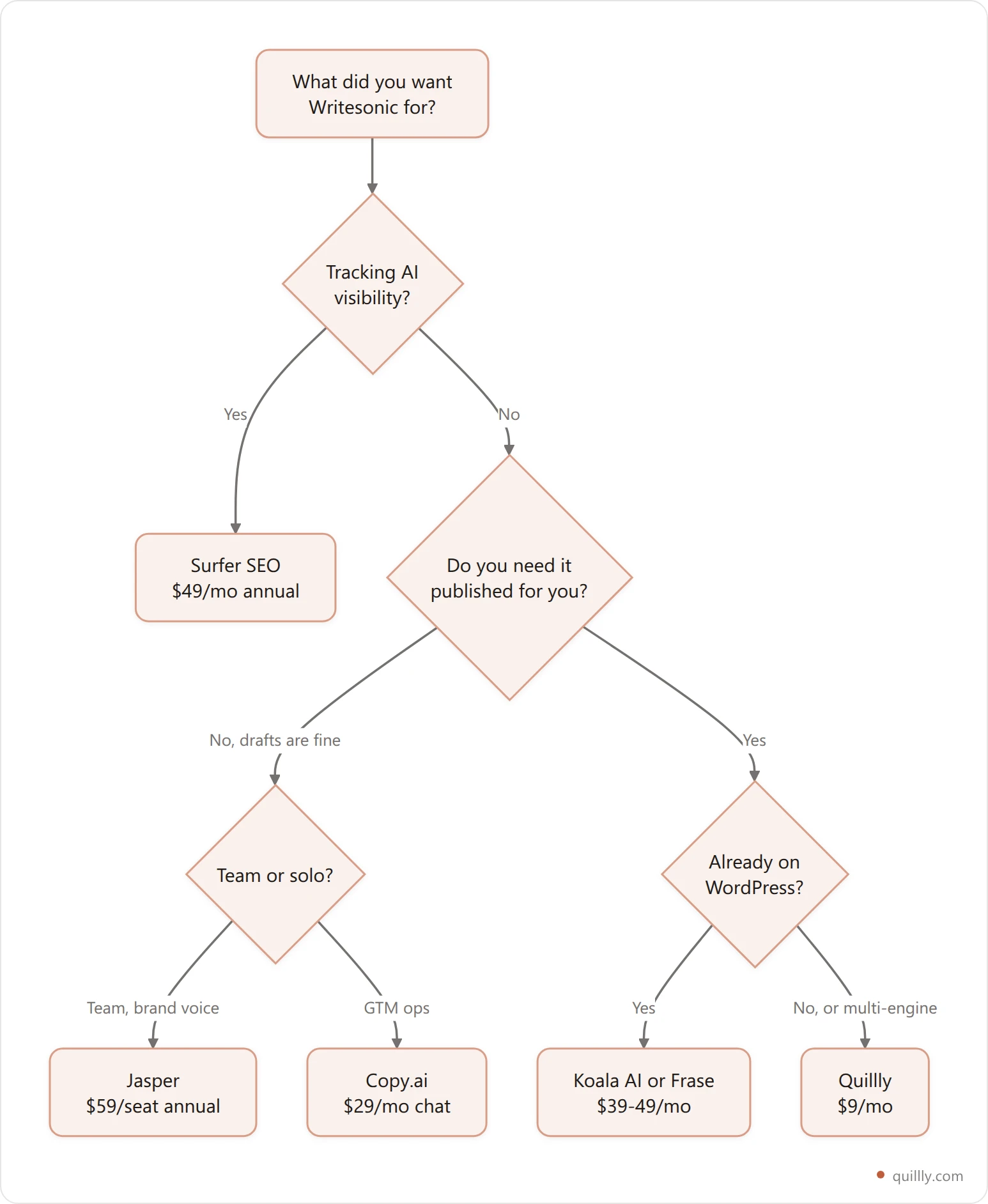
The honest summary: if Writesonic's new direction fits you, staying put is reasonable. If you left because you wanted a writer, Koala and Frase are the cleanest swaps. If you want the draft-to-indexed chain closed end to end, that's the gap we built Quillly to fill.
What to Check Before You Switch#
Whatever you pick, run these four checks on the vendor's own pages rather than on a listicle:
Billing terms. Nearly every price above is annual-prepay. Toggle to monthly and re-read.
Article limits. Frase Starter is 10/month. Writesonic Starter is 15. "Unlimited" is rarer than it looks.
Where it publishes. If the pricing page doesn't name your CMS, assume manual export.
What happens after publish. Ask specifically about search engine submission and indexing reporting. Most tools have no answer, and it's the step that decides whether any of it ranks.
If you want the underlying method rather than a tool, our complete guide to AI-powered blog SEO covers the workflow, and publishing blogs from Claude Code shows the MCP setup end to end.
Key Takeaways#
Writesonic changed categories. It's an AI search visibility platform starting at $79/month on annual billing, not the budget writer it was known as. Comparing it to blog writing software is comparing across categories.
Match the tool to the job. Surfer for visibility tracking, Koala AI or Frase for writing plus publishing, Jasper for team brand voice, Quillly for the full draft-to-indexed chain.
Publishing isn't indexing. On our own 135 published pages, Yandex stored 110, Google 76 and Bing 28 — so cost per indexed article is the number worth comparing, not cost per draft.
Read the billing toggle. Almost every headline price here is annual prepay, and several of the cheapest tiers don't include an article pipeline at all.
Frequently Asked Questions#
Is Writesonic still worth it in 2026?#
It depends what you need. Writesonic is now an AI search visibility platform starting at $79/month on annual billing, with article generation as one module. If you want visibility tracking across ChatGPT, Perplexity and Google AI, it's competitive. If you wanted a low-cost article writer, it's no longer priced for that job.
What is the cheapest Writesonic alternative?#
Quillly's Pro plan at $9/month is the lowest entry price in this comparison, followed by Copy.ai's Chat tier at $29/month and Frase at $39/month on yearly billing. Note that Copy.ai's cheap tier buys chat seats, not an article pipeline, so it isn't a true swap for article generation.
Which AI writing tools publish directly to your website?#
Frase publishes to WordPress, Webflow, Sanity and Wix. Koala AI offers 1-click publishing to WordPress, Shopify, Webflow and Ghost. Quillly publishes to your own domain and then auto-submits to eight search engines. Jasper, Copy.ai and Surfer hand you a draft to move yourself.
Does publishing an article mean Google will index it?#
No, and the gap is larger than most people expect. On quillly.com's own 135 published pages, Yandex has indexed 110, Google 76 and Bing 28. Publishing only makes a page reachable — getting it stored requires submission and, usually, patience. Budget for the difference.
Should I pick a tool based on price per article?#
Price per article is a misleading benchmark because it counts published articles, not indexed ones. Divide by your site's actual indexing rate to get the real number. At a 56% Google indexing rate, a $3 article costs $5.36 per article Google can actually serve.
Do any of these tools work with Claude or ChatGPT directly?#
Quillly connects to Claude, ChatGPT, Cursor and Windsurf over the Model Context Protocol, so the assistant you already use gets publishing tools directly in chat. The other tools on this list are standalone web apps with their own editors, though several offer Zapier or Make automation as a bridge.
Close the gap between draft and indexed
Connect your AI assistant to your own domain, publish in seconds, and auto-submit to 8 search engines — from $9/month with a 14-day free trial.
Try Quillly free

