
Every roundup of the best AI for writing measures the same thing: how good the prose sounds. Almost none measure the thing that decides whether the prose was worth writing — whether a search engine ever indexes it.
That gap matters more in 2026 than it did in 2023. Generating competent text is a solved, commoditised problem; nearly every tool below produces clean, grammatical, on-brief copy. What separates them is what happens in the twenty minutes after the draft exists: where it publishes, whether the URL gets discovered, whether it survives quality filtering, and whether you find out when it doesn't.
This guide is organised around that distinction. It is a framework and a category map — not a scoreboard of invented benchmark scores.
What this guide measures — and what it doesn't#
Being precise about methodology is the whole point, so here is the honest version.
What this guide does: map the categories of AI writing tool, name what each is genuinely good at, and give you an evaluation checklist that includes the publishing and indexing dimension prose-quality reviews leave out.
What it does not do: hand you a "9.4/10 vs 8.7/10" table. Those numbers, in most roundups, come from one person's impression of a handful of prompts. They look like measurement and aren't. Every claim here is one you can check yourself.
One transparency note: Quillly is our product, and it sits in the publishing-pipeline category below. Discount that accordingly — the framework works just as well for ruling us out.
Who actually ranks for this query#
Before the categories, one useful piece of evidence about the topic itself. We pulled the live search results for "best ai for writing" and looked at the authority of each page-one domain rather than the copy on it.

Page-one domain authority for "best ai for writing" — the two weakest seats belong to a Substack and a Medium post.
The interesting result is at the bottom of that chart. A Substack newsletter and a personal Medium post hold page-one positions against domains five times their authority. Their titles explain why: "I Tested 25+ AI Writing Tools", "I Tested 8 AI Writers With Detection", "Honest Picks I Actually Tested."
For this query, demonstrated first-hand testing is outranking domain authority. That is unusually good news for small sites — and it sets the standard for what a useful answer here has to look like.
The five categories of AI writing tool#
"Best AI for writing" is an ambiguous query because it spans five products that barely compete with each other.
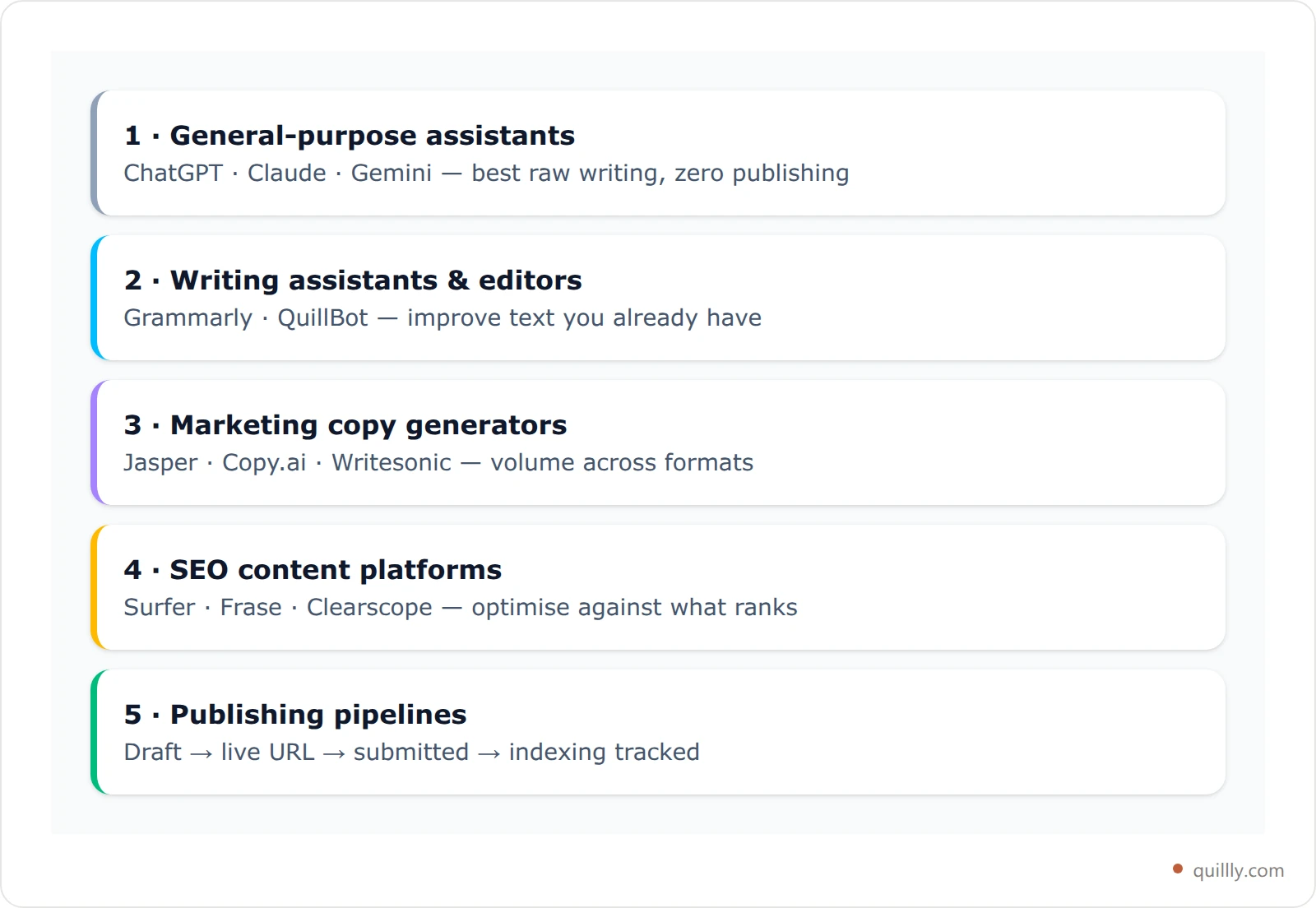
The five categories buyers conflate when searching for the best AI for writing.
1. General-purpose assistants#
ChatGPT, Claude, Gemini. The raw models with a chat interface. They are the strongest pure writers here — frontier models write better sentences than the wrappers built on them — and they have no opinion about your website, your keywords, or your publishing schedule.
Best for: thinking, drafting, editing, anything where a human stays in the loop and moves the output by hand.
Weakness: no memory of your content library, no publishing, no measurement. Every post is a fresh conversation that has forgotten the forty posts before it.
2. Writing assistants and editors#
Grammarly, QuillBot, Hemingway. These improve text you already have rather than producing it from scratch. Excellent at that, and largely orthogonal to SEO — a grammatically flawless post targeting a keyword nobody searches for still earns nothing.
Best for: polish, tone consistency, non-native-speaker confidence.
3. Marketing copy generators#
Jasper, Copy.ai, Writesonic. Built for marketing teams producing volume across formats — ads, emails, landing pages, social. Strong template libraries and brand-voice controls.
Best for: teams whose bottleneck is many short assets in a consistent voice.
Weakness: the output usually lands in a clipboard. Getting it onto a live, indexable URL remains your problem.
4. SEO content platforms#
Surfer, Frase, Clearscope. These optimise a draft against what currently ranks: term coverage, heading structure, length targets. The brief is their core artefact.
Best for: writers who already have a publishing workflow and want the draft to match the SERP's shape.
Weakness: optimisation advice is not distribution. They tell you what to write; they don't publish it, and they can't tell you whether the published version got indexed.
5. Publishing pipelines#
Quillly and similar automation tools. The premise differs: writing is one step in a chain ending at indexed and ranking, not at drafted. The tool publishes to your own domain, submits URLs to search engines, tracks whether each one gets indexed, and reports back.
Best for: people who want content live on their site without being the manual middleware between a chat window and a CMS.
Weakness: if you only want help with a difficult paragraph, this is the wrong category and a frontier model is better.
The test every roundup skips#
Here is the exercise that actually separates these tools. You can run it in an afternoon.
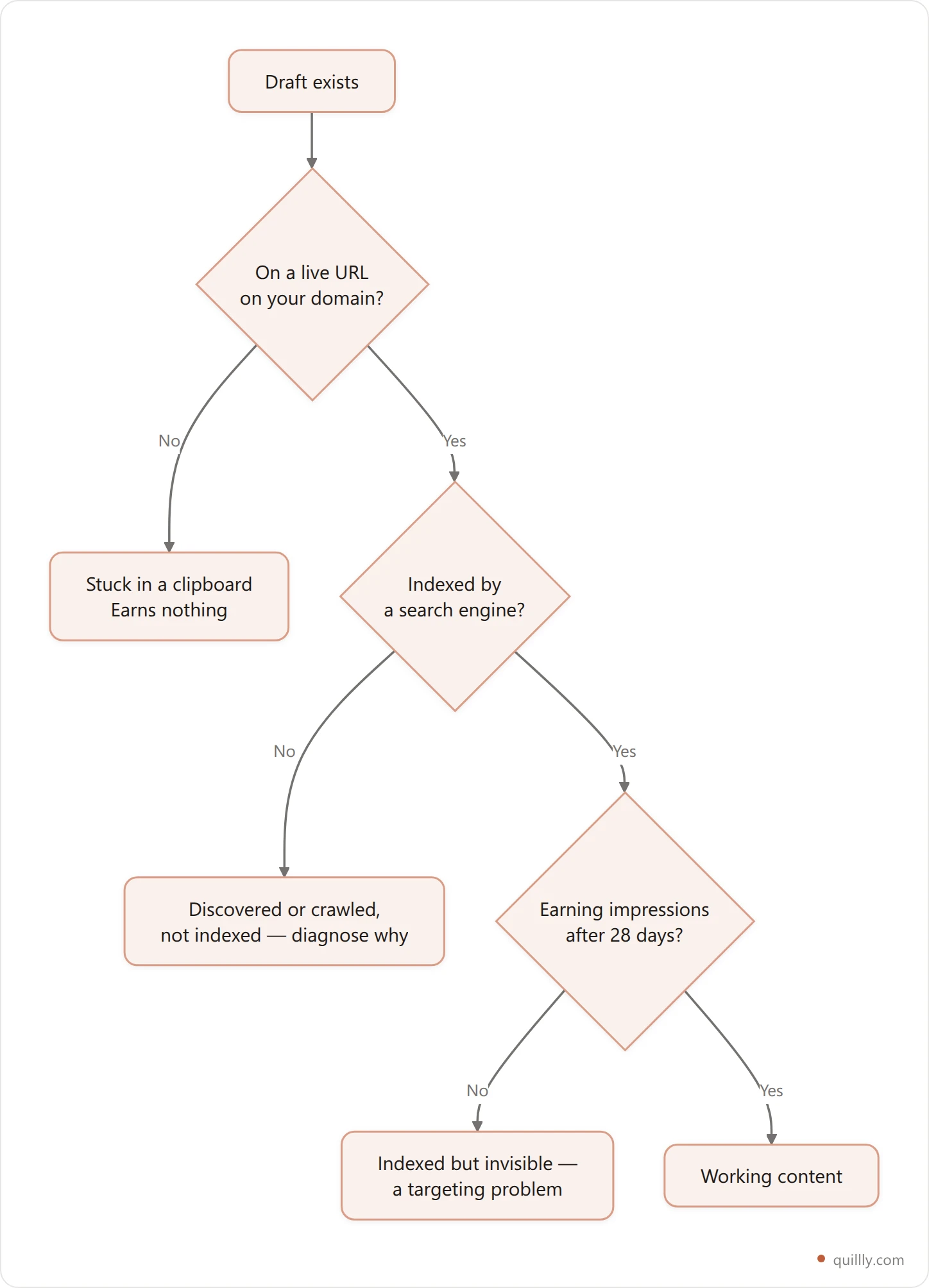
Three checkpoints stand between a finished draft and content that earns traffic.
Take a post produced by any tool on your shortlist, publish it, and two weeks later answer three questions:
Is the URL indexed? Not "is it live" — indexed. Check Search Console's URL Inspection tool, or search
site:yourdomain.com/your-slug. A live page no engine has indexed is functionally a private document.If it isn't indexed, do you know why? "Discovered – currently not indexed" and "Crawled – currently not indexed" are different problems with different fixes. The first is usually crawl budget and internal linking; the second is usually a quality or duplication judgement.
If it is indexed, is it getting impressions? An indexed page with zero impressions after a month is a page the engine kept but never shows. That's a targeting problem, not a writing problem.
Most teams using AI writing tools have never run this check, which is how libraries of a hundred posts end up with a fraction of that indexed. The writing was never the constraint.
This is also where Google's scaled content abuse policy stops being theoretical: it targets content produced at scale without added value, and the practical symptom is exactly the pattern above — pages crawled, then quietly not indexed. We've covered what that policy means in practice separately. If your tool has no visibility into indexing, you won't notice for a quarter.
The evaluation checklist#
Score any tool against these seven criteria. The first three are what reviews measure; the rest decide results.
Criterion | Question to ask |
|---|---|
Prose quality | Does it write sentences you'd publish without heavy editing? |
Brief adherence | Does it follow structure and keyword instructions, or drift? |
Research grounding | Are claims sourced, or confidently invented? |
Publishing | Does the output reach a live URL on your domain, automatically? |
Indexing feedback | Does it tell you which published URLs are indexed — and why not? |
Multi-engine reach | Does it consider Bing, Yandex and AI answer engines, or only Google? |
Internal linking | Does each new post get linked from existing ones automatically? |
The last four score zero for nearly every tool in categories 1–4, by design. That isn't a criticism — a language model isn't supposed to be a CMS — but it explains why teams assemble two or three tools and still watch nothing rank.
On multi-engine reach: Google is no longer the only surface that matters. Bing feeds Copilot, and answer engines increasingly cite sources directly — Bing Webmaster Tools is a separate submission surface most teams never touch. We've written separately on ranking beyond Google and how AI search picks its citations; the short version is that citations reward clean, machine-readable pages more than clever prose.
So what is the best AI for writing?#
The honest answer: the question has four correct answers depending on where your bottleneck actually is.
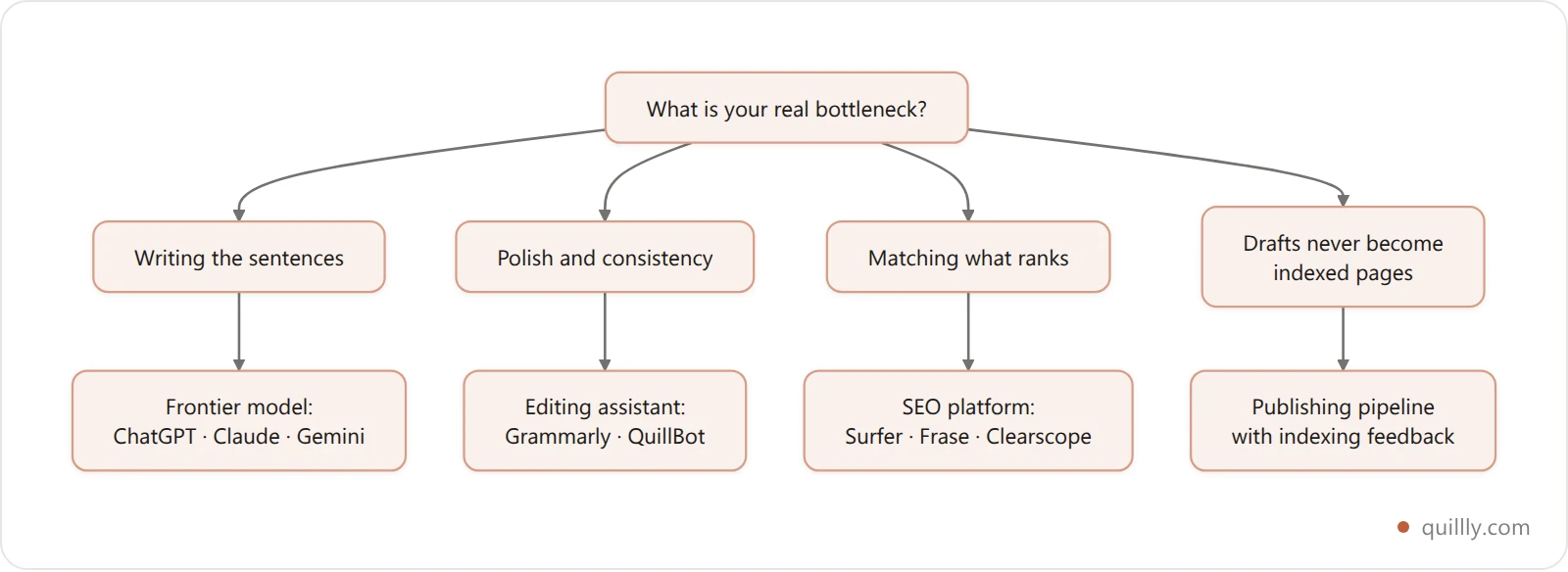
Diagnose the bottleneck before you buy — each one has a different right answer.
Your bottleneck is the sentence. Use a frontier model. Nothing built on top of them writes better than they do.
Your bottleneck is polish. Add an editing assistant; it solves a real problem cheaply.
Your bottleneck is matching what ranks. Use an SEO content platform to shape the brief before writing.
Your bottleneck is that drafts never become indexed pages. The most common case and the least discussed. You need a publishing pipeline, and its value is measured in indexed URLs, not words generated.
A team that buys a copy generator when its real problem is indexing will produce four times the content and the same traffic.
A note on AI detection#
Almost every buyer asks whether AI-written content gets penalised. Two things are true at once: the stated position of search engines is that they reward helpful content regardless of how it was produced, and content produced at scale without added value does get filtered.
Detection tools are a poor proxy for either. We tested how reliable AI content detectors actually are, and the false-positive rates make them unsuitable as a publishing gate. The useful signal isn't a detector score — it's whether the page gets indexed and earns impressions. That's the engine's own verdict, and it's free to check.
Frequently asked questions#
Is the best AI for writing always the most expensive one?#
No. Frontier models are inexpensive relative to their writing quality, and the pricier tools are usually selling workflow rather than prose. Pay for the layer that fixes your bottleneck.
Can AI-written content rank in 2026?#
Yes, and plenty does. Google's guidance is that it rewards helpful, reliable, people-first content regardless of how it was produced. What fails is content that adds nothing to what already ranks — a content-strategy failure, not an authorship one.
How long until a new post gets indexed?#
Anywhere from hours to several weeks, depending on your site's authority and crawl history. The important thing is measuring it: without a median time-to-index you can't distinguish "too early to judge" from "this page is never getting picked up."
Do I need a separate SEO tool as well?#
If your writing tool has no notion of keywords, rankings or indexing — yes. If it does, you're paying twice for the same layer.
The takeaway#
The best AI for writing in 2026 is whichever tool removes your actual constraint. For most people publishing regularly, that constraint stopped being the writing a long time ago. It's the distance between a finished draft and an indexed URL earning impressions — and that distance is measurable, which means you can stop guessing about it.
Run the three-question indexing check on your last ten posts. The answer tells you which category you should be shopping in, and it costs nothing but an afternoon.


