


You bought a local SEO tool, ran the audit, fixed what it flagged — and three months later the map pack looks exactly the same. That's not a bad tool. That's usually the wrong half.
Local search is two separate ranking systems wearing one name. Local SEO tools split into map pack tools — which manage your Google Business Profile, listings and reviews — and local organic tools, which rank your actual web pages for "near me" and city queries. Most buyers purchase one half and expect both to move. Sorting your problem into the right half first is what makes the second purchase work.
This guide maps the categories, shows which job each one does, and explains the one measurement trap that makes local rank tracking lie to you. It reflects how the two systems behave as of September 2026, and it draws on what we see running a 160-post content operation on this domain: the pages that win geographic queries are almost never the ones a listings tool touches.
On this page
Local SEO Tools at a Glance#
Lead with the split, not the logos. Here's what each category of local SEO software actually owns:
Category | Which half | What it replaces | Best for |
|---|---|---|---|
Listings & citation managers | Map pack | Manually updating 40+ directory profiles | Multi-location brands |
Google Business Profile managers | Map pack | Logging into GBP daily to post and reply | Anyone with a physical location |
Review platforms | Map pack | Chasing reviews by hand over email and SMS | Service businesses |
Grid rank trackers | Map pack | Guessing why you rank downtown but not in the suburbs | Diagnosing service areas |
Local keyword research | Local organic | Spreadsheets of city + service permutations | Planning page coverage |
Location page builders | Local organic | Hand-writing 40 near-identical pages | Multi-city service areas |
On-page & technical audits | Local organic | Manual crawls and schema checks | Every site |
Publishing & content platforms | Local organic | Copy-pasting drafts into a CMS | Teams shipping pages weekly |
Note how few products span both columns. The ones that claim to usually do one half well and bolt the other on.
The Two Halves of Local SEO Every Tool List Blurs#
A generic "10 best local seo tools" post ranks products against each other as if they compete. Mostly they don't — a citation manager and a content platform aren't substitutes any more than a wrench and a paintbrush are.
The map pack (the three-result block with the map) is ranked largely by proximity, prominence and relevance signals tied to your Google Business Profile — not your website's content. Google's own guidance on improving local ranking names three inputs: relevance, distance and prominence. Two of those three describe the business, not the page — which is exactly why your blog post doesn't enter that calculation directly.
The local organic results — the blue links under the map — are ranked like any other web page. Content, internal links, page speed and on-page relevance decide those. That's where your site actually competes.
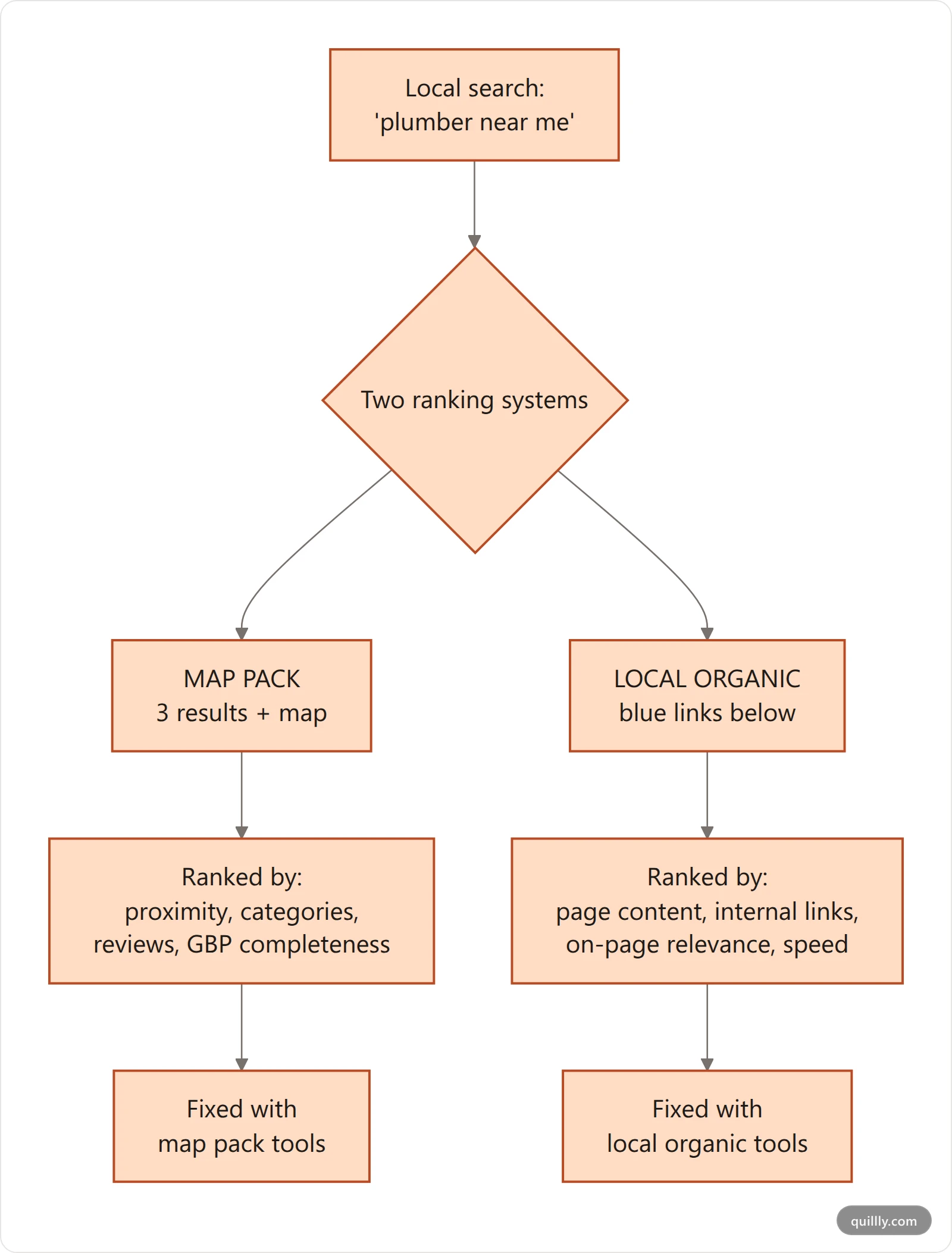
Diagnose before you buy. If you're invisible on the map but your city page ranks eighth, you have a map pack problem. If your profile is immaculate and no page of yours appears for "emergency plumber austin", you have a content problem. Buying listings software for a content problem is the single most common waste in this category.
Half One: Map Pack Tools#
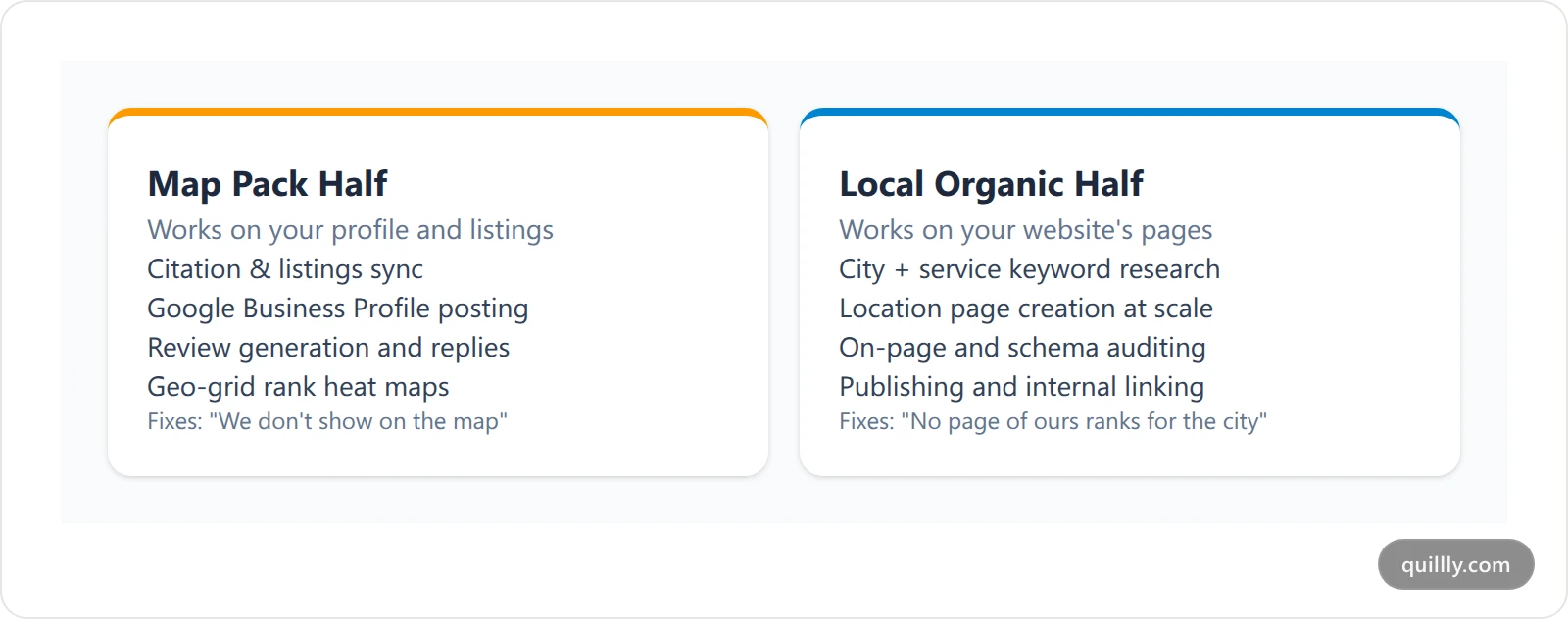
These work on the profile, not the site.
Listings and citation managers push your name, address and phone to dozens of directories and keep them consistent. Consistency matters because conflicting addresses across the web dilute the prominence signal. This is genuinely tedious manual work, and it's the clearest case for paying software to do it — especially across multiple locations.
Google Business Profile managers batch the daily grind: posting updates, answering questions, uploading photos, replying to reviews across locations from one screen. If you run one location, the free GBP dashboard is often enough. The tooling earns its cost at five locations and up.
Review platforms automate requests after a job closes and route replies. Review count and recency are visible ranking and conversion inputs, and BrightLocal's consumer review research has tracked for years how heavily buyers weight them. A steady trickle beats a burst.
Grid rank trackers are the diagnostic most people skip. They query your keyword from dozens of coordinates across a map and show a heat grid — strong at the shop, fading four miles out. That picture tells you whether you have a ranking problem or simply a proximity limit you can't tool your way past.
Half Two: Local Organic Tools#
The second half is ordinary SEO aimed at geography, and it's where most small businesses have the bigger gap — because the map pack has a hard ceiling. There are three slots. If ten competitors sit closer to the searcher than you do, no amount of listings hygiene puts you in them. The blue links below have ten slots and no proximity cap.
Local keyword research is combinatorial: every service crossed with every city, suburb and neighbourhood you serve. The volumes are small and the intent is high. Our AI keyword research playbook covers how to build and prune those lists without drowning in near-duplicates.
Location pages are the deliverable. One genuinely useful page per city you serve, each with local specifics — service area, real projects, local pricing context, directions — rather than a template with the city name swapped. Thin, duplicated city pages are a well-known way to get a whole folder ignored. We walked through producing these at volume without the doorway-page problem in local landing pages for small business.
On-page and technical auditing catches the unglamorous blockers: missing LocalBusiness markup, a city page with no internal links pointing at it, a title tag that never names the city. Google's local business structured data reference is the spec to validate against. An on-page SEO audit is the cheapest first pass here, and it's free to run.
Citations from directories straddle both halves — they feed map pack prominence and can pass real referral traffic. Which ones still justify the effort is a separate question we answered in directory submission sites that still work.
Ship city pages without the copy-paste
Quillly connects your AI assistant to your own domain, scores every page against 14+ SEO criteria before it goes live, and publishes it in seconds. Start a 14-day trial, no card required.
See how it worksLocal Rank Tracking Depends on Where the Search Happens#
Here's the trap. "Are we ranking?" has no single answer in local search, because the result changes with the searcher's coordinates. Two people a mile apart get different map packs for the same query at the same second.
That makes generic local rank tracking misleading in a specific way: most rank trackers report a position for a country or at best a city centroid. Quillly's own rank tracking works at country level, for example — useful for national queries, but it won't tell a plumber whether they're visible in one particular suburb. Read a single national number for a local query and you'll draw the wrong conclusion in both directions: it flatters you when you rank well downtown and hides wins out in the service area.
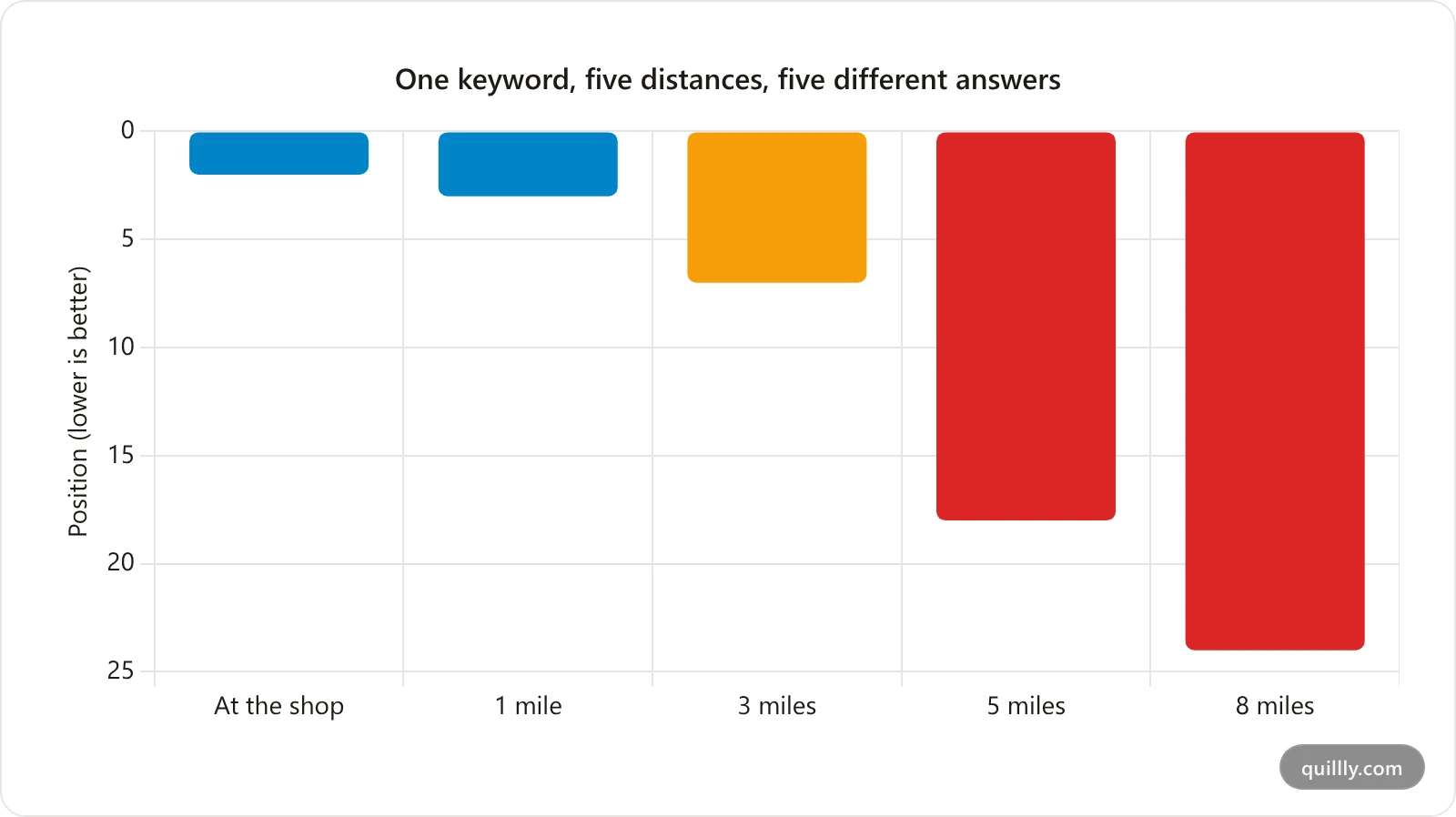
Practical rule: use a geo-grid tracker for map pack positions, and a conventional rank tracker for your location pages in organic results. They answer different questions and you need both. If you're setting up organic tracking from scratch, rank tracking without code covers the setup.
What Local SEO Software Costs at Each Stage#
Spend follows the number of locations, not ambition. A single-location business can cover the map pack half with free tools — the GBP dashboard, manual review requests, a quarterly citation check — and put every dollar into the content half, where the ceiling is higher.
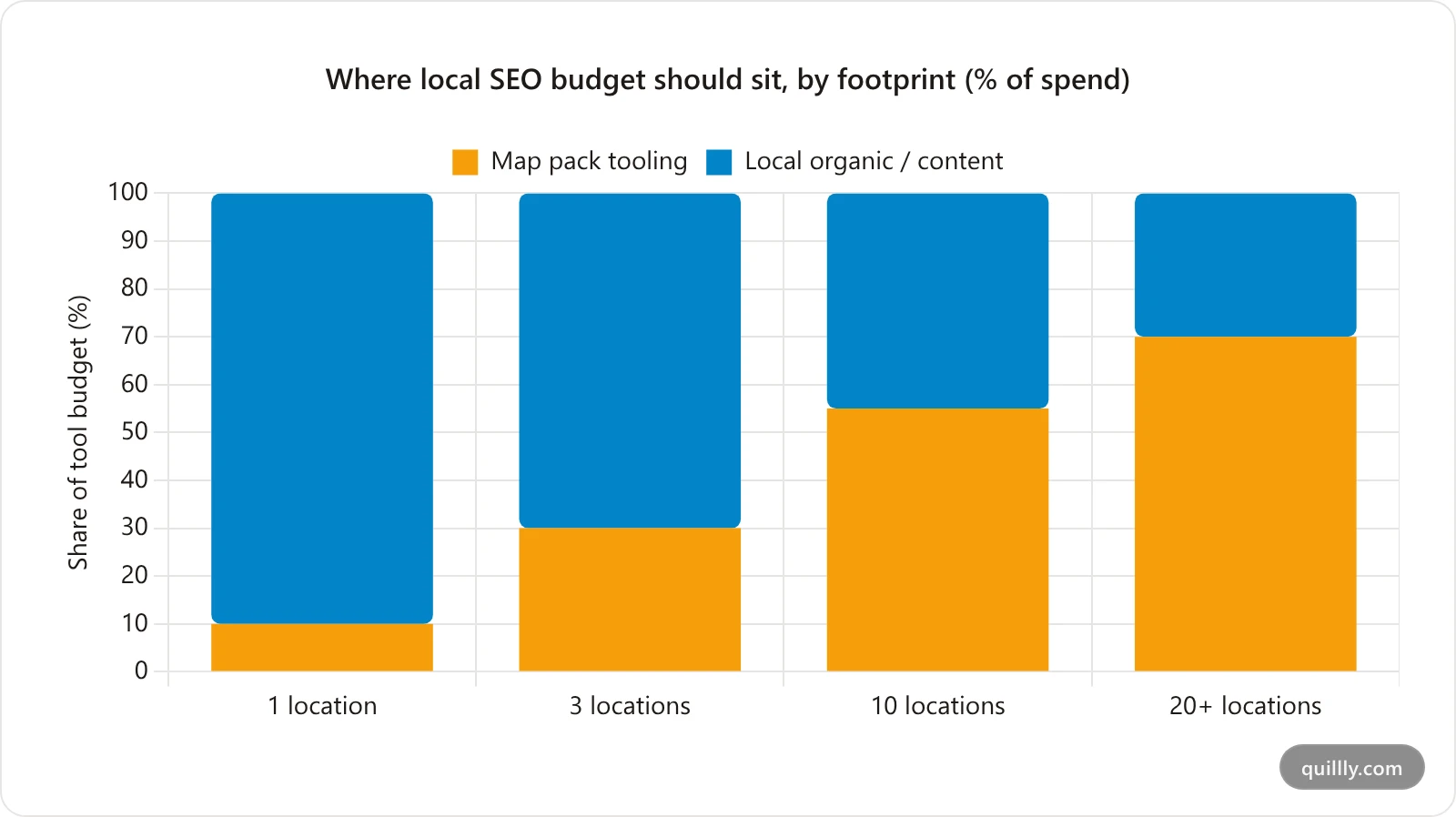
The inversion is the point. At one location, listings software automates about an hour of quarterly work — poor value. At twenty, it automates a job nobody on your team wants, and the content half gets harder to justify per location. Buy against your footprint, not against a feature list.
Building a Stack That Covers Both Halves#
Most overspending comes from overlap: three products that each do keyword research, none that publishes a page. Assemble by job instead.
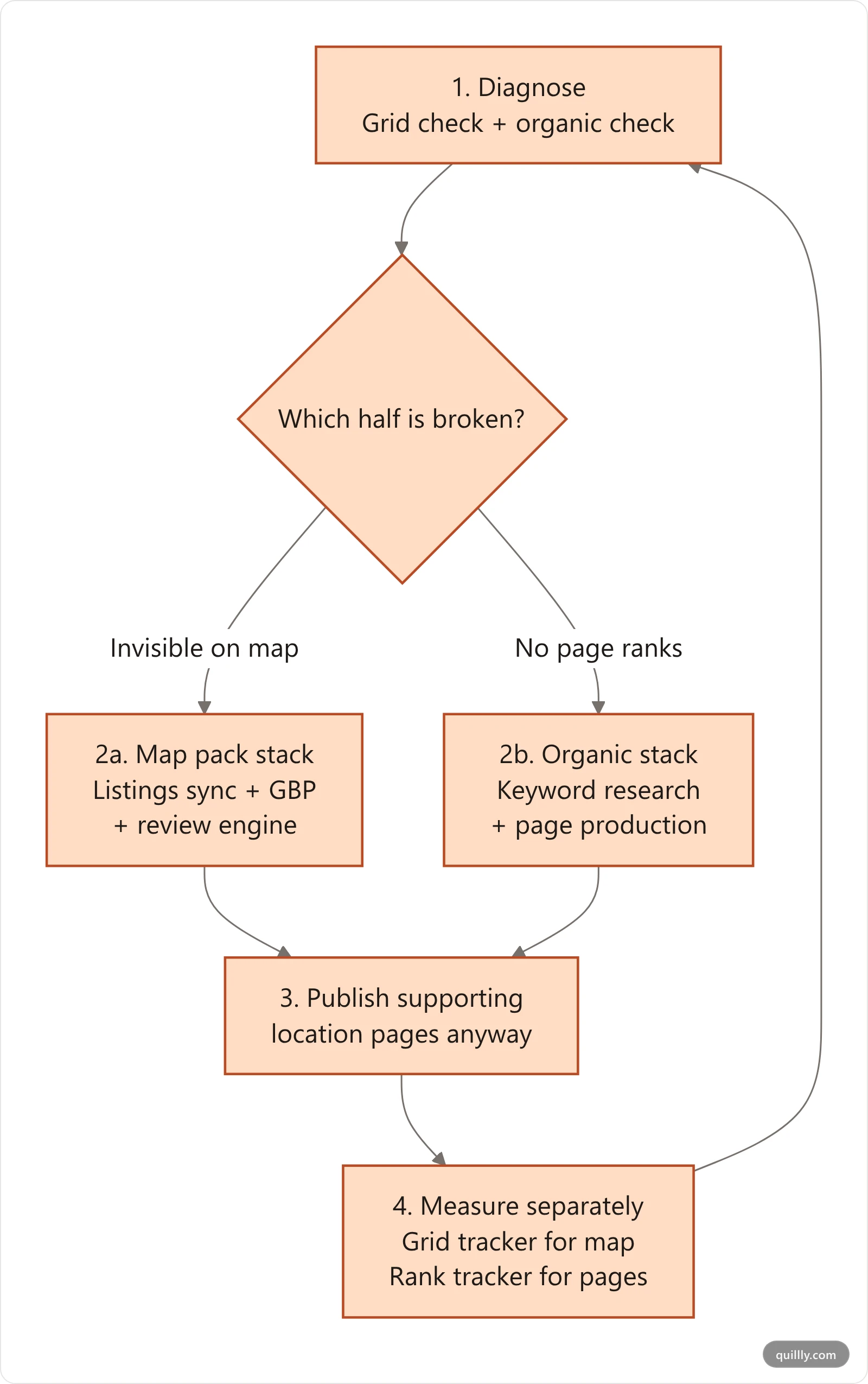
Four slots, filled once each. Anything that doesn't fill an empty slot is a renewal you'll regret. The pattern we run into most often auditing stalled local campaigns is three overlapping research subscriptions and nothing that actually ships a page — the diagnosis step exists to stop that. And note step 3: location pages help both halves, because a real page about the city reinforces relevance for the profile too. It's the one investment that isn't half-specific.
Where a publishing platform fits is narrow and worth stating plainly. Quillly is not a local SEO tool — it has no Google Business Profile management, no citation sync and no geo-grid tracking. What it does is the production line for the organic half: your AI assistant drafts the city page, Quillly scores it against 14+ SEO criteria, publishes it to your own domain, and submits it to eight search engines through Google's sitemap and the IndexNow network. If your bottleneck is forty pages that never get written, that's the gap it closes.
Five Ways Local SEO Budget Gets Wasted#
Buying listings software for a content problem. Perfect citations don't create a page that can rank for "roof repair Plano". Run the diagnosis first.
Paying for citations you could claim free. The high-value ones — Google, Apple Maps, Bing Places, Yelp, your industry's main directory — take an afternoon to claim by hand. Software earns its place on the long tail and on multi-location upkeep.
Judging local performance on one national rank number. Covered above, and it's the error that keeps the wrong strategy funded longest.
Spinning up templated city pages. Forty pages with the city name swapped is a pattern search engines handle badly, and it can suppress the folder. Fewer, genuinely local pages outperform.
Never measuring the map pack separately. Without a grid view you can't tell a ranking problem from a proximity limit — and only one of those is fixable.
On that last point, Whitespark's long-running local search ranking factors survey is a useful sanity check on where practitioners think the weight currently sits.
Key Takeaways#
Local search is two ranking systems: the map pack, driven by your Google Business Profile, and local organic, driven by your pages. Most local seo tools serve exactly one.
Diagnose before buying. Invisible on the map is a profile problem; no page ranking for the city is a content problem.
The map pack has three slots and a proximity ceiling. Local organic has ten and no ceiling — usually the larger opportunity for a single location.
Local rank tracking at country or city-centroid level misleads on local queries. Use a geo-grid tracker for the map, a conventional tracker for pages.
Let footprint set the budget: content-heavy at one location, listings-heavy at twenty.
Location pages are the one investment that serves both halves at once.
Frequently Asked Questions#
What are the best local seo tools for a single location?#
For one location, the free stack usually wins: the Google Business Profile dashboard for the map pack half, plus a geo-grid check a few times a year. Put the budget into the local organic half — keyword research and genuinely local pages — because that's where a single location has the most unclaimed room.
Do I need paid local seo software at all?#
Not immediately. Paid local seo software mainly buys back time: bulk listings updates, multi-location posting, automated review requests. At one or two locations that's a few hours a quarter. The break-even usually arrives around five locations, or sooner if review volume is your weak point.
Can local seo tools get me into the map pack?#
They can remove the reasons you're excluded — incomplete profile, wrong categories, inconsistent listings, thin review count. They cannot overcome proximity. If ten competitors sit physically closer to the searcher, no tool moves you into three slots for that coordinate. That's why grid data matters before you spend.
Why does my local rank tracking show a different position than what I see?#
Because you're searching from your own location, logged in, with your own history. Rank trackers query from a set coordinate with none of that personalisation. Neither number is wrong — they answer different questions. For local queries, trust grid data over any single position.
How many location pages should I actually build?#
One per place you genuinely serve and can write something specific about — real projects, service areas, local context. If you can't write 400 distinctive words about working in that suburb, skip it. Ten substantial pages outrank forty templated ones, and they don't put the folder at risk.
The organic half, automated
Quillly scores every page against 14+ SEO criteria before publishing, pushes it live on your own domain, and tracks indexing across Google, Bing and Yandex. 14-day trial, no card.
Start freeSort your problem into the right half, buy one tool per empty slot, and measure the two halves separately. That's most of local SEO tooling — the rest is just logos. If the gap you keep hitting is pages that never get written, get started with publishing from your AI assistant and close that half first.


