

You can generate twelve local landing pages this afternoon. Getting search engines to keep them is the hard part — and it's the part most guides skip entirely.
The short answer: AI content creation for small business local SEO works when the AI is fed genuinely local inputs and the output survives a simple test — change the city name, and the page should stop being accurate. Pages that pass get indexed and rank. Pages that fail are near-duplicates, and volume makes that problem worse, not better.
This guide covers the workflow we'd actually run: why local landing pages beat a single homepage, the five phases from research to publish, the uniqueness test that decides whether a page is worth shipping, what Google's own guidance says about scaled content, and how to measure results per location.
Why Local Landing Pages Beat One Homepage#
When someone searches "emergency plumber in Austin" or "yoga studio near Midtown," they aren't browsing — they're ready to act. A page built for that neighbourhood, using local terminology and answering hyper-local questions, matches that intent far more precisely than a homepage trying to serve everyone at once.
The competitive reality helps you here. Most small-business competitors still run one homepage across multiple service areas, because writing genuinely distinct pages for fifteen locations used to require copywriting capacity they didn't have. That capacity constraint is what AI removes: producing localized content at scale is now genuinely cheap. It is also the only part of the problem AI removes. Strategy, local knowledge, and judgment still have to come from you.
A caution worth stating early: covering more locations is not the same as ranking in more locations. A page that exists but never gets indexed contributes nothing, and on a young domain that's the common outcome. On our own site, 55% of published pages are indexed on Google and just 20% on Bing — and every one of those pages cleared a quality score before it shipped. Publishing is the easy half.
The Five-Phase Workflow#
This is a repeatable process one owner-operator or marketer can run. Phase 4 is the one teams skip, and it's the one that decides whether the pages survive.
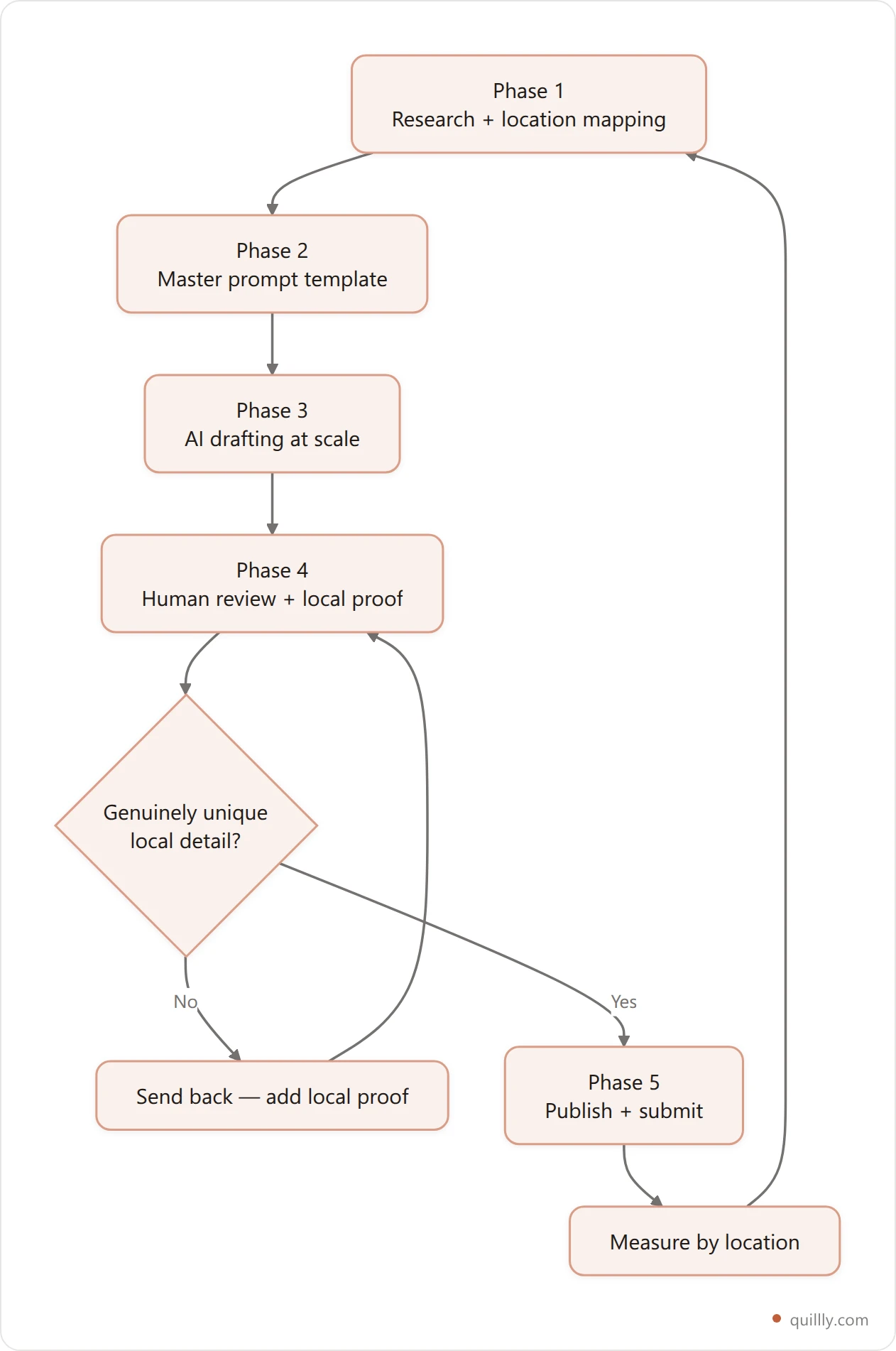
Phase 1 — Research and Location Mapping#
Before writing anything, decide which locations are worth targeting. Use your Google Business Profile data and Search Console queries to find the city or neighbourhood terms that already show demand for your service category.
Look for:
Lower-competition suburbs where ranking is realistic rather than aspirational
Neighbourhoods with distinct identities that give you something true to write about
Service-area clusters you can link together, so the pages support each other
Document them in a simple sheet: location, primary keyword, and whether you have any genuine local proof for it — a customer, a job, a landmark, a regulation. That last column is the one that matters. A location with an empty proof column isn't ready to be a page yet.
Which tools are worth paying for at this stage is a separate decision, and an easy one to get wrong: local SEO tools split into two halves — the ones that manage your business profile, and the ones that help your pages rank. Location pages sit squarely in the second half.
Phase 2 — Build a Master Prompt Template#
This is the highest-leverage step. Write one prompt that takes location variables and returns a structured draft, so the brand voice stays fixed while the local specifics change.
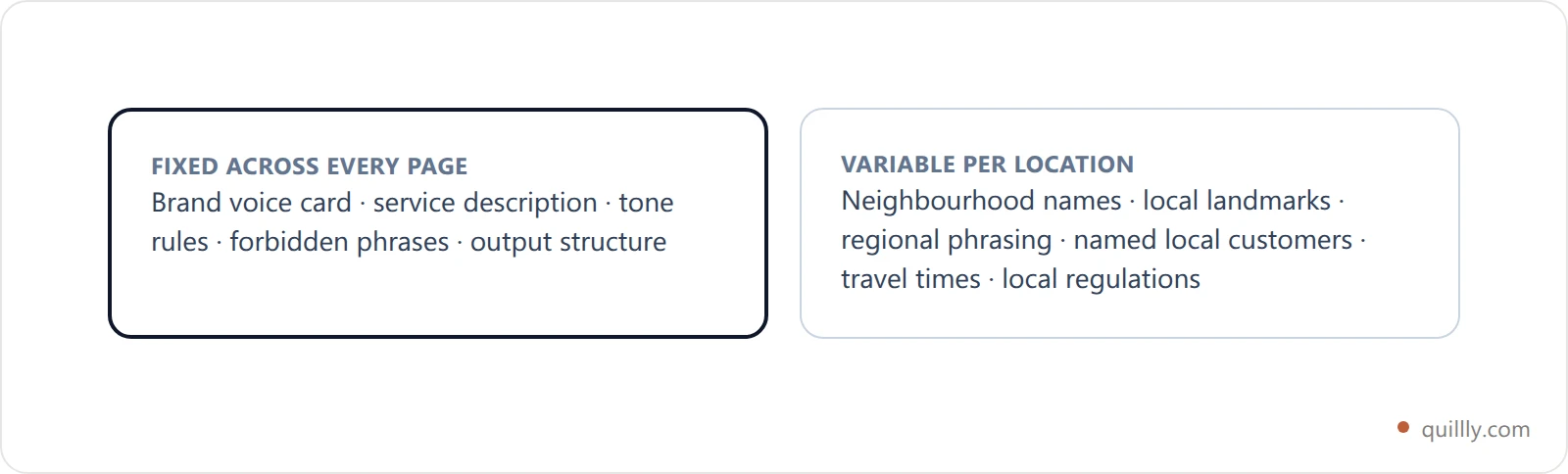
The variable slots are the whole point. If your per-location inputs are just the city name, your pages will differ by just the city name — and that's the failure mode described further down.
Store the prompt somewhere shared so it improves with each batch. A good master prompt is a reusable asset, not a one-off.
Phase 3 — AI Drafting at Scale#
Feed the template through your AI with each location's variables filled in. Batch by geography so review stays in context — five pages for one metro area back-to-back is faster to check than five unrelated cities.
The output isn't publish-ready, and it shouldn't be. The goal here is structured drafts a human can efficiently sharpen, not finished pages.
Phase 4 — Human Review and Local Proof#
This is what separates a working local SEO program from a pile of thin pages. A short review per page against a fixed checklist:
Does this sound like us, or like a generic service provider?
Are the local details accurate, specific, and verifiable?
Would a resident recognise this as written by someone who knows the area?
Is the call to action relevant to this location?
For more on keeping voice consistent while automating, see our guide to human-in-the-loop AI content creation.
Phase 5 — Publish and Submit#
Before each page goes live, confirm:
LocalBusiness structured data with the correct service area
A link to your Google Business Profile in the contact section
Title and meta description carrying the location naturally, not stuffed
Internal links to your main services page and to neighbouring location pages
Submission to every engine, not just Google — this is where most local pages quietly stall
That last point deserves its own emphasis. Publishing a page doesn't index it. Our own blog SEO checklist ranks multi-engine submission as the single highest-return item on a low-authority domain, ahead of every on-page refinement.
Publish location pages to every index at once
Quillly scores each page against 14+ SEO criteria, publishes to your own domain, and pushes every URL to Google plus the IndexNow network — then tracks indexing per engine so a stalled page shows up in week one.
Start a 14-day free trialThe Swap Test#
Here's the test that decides whether a page is worth publishing. Change the city name. If the page is still completely accurate, it's a template with a variable in it — and search engines treat it accordingly.
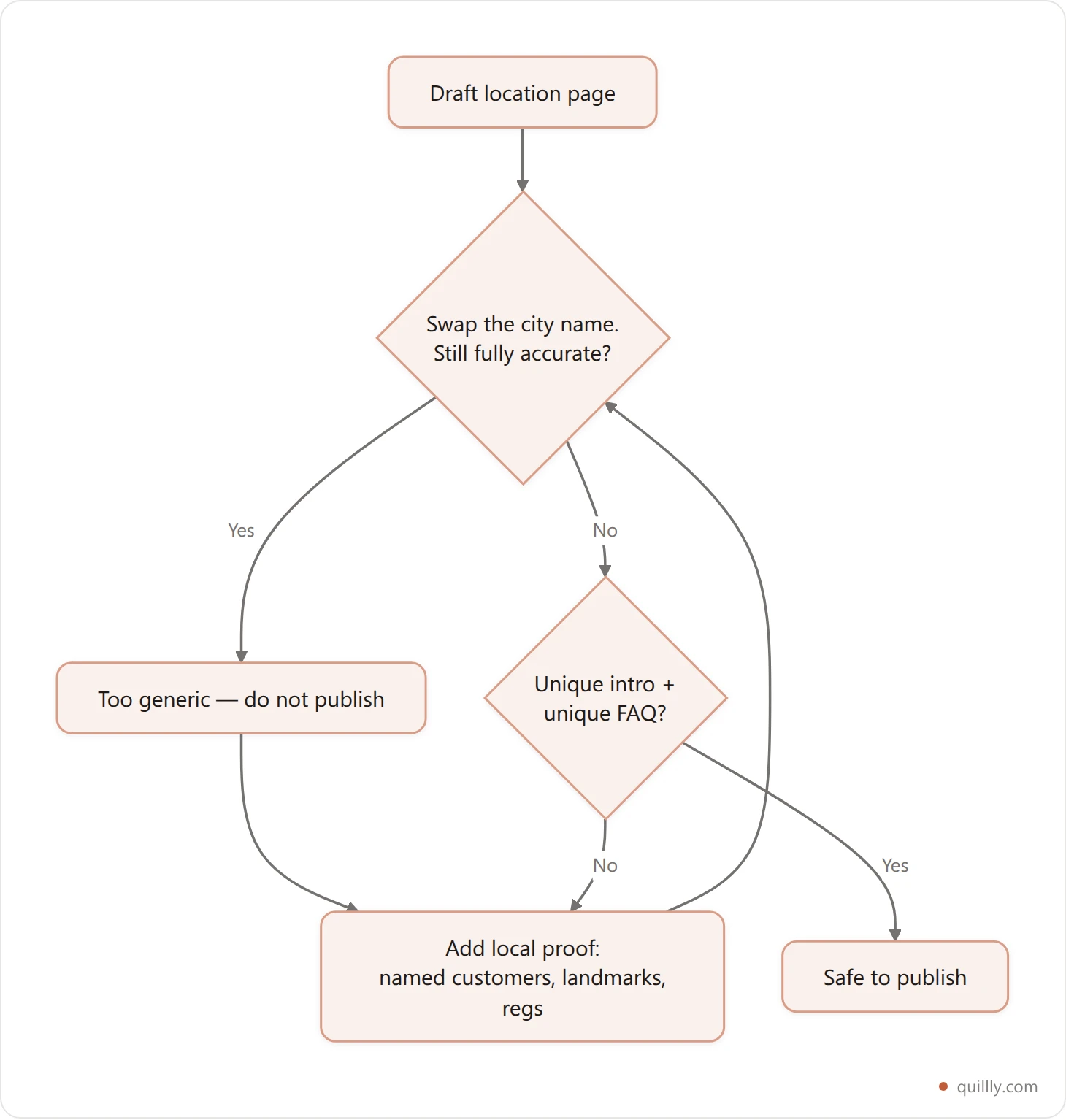
What passes the swap test is specific and checkable: a named customer in that area, a landmark people navigate by, travel times you'd actually quote, regional phrasing for the service, or a local regulation that changes how you work there. What fails it is adjective substitution — "the vibrant community of X" is the same sentence for every X.
What Google Actually Says About Scaled Pages#
Worth reading the source rather than the summaries. Google's spam policies define scaled content abuse as generating many pages primarily to manipulate rankings rather than to help people — and they're explicit that this applies regardless of how the pages were produced. Automation isn't the trigger. Producing pages with no independent value is.
The helpful content guidance points the same way: it asks whether content provides original information, insight, or analysis beyond the obvious. A location page carrying real local knowledge clears that bar comfortably. One carrying a swapped city name does not.
This is genuinely good news for careful operators. The line isn't drawn at "AI wrote it." It's drawn at whether the page earns its own place — which is a standard you can meet deliberately.
Five Ways These Pages Fail#
1. Duplicate content at scale. Ten pages sharing most of their text with a swapped city name will be treated as near-duplicates. Fix it with genuine local substance, not synonym rotation.
2. Brand voice drift. Tone shifts across a long batch of prompts. Set explicit voice rules with examples of what you do and don't say, and re-read a sample from each batch rather than trusting the first page you checked.
3. Missing local trust signals. Generic output lacks the details that convince a local reader. Feed the AI real inputs: customers who agreed to be named, landmarks, community involvement, actual service constraints.
4. Skipping technical SEO. Copy alone doesn't rank. Check structured data, titles, canonical tags, and mobile rendering before publishing. Our on-page SEO audit walks the full pre-publish check.
5. No measurement. Publishing without tracking means you can't tell which locations worked, which stalled, and which never got indexed at all. That's the difference between a program and a guess.
Measuring Local Landing Pages#
Segment every metric by location. A healthy average across your local landing pages routinely hides a set of dead ones.
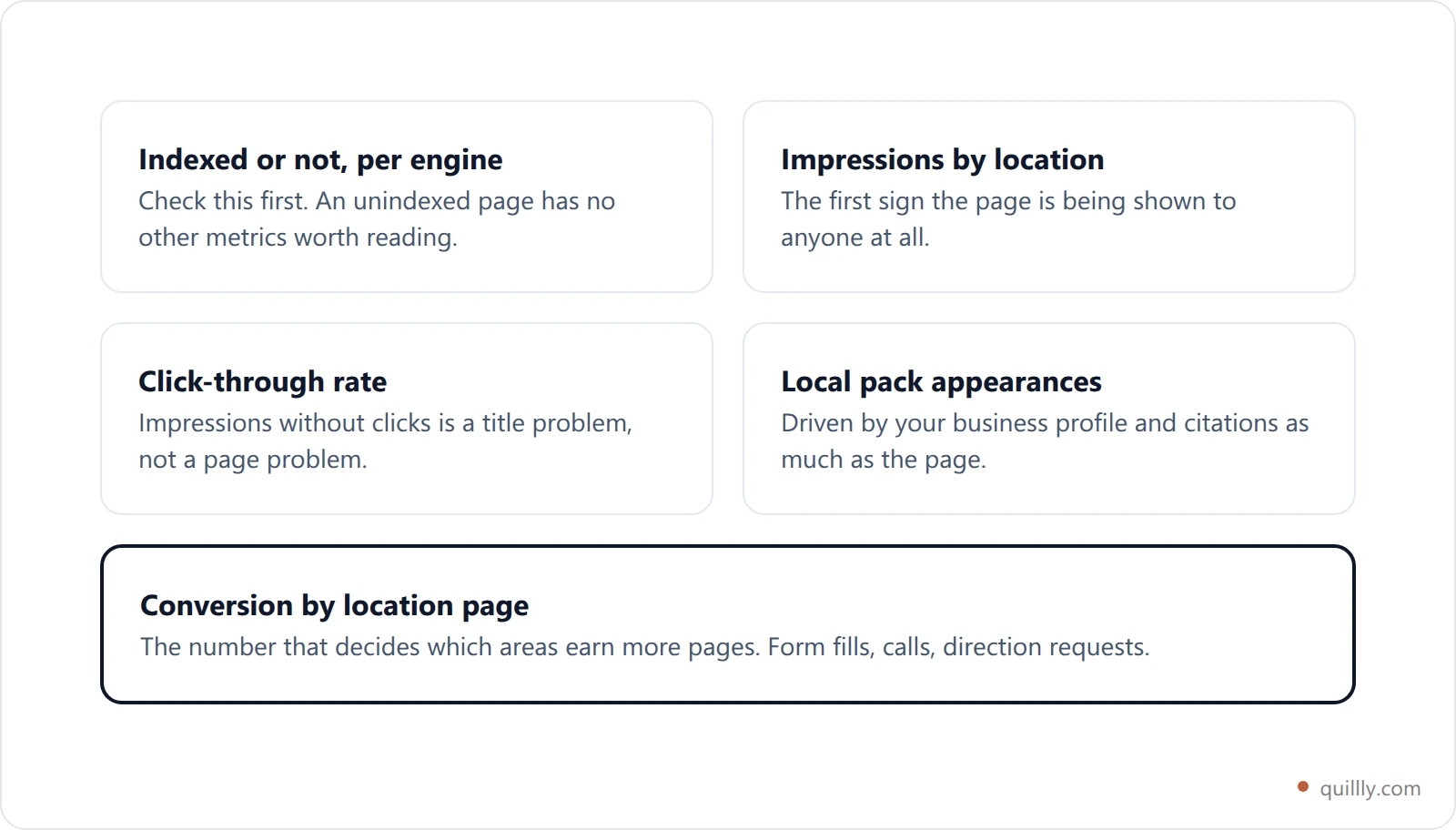
Give indexing a realistic window before you judge anything. On our own library the median time from publish to indexed currently runs around ten days, so a check at two weeks separates genuine failure from ordinary crawl lag.
One hard-won caveat: if a page does get indexed and later drops out, on-page editing is unlikely to bring it back. We tested exactly that across four dropped pages — adding internal links from indexed pages, then condensing the content — and recovered none of them over a ten-day window. Prevention is far cheaper than recovery here, which is the real argument for the swap test in Phase 4.
For the broader ROI framing, see our marketing automation ROI guide, and for workflow efficiency, content automation tools.
Frequently Asked Questions#
Does Google penalize AI-generated local landing pages?#
Not for being AI-generated. Google's spam policies target scaled content produced primarily to manipulate rankings, explicitly regardless of how it was made. A location page that survives the swap test carries independent value and is treated as ordinary content.
How many location pages should you start with?#
Three to five, not fifty. A small batch lets you confirm the pages get indexed and convert before you scale the template. Publishing dozens of untested pages at once multiplies whatever is wrong with the first one.
What makes a location page unique enough to rank?#
Specifics only a local would know: named customers in that area, landmarks, travel times, regional phrasing, and local regulations that change how you work. Adjectives about a city are not specificity.
How long until AI-generated local pages show results?#
Indexing comes first, typically within days to a few weeks — our own median currently runs around ten days. Ranking movement follows over one to three months. Check indexing before you judge anything else.
Do you still need a human in the loop at this scale?#
Yes, and it's the phase that pays for itself. Human review is where local proof gets added and voice drift gets caught. It's a check against the swap test rather than a rewrite, so it stays fast even across dozens of pages.
What if a location page gets dropped from the index?#
Assume you can't edit your way back. We tested internal links and condensation across four dropped pages and recovered none of them in ten days. Build the page well the first time and treat a drop as a signal about the whole template, not that one page.
The Short Version#
AI removes the capacity constraint on local landing pages. It doesn't remove the requirement that each page be worth having, and producing localized content at scale makes that requirement more important, not less. The workflow that holds up is the one where a human supplies genuine local inputs before drafting and verifies them after: research locations you have real proof for, build one master prompt, draft in batches, review against the swap test, then publish and submit to every engine.
The measurement discipline matters as much as the writing. Check indexing per engine before anything else, give it about two weeks, and segment every metric by location — because the average will look fine long after individual pages have gone quiet.
Ready to build your first batch? Start a 14-day free trial — brand voice configuration, SEO scoring against 14+ criteria, publishing to your own domain, and per-engine indexing tracking in one place.