
Why Human-in-the-Loop AI Content Creation Beats Full Automation#
Human in the loop AI content creation is the strategy top small businesses use to scale content output without sacrificing the brand voice that drives loyalty. 88% of marketers now use AI tools daily — yet brand inconsistency remains the single most cited complaint about AI-generated content. AI content tools can deliver up to 50% faster turnaround on blogs, emails, and social posts, but for small businesses, that speed comes with a quiet risk — the gradual erosion of the authentic, distinctive voice that makes customers choose you over a competitor.
This is the core tension of human-in-the-loop AI content creation: how do you scale output without flattening the personality that drives loyalty? According to HubSpot's State of Marketing report, teams using human-in-the-loop AI content creation workflows consistently outperform fully automated pipelines on engagement and conversion metrics. The answer isn't to choose between AI and humans — it's to combine them deliberately. A human-in-the-loop (HITL) workflow blends AI drafting with human editorial judgment to achieve both efficiency and brand consistency.
In this post, you'll learn exactly what that workflow looks like, which tools support it, how to build it in 30 days, and how to measure whether it's actually paying off.
Why Brand Voice Is the Hidden Casualty of Full AI Automation#
Brand voice is the consistent personality a business expresses across every piece of content — the specific words it favors, the sentence rhythms it uses, the values it signals between the lines. For small businesses competing against larger players, it's often the primary differentiator. A local skincare brand doesn't just sell moisturizer; it sells a particular feeling of being understood.
The data on consumer expectations is nuanced and worth understanding carefully. 70% of Gen-Z consumers say they prefer human-written content, yet 52% trust AI-generated content for decision-making purposes . This isn't a contradiction — it reflects a sophisticated expectation: readers want content that feels human even when AI helped produce it. When that feeling disappears, trust erodes.
Fully automated AI pipelines tend to produce content that passes a surface-level brand check — correct logo colors in the header, right product names in the copy — while missing the deeper texture that makes a brand recognizable . The vocabulary drifts toward generic. The sentence rhythm becomes uniform. The storytelling style loses its edge.
The Cost of Getting It Wrong#
The business consequences are measurable. When tone feels "off," readers disengage faster — higher bounce rates, lower repeat purchase frequency, and weakened email click-through rates follow . A boutique retailer that migrated to 100% AI-generated content reported a noticeable drop in social engagement within 60 days before reintroducing a human editing layer and recovering performance . The lesson: automation without oversight doesn't just plateau results — it can actively reverse them.
What 'Brand Voice' Actually Means in an AI Context#
In practical terms, brand voice encompasses five elements that AI alone struggles to preserve without deliberate configuration:
Tone adjectives — warm, irreverent, authoritative, conversational
Vocabulary preferences — the words you always use and the ones you never do
Sentence rhythm — short and punchy vs. long and layered
Storytelling style — data-first vs. narrative-first vs. problem/solution
Values alignment — the implicit beliefs embedded in every content choice
Without explicit configuration, AI tools default to statistically average language — competent, but indistinct .
What Is Human-in-the-Loop AI Content Creation and Why It Works#
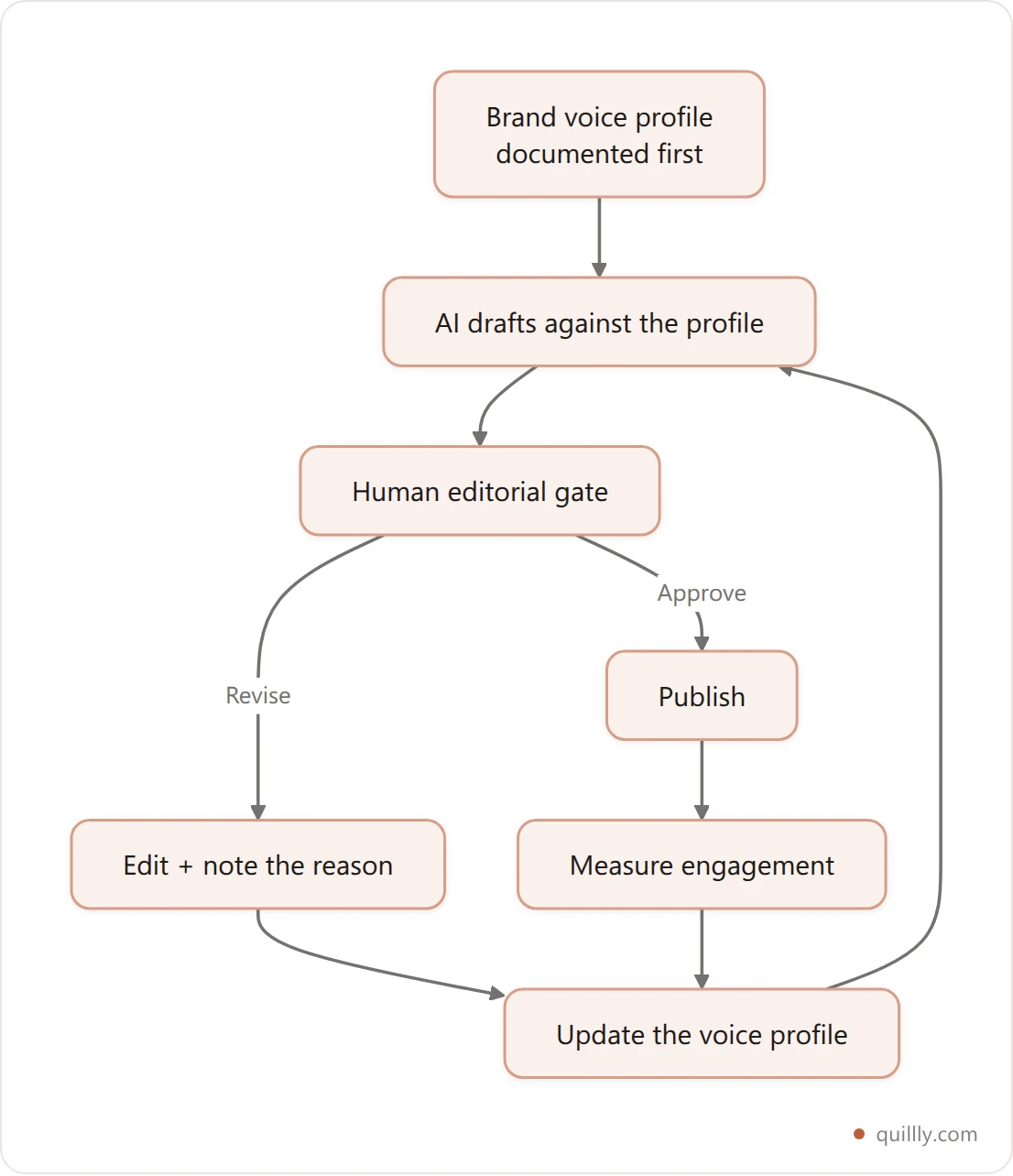
Human-in-the-loop AI content creation is a pipeline where AI handles the high-volume, low-judgment tasks — research aggregation, outline structuring, keyword integration, and first-draft generation — while human editors review, refine, and approve every piece before it reaches an audience.
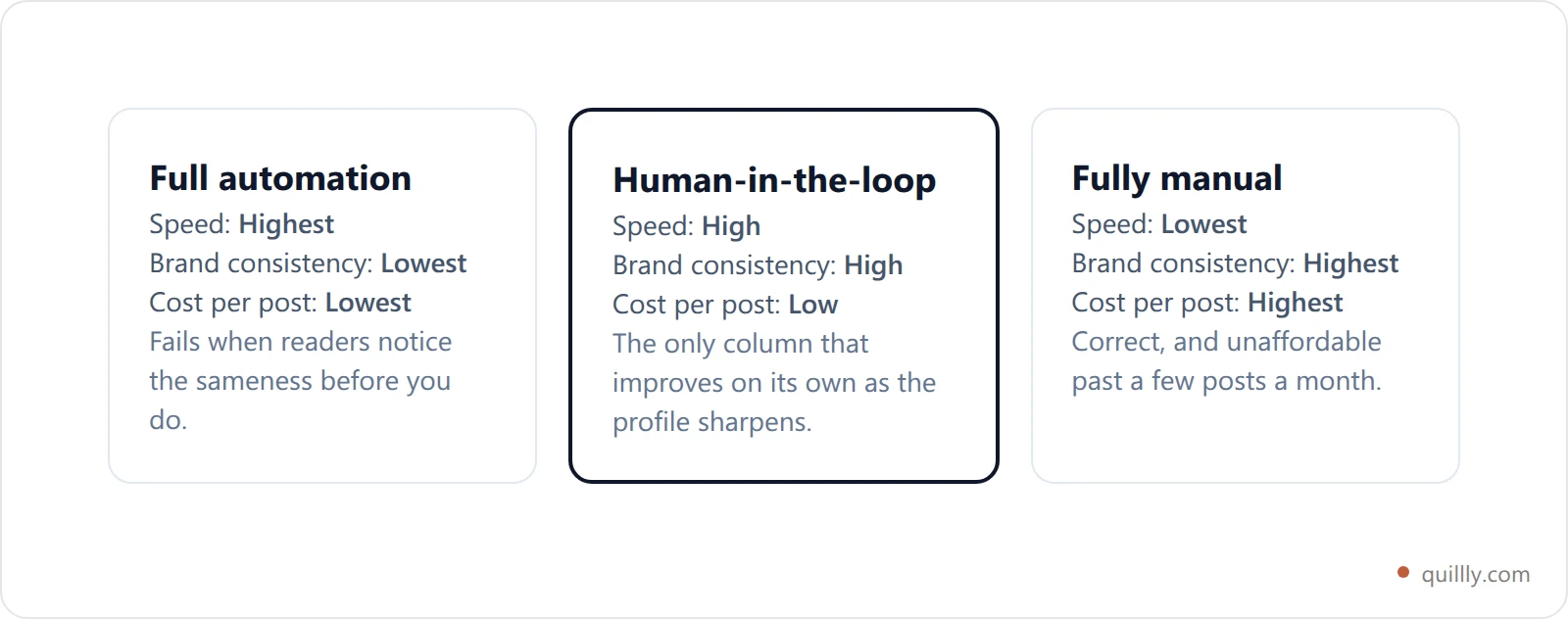
This isn't a workaround for AI's limitations. It's a deliberate division of cognitive labor. HITL workflows have been shown to yield 50% faster content turnaround and 15% higher audience engagement compared to either fully manual or fully automated approaches . The efficiency gains are real; so are the quality gains.
The strategic logic is straightforward: AI removes low-value cognitive labor (formatting, keyword placement, structural outlining) while humans contribute high-value judgment — nuance, empathy, cultural awareness, and brand alignment. Neither can fully substitute for the other in a content-quality-conscious operation.
The Three Stages of a HITL Pipeline#
A well-designed HITL pipeline moves through three distinct phases:
AI Research & Draft Generation — The AI tool ingests your brief, pulls relevant data points, structures an outline, and produces a complete first draft optimized for keyword targets.
Human Brand-Voice Editing — A human editor reviews for tone accuracy, factual correctness, emotional resonance, and brand alignment. This is where the content becomes yours.
AI-Assisted SEO Optimization — Before publishing, AI tools scan for keyword density, readability scores, meta description quality, and internal linking opportunities — removing the manual SEO checklist burden.
Why This Model Scales for Small Businesses#
A solo founder or two-person marketing team can realistically produce enterprise-level content volume using this model — without hiring a full content department. Platforms like Quillly are built specifically for this workflow: brand voice configuration lets you encode your tone parameters once, and the inline editing interface makes the human review step fast and frictionless rather than a bottleneck.
One small e-commerce brand using a HITL approach reduced content production time by 60% while maintaining measurable brand consistency scores across channels . That's the kind of leverage that changes what's possible for a lean team. For a broader look at how automation compounds these gains, see Content Automation Tools: How Small Businesses Save 30+ Hours Monthly.
Building Your HITL Workflow: A Step-by-Step Blueprint#
Step 1 — Document Your Brand Voice Before Touching Any AI Tool#
This is the most skipped and most critical step. Create a brand voice guide that covers:
3–5 tone adjectives with examples of each in action
A "we say / we never say" vocabulary list
Preferred sentence length and paragraph structure
Sample approved content pieces that represent the brand at its best
Values statements that should be implicit in every piece
No AI tool can preserve a voice you haven't defined. Start here.
Step 2 — Configure AI Tools with Your Brand Voice Parameters#
Platforms with built-in brand voice configuration — like Quillly — allow you to ingest these guidelines directly, so first drafts arrive already aligned with your tone rather than requiring wholesale rewrites. This is the difference between AI as a starting point and AI as a liability.
Step 3 — Define the Human Editing Checklist#
Your editor (even if that's you) should work through a consistent checklist on every piece:
Does the tone match our voice guide?
Are all facts accurate and cited correctly?
Does the opening hook earn attention?
Is the emotional arc of the piece intentional?
Is the CTA clear, specific, and on-brand?
Are SEO keywords integrated naturally?
Does the content reflect our current product/service reality?
Step 4 — Set Up a 30-Day Pilot on One Channel#
Don't try to automate everything at once. Start with email or a single blog category, measure CTR and conversion over 30 days, and use that data to refine your configuration before scaling . A contained pilot reduces risk and generates the evidence you need to justify broader rollout.
Step 5 — Measure and Iterate#
Track content production time saved, engagement rate changes, and conversion lift. Target at least a 30% efficiency gain before expanding the workflow to additional channels .
Tool Stack Recommendations#
AI draft generation: Quillly, Jasper
SEO optimization: SurferSEO
Workflow management: Zapier
Performance analytics: Google Analytics 4, HubSpot

Common Mistakes to Avoid#
Skipping the brand voice documentation step — the most common and costly error
Letting AI publish without human review — even one off-brand piece can erode trust
Failing to A/B test AI-assisted vs. manual content to validate your configuration
Measuring ROI: Proving That HITL AI Content Pays Off#
Most articles on AI content automation stop at efficiency claims. Let's go further and quantify what a HITL workflow is actually worth to a small business.
Key metrics to track monthly:
Content production hours saved
Cost-per-piece reduction
Organic traffic lift
Email CTR improvement
Lead conversion rate
Customer lifetime value trends
The benchmarks are encouraging: 83% of AI users report a 50% boost in content creation efficiency, and AI-driven personalization lifts purchase frequency by 35% and average order value by 21% . These are realistic SMB targets, not enterprise outliers.
A Simple ROI Calculator Framework#
Use this formula to calculate your monthly HITL ROI:
(Hours saved per month × hourly rate) + (Conversion lift × average order value) − AI tool subscription cost = Monthly HITL ROI
Worked example: A two-person team saves 20 hours/month at a blended rate of 75 dollars/hour (1,500 dollars saved). A 15% conversion lift on 8,000 dollars in monthly content-attributed revenue adds 1,200 dollars. Subtract a 150 dollar/month AI platform subscription. Monthly HITL ROI: approximately 2,550 dollars.
That math changes quickly as you scale volume or improve conversion rates.
When to Scale Up#
Once your 30-day pilot shows at least 30% conversion lift and 40% time savings, expand the HITL workflow to additional channels — blog, social, paid ad copy . For broader ROI context across your marketing stack, see Marketing Automation ROI: How Small Businesses Achieve 300% Returns with AI-Powered Content Tools.
A note on data privacy: Before deploying AI-personalized content at scale, implement a consent-management platform and ensure compliance with GDPR and CCPA requirements . Transparency around data use is itself a brand-building act.
Frequently Asked Questions#
What does human-in-the-loop mean in AI content creation?#
Human-in-the-loop means a person reviews and approves AI output before it publishes. The AI drafts against a documented brand voice profile, a human edits at a defined gate, and the reasons for each edit feed back into the profile so the next draft needs less work.
Does human-in-the-loop cancel out AI's speed advantage?#
No, because the editing burden shrinks over time. Early drafts need heavy correction; as each edit feeds back into the voice profile, later drafts need far less. You trade real speed in week one for output that does not need rewriting by week four.
How do you document a brand voice for AI?#
Write down four things: formality level, words and phrases you never use, the audience you are addressing, and two or three sample paragraphs that sound unmistakably like you. Concrete examples beat adjectives, because AI matches patterns far better than it interprets words like "friendly."
How many people do you need for a HITL workflow?#
One. A solo founder can run the full loop because the human stage is a review gate, not a rewrite. The model is designed so the person with the most brand context spends their time judging output rather than producing first drafts.
When should you scale up a HITL pilot?#
Scale once your own editing time per post has fallen for three consecutive weeks and engagement on AI-assisted posts matches your manual baseline. Those two signals together mean the profile is accurate, and adding channels will not reintroduce the brand-drift problem you just solved.
The Optimal Strategy for Small Businesses That Want to Scale Without Losing Themselves#
The human-in-the-loop model is not a compromise between quality and speed — it is the optimal strategy for small businesses that want AI efficiency without sacrificing the brand authenticity that builds lasting customer loyalty.
The numbers speak clearly: 50% faster turnaround, 15% higher engagement, 60% time reduction — all achievable without a large team . The five-step blueprint is straightforward, but it only works if you start with a documented brand voice guide. That document is the foundation everything else is built on.
As AI tools grow more capable in 2026 and beyond, the human editorial layer won't become obsolete — it will become a competitive differentiator. The businesses that invest in defining and protecting their voice now will be the ones that stand out in an increasingly automated content landscape.
Ready to launch your own HITL content workflow? Quillly's AI blog automation platform includes built-in brand voice configuration and inline editing — everything you need to produce consistent, on-brand content at scale, starting today. Start a free 14-day Quillly trial and see how fast your first HITL draft can be ready.
For a deeper dive into where AI content automation is heading, explore AI Blog Automation in 2026: Automated Blog Writing Transforms Content Creation.