

Small businesses face a critical challenge: limited marketing budgets demand maximum impact. Marketing automation ROI is where a small budget gets stretched, with vendor case studies commonly citing 200-400% first-year returns — figures worth treating as marketing claims until you have measured your own baseline. According to Nucleus Research, marketing automation drives a 14.5% increase in sales productivity and a 12.2% reduction in marketing overhead on average. This comprehensive guide explores how AI-powered content tools transform marketing efficiency and drive measurable business growth through content automation ROI optimization.
In this guide
Understanding Marketing Automation ROI Fundamentals#
Marketing automation ROI represents the measurable return generated from automated marketing systems compared to traditional manual approaches. The calculation considers time savings, cost reduction, lead generation improvements, and revenue increases. Small businesses implementing marketing automation typically see returns ranging from 200% to 400% within 12-18 months.
The foundation of strong marketing automation ROI lies in three key metrics: cost per lead reduction, conversion rate improvements, and customer lifetime value increases. Automated systems eliminate repetitive tasks, allowing small business owners to focus on strategic growth activities while maintaining consistent marketing output.
Marketing automation ROI specifically benefits small businesses by providing enterprise-level capabilities at affordable price points. Content automation ROI multiplies these benefits by streamlining content creation, distribution, and optimization processes that traditionally consume significant time and resources.
Key Benefits Driving Marketing Automation Returns#
Time Efficiency and Resource Optimization#
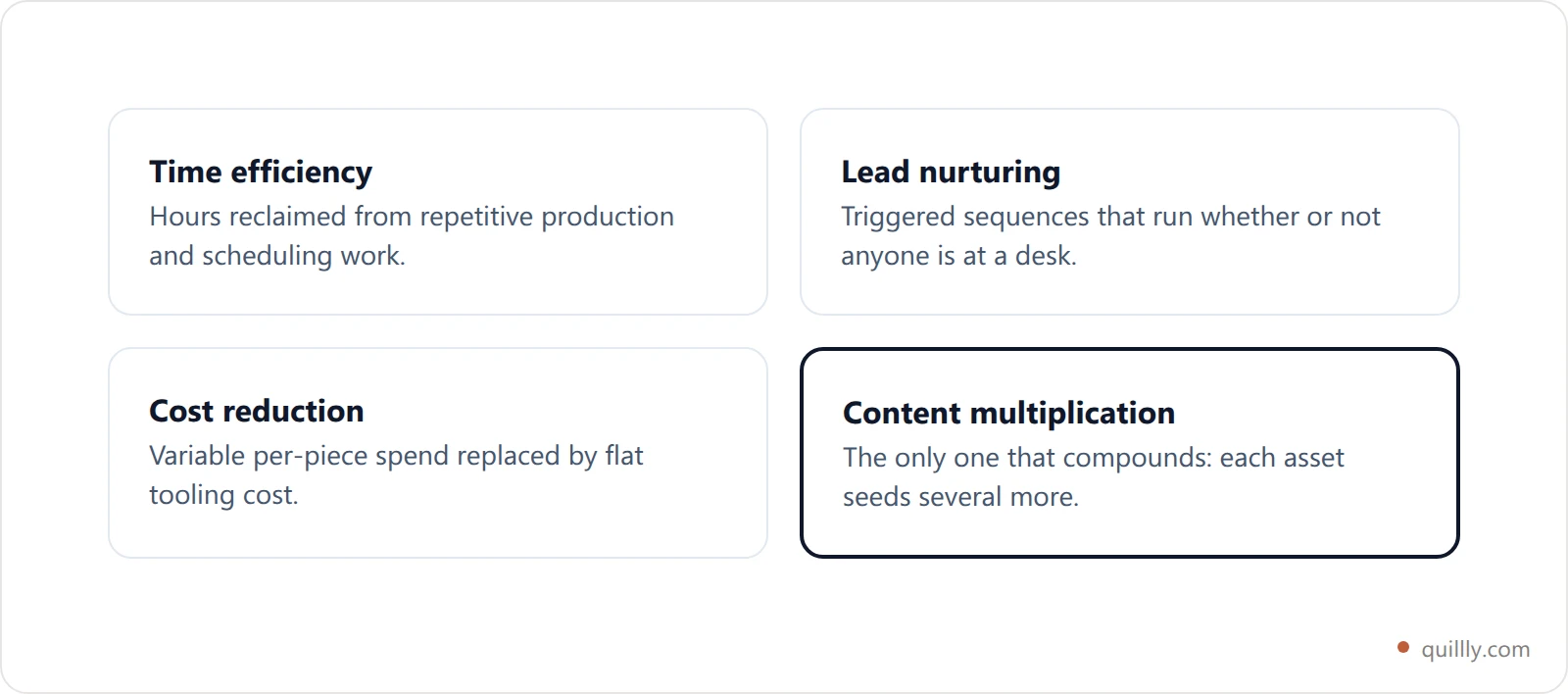
Marketing automation reduces content creation time by 70%, enabling small businesses to produce consistent, high-quality content without expanding their team. Automated systems handle scheduling, distribution, and basic optimization tasks that previously consumed hours of manual work each week.
Time savings extend beyond content creation to include customer segmentation, campaign analysis, and performance reporting. Small business owners reclaim 15-20 hours weekly by automating repetitive marketing tasks, allowing them to focus on strategic business development and customer relationship building.
Lead Generation and Nurturing Improvements#
AI-powered content tools generate 50% more qualified leads through targeted, personalized content delivery. Automated nurturing sequences maintain engagement with prospects, increasing conversion rates by 35% compared to generic marketing approaches.
Lead scoring and qualification automation ensure sales teams focus on high-value prospects, improving close rates by 28%. Automated follow-up sequences maintain consistent communication, reducing lead abandonment rates by 40% and extending the average customer lifecycle.
Cost Reduction and Scalability#
Small businesses save an average of 2,000 dollars monthly by automating content creation, distribution, and analysis processes. Marketing automation scales efficiently, allowing businesses to increase output without proportional cost increases.
Content automation ROI particularly impacts small businesses by eliminating the need for expensive freelance writers or additional staff members. AI-powered tools produce professional-quality content at a fraction of traditional costs while maintaining brand consistency and SEO optimization.
Content Automation ROI: The Ultimate Multiplier#
Content automation serves as the cornerstone of profitable marketing automation strategies. AI-powered platforms like Quillly enable small businesses to create SEO-optimized blog posts, social media content, and email campaigns in minutes rather than hours. This efficiency translates directly into improved marketing automation ROI through consistent content output and enhanced search engine visibility.
Automated content creation tools reduce production costs by 60% while maintaining quality standards — the same efficiency behind content automation tools that save 30+ hours a month. Small businesses can publish 3-5 times more content, expanding their digital footprint and attracting more organic traffic without additional staff or freelance costs.
Content automation ROI extends beyond cost savings to include improved search rankings, increased website traffic, and enhanced brand authority. Consistent content publishing schedules, automated keyword optimization, and systematic content distribution amplify marketing automation benefits significantly.
Measuring Marketing Automation ROI Success#
Primary ROI Metrics#
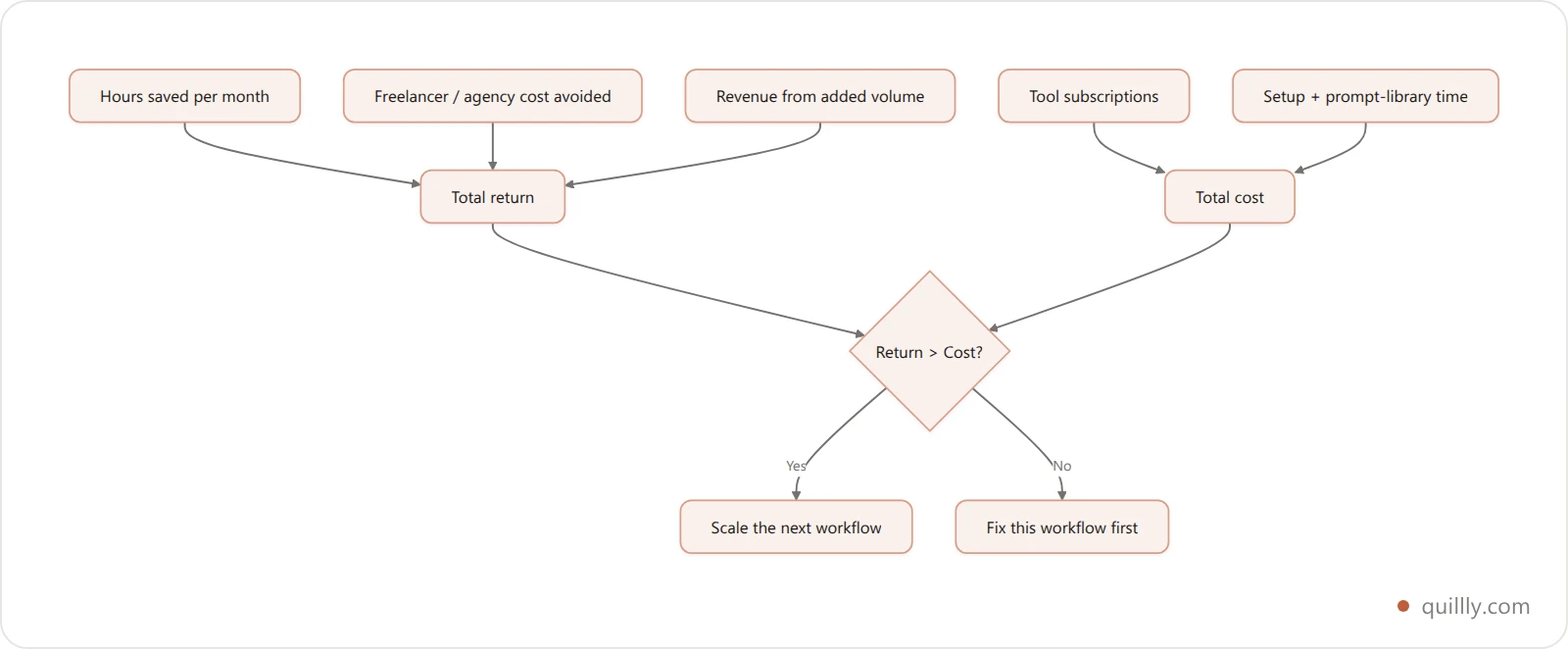
Track these essential metrics to evaluate marketing automation effectiveness: cost per acquisition, customer acquisition cost, marketing qualified leads generated, sales conversion rates, and customer lifetime value. Successful implementations show 25% reduction in customer acquisition costs and 40% increase in marketing qualified leads.
Marketing automation ROI calculations should include both direct revenue attribution and indirect benefits like brand awareness improvements, customer satisfaction increases, and operational efficiency gains. Comprehensive measurement provides accurate assessment of automation investment returns.
Content automation ROI specifically impacts these metrics by reducing content production costs while increasing output quality and consistency. Automated content tools enable small businesses to compete with larger competitors by maintaining professional, consistent marketing materials at scale.
Secondary Performance Indicators#
Monitor engagement metrics including email open rates, click-through rates, social media engagement, website traffic growth, and content consumption patterns. These indicators provide early signals of campaign effectiveness and optimization opportunities.
Content automation ROI specifically benefits engagement metrics by enabling personalized content delivery, optimized posting schedules, and systematic A/B testing. Automated systems continuously refine content performance, improving engagement rates over time without manual intervention.
Long-term Value Metrics#
Evaluate customer retention rates, repeat purchase frequency, average order value increases, and brand awareness improvements. Marketing automation typically improves customer retention by 20% and increases average order values by 15%.
Long-term marketing automation ROI includes compound benefits from improved customer relationships, enhanced brand loyalty, and increased referral generation. These cumulative effects often exceed initial ROI projections and provide sustainable competitive advantages.
Implementation Strategies for Maximum Marketing Automation ROI#
Phase 1: Foundation Building#
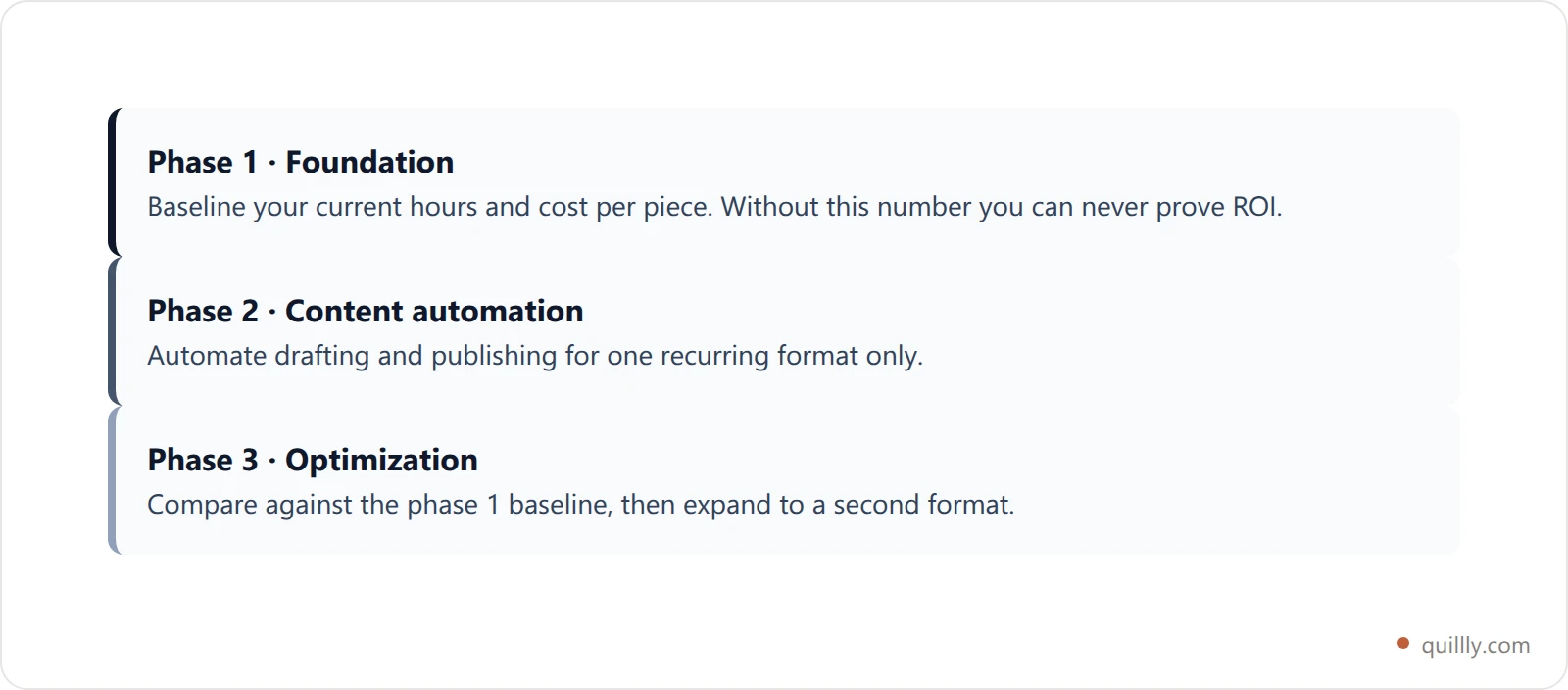
Start with email marketing automation and basic content scheduling. Implement customer relationship management integration to track interactions and measure early results. Focus on one or two channels initially to establish baseline performance metrics.
Foundation building includes setting up proper tracking systems, defining target audience segments, and creating initial automation workflows. Small businesses should prioritize high-impact, low-complexity automations that deliver immediate value while building internal expertise.
Phase 2: Content Automation Integration#
Incorporate AI-powered content creation tools to streamline blog generation, social media posting, and email campaign development. Establish consistent publishing schedules and brand voice guidelines across all automated content.
Content automation ROI becomes most apparent during this phase as businesses scale content production without proportional resource increases. If you want the drafting-to-published half handled for you, start a free 14-day trial and let your AI publish straight to your own domain. Integration with existing marketing systems ensures seamless workflow automation and comprehensive performance tracking.
Phase 3: Advanced Personalization#
Deploy behavioral triggers, dynamic content personalization, and predictive analytics to enhance customer experiences. Implement lead scoring systems to prioritize high-value prospects and optimize conversion funnels.
Advanced personalization significantly improves marketing automation ROI by delivering relevant, timely content to individual prospects. AI-powered recommendation engines and automated segmentation enhance campaign effectiveness while reducing manual effort.
Social Media Automation for Small Business ROI#
Social media automation for small business ROI is real, but it runs shallower than content automation, because a scheduled post stops working the moment it scrolls past. The durable return comes from using automation to repurpose assets you already own — one blog post feeding a month of channel activity — not from posting more often.
The distinction matters because social reach is rented and search reach is owned. Attention on the open web is getting harder to buy with volume alone: SparkToro's analysis of Similarweb clickstream data found only 31.99% of Google searches sent a click to the open web in early 2026, and Ahrefs' crawl of roughly 14 billion pages found 96.55% of content gets zero organic traffic. In that environment, an asset you can point at from every channel beats a feed post that expires in an afternoon.
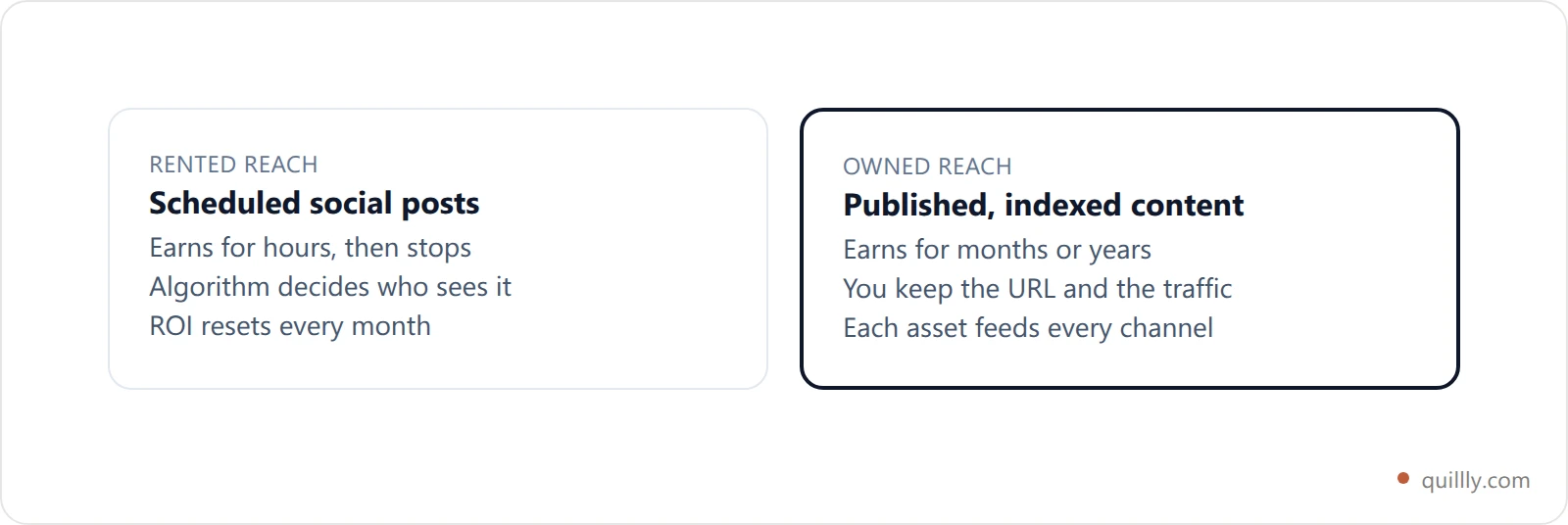
Automate these on social: repurposing a published post into a thread or carousel, scheduling evergreen re-shares, routing new posts to every channel on publish, and collecting engagement data into one report.
Don't automate these: replies and DMs, comments on other people's posts, and anything that reads as a personal opinion. Those are the interactions that actually convert, and they're the first thing an audience notices you've handed to a bot.
What social media automation for small business ROI actually looks like#
Run the numbers on a realistic solo setup and the shape of the return becomes obvious. Say you post five times a week across two channels, and each post takes roughly 45 minutes to write, format and schedule by hand. That is about 16 hours a month.
Now automate the repurposing step, so one published article becomes a thread, three short posts and a carousel. The same output takes about four hours. You have saved 12 hours a month.
That saving is real, and for a solo operator it is often the difference between posting consistently and quietly giving up by week six. But notice what kind of return it is: hours recovered, not revenue created. It is the same 12 hours next month, and the month after. It does not grow.
Content automation behaves differently. Every published asset stays live, keeps getting found, and adds to the library your social schedule draws from. The return accumulates instead of resetting.

That chart is an illustrative model rather than measured data, and the point is the shape, not the figures. Social automation gives you a flat, immediate, dependable saving from month one. Content automation starts slower and then overtakes it, because published pages keep compounding and scheduled posts do not.
The practical read for a small business marketing plan: automate social to protect your hours, automate content to grow your traffic. If you can only fund one, the compounding one wins over a 12-month horizon, and it feeds the other for free.
Turn one article into a month of channel activity — publish to your own domain first, then repurpose from an asset that keeps earning.
One more measurement warning specific to social: attribution is genuinely hard, so judge the channel on assisted conversions and branded search lift rather than last-click revenue. If you only count last-click, social automation will always look like it lost — and you'll cut the thing that was feeding the top of your funnel.
Common Marketing Automation ROI Pitfalls and Solutions#
Over-Automation Risks#
Avoid automating every customer interaction, which can create impersonal experiences. Balance automation with human touchpoints, particularly for high-value prospects and customer service interactions.
Content automation ROI suffers when businesses prioritize quantity over quality or fail to maintain brand consistency across automated content. Regular review and optimization ensure automated systems enhance rather than replace authentic customer relationships.
Inadequate Measurement Systems#
Implement comprehensive tracking from day one to capture accurate ROI data. Use UTM parameters, conversion tracking, and customer journey mapping to attribute results correctly to automated campaigns.
Many small businesses underestimate marketing automation ROI because they lack proper measurement systems. Comprehensive analytics integration ensures accurate attribution and identifies optimization opportunities for maximum returns.
Technology Integration Challenges#
Choose marketing automation platforms that integrate seamlessly with existing business systems. Poor integration creates data silos and reduces automation effectiveness, negatively impacting ROI calculations.
Content automation ROI depends heavily on integration quality between content creation tools, distribution platforms, and analytics systems. Seamless data flow enables comprehensive performance tracking and optimization recommendations.
Industry-Specific Marketing Automation ROI Benchmarks#
E-commerce Small Businesses#
E-commerce companies typically achieve 400% ROI through abandoned cart recovery, personalized product recommendations, and automated customer re-engagement campaigns. Average order values increase by 25% with targeted automation.
Content automation ROI particularly benefits e-commerce through automated product descriptions, category page content, and seasonal promotional materials. AI-powered tools generate SEO-optimized content that improves search rankings and drives organic traffic growth.
Service-Based Businesses#
Professional services firms see 250% ROI through automated appointment scheduling, follow-up sequences, and content marketing automation. Client acquisition costs decrease by 30% while retention improves significantly.
Marketing automation ROI for service businesses includes time savings from automated proposal generation, client communication, and project management workflows. Content automation enables consistent thought leadership publishing that establishes market authority.
Local Retail Businesses#
Local retailers achieve 180% ROI through automated loyalty programs, seasonal promotions, and customer birthday campaigns. Repeat visit frequency increases by 40% with personalized automated communications.
Content automation ROI helps local businesses maintain consistent social media presence, generate location-based content, and automate customer review requests. These activities improve local search visibility and customer engagement without requiring dedicated marketing staff.
Future-Proofing Your Marketing Automation ROI Investment#
AI and Machine Learning Integration#
Advanced AI capabilities will continue improving personalization accuracy and campaign optimization. Small businesses investing in AI-powered platforms position themselves for enhanced future returns as technology capabilities expand.
Content automation ROI will increase as AI tools become more sophisticated in understanding audience preferences, optimizing content performance, and predicting market trends. Early adoption of AI-powered platforms provides competitive advantages and superior returns.
Multi-Channel Automation Expansion#
Expand automation across all marketing channels including social media, SMS marketing, and voice search optimization. Integrated multi-channel approaches deliver 40% higher ROI than single-channel implementations.
Marketing automation ROI multiplies when businesses coordinate messaging across email, social media, content marketing, and paid advertising channels. Consistent automation across touchpoints creates cohesive customer experiences that drive higher conversion rates.
Predictive Analytics Implementation#
Implement predictive analytics to anticipate customer needs, optimize campaign timing, and improve content relevance. Early adopters of predictive automation see 35% improvement in campaign performance.
Content automation ROI benefits significantly from predictive analytics by enabling proactive content creation, optimal publishing timing, and personalized content recommendations. These capabilities improve engagement rates and conversion performance over time.
Maximizing Content Automation ROI Through Strategic Implementation#
Content automation ROI represents the intersection of marketing automation efficiency and content marketing effectiveness. Small businesses achieve maximum returns by integrating AI-powered content creation with comprehensive marketing automation strategies.
Successful implementation requires balancing automation capabilities with authentic customer relationships, maintaining content quality while scaling production, and continuously optimizing based on performance data. Content automation ROI compounds over time as businesses build content libraries, improve search rankings, and establish market authority.
The combination of marketing automation ROI and content automation ROI creates a powerful growth engine for small businesses. By automating repetitive tasks while maintaining personalized, high-quality content, businesses achieve sustainable competitive advantages and long-term profitability improvements.
Frequently Asked Questions#
How do you actually calculate marketing automation ROI?#
Add up hours saved, external content spend avoided, and revenue from added volume, then subtract tool subscriptions and setup time. Setup time is the line most teams omit, which is why month one looks disappointing and month three looks transformative.
How long before marketing automation shows a return?#
Most small businesses see the crossover between 30 and 90 days. Anything faster usually means the baseline was never measured properly. The variable is not the tooling but how quickly you stop hand-running the process you just automated.
What is the most common reason automation fails to pay off?#
Automating a process nobody had measured. Without a baseline for hours and cost per piece, there is no way to prove a return, so the spend gets cut in the next budget review regardless of how well it worked.
What ROI can a small business expect from social media automation?#
Social media automation for small business ROI runs thinner and slower than content automation. Scheduled posts stop earning once they scroll past, so the durable gain comes from repurposing published assets across channels and from the hours saved, not from raw posting volume. Judge it on assisted conversions, not last-click revenue.
Should small businesses automate content or lead nurturing first?#
Content, because it compounds. A nurture sequence saves the same hours every month; a content workflow produces assets that keep earning after they ship. Content also feeds the nurture sequence, so the order matters.
Do you need a large team to get ROI from automation?#
No. Returns are usually strongest for the smallest teams, because automation replaces work a solo operator would otherwise do personally or outsource per piece. The constraint is process clarity, not headcount.
Conclusion: Maximizing Your Marketing Automation ROI#
Marketing automation delivers exceptional returns for small businesses through cost reduction, efficiency improvements, and revenue growth. AI-powered content tools amplify these benefits by enabling consistent, high-quality content creation at scale. Success requires strategic implementation, comprehensive measurement, and continuous optimization based on performance data.
Small businesses achieving the highest marketing automation ROI focus on customer experience improvements, data-driven decision making, and strategic technology integration. With proper implementation, marketing automation transforms from a cost center into a profit-generating engine that drives sustainable business growth.
Content automation ROI specifically provides compounding returns as businesses scale content production, improve search rankings, and establish thought leadership in their industries. The combination of marketing automation and AI-powered content creation represents one of the most valuable investment opportunities for small business growth.
Start your marketing automation journey today by evaluating your current processes, identifying automation opportunities, and implementing comprehensive measurement systems.
Make content the part that compounds
Connect Claude, ChatGPT, or Cursor to Quillly and your AI drafts, scores and publishes SEO content straight to your own domain — then submits it to 8 search engines. 14-day trial, no card.
Start free trialStart a free 14-day Quillly trial to generate SEO-optimized blog content that powers your automation flows from day one.
For deeper reading, explore AI lifecycle marketing automation, AI content repurposing for multi-channel distribution, and human-in-the-loop AI content creation.