

Content automation tools use AI to research, draft, optimize, and publish content on autopilot — clearing the busywork that eats a small team's week. Used well, they help owners reclaim 30-plus hours a month and publish far more often, without hiring writers or sacrificing quality.
In 2026, the real question for a small business isn't whether to automate content — it's which parts to hand off first. AI now sits in most marketing workflows: 55% of marketers name content creation as their top AI use case, and roughly 94% plan to use AI in content this year, per HubSpot's 2025 State of AI report. This guide breaks down what these tools actually do, where the hours go, and how to roll them out without wrecking your brand voice.
What content automation tools actually do#
Content automation tools handle the repeatable parts of publishing so you spend your time on strategy, not formatting. They cluster into four jobs: research (topics, keywords, competitor gaps), drafting (turning a brief into a first draft), optimization (SEO scoring, internal linking, metadata), and distribution (publishing, indexing, and cross-posting). Very few tools cover all four — we scored eight of them job by job in our AI content agent comparison, and most stop after drafting.
A common misconception is that one tool does everything. In practice, most teams pair an AI model that writes with a platform that scores and ships. That split matters when you pick tools — and it's exactly how Quillly works.
Quillly is SEO infrastructure, not a text generator. You bring your own AI — Claude, ChatGPT, or Cursor — connected through Quillly's MCP server. Your model drafts; Quillly scores the draft against 14+ SEO criteria, publishes it to your own domain, and submits it to Google through your Search Console sitemap and RSS feed — plus Bing, Yandex and the rest of the IndexNow network — with sitemaps, RSS, and analytics handled for you. You keep the writing voice; the platform removes the technical drudgery.
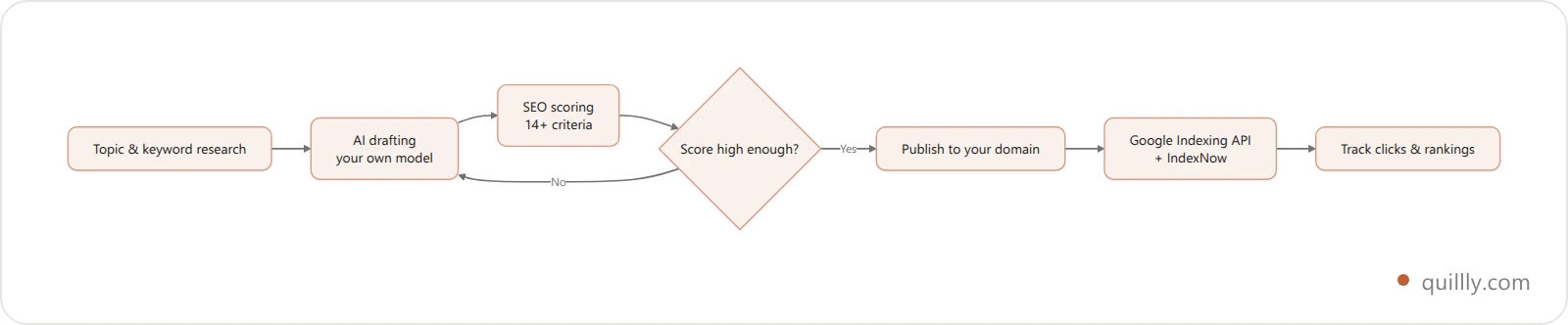
If you want the strategy layer that feeds this pipeline, start with automated content planning before you scale output.
Where your content hours actually go#
Most of the week disappears into a handful of repeatable tasks. The average article took just under 3.5 hours to produce in 2025, down from nearly 4 hours in 2024, and 29% of marketers spend 10–15 hours a week just creating content, according to Semrush's 2025 content marketing statistics. Add social: 43% of small business owners put in about six hours a week there alone.
Automation doesn't erase those hours evenly — it collapses the mechanical ones. HubSpot's data shows AI saves creators roughly three hours per piece, and 78% of marketers say it cuts time on manual tasks. The chart below shows where a typical small team's weekly hours move once drafting, optimization, and publishing are assisted.

Manual vs. automated: the honest comparison#
Automation wins on speed and consistency, but it isn't free of effort — it shifts your work from producing to directing. Here's the trade-off laid out plainly.
Factor | Manual content creation | Automation-assisted workflow |
|---|---|---|
Time per article | ~3.5 hours (Semrush, 2025) | Under 1 hour of hands-on time |
Cost | $100–300 per freelance article | Flat tool subscription (often <$20/mo) |
Publishing cadence | 1–2 pieces/month is typical | 2–4+ pieces/week is realistic |
Consistency | Drops when the owner gets busy | Steady once the workflow is set |
Brand voice | Fully human, but slow | Human-directed; needs voice setup |
Biggest risk | Burnout and gaps | Publishing thin content on autopilot |
The takeaway: automation is a force multiplier for a clear strategy, not a substitute for one. The teams that get burned are the ones that let a tool publish unreviewed. For a deeper look at the constraints automation is meant to solve, see the biggest small-business content marketing challenges.
How to choose a content automation tool#
Match the tool to your workflow, not to its feature list. A platform built for enterprise teams will drown a solo owner in options they'll never use. Weigh these six factors:
Output quality and control — Can you edit, score, and approve before anything goes live?
SEO built in — Does it score content and handle metadata, or bolt SEO on later?
Brand voice setup — Can you train tone, style, and vocabulary with examples?
Publishing and indexing — Does it push to your own domain and notify search engines automatically?
Bring-your-own-AI — Are you locked into one model, or can you use the AI you already pay for?
Transparent pricing — Flat monthly cost beats per-word or per-credit metering that punishes volume.
That last point matters more than it looks. Tools that charge per credit or per word make you ration output — the opposite of what automation is for. Flat pricing lets you publish as much as your strategy demands.
Want the publishing step handled too? Start a free 14-day Quillly trial — your AI drafts, Quillly scores and ships it to your own domain.
The 30-Hour Playbook: a five-step rollout#
Successful automation follows a pattern — start narrow, prove value, then widen. Rushing to automate every channel at once is the fastest way to publish content you're not proud of.
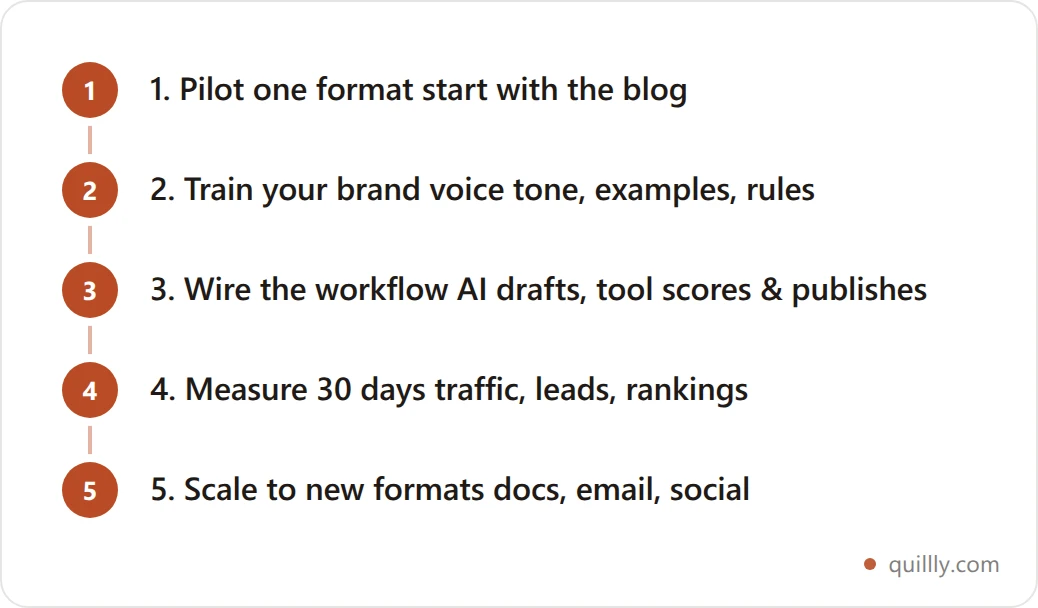
Pilot one format. Begin with blog posts, usually the highest-leverage format for search. Get one workflow reliably good before adding channels.
Train your brand voice. Give the AI examples of your best content, a short style guide, and words to avoid. This is the step most people skip — and the reason "AI content" sometimes reads generic.
Wire the workflow. Let your AI draft, and let the platform score, optimize, and publish. Keep a human approval gate for the first month.
Measure for 30 days. Track organic traffic, leads, and rankings — not vanity output counts. Adjust based on what the data says, not what you assumed.
Scale to new formats. Once the blog runs smoothly, extend to docs, email, and social. Each new format reuses the voice and workflow you already built.
Teams that follow this sequence tend to see compounding gains — the same pattern behind 450% ROI on AI marketing tools when automation is paired with a real strategy.
What kind of ROI to actually expect#
Be skeptical of tidy "500% ROI" promises — real returns depend on your strategy, niche, and how well you direct the tools. What's well-documented is the input side: AI reliably reclaims hours and steadies your cadence, and consistent publishing is what drives organic traffic over time.
The clearest early win is time. If AI saves ~3 hours per piece and you publish four posts a week, that's about 12 hours reclaimed weekly — more than a full workday back. The article-production trend backs this up: average time per article is already falling year over year.

Track both sides: efficiency (time saved, cost per piece) and effectiveness (traffic, leads, rankings). For a framework on tying automation spend to returns, see how small businesses measure marketing automation ROI.
Get the 30 hours back
Quillly is the publishing half of the stack — your own AI writes, Quillly scores against 14+ SEO criteria and publishes straight to your domain. No CMS, no plugins, no credit meter.
Start your 14-day trialFrequently asked questions#
What are content automation tools?#
Content automation tools are software platforms that use AI to handle repeatable parts of content marketing — research, drafting, SEO optimization, and publishing. Instead of writing every piece by hand, you direct the process and approve the output, cutting production time sharply.
Do content automation tools replace writers?#
No. They replace the mechanical parts of the job, not the judgment. You still set strategy, shape the brand voice, and approve what ships. The best results come from a human directing AI, not a tool publishing unsupervised.
How much time can automation actually save?#
HubSpot's 2025 data pegs the savings at roughly three hours per piece of content. For a small team publishing several posts a week, that adds up to 30-plus hours a month — most of it from drafting and the repetitive SEO-and-publishing steps.
Will Google penalize AI-assisted content?#
Google rewards helpful, accurate content regardless of how it's produced, and penalizes thin, unhelpful content — also regardless of how it's produced. The risk isn't AI; it's publishing low-value pages on autopilot. Keep a human review gate and focus on genuinely useful content.
How much do content automation tools cost?#
Pricing ranges from free tiers to enterprise contracts. Flat-rate tools are the best fit for small businesses that want to publish often. Quillly, for example, starts at $19/mo (or $190/yr) for unlimited content you write, full SEO scoring, and publishing to your own domain — and you connect your own AI model rather than paying per word or per credit.
What's the best way to start?#
Pilot one format — usually blog posts — and get that workflow reliably good before expanding. Train your brand voice with examples, keep a human approval step for the first 30 days, and measure traffic and leads rather than raw output.