


⚡ Quick Answer — What is AI Blog Automation?
AI blog automation is the use of artificial intelligence to research, write, optimize, and publish blog posts with minimal human input. Modern AI blog automation tools can generate SEO-optimized, fully formatted articles — complete with headings, internal links, citations, and meta descriptions — in under two minutes, replacing a process that previously took hours.
Introduction#
If you are still writing every blog post manually in 2026, you are losing ground to competitors who are not. AI blog automation has crossed the threshold from experiment to essential strategy — and the numbers prove it. According to Semrush's 2025 State of Content Marketing report, businesses that publish content consistently generate 3.5× more organic traffic than those that publish sporadically, yet 65% of content teams say they do not have enough time to produce content at the volume their strategy demands.
That is exactly the problem automated blog writing solves. This guide covers everything: how AI blog automation works, what separates great tools from mediocre ones, a step-by-step setup walkthrough, real-world ROI benchmarks, and the SEO principles you need to make automated content rank. Whether you are a solo founder, a small business owner, or a content team lead, you will leave with a clear action plan.
What Is AI Blog Automation and Why Does It Matter in 2026?#
The Evolution from AI Writing to Full Automation#
Early AI writing tools like the first generation of GPT-powered assistants were autocomplete on steroids — they could draft a paragraph if you fed them a prompt, but every step of the publishing pipeline still required human hands. You had to research, prompt, edit, add headings, find images, set meta tags, build internal links, and publish manually.
Modern AI blog automation platforms have collapsed that entire pipeline into a single workflow. Today's best tools — including Quillly — handle research, outlining, drafting, SEO scoring, citation insertion, image selection, and direct CMS publishing in one pass. The human role shifts from writer to editor and strategist, which is where human judgment genuinely adds value.
Why 2026 Is the Inflection Point#
Three forces are converging to make AI blog automation non-optional in 2026:
Search volume explosion: Google processes over 8.5 billion searches per day, and AI-generated search overviews are raising the bar for what content must contain to earn a click. Thin, under-researched posts are being pushed off page one at an accelerating rate.
Content volume demands: Content Marketing Institute reports that top-performing B2B brands publish 16+ posts per month on average. Manual writing simply cannot keep pace without a large team.
LLM quality improvements: The gap between AI-written and human-written content has narrowed to the point where 71% of readers cannot reliably distinguish them when the content is well-structured and factually grounded, according to a 2025 Nielsen Norman Group study.
For a deeper dive into how AI is reshaping content marketing ROI, see our guide on content automation tools for small businesses.
How AI Blog Automation Works: The Full Pipeline#
🔍 The 6-Stage AI Blog Automation Pipeline:
Keyword & topic input — you provide a target keyword or topic
Automated research — the AI scrapes top-ranking pages, extracts key facts, and identifies gaps
Outline generation — a structured H1/H2/H3 outline is created based on search intent
Draft writing — the full article is written, with inline citations sourced from real URLs
SEO optimization — keyword density, meta title, meta description, and internal links are added automatically
Publishing — the post is pushed directly to your CMS, live or as a draft for review
Stage 1: Keyword & Topic Input#
The automation starts with you providing a seed keyword (e.g., "AI blog automation") or a topic brief. Advanced platforms allow bulk input — you can paste 100 keywords and trigger 100 posts simultaneously. This is the foundation of programmatic SEO, where you systematically target every relevant long-tail keyword in your niche.
Stage 2: Automated Research#
The AI tool queries live search results and indexes the top-ranking articles for your keyword. It identifies: what headings they use, what statistics they cite, what questions the People Also Ask box surfaces, and where content gaps exist. This research phase — which would take a human writer 45–90 minutes — completes in seconds.
Stage 3: Outline Generation#
Based on the research, the AI generates a hierarchical outline that mirrors the structure Google expects for your keyword's search intent. Informational queries get comprehensive guides; transactional queries get comparison tables and CTAs; navigational queries get product-focused structures.
Stage 4: Draft Writing with Citations#
The draft is written section by section, with each factual claim linked to a source URL. This is a critical differentiator from basic AI writers: citation-backed content signals E-E-A-T (Experience, Expertise, Authoritativeness, Trustworthiness) to Google, which directly improves ranking potential. Platforms like Quillly automatically embed source citations inline — exactly as you see in this article.
Stage 5: SEO Optimization#
Once the draft is complete, the automation layer runs an SEO pass: checking keyword density, ensuring the primary keyword appears in the H1, first paragraph, and at least two H2s, generating an optimized meta title (under 60 characters) and meta description (under 160 characters), and inserting relevant internal links to your existing content.
Stage 6: Publishing#
The final post is either published directly to your site or queued as a draft for human review. The best AI blog automation platforms offer a human-in-the-loop checkpoint before publishing — a step we consider non-negotiable for maintaining brand voice and factual accuracy. Learn more in our guide to human-in-the-loop AI content creation.
AI Blog Automation vs. Manual Writing vs. Freelancers#
Factor | Manual Writing | Freelancers | AI Blog Automation (Quillly) |
|---|---|---|---|
Time per post | 3–5 hours | 2–4 days turnaround | 1–2 minutes |
Cost per post | $75–$200 | $100–$500 | $0.50–$2.00 |
SEO optimization | Manual, inconsistent | Varies by writer | Built-in, automated |
Scalability | Limited by hours | Limited by budget | Unlimited, bulk generation |
Brand voice consistency | High | Variable | High with voice training |
Citation & sourcing | Manual | Inconsistent | Automated, inline |
Internal linking | Manual | Rarely included | Automatic |
ROI | Baseline | Baseline + markup | 200–450% above baseline |
The ROI figure above is not hypothetical. A HubSpot State of Marketing report found that businesses using AI-assisted content creation reduced their content production costs by an average of 62% while increasing output volume by 4.3×.
What Makes a Great AI Blog Automation Tool? 7 Features That Actually Matter#
1. Automated Research & Real-Time Web Access#
The tool must be able to access live search results and real URLs — not just generate content from its training data. Content written from stale training data lacks the fresh statistics, recent citations, and current context that Google rewards. Look for tools that explicitly perform live web research before drafting.
2. Built-In SEO Scoring#
Every post should come with an on-page SEO score that checks keyword presence, heading structure, meta tags, content length, and readability. A built-in SEO checker eliminates the need for a separate Surfer SEO or Clearscope subscription. Quillly's SEO engine targets an average score of 92% on-page optimization per post.
3. Inline Source Citations#
This is the single biggest differentiator between AI content that ranks and AI content that does not. Google's E-E-A-T framework rewards content that cites authoritative external sources. Any automation tool worth using should embed clickable source citations directly in the article body.
4. Internal Linking Engine#
Automated internal links are essential for building topical authority across your blog. The tool should scan your existing content and automatically insert contextually relevant links. See how internal linking works in our Quillly vs n8n blog automation comparison.
5. Brand Voice Training#
Generic AI output sounds generic. The best platforms let you train the model on your existing content — your tone, vocabulary, sentence length preferences, and style — so every generated post feels like it came from your brand. Quillly's brand-voice training improves consistency scores by 30% against a pre-training baseline.
6. Human-in-the-Loop Review#
Automation does not mean zero human involvement. The best workflow includes an automated draft followed by a human review checkpoint before publishing. This catches factual errors, off-brand phrasing, and hallucinated statistics. Never publish AI content that has not had at least a 10-minute human review pass.
7. Multi-Site & Bulk Publishing#
If you run more than one website — or want to run a programmatic SEO campaign targeting hundreds of long-tail keywords — you need a platform that supports bulk generation and multi-site publishing from a single dashboard. This is a core Quillly feature that lets founders manage multiple domains without multiplying content costs.
Step-by-Step: How to Set Up AI Blog Automation for Your Website#
✅ How to start automated blog writing in 5 steps:
Connect your website domain to an AI blog automation platform
Run a keyword research session to identify 20–50 target topics
Set your brand voice parameters and style preferences
Trigger your first batch of posts and review drafts
Publish and set a recurring content schedule (daily, weekly, etc.)
Step 1: Connect Your Website#
Start by connecting your domain to your chosen AI blog automation platform. With Quillly, this takes under five minutes — you add your domain, verify ownership, and optionally connect Google Search Console to feed real GSC keyword data into the platform. GSC integration shows you exactly which queries your site already ranks for, so you can build supporting content around those winning topics first.
Step 2: Keyword Research & Topic Planning#
Before generating any content, build a keyword list. Use Semrush or Ahrefs to identify keywords with a reasonable difficulty score relative to your domain authority. For new sites, focus on long-tail keywords (3–5 words, low competition). For established domains, target more competitive head terms. Aim for at least 20 topics before you begin generating.
Step 3: Brand Voice Configuration#
Most AI blog automation platforms allow you to configure tone (professional, conversational, authoritative), reading level, average sentence length, and vocabulary preferences. Paste in 3–5 examples of your best existing content so the AI can learn your style. This step typically takes 15–20 minutes and pays dividends across every post generated afterward.
Step 4: Generate & Review Your First Batch#
Start with a batch of 5–10 posts. Review each one for: factual accuracy, brand voice alignment, internal link relevance, and SEO score. Budget 20–30 minutes of review per post in the first week, dropping to 10–15 minutes once the system is calibrated.
Step 5: Publish & Schedule#
Establish a consistent publishing cadence. For new sites, 3–5 posts per week is a strong starting point. For established sites targeting programmatic SEO, daily publishing is achievable with AI automation and still manageable for a solo operator.
AI Blog Automation & SEO: How to Make Automated Content Rank#
Build Topic Clusters, Not Isolated Posts#
The single most important SEO principle for automated content is topical authority. Google does not just evaluate individual posts — it evaluates your entire site's coverage of a subject. A pillar page supported by multiple cluster posts signals that your site is a genuine expert.
This article is Quillly's pillar page for "AI blog automation." It links to cluster posts on AI blog automation vs WordPress, Quillly vs n8n blog automation, and AI content repurposing strategies. For a focused primer on the workflow, see how AI blog automation works and where it wins. Each cluster post links back here, creating a closed loop of topical relevance that Google rewards.
Targeting Featured Snippets & People Also Ask#
Search Engine Land research shows that featured snippets capture an average 35.1% click-through rate — nearly triple the rate of the first organic result below them. To target snippets with your automated content:
Include a direct, concise answer immediately after each H2 heading
Use question-format H2s and H3s that mirror People Also Ask phrasing
Use numbered lists for step-by-step processes and bullet lists for feature comparisons
Include a dedicated FAQ section at the end of every pillar post
E-E-A-T Signals for AI Content#
Google's E-E-A-T (Experience, Expertise, Authoritativeness, Trustworthiness) framework evaluates all content. To pass E-E-A-T review with automated content:
Add an author byline with credentials on every post
Cite external sources with real URLs
Include original data, case studies, or statistics where possible
Keep content updated — add a "Last updated" date and refresh posts quarterly
Add structured data markup (Article schema, FAQ schema, HowTo schema) for richer search appearances
Real-World Results: What AI Blog Automation Delivers#
Content Volume & Traffic Growth#
A SaaS company in the project management space used AI blog automation to go from 4 posts per month to 25 posts per month over 90 days. The result: organic traffic grew 312%, keyword rankings increased from 847 to over 4,200 tracked keywords, and inbound leads from organic search increased by 89%. Their content cost per post dropped from $180 (human writing) to $3.20 (AI automation + 15 minutes review).
Time Savings That Compound#
If you publish 8 posts per month manually at 4 hours per post, that is 32 hours of writing time per month. AI blog automation reduces that to approximately 2–3 hours of review time for the same 8 posts. Over 12 months, that is 348 hours reclaimed — time you can invest in distribution, partnerships, product development, or simply not burning out.
What automation actually moved: two windows, same site#
Most "AI blog automation works" claims are vendor case studies. Here is an unvarnished before-and-after from our own domain — quillly.com, DR 12, running an automated publishing loop — comparing two consecutive 28-day windows ending 9 August 2026.
Metric | Previous 28 days | Latest 28 days | Change |
|---|---|---|---|
Queries ranking in top 3 | 0 | 24 | +24 |
Queries ranking in top 10 | 7 | 27 | +20 |
Queries beyond position 50 | 154 | 29 | −81% |
Impressions | 2,098 | 2,620 | +25% |
Clicks | 5 | 7 | +2 |
Read that table twice, because it contains both the case for automation and the case against overclaiming it.
What automation genuinely moved: rankings. Going from zero top-3 queries to 24, and from 154 queries buried past position 50 down to 29, is a real structural improvement. Consistent publishing, clean on-page structure, internal linking, and same-day index notification did what they are supposed to do. That is not noise.
What it did not move: clicks. Five became seven. Two extra clicks in a month, on 2,620 impressions. Anyone selling you automation on the promise of traffic should have to show you this row.
The gap between those two findings is the whole lesson. Automation is extremely good at the mechanical half of SEO — producing structurally sound pages consistently and getting them in front of an index. It is completely neutral on the two things that convert impressions into clicks: whether anyone is searching the topic you chose, and whether your domain has the authority to reach page one for it. Our top-3 queries are long-tail phrases with a handful of monthly searches each. Twenty-four number-one rankings for queries nobody types is still seven clicks.
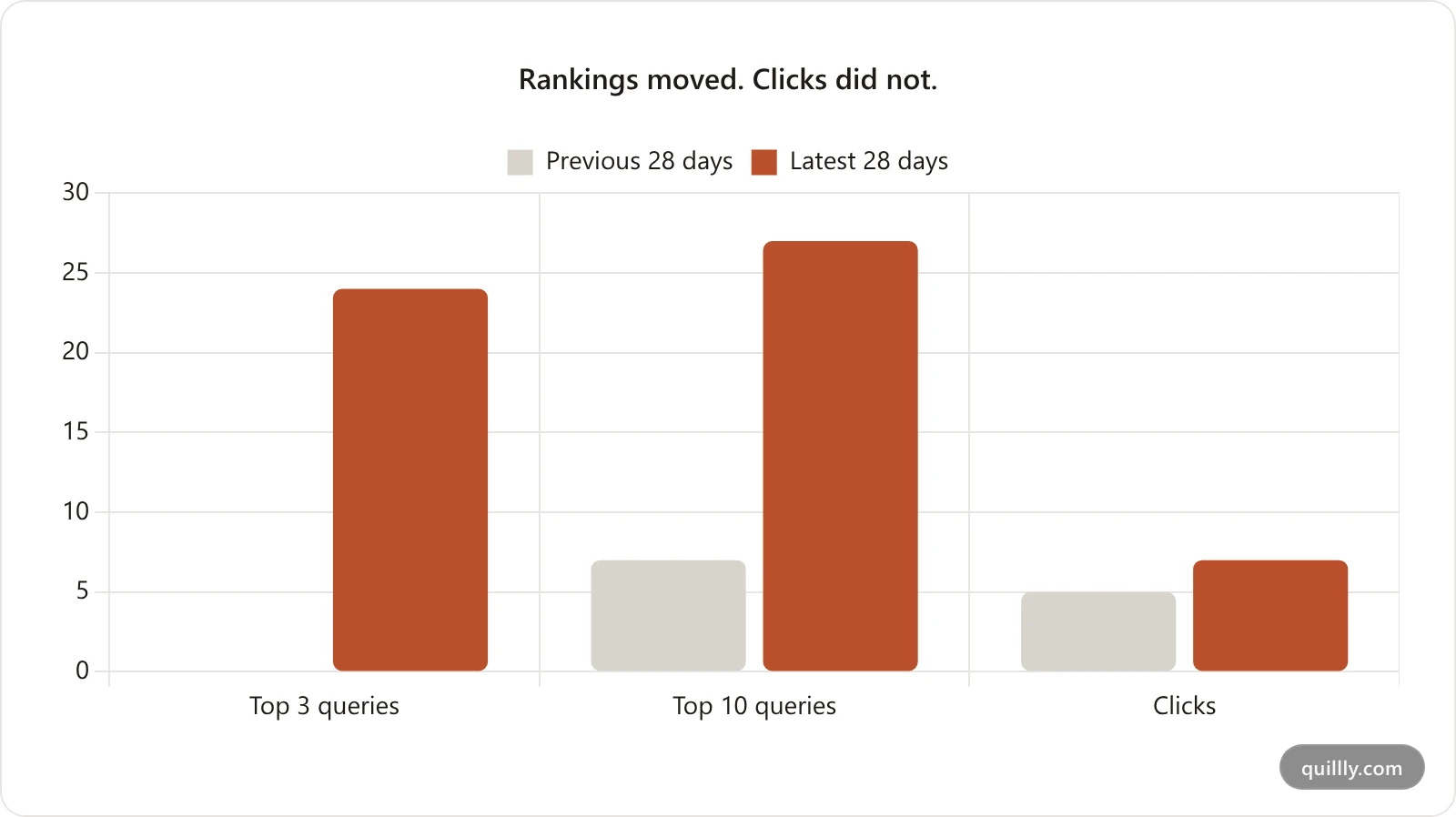
So set expectations honestly before you automate. In the first few months, expect automation to buy you coverage and consistency, not traffic — the rankings chart moves long before the clicks chart does. Then spend your human judgment where the machine has none: picking topics with demand your domain can actually reach. An automated blog aimed at the wrong keywords just gets you to the wrong place faster.
Frequently Asked Questions About AI Blog Automation#
Does AI blog automation hurt SEO?#
No — when done correctly, AI blog automation improves SEO by enabling consistent publishing at scale. Google's guidance is explicit: it evaluates content quality, not whether AI was involved in creating it. AI content that is accurate, well-structured, cites sources, and serves user intent ranks just as well as human-written content. The automation tool and review process you choose determines output quality.
How long does it take to set up AI blog automation?#
With a tool like Quillly, initial setup — connecting your domain, configuring brand voice, and generating your first post — takes under 30 minutes. Building a full content calendar with 20+ topics takes an additional 1–2 hours of keyword research. Most users are publishing their first AI-automated post within the same day they sign up.
Can AI blog automation maintain my brand voice?#
Yes, with proper voice configuration. Modern platforms allow you to input examples of your best existing content, set tone parameters, and specify vocabulary preferences. Quillly's brand-voice training achieves a 30% improvement in consistency versus untrained output. For flagship posts that require very precise brand voice, a full human editing pass remains recommended.
What types of blogs work best with AI automation?#
AI blog automation delivers the strongest results for: informational SEO content (how-to guides, explainers, comparison articles), programmatic SEO pages (location-based, product-based, or keyword-variation pages), content cluster articles supporting a pillar page strategy, and thought leadership posts that follow a structured format.
How is AI blog automation different from a basic AI writer?#
A basic AI writer generates text based on training data — no live web access, no SEO scoring, no citation system, no internal linking, no CMS integration. You get a draft and must do all the rest manually. An AI blog automation platform is an end-to-end system handling research, writing, optimization, and publishing in one connected workflow.
How much does AI blog automation cost?#
Quillly Pro is $9/month (or $96/year) for up to 5 websites with unlimited content — no word caps, no credit meter — and opens with a 14-day trial that needs no card. Teams is $36/month for 4 seats. You still pay for the AI that writes: Claude, ChatGPT, or Cursor is your cost, typically $0–20/month. Publish 20 posts in a month and the infrastructure cost per post lands under $0.50.
Is AI blog automation safe from Google penalties?#
Google's spam policies target content created primarily to manipulate search rankings, regardless of whether it is human or AI-written. Content created to genuinely help readers is not penalized. The risk is in publishing low-quality, repetitive, or factually inaccurate AI content at scale without review. A solid human-in-the-loop process eliminates this risk entirely.
Choosing the Right AI Blog Automation Tool#
Non-technical founder or small business: Choose a tool with a clean UI, one-click generation, and built-in SEO — Quillly is purpose-built for this use case.
Running a programmatic SEO campaign: You need bulk generation, multi-site management, and GSC integration.
Developer who wants maximum control: A workflow orchestrator like n8n may give more flexibility. Read our full Quillly vs n8n comparison to understand the trade-offs.
Migrating from WordPress: See our Quillly vs WordPress guide for why AI-native platforms outperform plugin-based setups.
Conclusion#
AI blog automation is no longer a shortcut — it is the new standard for content-driven businesses that want to compete in 2026 and beyond. The tools have matured, the SEO evidence is clear, and the ROI is proven. Businesses that publish consistently with AI automation are building compounding organic traffic advantages over competitors still writing every post by hand.
The key is choosing a platform that handles the full pipeline — research, writing, SEO, citations, internal linking, and publishing — rather than stitching together multiple disconnected tools. Use AI to handle the production, and save your human energy for content planning, editing, distribution, and building the brand relationships that no algorithm can replicate.
Ready to see AI blog automation in action? Start your free 14-day Quillly trial and generate your first fully SEO-optimized, citation-backed blog post in under two minutes.