

Why WordPress Blogging Still Feels Like Duct Tape#
WordPress powers 43% of the web, yet for all its dominance, its ai blog automation story remains stubbornly incomplete. Businesses relying on WordPress for content marketing are stitching together three to five separate tools — an AI writer, an SEO plugin, an analytics dashboard, and a publishing scheduler — and still losing 30 or more minutes per post to copy-paste friction and formatting fixes. The result is a workflow that feels less like a content engine and more like a patchwork quilt held together with duct tape.
Quillly replaces that entire patchwork with a single AI-powered platform — from topic ideation and brand-voice training to SEO optimization and direct publishing — delivering measurable time savings and up to 450% ROI . This article compares Quillly and WordPress across five dimensions: workflow, AI capabilities, SEO, cost, and publishing — with hard data and a clear recommendation for businesses serious about scaling content in 2026.
The WordPress Blog-Writing Workflow: Powerful but Fragmented#
The standard WordPress content workflow looks something like this: generate an idea, conduct keyword research in a separate tool, write a draft in Gutenberg or a third-party AI plugin, run it through Yoast or Rank Math for SEO scoring, optimize images manually, copy-paste the final draft into WordPress, configure meta tags, schedule the post, and then check performance in a separate analytics dashboard. That is at least seven distinct steps across three or more platforms.
Plugin sprawl is the defining problem. WordPress has no native AI writing capability, which has driven explosive demand for third-party solutions. AI-writing plugins for WordPress — including WriteRush, Bertha AI, and GetGenie — collectively attracted 315 million visits in 2025 , proving that the market wants AI-assisted content creation. But that demand has been met with fragmentation rather than integration.
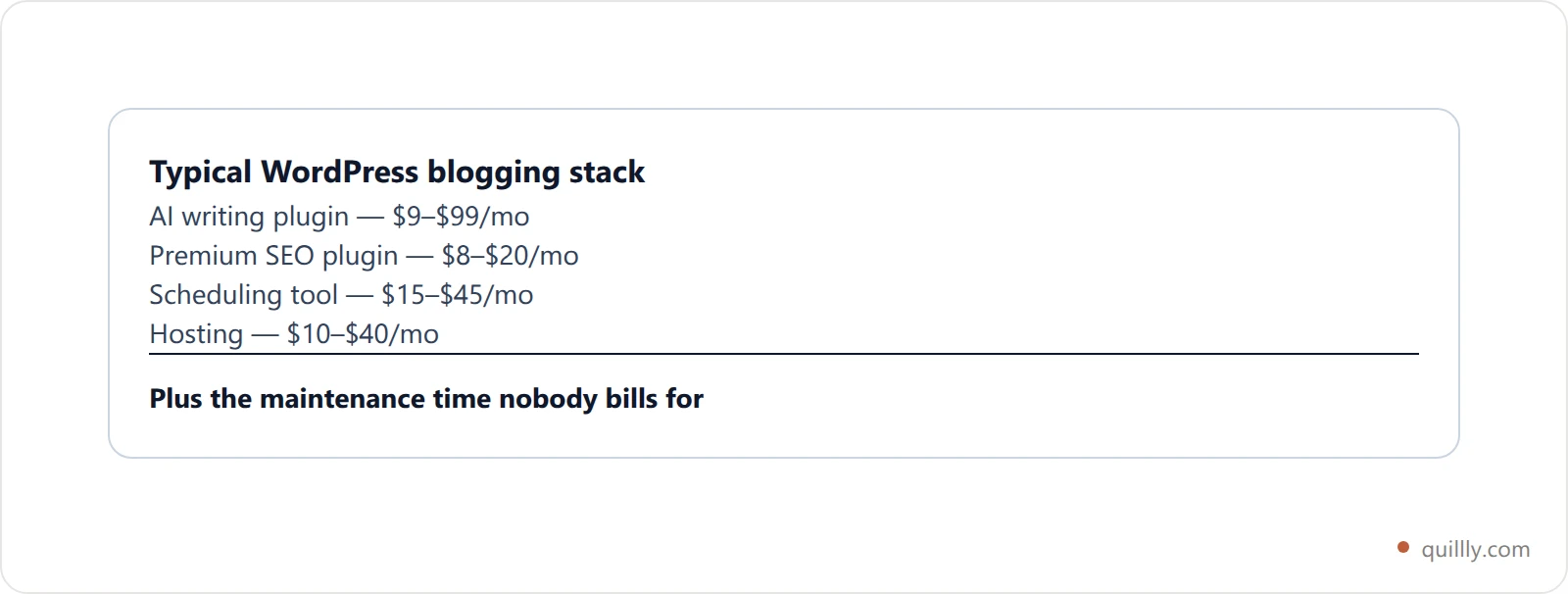
The cost reality compounds the problem quickly. A single AI-writing plugin runs $9–$99 per month . Add a premium SEO plugin like Rank Math Pro, a scheduling tool, and an analytics solution, and the monthly bill easily climbs to $150–$200 — for features that Quillly bundles into a single subscription at $19 per month.
Then there is the human-error risk that rarely gets discussed. Every time a writer copies AI-generated content from a plugin interface into the WordPress editor, something breaks. Formatting degrades. Meta tags get misconfigured. Schema markup gets missed entirely. Each error requires manual correction — adding yet more time to a workflow that was already inefficient.
For businesses already exploring how to consolidate their tool stack, Content Automation Tools for Small Businesses: Build a Low-Cost, High-Impact AI Stack in 2026 offers a practical framework for identifying and eliminating redundant tools.

Quillly vs. WordPress: Side-by-Side Feature Comparison#
The table below captures the core differences across every dimension that matters for a content-focused business. This is where the all-in-one advantage of automated blog writing becomes impossible to ignore.
Feature | WordPress + Plugins | Quillly |
|---|---|---|
AI Content Engine | Third-party plugin (GPT-3.5 or GPT-4 depending on tier) | Your own AI — Claude, ChatGPT or Cursor over MCP, on the subscription you already have |
SEO Optimization | Requires separate plugin (Yoast or Rank Math) | Built-in SERP analysis, meta-tag generation, keyword density, schema markup |
Direct Publishing | Manual copy-paste required for all AI plugins | Reverse-proxy publishing saves ~30 min per post |
Brand-Voice Training | Limited or absent in most plugins | Upload 10–15 posts; AI learns tone, vocabulary, and style |
Analytics | Requires Google Analytics or separate plugin | Built-in content analytics dashboard |
Multi-Site Support | Per-plugin licensing per site | Up to 5 websites on Quillly Pro, one price |
Starting Price | Free (core) + $9–$99/mo per plugin | $19/mo (or $190/yr) after a 14-day trial, no card |
Content Volume | Depends on plugin limits | Unlimited content — no word caps, no credits |
Workflow Steps | 7+ steps across 3+ tools | Single end-to-end workflow |
The pattern in this table tells a clear story. WordPress with plugins can approximate most of Quillly's features — but only by assembling multiple tools, paying multiple subscriptions, and managing multiple points of failure. Quillly's all-in-one architecture eliminates that overhead entirely, delivering a faster, cheaper, and more reliable path from idea to published post .
Where Quillly Outperforms WordPress: Five Key Advantages#
1. End-to-End Automation (Ideation to Publishing)#
Quillly handles topic gap analysis, outline generation, full draft creation, SEO optimization, and direct publishing in one continuous workflow — automated blog publishing in the literal sense, with no copy-paste step in the middle. WordPress users, by contrast, must switch between at least three separate tools to accomplish the same result — a context-switching tax that adds up fast.
The time math is straightforward. At 30 minutes saved per post , a business publishing 10 posts per month reclaims 5 hours monthly. At 20 posts per month, that's a full 10 hours — more than a full workday — returned to higher-value activities like strategy, client work, or product development.
2. Bring Your Own AI — No Model Lock-In#
Most WordPress AI writing plugins lock users into whatever model the vendor ships, and on lower-priced plans that often means an older GPT-3.5 tier. Quillly takes the opposite approach: it doesn't sell you a writing model at all. You connect Claude, ChatGPT, Cursor or any MCP-capable assistant on the subscription you already pay for, and it drafts through Quillly's tools.
That matters because you're never stuck with someone else's model choice. When your assistant gets better, your drafts get better, with nothing to migrate and no second writing bill. Quillly's job is the part an assistant can't do on its own: score the draft against 14+ SEO criteria before it ships, publish it to your own domain, and submit it to eight search engines.
For a broader comparison of ai content creation platforms, Quillly vs. n8n: Which Automated Blog Writing Tool Is Right for Your Small Business in 2026? provides a useful parallel analysis.
3. Brand-Voice Training That Scales#
Upload 10–15 of your existing blog posts and Quillly's AI analyzes your tone, vocabulary, sentence structure, and stylistic preferences — then applies that learned voice automatically to every future post . The result is content that sounds like your brand, not like generic AI output.
The performance data backs this up. Quillly's brand-voice training case study shows a 10% higher engagement rate and a 15% higher click-through rate compared to generic AI-generated WordPress content . Most WordPress AI writing plugins simply do not offer this capability, which means maintaining brand consistency on those platforms requires manual editing on every single post — defeating much of the purpose of automation.
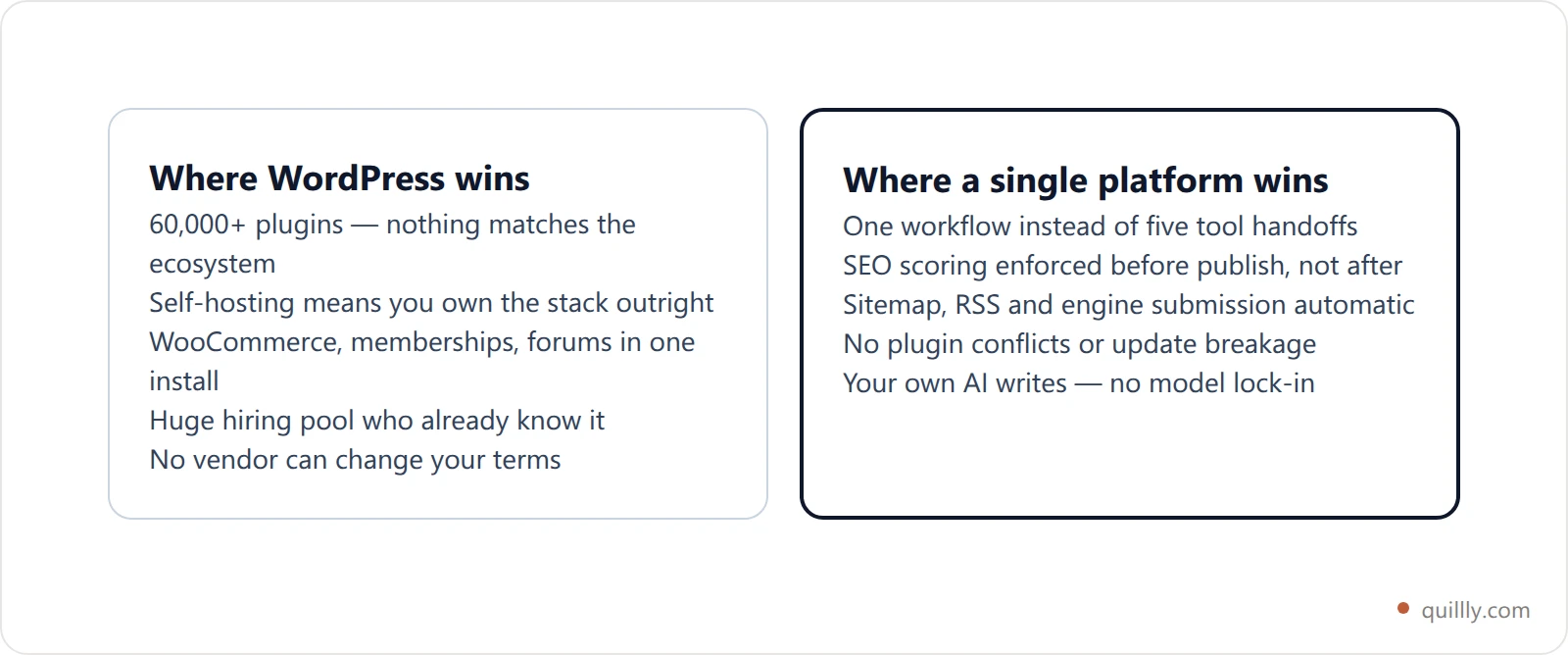
If you run a store, a membership site, or anything that depends on the plugin ecosystem, WordPress is still the right answer and this comparison should not talk you out of it. The case below is specifically about the blogging workflow.
4. Built-In SEO That Eliminates Plugin Dependency#
Quillly generates meta titles, meta descriptions, keyword-optimized headings, internal link suggestions, and schema markup natively within its content workflow, so SEO content optimization happens before a post ships instead of after it underperforms. There is no separate SEO plugin to configure, no compatibility conflicts to troubleshoot, and no additional monthly fee to pay.
Those plugins also quietly own your crawl rules, which is a trap of its own — the robots.txt WordPress actually serves is generated on every request, so one stray file at your web root overrides everything the plugin thinks it controls. WordPress users typically need Rank Math or Yoast on top of their AI writing plugin — our breakdown of what each WordPress SEO plugin actually fixes covers how to choose between them, and what none of them can do. Both are excellent tools, but adding them means another subscription, another settings panel to manage, and another potential point of failure when plugins update and conflict with each other. Quillly's integrated SEO approach covers the core needs of most small business blogs without any of that overhead.
5. Cost Efficiency for Agencies and Multi-Site Operators#
Quillly Pro is $19 per month (or $190 per year) and covers up to five websites with analytics included. A WordPress agency managing five client sites would typically pay $9–$99 per plugin per site — potentially $250–$500 per month for equivalent functionality, without the automation benefits. Agencies can add teammates to the same plan at $19 per month per seat.
That math only gets worse as the agency grows. Each new client site added to a WordPress stack means another round of plugin purchases, configuration, and maintenance. Client sites two through five sit under the same $19 Pro subscription — zero incremental cost, zero additional setup complexity.
Curious how much of that patchwork you could drop? Start a free 14-day Quillly trial and publish one post end to end before you decide.
Real-World ROI: What Businesses Gain by Switching to Quillly#
Small businesses using AI-powered content tools report 200–450% ROI and 75% faster campaign launch times. These are not marginal efficiency gains — they are the kind of competitive advantages that separate growing businesses from stagnant ones in a content-saturated market.
Time Savings at Scale#
At 30 minutes saved per post, a business publishing 20 posts a month reclaims 10 hours. Content is unlimited on the $19 plan, so the real ceiling is how fast your AI drafts, not how many posts your tier allows — and those hours go back into strategy, client relationships, or new revenue streams instead of copy-pasting and plugin configuration.

Worth checking against your own numbers: time one post end to end on a trial and compare it with your current WordPress cycle.
Content Volume Without Headcount#
There is no word cap and no credit meter, so monthly volume is bounded by how fast your AI can draft, not by your plan. Producing agency-scale volume on WordPress would require a dedicated team of writers, editors, and SEO specialists. For businesses pursuing programmatic SEO or topical authority strategies, this kind of content automation tools capability is genuinely transformative — it makes content strategies feasible that simply were not possible before without significant headcount investment.
Brand Consistency Drives Compounding Engagement#
Quillly's brand-voice training case study shows a 15% higher CTR versus generic WordPress AI content . Over a six-month period, that compounding advantage translates into significantly higher organic traffic, more qualified leads, and stronger domain authority. The gap between brands that invest in voice consistency and those that publish generic AI content will only widen as search algorithms become more sophisticated at detecting and rewarding authentic, consistent content.
Reduced Tool Sprawl Lowers Cognitive Load#
Managing one platform versus five plugins means fewer update conflicts, fewer security vulnerabilities, and less time spent on tool maintenance. This is a hidden cost that WordPress users rarely quantify — but it is real. Every plugin update is a potential compatibility issue. Every security patch is a manual action item. Every new tool added to the stack is another login, another dashboard, another invoice.
Consider this scenario: A boutique marketing agency managing eight client blogs switches from WordPress plus three plugins per site to one Quillly subscription with a seat per teammate. Monthly tool costs drop by approximately 40%. Publishing time per post drops by 50%. The agency can now onboard new clients without proportionally increasing its tool spend — a structural advantage that compounds over time .
For a deeper dive into the ROI methodology behind these numbers, AI Marketing Tools: How Small Businesses Achieve 450% ROI with Intelligent Automation in 2026 provides the full analytical framework.
When WordPress Still Makes Sense (And How to Use Both)#
A balanced assessment requires acknowledging what WordPress does exceptionally well. WordPress remains unmatched for full CMS control, custom theme development, e-commerce via WooCommerce, and membership sites — backed by an official plugin directory nothing else in the category comes close to. These are use cases that go far beyond blog writing, and for businesses where those capabilities are central, WordPress is not going anywhere.
The good news is that choosing Quillly does not mean abandoning WordPress. Quillly's reverse-proxy integration allows businesses to keep their existing WordPress theme, domain structure, and front-end experience while automating all content creation through Quillly . You retire your AI writing plugin and your SEO plugin. Quillly handles content. WordPress handles the front-end. It is genuinely the best of both worlds.
Who should go Quillly-first:
New blogs launching without legacy WordPress infrastructure
Content-focused businesses where blog output volume and SEO performance are primary KPIs
Agencies managing multiple client sites who want unified tooling and billing
Any organization where the manual overhead of WordPress's plugin workflow is visibly slowing content production
Who should stay WordPress-first:
Developers building complex custom sites with highly specific technical requirements
E-commerce operators where WooCommerce integration is mission-critical
Businesses where the blog is a secondary feature rather than the core growth engine
For readers concerned about maintaining editorial oversight while scaling content production, Human-in-the-Loop AI Content Creation: How Small Businesses Maintain Brand Voice While Automating at Scale in 2026 addresses exactly how to preserve quality control within an automated workflow.
Keep WordPress if you need it. Drop the blogging patchwork.
Your own AI writes the post. Quillly scores it against 14+ SEO criteria and publishes to your own domain, with sitemap, RSS and engine submission handled. $19/month after a 14-day trial, no card.
Start your free trialFrequently Asked Questions#
Can Quillly publish directly to my WordPress site?#
Yes. Quillly's reverse-proxy integration allows you to keep your existing WordPress theme and domain while Quillly handles all content creation and publishing automatically . This eliminates the manual copy-paste step that costs an estimated 30 minutes per post when using standard WordPress AI plugins.
Is Quillly cheaper than using AI writing plugins on WordPress?#
For most use cases, yes. WordPress AI writing plugins cost 9–99 dollars per month each, and you typically need additional plugins for SEO, analytics, and scheduling . Quillly Pro at $19 per month bundles SEO scoring, direct publishing, indexing submission, and analytics in one subscription — and you bring your own AI, so there is no separate writing-tool bill. That makes it more cost-effective for anyone publishing 10 or more posts per month.
Does Quillly work for SEO the same way WordPress SEO plugins like Yoast or Rank Math do?#
Quillly includes built-in SEO features — meta title and description generation, keyword density optimization, SERP-based outlines, and schema markup — natively within its content workflow . While dedicated plugins like Rank Math offer advanced features such as local SEO , Quillly's integrated approach covers the core SEO needs of most small business blogs without requiring a separate tool.
What AI models does Quillly use to write blog posts?#
Quillly doesn't supply the writing model — you bring your own. Connect Claude, ChatGPT, Cursor or another MCP-capable assistant using your existing subscription and it drafts through Quillly's tools. You pay Quillly for the publishing, SEO scoring and indexing infrastructure rather than for tokens, so you're never locked to one vendor's model choice.
How does Quillly's brand-voice training work compared to WordPress AI plugins?#
Quillly allows you to upload 10–15 of your existing blog posts, which the AI analyzes to learn your unique tone, vocabulary, and style . This trained brand voice is then applied automatically to every new post generated. Most WordPress AI writing plugins do not offer this capability, requiring manual editing to maintain brand consistency across posts.
The fastest way to settle it for your own site is to publish one post end to end on a trial and compare it against your current WordPress cycle.
Conclusion: Stop Patching WordPress — Start Automating with Quillly#
The case for ai blog automation over WordPress's plugin patchwork comes down to five compounding advantages: end-to-end workflow automation, your own AI writing through the platform instead of a model someone else picked for you, brand-voice training that scales without manual editing, built-in SEO that eliminates plugin dependency, and agency-grade cost efficiency that improves as you grow .
WordPress is a great CMS. It is not a great blog-writing platform. It was built for publishing flexibility, not for automated content production at scale. Quillly was purpose-built for exactly that one job — producing high-quality, SEO-optimized, on-brand blog content without the manual overhead that makes WordPress's content workflow so time-consuming and error-prone.
The ROI case is not subtle. 200–450% ROI. 75% faster campaign launches. 30 minutes saved per post. A 15% higher CTR from brand-voice-trained content. These are not marginal improvements — they are structural competitive advantages that compound over time. Every month a business spends wrestling with plugin conflicts and copy-paste workflows is a month its competitors using purpose-built automation are pulling further ahead.
The businesses winning at content marketing in 2026 are not the ones with the most plugins. They are the ones with the most streamlined, intelligent, and scalable content workflows.
Ready to replace your plugin stack with a single intelligent platform? Start a 14-day Quillly trial today — no credit card, full MCP tool set, unlimited content. See how many hours you reclaim in your first week.
Already convinced and ready to explore what a full content calendar looks like with Quillly? Automated Content Planning: How Small Businesses Build Winning Content Strategies in 2026 is your next read. And when you're ready to go deeper on pricing and plan options, the Quillly pricing page has everything you need to find the right fit for your publishing volume and growth goals .