

Most small businesses treat email like a megaphone: blast a promotion, wait for clicks, repeat. Lifecycle automation replaces that with something quieter and far more profitable — a set of triggered flows that respond to what each customer actually does.
The short answer: AI lifecycle marketing automation means behavior-triggered email sequences where AI drafts the copy, handles segmentation, and optimizes send timing. You build five core flows once, and they run continuously. For a one-to-five person team, it's the highest-leverage marketing automation ROI available, because the effort is front-loaded and the returns compound.
The core problem is bandwidth. A small marketing team can't manually build, test, and optimize welcome series, nurture sequences, post-purchase flows, and re-engagement campaigns at the same time. The result is missed conversions, inconsistent follow-up, and growth that stalls exactly when it should compound.
This guide covers the five flows worth building, the tool stack, how to measure marketing automation ROI honestly, and a 30-day launch plan that needs no developer or agency.
What's in this guide
Why Lifecycle Automation Beats Broadcast Email#
Lifecycle marketing automation refers to automated sequences that guide customers through every stage of the journey — from first signup through purchase, retention, advocacy, and win-back. Unlike one-off campaigns that need a full production cycle every time, lifecycle flows run in the background, reacting to real behavior.
The contrast with broadcast email is the whole argument. A one-off campaign requires brief, write, design, review, schedule, analyze — every single time. A lifecycle flow requires that investment once, then keeps working. The effort curve inverts: broadcast email gets more expensive as you scale; lifecycle automation gets more effective.
AI changes the setup cost specifically. Drafting five emails for a nurture sequence used to be a week of work. Generating first drafts against a documented brand voice, then editing them, is an afternoon. That shift is what puts a five-flow program within reach of a team that previously managed one newsletter.
Marketing automation ROI is easiest to see at this size, because the before-and-after is so stark. Why small business email automation pays off harder than the enterprise version:
Limited staff means automation multiplies output without hiring.
AI handles segmentation, copy variants, and send-time optimization at once — work that would otherwise need a dedicated team.
The compounding effect of always-on flows is proportionally larger on a smaller revenue base.
Native AI features now ship inside SMB-priced platforms, so there's no separate enterprise tool to buy.
If you're already working on AI email personalization beyond subject lines, lifecycle automation is the framework that makes those tactics scale. Dynamic content is useful in one email; inside an automated flow, it becomes an engine that adapts to each subscriber over time.
The Five Core Flows Worth Building#
Five foundational flows deliver most of the ROI. Each addresses a specific stage, and each benefits from AI in a different way. Build them in this order — not all at once.
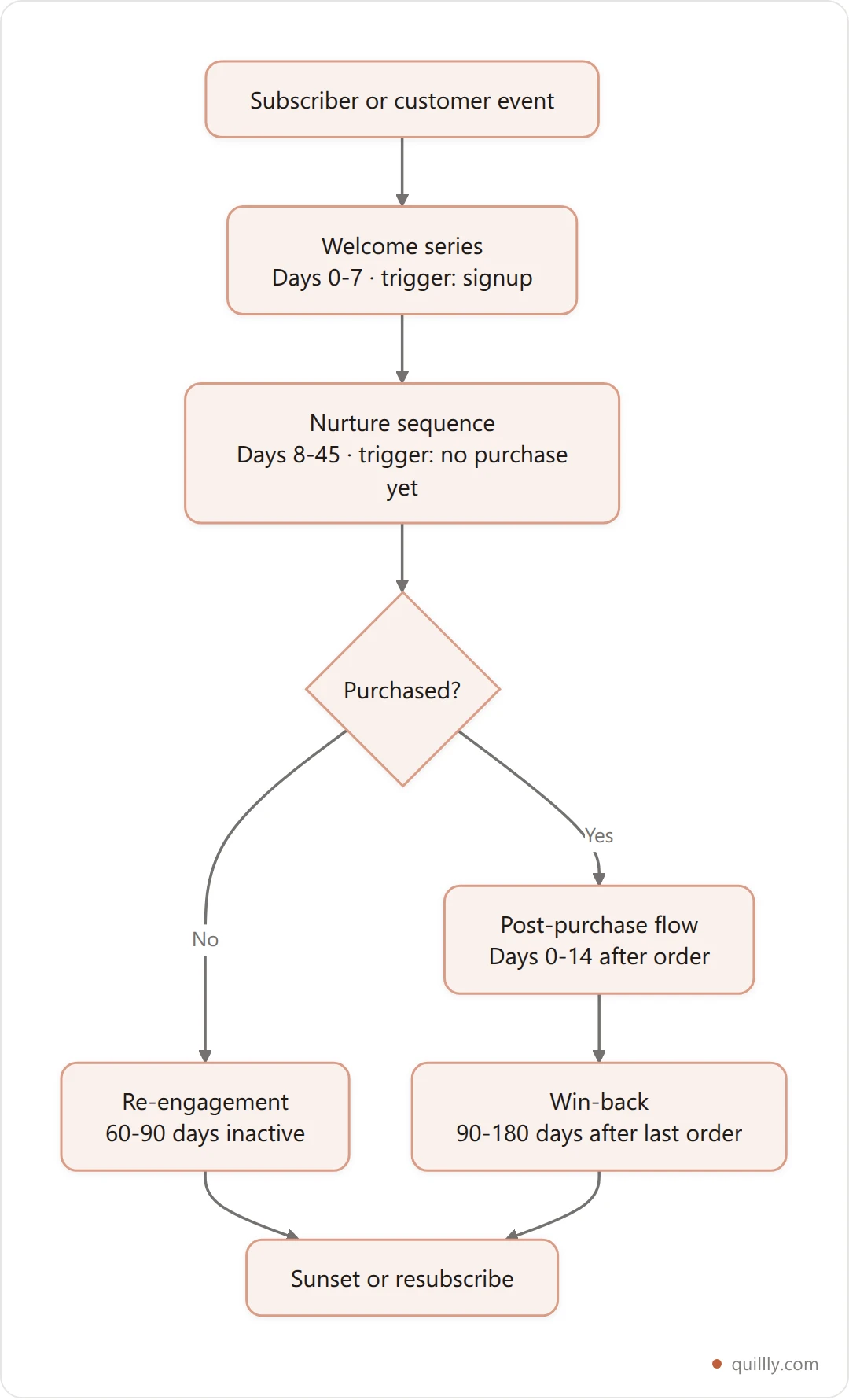
1. Welcome Series (Days 0–7)#
The welcome series is the highest-engagement moment in any subscriber's lifecycle. People who just signed up are paying more attention than they ever will again, which makes this the most valuable real estate in your program.
AI enhancements:
Generate three to five subject line variants per email and A/B test automatically.
Personalize the opening paragraph by signup source — a blog reader and a discount seeker want different things.
Optimize send timing against each subscriber's own behavior.
A strong welcome series is usually three emails: a brand introduction, a value-delivery email (your best content or resource), and a soft conversion prompt.
2. Nurture Sequence (Days 8–45)#
Not everyone is ready to buy immediately. A nurture sequence keeps you top-of-mind while delivering genuine value — education, case studies, social proof — until the prospect is ready.
AI enhancements:
Branch the sequence on engagement, so openers and non-openers take different paths.
Generate variations tailored to different pain points or personas.
Suppress contacts who convert mid-sequence, so nobody gets pitched something they just bought.
This is where AI content personalization pays the largest dividends, because the right message at the right stage beats generic content by a wide margin.
3. Post-Purchase Flow (Days 0–14 After Purchase)#
Post-purchase flows are the most underused revenue driver on this list. Two or three emails after a purchase can lift repeat purchase rates, reduce buyer's remorse, generate reviews, and introduce complementary products.
AI enhancements:
Generate product-specific onboarding or usage tips based on what was actually bought.
Time the cross-sell against product category and purchase value rather than a fixed delay.
Automate review requests for when sentiment is highest.
A good post-purchase flow doesn't just confirm a transaction. It starts the retention journey while the customer still feels good about the decision.
4. Win-Back Campaign (90–180 Days After Last Purchase)#
Lapsed customers are cheaper to re-engage than new ones are to acquire. A win-back flow targets people who haven't purchased inside a defined window.
AI enhancements:
Segment by purchase history, lifetime value, and recency, then scale the offer to match.
Test several creative angles — new arrivals, exclusive discount, a straightforward "we noticed you've been away."
Sunset contacts who don't re-engage after the full sequence, which keeps your list healthy.
5. Re-Engagement Flow (60–90 Days of Email Inactivity)#
Distinct from win-back, which targets non-purchasers, re-engagement targets subscribers who stopped opening. That's a deliverability signal before it's a revenue one.
AI enhancements:
Generate high-curiosity subject lines built specifically to break an inactivity pattern.
Branch the flow: re-engaged contacts rejoin standard flows, confirmed disengaged contacts get removed.
Send at each individual's historically highest-engagement window.
Together these five form a complete, self-sustaining journey — customer journey optimization in the practical sense rather than the diagram-on-a-whiteboard sense. Most teams that implement all five see movement in both revenue per subscriber and list health within the first two to three months.
Building Your AI Lifecycle Stack#
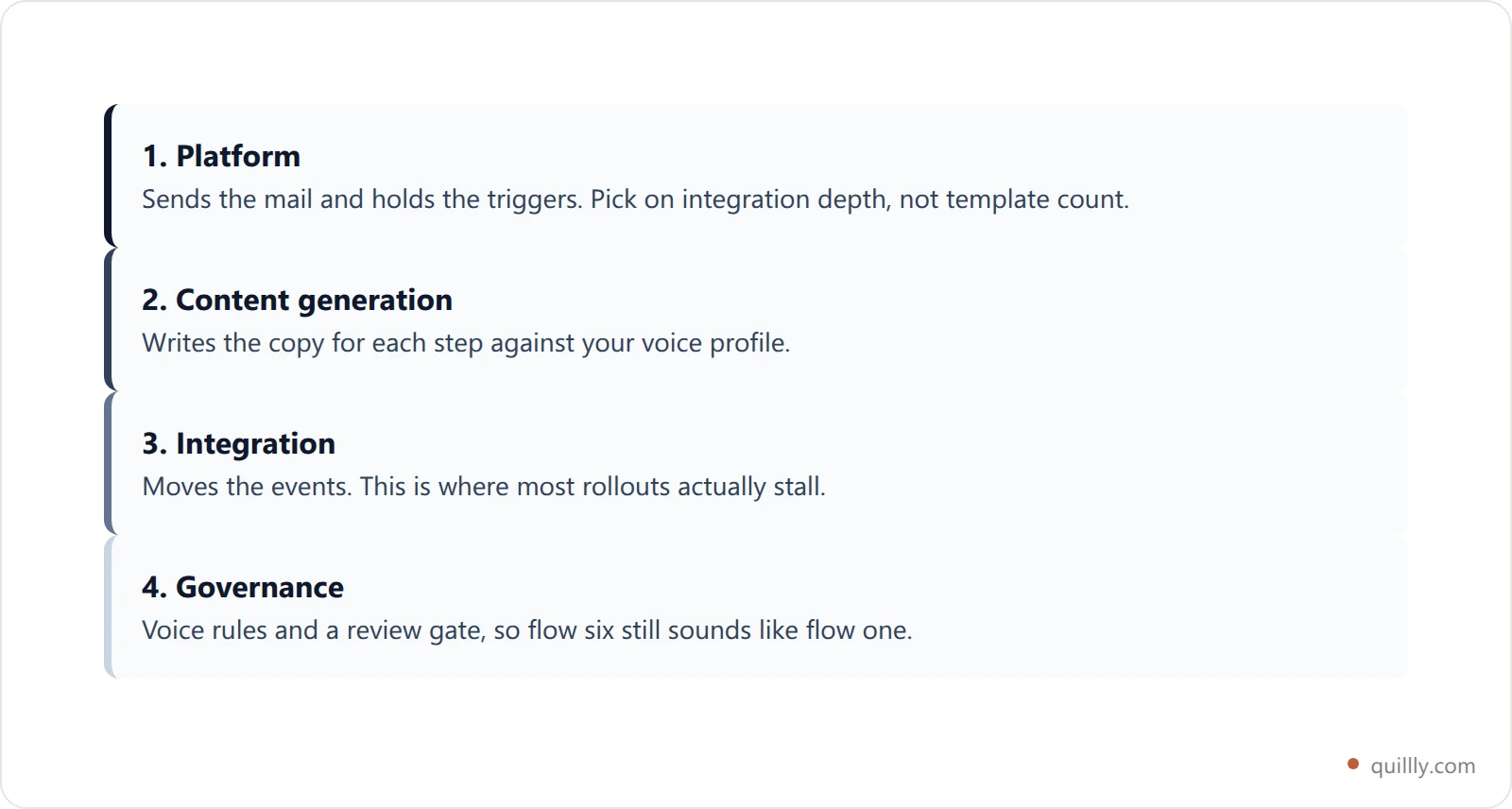
Tool selection is where most small businesses stall. The stack is simpler than it looks, and it has four layers.
Platform Selection#
Choose based on your business model rather than feature count:
Klaviyo — best for e-commerce; deep Shopify integration, native predictive send time, strong flow branching.
ActiveCampaign — best for service businesses; powerful conditional logic and built-in CRM.
Braze — best for mobile-first businesses with heavy app engagement.
HubSpot — best all-in-one if you want CRM, email, and reporting in one place.
All four ship native AI for subject line generation, send-time optimization, and branching, so you don't need a separate AI tool just to start.
See how Quillly scores and publishes the content that feeds these flows
Content Generation Layer#
Pair your platform with a writing tool for first drafts. The thing that actually matters here isn't which model you pick — it's structured prompt libraries: a curated set of pre-approved prompts organized by flow type, tone, and audience segment.
Keep them somewhere shared, tag each one by flow and tone, and review the set quarterly. Teams that write from structured briefs instead of ad-hoc prompts spend noticeably less time editing, because the draft arrives closer to on-brand.
Integration Reality Check#
Most small businesses already run a CMS, CRM, or store. The good news is that these integrate without a developer: Klaviyo connects to Shopify in minutes, ActiveCampaign has a WordPress plugin, and HubSpot syncs audiences to Google Ads natively.
Integration is still where rollouts stall most often. Test your trigger logic with internal accounts before a single real customer enters a flow.
Governance and Brand Voice#
Brand voice drift is the real risk, and it doesn't show up in flow one. It shows up in flow five, when nobody is reviewing anymore because the first four went out fine.
A one-page QA checklist applied before any flow goes live prevents this from becoming systemic. For the full framework, our guide on AI content governance for small businesses covers maintaining voice at scale. The core principle: governance doesn't have to be heavy. A checklist and a quarterly prompt review are enough for most teams.
See how automated SEO scoring gates content before it ships
Measuring Marketing Automation ROI Honestly#
Without clear metrics, AI investment feels like a cost rather than a growth driver. A simple dashboard removes the ambiguity.
Primary Metrics Per Flow#
Metric | What It Measures |
|---|---|
Open rate | Subject line and sender reputation effectiveness |
Click-through rate | Content relevance and CTA clarity |
Conversion rate | Flow effectiveness at driving the target action |
Revenue per recipient | Direct revenue attribution per contact |
Unsubscribe rate | Content quality and list health signal |
Set Your Own Baseline, Not an Industry One#
This is the part most guides get wrong. Published benchmarks vary enormously by industry, list quality, and how the sender defines an "open" in a post-Mail-Privacy-Protection world. A number that looks great for one business is mediocre for another.
So measure against yourself. Record your broadcast-email numbers for the 90 days before you launch any flow. That's your baseline. Every flow you build gets judged against it. This is slower than copying a benchmark table off a blog, and it's the only version that tells you anything true.
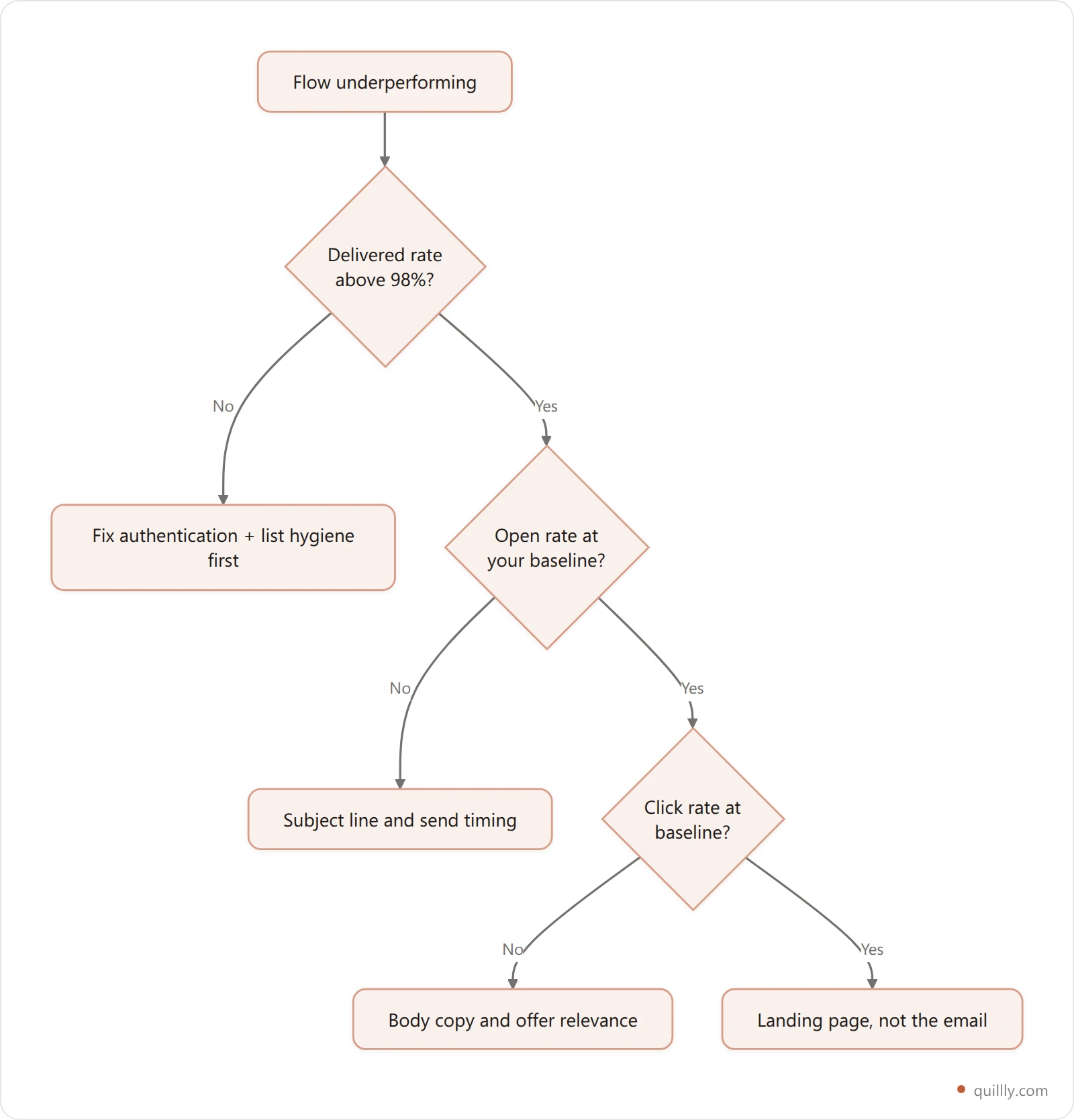
Diagnose top-down. Most apparent conversion problems are deliverability problems wearing a disguise — if a third of your sends never arrive, no amount of copy testing will fix the conversion rate.
Dashboard Setup#
Connect Google Looker Studio (free) to your email platform via API. Add AI usage metrics alongside performance data — drafts generated, variants tested, QA pass rate — so you can correlate the investment with the output.
ROI Calculation Framework#
Use this formula:
(Revenue lift from automation) + (Time saved × hourly rate) − (Tool subscription cost) = Net AI ROI
Worked example. Say a small store attributes $8,000 in incremental revenue to its lifecycle flows in month one. The team saves 15 hours of production at an effective $50/hour, or $750. Tools cost $200/month. Net ROI is 8,000 + 750 − 200 = $8,550.
Two honest caveats on that example. First, the revenue figure is the hard part — attribution between a flow and a purchase is genuinely contested, so use your platform's own attribution window and stay consistent rather than switching to whichever model flatters the result. Second, the time-saved line is real but one-off-ish; it shrinks once the flows are built and stops being a recurring gain.
For a broader framework beyond email, our AI marketing tools guide covers the full spectrum of AI marketing investments and their returns.
Your 30-Day Launch Plan#
Any one-to-three person team can execute this without a developer. The key is sequencing: one high-impact flow, measured, then expand.
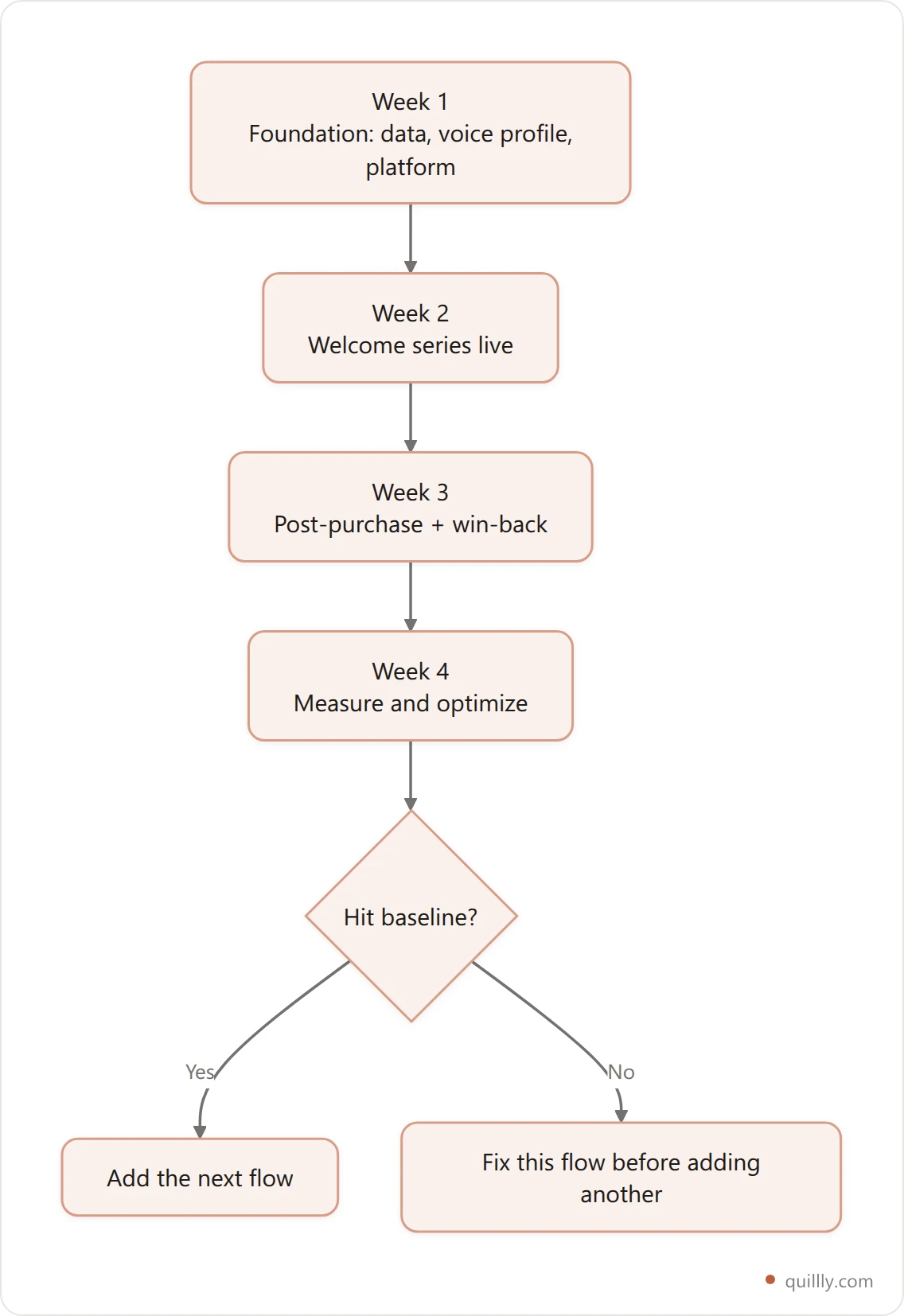
Week 1: Foundation#
Audit your list. Clean invalid addresses and identify existing segments (purchasers vs. non-purchasers, engagement tiers).
Record your baseline. Pull the last 90 days of broadcast numbers before anything changes.
Set up your platform — Klaviyo for e-commerce, ActiveCampaign for services.
Build your prompt library. Ten to fifteen approved prompts covering brand voice, value propositions, and tone per flow type.
Connect your CMS or store via native integration.
Week 2: Welcome Series Launch#
Write and build the three-email series using drafts from your prompt library.
Segment by signup source — blog reader, paid ad, referral.
QA every email against your voice checklist before activating.
Launch and start collecting data.
Week 3: Post-Purchase and Win-Back#
Build the two-email post-purchase flow with product-specific content.
Set a 90-day win-back trigger for customers who haven't ordered since their first.
Connect purchase data from your store or CRM so flows fire on real transaction events.
Test all trigger logic with internal accounts before going live.
Week 4: Measurement and Optimization#
Build the dashboard connected to your email platform.
Run your first A/B test on welcome series subject lines.
Document results and refine the prompt library based on what won.
Plan the next flow — nurture or re-engagement — for the following month.
Common Pitfalls to Avoid#
Skipping QA on AI drafts. Voice drift is the default failure mode, not an edge case. Review before activating, every time.
Over-segmenting too early. Start with two or three segments. Over-segmentation on thin data produces audiences too small to learn anything from.
Ignoring unsubscribe rate. A rising unsubscribe rate is a content-quality signal, not just a list-hygiene number.
Building all five flows at once. One flow live and measured beats five half-built.
If your real bottleneck is producing the content these flows point at rather than the flows themselves, start a 14-day free trial and let the AI you already use draft, score and publish it.
For integrating lifecycle content into a broader editorial strategy, our guide on automated content planning connects email flows with your blog, social, and SEO calendar.
Frequently Asked Questions#
What is AI lifecycle marketing automation?#
It's a set of triggered email and messaging flows where AI writes the copy for each step against your brand voice. Instead of broadcasting the same promotion to everyone, each subscriber receives messages based on where they are in their relationship with you, and the flow runs continuously without manual scheduling.
Which lifecycle flow should a small business build first?#
The welcome series, without exception. It reaches people at their moment of highest intent, it's the simplest to trigger, and it gives you a clean baseline to measure every later flow against. Teams that start with win-back campaigns usually lack the purchase data to segment them well.
Do you need a big list before lifecycle automation is worth it?#
No. Lifecycle flows pay off on small lists precisely because they're triggered rather than scheduled, so every subscriber gets the full sequence regardless of list size. The economics work from a few hundred contacts, since the flow is built once and then runs indefinitely.
How do you stop automated flows sounding robotic?#
Document a brand voice profile before generating anything, and embed it in every prompt. Then review the first send of each flow manually. Most drift enters at flow four or five, when teams stop reviewing because the first three went out fine.
How do you know a lifecycle flow is actually working?#
Diagnose top-down: delivered rate, then open rate, then click rate, then conversion. Most apparent conversion problems are deliverability problems in disguise. Compare each flow against your own pre-automation baseline rather than a published industry benchmark.
How long before lifecycle automation shows a return?#
Expect signal within 30 days on the welcome series, since it fires on every new signup and accumulates data fastest. Win-back and re-engagement flows take a full trigger window — 90 to 180 days — before you have enough completions to judge them fairly. Don't kill a win-back flow at week three.
The Compounding Advantage#
Lifecycle automation isn't an enterprise-only capability. It's accessible to a small team in a month, and it compounds.
What to take away:
Five core flows — welcome, nurture, post-purchase, win-back, re-engagement — deliver most of the lifecycle ROI.
A four-layer stack — platform, content generation, integration, governance — with governance being the layer everyone skips and later regrets.
Your own baseline beats any published benchmark table for judging whether a flow works.
A 30-day plan that any small team can run without outside help.
The compounding part is the bit worth internalizing. One-off campaigns reset to zero after each send. Lifecycle flows improve continuously as behavioral data accumulates and test results stack up. The business that launches its welcome series today is in a materially stronger position six months from now than the one still planning it.
For the content side of the journey, see our guides on AI content repurposing for multi-channel distribution and human-in-the-loop AI content creation.
Fuel your flows with content that ships itself
Quillly connects Claude, ChatGPT or Cursor to your own domain — scored against 14+ SEO criteria, published live, and submitted to 8 search engines. From $19/month with a 14-day free trial, no card required.
Try Quillly free